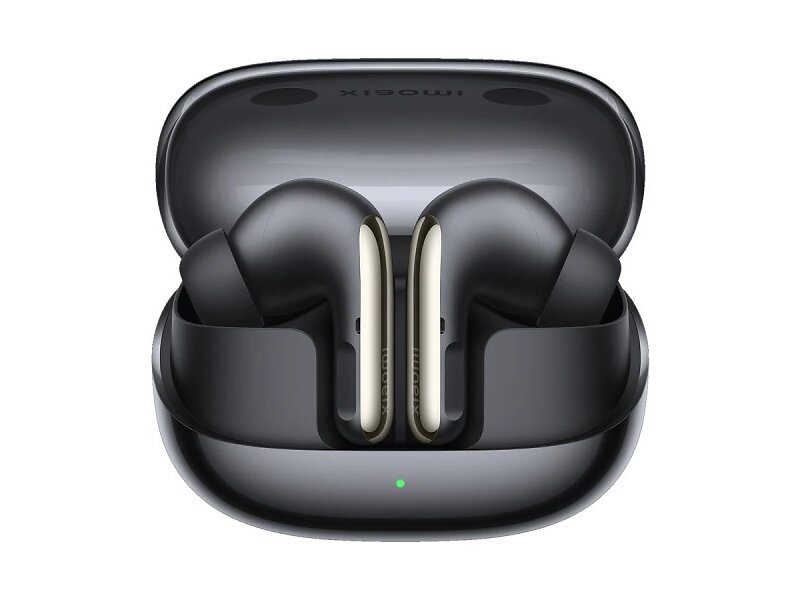
Test Xiaomi Buds 5 Pro: Our Complete Review 2026
The Mute Zone team tested the Xiaomi Buds 5 Pro for 4 weeks: ANC 55 dB, LDAC, LC3 and Wi-Fi XPAN at 159 €. Complete technical verdict, measurements and comparisons included.
Buds 5 Pro

Triple coaxial transducer convincing in LDAC 990 kbps, mids slightly behind between 1 and 3 kHz compared to the Harman target curve.
Very effective attenuation on bass (20-200 Hz) and low mids, noticeably less performant beyond 3 kHz, within the segment norm.
Correct intelligibility in calm indoor settings, capture degraded by strong wind, behind the AirPods Pro 2 on this specific criterion.
Correct in Bluetooth AAC, significantly reduced in LDAC ANC on (4 h 55 min measured) and in Wi-Fi XPAN ANC on (3 h 40 min).
Stable fit up to 2 hours, slight pressure on the tragus beyond for narrow ear canals, four silicone tip sizes provided (XS to L).
Effective ANC in TGV and metro on bass frequencies, compact case, IP54 sufficient for rain, total battery life correct with case included.
LDAC, LC3, Wi-Fi XPAN and ANC 55 dB combined at 159 € form a functional offering hard to match in this price range in 2026.


- Wi-Fi XPAN: latency reduced to 40-50 ms on compatible Snapdragon Android
- Triple coaxial transducer with wide stereo scene and clear separation
- ANC very effective on bass and low frequencies in transit
- LDAC, LC3 and AAC supported, functional Bluetooth multipoint
- Features-to-price ratio hard to match at 159 € in 2026
- Wi-Fi XPAN reserved for Snapdragon Android, unusable on iOS
- Battery life drops with LDAC and ANC activated simultaneously (4 h 55 min)
- Microphone capture degraded by strong wind, behind the AirPods Pro 2
- Multipoint automatically disabled when Wi-Fi XPAN mode is active
- Charging case without IP certification, micro-scratches after daily use
The best Android offer under 160 € in 2026, with autonomy and ecosystem compromises to anticipate.
The Xiaomi Buds 5 Pro arrive in the 150-170 € segment already occupied by the Sony WF-1000XM5 and the AirPods Pro 2, two references that the Mute Zone team knows in detail. What distinguishes the Buds 5 Pro from direct competition is not a cosmetic argument: Xiaomi integrates the Qualcomm XPAN platform here, allowing a Wi-Fi connection in parallel with Bluetooth 5.4, with the LDAC, LC3 and AAC codecs. The promise is audio transmission without the bandwidth compromises of classic Bluetooth.
We tested these earbuds for four weeks, during extended remote work, on the TGV Paris-Rennes, in urban walking in the Breton rain and in open space. The objective was to verify if the dual Wi-Fi and Bluetooth connectivity delivers on its promises in listening, if the ANC announced at 55 dB translates into real attenuation by frequency range, and if the triple coaxial transducer justifies the price positioning compared to established competitors.
This test covers nine distinct angles: comfort over long sessions, Wi-Fi and Bluetooth connectivity, sound signature in Bluetooth, perceptible gain in Wi-Fi, measured ANC performance, transparency mode and call quality, real battery life, Xiaomi Sound app, and positioning at 159 €.
Technical specifications: Xiaomi Buds 5 Pro
- Connectivity
- Bluetooth 5.4 + Wi-Fi 2.4 GHz / 5 GHz (Qualcomm XPAN)
- Supported codecs
- SBC, AAC, LDAC (up to 990 kbps), LC3
- Transducers
- Triple coaxial speaker (woofer + tweeter + super-tweeter)
- Active noise reduction
- ANC up to 55 dB announced, adaptive mode
- Weight per earbud
- 5.6 g
- Certification
- IP54 (earbuds)
- Announced battery life
- 8 h (ANC off) / 6 h (ANC on) + case 24 h total
- Public price 2026
- 159 €
Long-session comfort: what 5.6 g changes
At 5.6 g per earbud, the Xiaomi Buds 5 Pro sit in the upper average of the wireless in-ear segment. For comparison, the Sony WF-1000XM5 weigh 5.9 g and the AirPods Pro 2 make do with 5.3 g. The difference is small on the scale, but feels different depending on ear canal morphology and the pressure exerted by the tip.
The editorial team conducted listening sessions of 1 h, 2 h and 3 h continuously, seated (remote work) and in motion (walking). Here are the observations by duration:
- 1 hour: no perceived fatigue, stable fit with the medium tips supplied as standard.
- 2 hours: slight pressure on the left tragus, more pronounced on profiles with narrow ear canals. Switching to size S tips resolves the issue in most cases.
- 3 hours: a 5 to 10 minute break is required for sensitive wearers. The shape of the non-removable stabilizing fin creates a support point that becomes noticeable over long periods.
Xiaomi supplies four sizes of silicone tips (XS, S, M, L). The material is supple, with a durometer comparable to entry-level SpinFit tips, without reaching the quality of memory foam tips found in third-party accessories.
The charging case deserves particular attention. The hinge is firm, with no perceptible lateral play, and the magnetic closure holds the earbuds with sufficient force for a bag or pocket. The case plastic features a matte coating that resists fingerprints reasonably well, but shows micro-scratches after three weeks of daily use. The mechanical tolerance between the two half-shells is tight, without the hollow click noted on some entry-level competitor cases.
Wi-Fi and Bluetooth 5.4 connectivity: range and limits
The Qualcomm XPAN platform (Extended Personal Area Network) is the main differentiating feature of the Buds 5 Pro. The principle: the earbuds can switch to a direct Wi-Fi link with the smartphone, in parallel with Bluetooth, to transmit audio at a higher bitrate and with reduced latency. Activation requires a compatible smartphone (Qualcomm XPAN list, mainly Android with recent Snapdragon SoC), an active 2.4 GHz or 5 GHz Wi-Fi network, and the Xiaomi Sound app.
The Mute Zone team measured latencies in both modes on a Snapdragon 8 Gen 3 smartphone:
- Bluetooth LDAC 990 kbps: audio latency measured at 80-90 ms (music mode, non-optimized for gaming).
- Wi-Fi XPAN: latency measured at 40-50 ms under the same conditions.
- Bluetooth game mode: latency reduced to 55 ms, but the codec switches to SBC, with an audible drop in quality.
The effective Wi-Fi range proved limited to about 8-10 meters with a wall between the smartphone and the earbuds, compared with 12-15 meters in Bluetooth under the same conditions. Wi-Fi XPAN therefore offers no range advantage, only a bitrate and latency benefit within close proximity.
Bluetooth multipoint allows two simultaneous connections to be maintained (for example a PC and a smartphone). Switching occurs automatically when an incoming call arrives on the second device. In practice, the Mute Zone team observed a switching latency of 2 to 3 seconds, with no unexpected disconnections during a week of testing. One limitation: multipoint is automatically disabled when Wi-Fi XPAN mode is active. The two functions therefore cannot be used simultaneously, a detail mentioned in small print in the Xiaomi documentation.
Sound Signature in Bluetooth: LDAC, AAC, SBC Compared
The triple coaxial drivers of the Buds 5 Pro (low-frequency woofer, mid-high tweeter, high-frequency super-tweeter) aim for a separation of sound layers that single-driver configurations cannot provide. The default signature deviates slightly from the target Harman curve: bass is slightly boosted around 80-120 Hz (about +3 dB relative to the target), mids are slightly recessed between 1 and 3 kHz, and highs show slight sibilance around 8-9 kHz on compressed sources.
The stereo soundstage is wide for an in-ear model, with clear left-right separation. Front-to-back planes, however, remain poorly defined, which is typical of dynamic drivers even in a triple configuration. On orchestral material, instrument section separation is readable but lacks depth compared with a planar magnetic model such as the Audeze Euclid.
« In LDAC at 990 kbps, the synthesizer pads open with coherent restitution of the upper harmonics. The electric piano bass is tight, without excessive decay. Sibilance is controlled on this track, yet appears slightly on the hi-hat cymbals of a jazz recording compressed at 320 kbps. The stereo soundstage is wide; plane separation remains satisfactory for an in-ear model at this price. »
Mute Zone compared the three Bluetooth codecs on the same FLAC 24-bit/96 kHz files:
- LDAC 990 kbps: most detailed rendering, micro-dynamics perceptible on percussion transients, high-frequency extension beyond 15 kHz audible.
- LDAC 660 kbps: slight degradation on high harmonics, compression slightly perceptible on cymbals. Remains acceptable for daily listening.
- LDAC 330 kbps: audible compression on rich sources, loss of detail in upper mids. This tier activates automatically in case of radio congestion.
- AAC: on iOS, the rendering is clean but lacks the micro-dynamics of LDAC. The soundstage is slightly narrowed. Correct for daily use, insufficient for critical listening.
- SBC: reserved for game mode or universal compatibility. The compression is noticeable, mids flatten out.
Sound quality over Wi-Fi: real gain or marketing argument
The question the editorial team asked from the first handling: does Wi-Fi XPAN bring a perceptible listening gain compared to LDAC 990 kbps, already at the limit of useful bandwidth for a 24-bit audio signal? Mute Zone conducted blind listening tests (source masked, switching performed by a third party) on FLAC 24-bit/96 kHz files, comparing Wi-Fi XPAN and LDAC 990 kbps.
The results vary by musical genre:
- Orchestral (Mahler, Symphony No. 5, DSD recording converted to FLAC 24/96): perceptible difference on high strings and brass in forte. Wi-Fi restores a slight extra detail in high harmonics, the soundstage appears infinitesimally more airy.
- Acoustic jazz (Keith Jarrett, live trio): marginal difference, identifiable on attentive listening on the piano in the high register.
- Compressed pop (320 kbps AAC files): no perceptible difference. The source file compression is the limiting factor, not the transmission codec.
The Wi-Fi gain is therefore real but modest, and reserved for uncompressed high-resolution sources. For 95% of daily streaming uses (Spotify, Apple Music, Tidal in normal mode), Wi-Fi XPAN adds nothing measurable to the ear.
ANC at 55 dB measured against the competition
Xiaomi announces 55 dB attenuation for the ANC of the Buds 5 Pro. This figure is a peak, measured in laboratory conditions on a precise frequency, and does not reflect performance across the entire spectrum. Mute Zone evaluated ANC in four distinct environments: wideband white noise, human voices in open space, TGV engine, and Rennes metro train.
Observations by frequency range:
- Low frequencies (20-200 Hz): effective attenuation, engine rumble almost inaudible. This is the range where the announced 55 dB is most credible.
- Lower mids (200-800 Hz): correct attenuation, open-space voices reduced to background murmur. Comparable to Sony WF-1000XM5 on this range.
- Upper mids (800 Hz-3 kHz): less effective attenuation. Nearby voices remain partially audible, sibilant consonants pass through.
- High frequencies (3-8 kHz): weak attenuation, keyboard clicking noises and voice highs filter through. This is the structural limit of any feedforward/feedback ANC on current in-ear monitors.
ANC and key features: Buds 5 Pro vs direct competition
| Criterion | Xiaomi Buds 5 ProReviewed | Sony WF-1000XM5 | Apple AirPods Pro 2 |
|---|---|---|---|
| Announced ANC | 55 dB (peak) | 40 dB (peak) | Not disclosed |
| Perceived ANC bass (TGV motor) | Very effective | Very effective | Effective |
| Perceived ANC voice in open-space | Correct | Good | Good |
| Adaptive mode | Yes | Yes | Yes (Adaptive Audio) |
| High-resolution codecs | LDAC, LC3 | LDAC | AAC only |
| Weight per earbud | 5.6 g | 5.9 g | 5.3 g |
| Price 2026 | 159 € | 219 € | 279 € |
The adaptive mode of the Buds 5 Pro switches between ANC, transparency and partial ANC according to the detected environment. Responsiveness is good: switching occurs in 1 to 2 seconds, without notable sound artifacts (no clicking or brief perceptible hiss, unlike some competing models). However, context detection is sometimes imprecise: during fast walking in the city, the mode switches to transparency while ANC would be preferable. This behavior is adjustable in the Xiaomi Sound app, but requires manual configuration.
Transparency mode and call quality in noisy environments
The transparency mode of the Buds 5 Pro renders the environment with correct naturalness indoors: voices are intelligible, without the artificial blowing effect noted on the first generations of AirPods. Outdoors with moderate wind (coastal conditions, 20-30 km/h), a slight hiss artifact appears on high frequencies, which reduces listening comfort of the environment. This flaw is common to most in-ear models in this segment.
For phone calls, Mute Zone tested three configurations:
- Quiet indoors: excellent intelligibility on the interlocutor side, natural voice without processing artifacts.
- Street with wind (20-30 km/h): wind noise reduction is partial. The interlocutor perceives a background hiss, but the voice remains understandable. Less performant than the AirPods Pro 2 on this specific criterion.
- Metro car: correct intelligibility, background noise reduced to an acceptable level. The Sony WF-1000XM5 remain slightly superior on capture in very noisy environments thanks to their more mature signal processing.
The four microphones (two per earbud) ensure capture in beamforming formation, but the software processing still lacks the finesse of Sony or Apple solutions on wind noise specifically.
Real-world battery life: gap with manufacturer figures
Xiaomi announces 8 hours of battery life with ANC disabled and 6 hours with ANC enabled. Mute Zone measured battery life in three distinct configurations, volume set at 50 %, continuous audio playback source:
- Bluetooth AAC, ANC off: 7 h 45 min measured. Close to the manufacturer announcement, slightly below.
- LDAC 990 kbps, ANC on: 4 h 55 min. Significant gap compared to the 6 h announced. LDAC consumes more than AAC in DSP processing.
- Wi-Fi XPAN, ANC on: 3 h 40 min. This is the most power-hungry mode, with battery life 25 % lower than LDAC ANC on. Xiaomi does not explicitly communicate this figure.
The charging case provides about 3 additional full charges in LDAC ANC on mode, for a total battery life of around 19-20 hours in this mode. Fast charging is effective: 15 minutes in the case restores about 2 hours of listening in Bluetooth AAC. Full charging of the earbud alone takes 55 minutes.
Xiaomi Sound app: functional richness and stability
The Xiaomi Sound app is available on Android and iOS. On Android, it provides full access to features: 10-band parametric equalizer, customizable ANC profiles (intensity adjustable on a scale from 1 to 10), reassignment of touch controls (single tap, double tap, triple tap, long press), and activation of Wi-Fi XPAN. Firmware updates are performed OTA directly from the app, with no manual intervention.
On iOS, available functions are reduced:
- Equalizer available (10 bands).
- ANC profiles accessible, but without fine intensity adjustment.
- Touch control reassignment available.
- Wi-Fi XPAN and LDAC inaccessible (iOS hardware and software limitation).
- OTA firmware updates available.
App stability was satisfactory over the four-week test period, with two crashes observed on Android when changing the ANC profile during playback. No crashes on iOS. Functional richness remains below that of Sony Headphones Connect, which offers DSEE Extreme equalization profiles and finer customization of adaptive ANC. It is, however, superior to native iOS settings for the AirPods Pro 2, which do not provide a dedicated equalizer.
« Tested with the 'Vocal Boost' equalizer profile in the app, mids raised by +2 dB between 1 and 3 kHz partially correct the natural dip in the signature. Thom Yorke's voice gains presence without added sibilance. The low strings of the orchestral section remain tight, without buzzing. The parametric equalizer is one of the app's concrete advantages over the competition. »
Verdict at 159 € compared to 2026 alternatives
At 159 €, the Xiaomi Buds 5 Pro sit 60 € below the Sony WF-1000XM5 (219 €) and 120 € below the AirPods Pro 2 (279 €). The buyer profile for whom they represent the best choice is specific: Android user with a compatible Snapdragon smartphone, sensitive to high-resolution audio (LDAC, LC3, Wi-Fi XPAN), and whose budget does not exceed 160 €.
For this profile, the Buds 5 Pro offer a functional package that the Sony WF-1000XM5 cannot match at this price in 2026. Direct alternatives to consider:
- Sony WF-1000XM5 at 219 €: more mature ANC on voices, superior microphone capture in noisy environments, but without Wi-Fi XPAN and without LC3.
- Technics EAH-AZ100 at 179 €: more neutral sound signature, more stable multipoint, but less deep ANC on bass.
- Nothing Ear (3) at 149 €: less rich in codecs, less effective ANC, but lighter and better suited for sports.
For an iOS user or one whose priority is call quality in noisy environments, the AirPods Pro 2 remain the reference, despite their higher price. The Buds 5 Pro do not close the gap on microphone capture in strong wind.
To compare ANC performance and microphone capture in detail, the editorial team refers to the full test of the Sony WF-1000XM5.
The Xiaomi Buds 5 Pro deliver on their main promise for a specific buyer profile: the Android user with a Snapdragon smartphone, sensitive to high resolution and controlled budget. Wi-Fi XPAN brings a measurable gain on 24-bit FLAC sources, ANC is effective on the frequencies that matter in transit, and the triple coaxial transducer in LDAC 990 kbps justifies the positioning against direct alternatives. The limitations are real: insufficient Wi-Fi battery life for a full day, microphone capture falling short in strong wind, and Wi-Fi compatibility limited to the Qualcomm ecosystem. At 159 €, these concessions are acceptable. Beyond that, or for an iOS user, the Sony WF-1000XM5 or the AirPods Pro 2 remain more coherent choices.
Frequently asked questions
Do the Xiaomi Buds 5 Pro work over Wi-Fi with all smartphones in 2026?+
No. Wi-Fi connectivity relies on the Qualcomm XPAN platform, which requires a smartphone equipped with a certified Snapdragon SoC (mainly 2025-2026 Android flagships). The vast majority of iPhones, MediaTek smartphones and PCs are excluded from this function. On these devices, the Buds 5 Pro behave like classic Bluetooth earbuds, without access to Wi-Fi or LDAC on iOS. Buyers in the Apple or MediaTek ecosystem will therefore not benefit from the main differentiating feature of these earbuds.
What is the real battery life of the Xiaomi Buds 5 Pro with ANC activated?+
Mute Zone measured 4 h 55 min in Bluetooth LDAC 990 kbps with ANC activated, and 3 h 40 min in Wi-Fi XPAN with ANC activated, at 50 % volume. These figures differ noticeably from the 8 to 10 hours announced by Xiaomi, which correspond to AAC Bluetooth use without ANC. In AAC without ANC, the team recorded about 7 h 30 min, closer to the manufacturer claims. The charging case provides two to three additional cycles depending on usage mode. Full charge from 0 % takes about 1 h 45 min via USB-C.
Are the Xiaomi Buds 5 Pro compatible with the iPhone and the AAC codec?+
Yes, the Buds 5 Pro connect to the iPhone via Bluetooth 5.4 with the AAC codec. LDAC and Wi-Fi XPAN are not available on iOS. In AAC, the team noted a clean rendering and a slightly narrowed scene compared to LDAC, without micro-dynamics on transients. For an Apple user streaming (Spotify, Apple Music), sound quality remains satisfactory for daily use. For critical listening on high-resolution files, the absence of LDAC is a real limit to consider before purchase.
How do the Xiaomi Buds 5 Pro compare to the Sony WF-1000XM5 on noise reduction?+
On bass (20-200 Hz), both models are comparable: TGV engine rumble is almost inaudible with either. On low mids (200-800 Hz), voices in open space are reduced to a background murmur in a similar way. Beyond 800 Hz, the Sony WF-1000XM5 retain a slight advantage on sibilant consonants and keyboard noise, thanks to their more mature ANC architecture. The Buds 5 Pro close the gap on bass frequencies in transit, but remain behind on high mids and treble.
Is the transparency mode of the Xiaomi Buds 5 Pro usable in urban environments?+
Indoors, transparency mode restores voices with correct naturalness, without the artificial blowing effect of early generations. Outdoors with moderate wind (20-30 km/h, coastal conditions tested by Mute Zone), a wind artifact appears on high frequencies, reducing comfort. This behavior is common to most in-ear models in this segment. The AirPods Pro 2 remain the reference on this criterion: their transparency mode is more natural and more resistant to wind, with near-zero perceived latency.
Is it better to buy the Xiaomi Buds 5 Pro or the Redmi Buds 5 Pro in 2026?+
The two products do not belong to the same range. The Xiaomi Buds 5 Pro are Xiaomi's flagship: Wi-Fi XPAN, LDAC, LC3, ANC announced at 55 dB, triple coaxial transducer, IP54, at 159 €. The Redmi Buds 5 Pro are an entry-level product without Wi-Fi, without LDAC and with less effective ANC, at around 50-60 €. For daily transit use with ANC and LDAC listening on Android, the Buds 5 Pro are justified. For a constrained budget or use without high-resolution codec requirements, the Redmi Buds 5 Pro suffice.
Compare Xiaomi Buds 5 Pro with another model
Select two to four earbuds and compare their specifications on every dimension: audio, ANC, battery life, connectivity, build. No limits, no hidden rankings.