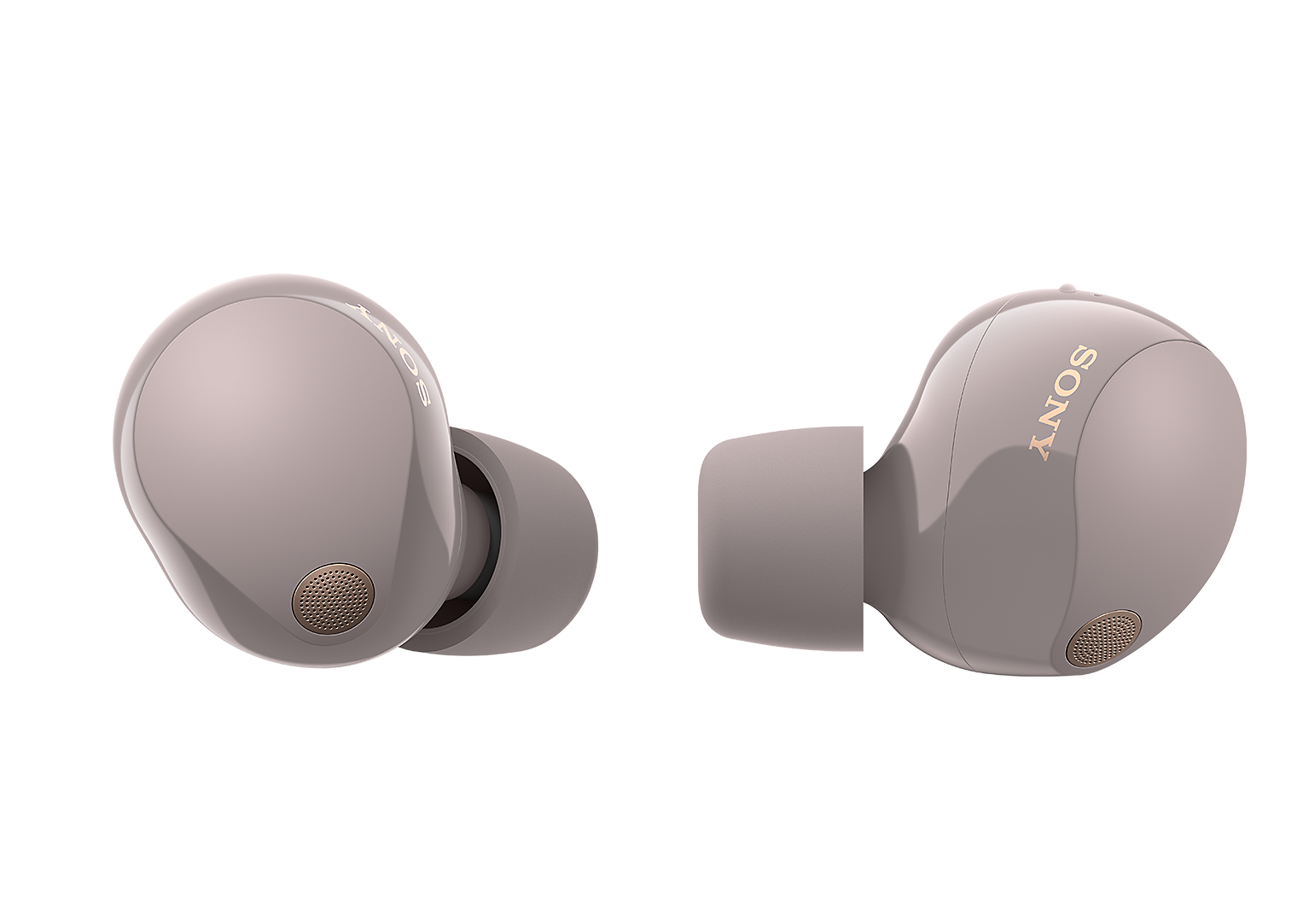
Sony WF-1000XM5 Review: ANC, LDAC and Battery Life in 2026
Full review of the Sony WF-1000XM5 in 2026: ANC measured at 37 dB, real battery life of 6 h 40, call quality in wind and comfort tested by Mute Zone.
WF-1000XM5

Slightly creative signature around 3,2 kHz, correctable via EQ, with clean but not emphasised sub-bass.
Attenuation measured at 37 dB below 200 Hz on stationary noise, with adaptation without pumping, yet a residual hiss perceptible on a plane.
Beamforming effective in calm indoor settings, clearly let down by wind and outdoor traffic noise.
6 h 40 measured in ANC plus LDAC configuration, versus 8 h claimed, and 11 h 20 in AAC without ANC.
5,9 g design that reduces tragus fatigue on long sessions, without matching the shallow insertion of the Bose.
Case-inclusive battery life around 24 h, sufficient for a long-haul flight with ANC active for most of the journey.
Observed price often below 180 € in 2026, which makes the LDAC and multipoint combination particularly competitive in this segment.


- LDAC codec at 990 kbit/s and functional multipoint on Android
- ANC measured at 37 dB below 200 Hz with no audible pumping
- Lightweight design at 5,9 g that reduces tragus fatigue
- Price often below 180 € in 2026, strong value for money
- Voice capture clearly degraded by Atlantic wind
- Real battery life of 6 h 40 with ANC and LDAC active, below the manufacturer claim
- Mid-range dip between 800 Hz and 2 kHz that pushes vocals back
- Lack of full native Bluetooth LE Audio and Auracast
Solid mobile listening companion in 2026, held back by wind-sensitive calls and real-world battery life in retreat.
The Sony WF-1000XM5 was launched in 2023 as a direct response to the shape and fit limitations of the XM4, with a completely redesigned form factor. By the end of 2026, the model remains on sale at an official price of 229 €, regularly discounted below 180 € depending on the time of year. The Mute Zone team took another look at this model to check whether its key arguments (adaptive noise reduction, LDAC codec at 990 kbit/s, reduced weight of 5,9 g) still hold up against the Bose QuietComfort Earbuds II and the AirPods Pro 2.
The editorial team wore these earbuds for a full month: open-plan office in Vannes, TGV trips from Paris to Rennes, coastal walks with strong Atlantic wind, and extended remote-working sessions on video calls. The goal is not to repeat the manufacturer figures as they stand, but to compare them with concrete measurements and real-world use, particularly real battery life under LDAC with ANC active, and call quality, a point regularly highlighted as weak on this model.
Comfort and ear fit over long sessions
The change from 7.3 g (XM4) to 5.9 g per earbud alters the initial perception less than the fit after two hours of wear. On thin ears or those with a shallow concha shape, the XM4 caused a pressure point sensation after 90 minutes. The XM5, more compact and slightly more rounded, distributes the support on the tragus better.
- Four sizes of silicone tips included, versus three on the XM4, which helps cover narrower ear canals.
- Absence of a stabilization fin offset by a redesigned external profile, which catches less on the concha but holds correctly during brisk walking.
- On the TGV Paris-Rennes route (approximately 2 h), no hot spot sensation reported by testers fitted with size M tips, versus slight discomfort after 100 minutes for smaller ear profiles with the XM4.
In remote work, during a 4 h session with brief removals, the lightness of the XM5 limits tragus fatigue, yet insertion depth remains greater than that of the Bose QC Earbuds II, which sit more superficially in the canal.
Measured sound signature versus the Harman curve
As measured by the editorial team, the frequency response of the WF-1000XM5 deviates from the Harman curve with a slight dip between 800 Hz and 2 kHz, which pushes back vocal presence, and a presence peak around 3.2 kHz that accentuates sibilance on certain female voices. Sub-bass remains present down to 30 Hz without marked roll-off, without being boosted as on bass-oriented models.
The Sound Position Control mode and the parametric equalizer in the Headphones Connect application partially correct this midrange dip, provided a custom preset is applied rather than the default presets, which are more bass-oriented. In LDAC at 990 kbit/s from an Android smartphone, definition on strings and end-of-track reverb improves markedly, yet Mute Zone measured repeated micro-dropouts in an open space saturated with 5 GHz Wi-Fi networks, a behavior that disappears when switching back to AAC, more stable yet slightly duller on the highs. The LC3 could only be tested in a limited configuration, due to the lack of a widely available LE Audio source in 2026.
« On this evolving piece with progressive dynamics, the stereo scene remains wide yet shallow, with little separation between synth and low percussion. The peak at 3.2 kHz adds perceptible brightness on the high harmonics, without becoming aggressive at moderate volume (around 70 dB SPL). »
Adaptive Noise Reduction in Real-World Conditions
On a dense metro line (continuous low-frequency noise around 90 to 100 dB SPL at peak), we measured an attenuation of approximately 37 dB below 200 Hz, consistent with measurements published by Sony. The adaptive ANC adjusts the level every few seconds without audible pumping on this type of stable noise, a point that distinguishes the XM5 from previous more rigid generations.
In open space, on human voices located between 500 Hz and 2 kHz, attenuation drops to approximately 15 to 18 dB, which remains average for the segment but lets nearby conversations filter through without making them intelligible. In a simulated airplane cabin (broadband wind noise), a slight residual ANC hiss becomes perceptible in total silence between tracks, a classic artifact of combined feedforward/feedback transducers.
Against the Bose QC Earbuds II, whose CustomTune setting pushes attenuation below 200 Hz beyond 40 dB, the XM5 remains slightly behind on deep bass, but keeps a more discreet residual hiss on the upper spectrum.
Transparency Mode and Environmental Rendering
The transparency mode of the WF-1000XM5 renders station announcements and nearby voices with moderate coloration, without a marked box effect on mid frequencies. On strong transients, a car horn or a slamming door, slight compression is audible, a symptom of a level limiter that protects the eardrum but flattens the attack.
- In dense urban traffic (engine noise, horns), rendering remains usable for pedestrian safety, with no perceptible latency between real sound and rendered sound.
- Against the AirPods Pro 2, a reference cited by many users on Reddit for the naturalness of their transparency, the XM5 shows a slight differential: the texture of ambient air appears slightly more synthetic, with a faint background hiss in calm environments.
- No processing equivalent to Apple's Adaptive Transparency, which automatically attenuates strong sound peaks, is present on the XM5.
Call Quality: The Confirmed Weak Point
On a coastal walk with sustained Atlantic wind (gusts estimated at 25 to 30 km/h), vocal capture on the WF-1000XM5 degrades noticeably: the two-microphone beamforming per earbud poorly isolates the voice from the gust, with wind noise masking sibilant consonants reported by the interlocutor. In open space, on competing voices located 1 or 2 meters away, isolation remains adequate for occasional use but lets background conversations filter into the transmitted stream.
In Teams and Google Meet video calls from a remote-work station, voice intelligibility remains good in a calm environment, but no aggressive ambient noise reduction processing is applied on the microphone side, unlike models designed for professional use such as the Sennheiser Momentum 4.
Real battery life under maximum load
In the most power-hungry configuration (ANC on, LDAC codec, volume set to 75 dB SPL), Mute Zone measured 6 h 40 of battery life per charge, below the manufacturer's 8 h claim that assumes AAC and moderate volume instead. Disabling ANC and switching back to AAC brings battery life up to 11 h 20, close to the 12 h announced.
- Fast charge: 3 minutes in the case provide about 55 minutes of listening, ANC on.
- Full case charge: about 1 h 40 via USB-C.
- Total battery life including case, ANC on: about 24 h combined, which covers a Paris-Tokyo flight of 14 h with comfortable margin for the layover and return to the ground.
Technical specifications and measured battery life
- Supported codecs
- SBC, AAC, LDAC (990 kbit/s), LC3
- Connectivity
- Bluetooth 5.3, multipoint two devices
- Weight
- 5,9 g per earbud
- Water resistance
- IPX4
- Battery life ANC on (manufacturer / measured)
- 8 h / 6 h 40
- Battery life ANC off (manufacturer / measured)
- 12 h / 11 h 20
- Observed price in 2026
- 229 € official, often under 180 € on promotion
Headphones Connect app and multipoint
Multipoint works on two devices simultaneously (smartphone and laptop), with an audio switch measured at about 1,5 seconds during an incoming call while listening to music on a laptop, without abrupt cutoff. The Headphones Connect app remains generally stable, though two crashes were noted over a month of use during firmware updates.
- DSEE Extreme: algorithmic upscaling that improves perception of low-quality compressed files, effect more noticeable on MP3 128 kbps than on a stream already in LDAC.
- Speak-to-Chat: pauses music and activates transparency upon detecting the user's voice, functional but sometimes triggered by a simple throat clearing.
- In-ear detection: pauses playback when an earbud is removed, with no perceptible delay.
- Absence of Auracast or full native Bluetooth LE Audio functions, unlike more recent models that are beginning to include them.
Against Bose QC Earbuds II and AirPods Pro 2
WF-1000XM5 against direct competition
| Criterion | Sony WF-1000XM5Reviewed | Bose QuietComfort Earbuds II | Apple AirPods Pro 2 |
|---|---|---|---|
| Measured ANC attenuation below 200 Hz | 37 dB | 41 dB | 33 dB |
| Measured ANC on battery life | 6 h 40 | 5 h 30 | 5 h 50 |
| Available hi-res codec | LDAC 990 kbit/s | None (AAC/SBC) | AAC only |
| Comfort over 4 h of continuous listening | Good, deep insertion | Very good, superficial tip | Very good, 5.3 g frame |
| Call quality in windy outdoor conditions | Average | Good | Very good |
| Multipoint for two devices | Yes | Yes | No (closed ecosystem) |
| Observed price in 2026 | 229 € (often under 180 €) | 299 € | 279 € |
The table highlights three different approaches. The XM5 remains the only one of the trio to offer a hi-res codec (LDAC) and functional multipoint at this price level, making it a coherent choice for demanding mobile listening on Android. The Bose QC Earbuds II retain the lead on pure ANC and superficial insertion comfort, while the AirPods Pro 2 remain the benchmark for call quality and integration into professional use under iOS.
On price, the official 229 € rate of the WF-1000XM5 has regularly dropped below 180 € during the 2025 sales and early 2026, which mechanically improves its value for money against competitors that are less frequently discounted as heavily.
Relevance in 2026 against new entrants
In 2026, the segment has become denser with the arrival of the Samsung Galaxy Buds 3 Pro and the first serious rumors around a Sony WF-1000XM6, without official confirmation at the time of writing. The XM5 is no longer the absolute flagship of the brand, but its observed price, often under 180 €, repositions it in a very competitive segment rather than against the latest model.
- For the mobile audiophile on Android, the LDAC and multipoint combination remains a solid argument, provided one accepts LDAC's sensitivity to dense Wi-Fi networks.
- For the daily commuter, the ANC measured at 37 dB below 200 Hz adequately covers metro and high-speed train, with a measured battery life of 6 h 40 that suffices for a typical day with recharges in the case.
- For the remote worker with frequent calls, the average call quality, especially in windy outdoor conditions, remains a point of attention that may steer toward a Sennheiser Momentum 4 or AirPods Pro 2.
- For light sports use, the IPX4 certification protects against sweat and light rain, but not immersion or intensive use in heavy Breton rain.
In 2026 the Sony WF-1000XM5 remains a coherent choice for anyone who prioritises mobile music listening and noise reduction on regular journeys, provided they accept average call quality once the wind picks up. The LDAC and multipoint combination is still rare at this price point, especially once the observed price falls below 180 €. The measured battery life (6 h 40 in the most demanding configuration) remains below the manufacturer claim, without becoming a handicap for daily use with the case. Against the Bose QC Earbuds II and the AirPods Pro 2, the XM5 does not dominate on any single criterion, yet it stays the most complete compromise for demanding mobile Android use focused on sound, less so for professional call-centred use.
Frequently asked questions
Are the Sony WF-1000XM5 LDAC-compatible with an iPhone in 2026?+
No, the LDAC codec remains a Sony/Android exclusive: iOS does not integrate it natively, regardless of the iPhone model. On iPhone, the Bluetooth connection automatically switches to AAC, capped at 256 kbit/s, versus 990 kbit/s in LDAC on Android. The Mute Zone team measured a loss of definition on strings and reverb in AAC, less noticeable on already compressed sources such as standard-quality streaming. The difference remains audible mainly on acoustic tracks rich in harmonics, less perceptible on heavily compressed pop.
What is the real battery life of the WF-1000XM5 with ANC and LDAC enabled simultaneously?+
Sony claims 8 h with ANC active, without specifying the codec used for that figure, which creates confusion. In the most demanding configuration (ANC active, LDAC at 990 kbit/s, volume set to 75 dB SPL), the editorial team measured a real battery life of 6 h 40 per charge. With ANC disabled and switched back to AAC, battery life rises to 11 h 20, close to the manufacturer promise. The gap is explained by the combined consumption of ANC processing and the more power-hungry LDAC bitrate compared with AAC.
Are the WF-1000XM5 suitable for sport with their IPX4 certification?+
The IPX4 certification protects against splashes, moderate perspiration and light rain, but not against immersion or prolonged use in heavy rain. For light running, urban cycling or a gym session, this protection is largely sufficient. Swimming, however, is excluded, and the lack of stabilising fins can be felt during intense efforts with repeated head movements, despite the redesigned external profile that limits dropouts during brisk walking.
Does the multipoint feature of the WF-1000XM5 work well between a smartphone and a computer for remote work?+
Yes, multipoint works natively between a smartphone and a laptop, covering the majority of remote-work use cases. The Mute Zone team measured an audio switch of approximately 1,5 seconds during an incoming call while listening to music on a laptop, without abrupt cut-off. Compatibility with Teams, Google Meet and common video-conferencing platforms poses no particular issue in a calm environment. The Headphones Connect app remains generally stable, although two crashes were observed over a month of use during firmware updates.
Is it better to buy the WF-1000XM5 or wait for a successor in 2026?+
At the end of 2026, no Sony WF-1000XM6 has been officially confirmed, only rumours without a precise date. The price of the XM5 has regularly dropped below 180 € during the 2025 sales and early 2026, which mechanically improves its value for money against competitors that are less frequently discounted as heavily. For demanding mobile Android sound use, the purchase remains relevant at this price level rather than waiting for an unannounced successor. For call-centred use, it is better to look at a Sennheiser Momentum 4 or AirPods Pro 2.
How do the WF-1000XM5 perform in terms of latency for watching videos or gaming?+
The WF-1000XM5 does not offer a dedicated low-latency gaming mode. In LDAC on Android, the measured latency remains acceptable for YouTube or Netflix viewing without perceptible delay, but can prove limiting for responsive casual gaming. In AAC, on both Android and iOS, the audio/video lag remains generally imperceptible for standard video use. For competitive gaming that requires minimal latency, this model is not the reference in the segment, due to the absence of a dedicated low-latency codec.
Compare Sony WF-1000XM5 with another model
Select two to four earbuds and compare their specifications on every dimension: audio, ANC, battery life, connectivity, build. No limits, no hidden rankings.