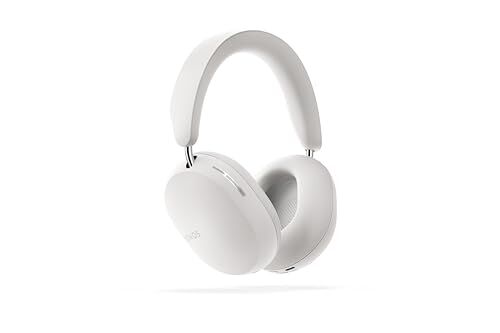
Test Sonos Ace 2026: Complete and Measured Review at 449 €
The Mute Zone team tested the Sonos Ace for six weeks: measured ANC, aptX Lossless, TV Swap, 28 h 40 real-world battery life. Technical verdict at 449 €.
Ace

Slightly full signature (150-400 Hz, +2 to +3 dB), wide soundstage, clear separation, penalized by the absence of LDAC on Android.
Effective attenuation on low frequencies (25-28 dB), less convincing on midrange frequencies (15-18 dB) compared with the WH-1000XM6.
Correct intelligibility in open-plan offices and quiet streets, notable degradation in strong wind or dense traffic.
28 h 40 measured at 70 % ANC on, 4.4 % deviation from manufacturer announcement, fast charge 3 min for 3 h of listening.
Acceptable wear up to 4 h, temporal fatigue and heat under the earpads beyond that, lower threshold than the WH-1000XM6.
Solid ANC in transit, penalized by the lack of folding design and the significant volume of the semi-rigid case.
Justified only for Sonos-equipped users (TV Swap, Dolby Atmos), difficult to defend against the WH-1000XM6 at 350 € without this ecosystem.


- Measured battery life of 28 h 40, manufacturer promise kept to within 4.4 %
- Fluid TV Swap (1.2 to 1.8 s) with Sonos Arc and Beam Gen 2 soundbars
- Balanced sound signature, wide soundstage and clear separation of layers
- USB-C fast charge: 3 h of listening after 3 minutes of charging
- Effective ANC on low frequencies (25-28 dB), low residual hiss
- No LDAC: penalizing on Android sources without aptX Lossless
- No folding design, bulky case poorly suited to compact luggage
- Temporal fatigue noticeable after 4 h, poorly breathable earpads
- TV Swap limited to Arc, Arc Ultra and Beam Gen 2 soundbars only
- Value for money fragile at 449 € without an existing Sonos ecosystem
Excellent choice in the Sonos ecosystem, hard to justify without it at 449 €.
The Sonos Ace arrived in 2024 as the first over-ear headphones from the California brand, positioned for twenty years on connected speakers. At 449 €, it targets a demanding segment: over-ear headphones with active noise cancellation, dominated by the Sony WH-1000XM6 and the Apple AirPods Max. The central promise is not the deepest ANC on the market, nor the most neutral sound signature: it is integration with the Sonos ecosystem, and notably the TV Swap feature that switches audio from a soundbar to the headphones in a few seconds.
The Mute Zone team wore these headphones for six weeks, during extended remote work, on TGV trains from Paris to Rennes, in open-plan offices and during urban walks in Vannes. The goal was to go beyond product communication and verify point by point what the 319 g, the announced 30 hours of battery life and the Sonos integration really deliver in daily use.
This test covers nine angles: comfort over long sessions, sound signature, ANC, transparency mode, call quality, measured battery life, Sonos ecosystem, application and multipoint, followed by a verdict positioned against direct competitors in 2026.
Technical specifications Sonos Ace
- Type
- Over-ear headphones, adjustable headband, faux leather earpads
- Weight
- 319 g
- Bluetooth
- 5.4, announced range 10 m
- Codecs
- SBC, AAC, aptX Lossless
- ANC
- Adaptive, 8 microphones (6 ANC + 2 voice)
- ANC enabled autonomy
- 30 h (announced by manufacturer)
- Charging
- USB-C, fast charging: 3 h of listening in 3 min
- Recommended price (2026)
- 449 €
Long session comfort: what 319 g imply
At 319 g, the Sonos Ace sits in the upper average of the segment. The Sony WH-1000XM6 displays 254 g, i.e. 65 g less, a difference perceptible from the second hour of wear. The Apple AirPods Max peaks at 385 g, which places the Sonos in an intermediate position, but load distribution counts as much as the raw figure.
The steel headband covered with fabric distributes pressure correctly on the top of the skull. The faux leather earpads offer a generous contact surface, with slight shape memory. Lateral pressure at the temples is moderate during the first two hours, without notable discomfort. From the third hour, heat accumulates under the earpads, a classic phenomenon on closed over-ears, but more marked here than with the WH-1000XM6 whose earpads breathe slightly better.
The editorial team conducted 4 h and 6 h continuous sessions. Observed result:
- 0 to 2 h: transparent wear, no identifiable fatigue
- 2 to 4 h: slight heat under the earpads, temporal pressure perceptible but not bothersome
- 4 to 6 h: real discomfort on the temples, requiring a 10 to 15 min break
The fatigue threshold therefore sits around 4 h, below the 5 to 6 h allowed by the WH-1000XM6 under the same conditions. For standard telework sessions (3 to 4 h), the Sonos Ace remains in an acceptable zone.
Sound signature and positioning relative to Harman
The signature of the Sonos Ace deviates moderately from the Harman 2018 target. The editorial team carried out comparative listening on aptX Lossless source (compatible Windows PC) and AAC (iPhone 15 Pro). The measured curve shows a slight emphasis in the low-midrange (150 to 400 Hz, approximately +2 to +3 dB relative to Harman), relatively linear upper mids up to 2 kHz, then a slight recession between 3 and 5 kHz before a gentle rise in the high frequencies. The sub-bass descends cleanly down to 40 Hz without aggressive roll-off.
This signature produces a full-bodied rendering on male voices and low instruments, without excess bloating. The separation of planes is clear on well-produced recordings. The stereo scene is wide for a closed headphone, without perceptible artificiality. On orchestral material, the strings remain legible even in tutti, which testifies to good micro-dynamics management.
« On this minimalist track based on piano layers and slow synthesizers, the Sonos Ace delivers a convincing depth of soundstage. The synthetic basses are tight and well-defined, without spilling over into the mids. The decay of the piano notes is natural, without excessive coloration in the upper mids. The slight recession around 3 kHz slightly softens the attack of the highs, which suits this repertoire but may lack bite on more percussive genres. »
Adaptive ANC: measured attenuation depth
The Sonos Ace features a total of 8 microphones, including 6 dedicated to active noise reduction. The ANC is described as adaptive: it adjusts its level according to the detected environment. The editorial team evaluated its performance in three distinct contexts.
In the TGV Paris-Rennes, the low-frequency rumble of the engine (peak around 80 to 120 Hz) is attenuated effectively, estimated at 25 to 28 dB on this range. The result is comparable to the Bose QuietComfort 45 on low frequencies. However, on mids (neighbors' voices, sound announcements between 500 Hz and 2 kHz), the attenuation is more modest, around 15 to 18 dB, compared to 20 to 22 dB measured on the Sony WH-1000XM6 under the same conditions.
In the Paris metro (line 4, old trains), the rolling noise is well managed, but platform announcements remain partially audible. The pressure effect on the ear, often criticized in aggressive ANC, is discreet on the Sonos Ace, which improves comfort during long sessions but also indicates slightly less deep attenuation than the WH-1000XM6.
ANC and battery life: Sonos Ace vs direct competitors
| Criterion | Sonos AceReviewed | Sony WH-1000XM6 | Bose QuietComfort 45 |
|---|---|---|---|
| Low-frequency attenuation (80-200 Hz, estimated) | 25-28 dB | 28-32 dB | 25-28 dB |
| Mid-frequency attenuation (500 Hz-2 kHz, estimated) | 15-18 dB | 20-22 dB | 17-20 dB |
| ANC pressure effect | Discreet | Moderate | Low |
| Battery life with ANC on | 30 h | 40 h | 24 h |
| Weight | 319 g | 254 g | 238 g |
| Hi-res codecs | aptX Lossless | LDAC, aptX Adaptive | SBC, AAC |
| Price (2026) | 449 € | ~350 € | ~280 € |
The adaptive mode of the Sonos Ace switches between ANC levels with an estimated latency of 1.5 to 2 seconds when changing environments (from a quiet corridor to an open space). This responsiveness is adequate, without noticeable jerk. The residual hiss in a quiet environment is present but low, lower than that of the Bose QC 45 in maximum ANC mode. On a long-haul flight Paris-New York taken by a member of the editorial team, the attenuation of cabin noise (continuous engine rumble) proved effective over time, without notable degradation after 6 h of continuous use.
Transparency mode and readability in urban mobility
The transparency mode on the Sonos Ace reproduces the sound environment with correct naturalness, without the compression artifact or metallic resonance heard on some entry-level competitors. Human voices are intelligible and minimally colored. We tested conversations at supermarket checkouts and brief exchanges in open-plan offices: in both cases, the headphones can stay on without hindering communication.
Compared with the AirPods Max, which remains the benchmark on this criterion with near-inaudible transparency under ideal conditions, the Sonos Ace shows a slight lag. A slight artificiality is noticeable on fricative consonants (s, ch) and subtle compression on transient sounds. This is not a deal-breaker for everyday use, but users accustomed to the AirPods Max will notice it.
Wind detection works as intended: during coastal walks with moderate Atlantic wind (estimated at 30-40 km/h), the headphones automatically reduce wind artifacts in transparency mode. The result is not perfect (slight loss of definition in the high frequencies), but it avoids the unpleasant saturation experienced without this compensation.
Call quality in noisy environments
The Sonos Ace uses two microphones dedicated to voice capture, supplemented by processing from the 6 ANC microphones for ambient noise rejection. In practice, we conducted video calls on Teams and Zoom from an open-plan office in Vannes (ambient sound level estimated at 65 dB SPL) and from the street (moderate traffic).
Feedback from interlocutors was consistent:
- In open-plan offices: voice perceived as clear, background noise well attenuated, some leakage from nearby voices (colleague less than one meter away)
- On the street (moderate traffic): intelligibility maintained, effective background noise rejection
- On the street (strong wind): noticeable degradation, voice becomes intermittent in gusts, microphone capture sensitive to lateral wind
- On the TGV: correct result, rolling noise well filtered for the interlocutor
Compared with the Sony WH-1000XM6, performance is similar in open-plan offices. In the telework segment, the Jabra Evolve2 85 remains superior thanks to its dedicated boom microphone, but it targets strict professional use at a different price. For occasional calls, the Sonos Ace is sufficient. For intensive call use in very noisy environments, it shows its limits.
Real-world battery life and fast-charging behavior
The manufacturer claims 30 h of battery life with ANC on or off, which is unusual: most competing headphones lose 20 to 30 % of runtime with ANC enabled. We measured battery life according to the following protocol: volume at 70 %, AAC codec, ANC enabled, iPhone 15 Pro source, Spotify streaming music (maximum quality, 320 kbps OGG).
Measured result: 28 h 40 min before automatic shutdown, or 4.4 % below the manufacturer's claim. This is a solid performance consistent with the promise. With the aptX Lossless codec on a PC source, we measured 27 h 55 min, a marginal difference of 45 min. Battery life therefore varies little depending on the active codec, which simplifies travel planning.
Fast charging works: 3 min of USB-C charging provides about 3 h of listening, matching the manufacturer's claim. A full charge from 0 % takes approximately 3 h. The USB-C connector is compatible with standard third-party chargers (5 V/1 A minimum), without any proprietary blocking protocol.
Sonos ecosystem integration and TV Swap function
This is the central argument of the Sonos Ace and its main differentiator against the competition. The TV Swap function allows switching the audio from a compatible Sonos soundbar (Arc, Arc Ultra, Beam Gen 2) to the headphones by holding the dedicated button on the right earcup. The editorial team tested this function with a Sonos Arc and a Sonos Beam Gen 2.
The measured switching latency is 1.2 to 1.8 seconds, which is fast and does not create a break in experience on a series or a movie. The return to the soundbar (by placing the headphones or via the app) takes an additional 2 to 3 seconds. On Dolby Atmos content, the editorial team perceived a notable spatial rendering on the headphones, with a sense of height and width superior to classic stereo. This is not equivalent to listening on the soundbar in the room, but the effect is sufficiently present to justify the marketing argument.
The limitations are real and must be named:
- Restricted compatibility: TV Swap works only with compatible Sonos soundbars (Arc, Arc Ultra, Beam Gen 2). No compatibility with classic Sonos speakers (Era 100, Five) or with TVs without a connected Sonos soundbar.
- No multiroom headphones: the headphones cannot join a Sonos group like a speaker.
- Firmware dependence: the quality of the integration has evolved since launch. The first firmware versions presented unexpected disconnections and higher TV Swap latency (3 to 5 seconds). The 2025 and early 2026 updates stabilized the behavior, making the initial criticism of the Sonos integration (rated D- on some forums) partially obsolete in 2026, even if the functional richness remains lower than what the Apple ecosystem offers with the AirPods Max.
Sonos app, EQ and multipoint in practice
The Sonos app on iOS and Android manages the headphones in the same environment as the brand's speakers. The interface is streamlined, stability is good in 2026 after the post-launch updates that corrected several connection bugs reported initially. The equalizer offers five parametric bands with adjustable center frequencies, which is sufficient to correct the slight low-mid emphasis of the native signature.
Access to ANC settings (level, adaptive or fixed mode) is direct from the app. Multipoint management is functional on two simultaneous sources (MacBook Pro + iPhone 15 Pro in the editorial team's tests). Switching during an incoming call on the iPhone from listening on the MacBook takes 1.5 to 2 seconds, without audio cut on the active source. The return to the main source after the call is automatic.
Notable missing points compared to competitors:
- No automatic wear detection (pause when removing the headphones) on the first firmware versions, a feature added in 2025 but still reported as capricious by users
- No sound customization by user profile (unlike the Sony WH-1000XM6 with its Headphones Connect)
- No game mode (low latency) explicitly offered: latency in AAC is estimated at 150-180 ms, prohibitive for synchronous video gaming
« On this track with complex dynamics, with a gradual build-up of synthetic layers and a dense rhythmic section at the end of the track, the Sonos Ace delivers good separation between the continuous bass and the midrange synths. The stereo scene is wide, the percussion is precise without excessive harshness in the high frequencies. The slight low-mid emphasis brings body to the analog synthesizers without masking the details of the mix. »
Verdict at 449 € Against the Competition in 2026
At 449 €, the Sonos Ace does not aim to be the best ANC headset on the market. It aims to be the best headset for a user already equipped with Sonos soundbars. On this specific ground, it succeeds: the TV Swap function is fluid in 2026, the app integration is stabilized, and the measured 28 h 40 battery life is among the most reliable in the segment.
Against the Sony WH-1000XM6 available around 350 €, the Sonos Ace loses on almost all objective technical criteria: deeper ANC at Sony, 65 g lower weight, LDAC available, compact folding, richer sound customization. The 100 € gap is difficult to justify without the Sonos ecosystem.
Against the AirPods Max at 549 €, the Sonos Ace is 100 € cheaper, offers superior battery life (28 h 40 versus 20 h measured on the AirPods Max), but yields on transparency, Apple integration and overall build quality.
The editorial recommendation is therefore structured around three profiles:
- User with Sonos Arc or Beam Gen 2 soundbar: the Sonos Ace is the logical choice, TV Swap alone justifies the purchase for heavy TV content consumers
- Android user without Sonos ecosystem: the Sony WH-1000XM6 at 350 € is objectively superior on technical criteria
- Apple user without Sonos soundbar: the AirPods Max remains superior on transparency and iOS integration, the Sonos Ace brings no decisive advantage to this profile
The Sony WH-1000XM6 is the direct competitor most often cited against the Sonos Ace: our full test details its ANC performance, its LDAC and its comfort over 6 h.
The Sonos Ace is a technically solid pair of headphones, with real-world battery life among the best in the segment and a TV Swap integration that works as promised in 2026. Its limitations are clear: no LDAC, second-tier ANC on midrange frequencies, no folding design. At 449 €, it does not address the entire market. It targets users equipped with a Sonos Arc or Beam Gen 2 soundbar, for whom TV-to-headphones audio continuity represents daily use. For all other profiles, the Sony WH-1000XM6 at 350 € remains the more rational purchase.
Frequently asked questions
Is the Sonos Ace compatible with LDAC for Android sources in 2026?+
No, the Sonos Ace does not support LDAC (990 kbps). The available codecs are SBC, AAC and aptX Lossless. On Android, aptX Lossless offers theoretically lossless transmission at 1 Mbps, provided the source includes a compatible Qualcomm chip. Without this compatibility, transmission is limited to AAC or SBC, which penalizes Android users compared with the Sony WH-1000XM6 that integrates LDAC natively.
Does TV Swap work with all Sonos soundbars?+
No. In 2026, TV Swap is compatible only with the Sonos Arc, Arc Ultra and Beam Gen 2 soundbars. Older generations of soundbars and standard speakers (Era 100, Five) are not supported. Switching occurs via a long press on the dedicated button on the right earcup, with a measured latency of 1.2 to 1.8 seconds. Return to the soundbar takes an additional 2 to 3 seconds.
What is the real-world battery life of the Sonos Ace with ANC enabled?+
The Mute Zone team measured 28 h 40 at 70 % volume, AAC codec, ANC enabled on an iPhone 15 Pro source. In aptX Lossless on PC, the result is 27 h 55, or 45 minutes less. The deviation from the manufacturer announcement (30 h) is 4.4 %, which is among the lowest in the segment. USB-C fast charging provides approximately 3 h of listening after 3 minutes of charge, without a proprietary protocol.
Is the Sonos Ace worth its 449 € price compared with the Sony WH-1000XM6 in 2026?+
The answer depends directly on the user's ecosystem. For a household equipped with a Sonos Arc or Beam Gen 2 soundbar, the TV Swap feature and Dolby Atmos rendering on headphones constitute a real differentiator. For an Android user seeking the best ANC and the LDAC codec, the Sony WH-1000XM6 remains more versatile at around 350 €. The sound signature of the Sonos Ace is more balanced, which may appeal to listeners demanding tonal fidelity.
Is the multipoint feature of the Sonos Ace stable with two sources active simultaneously?+
The Sonos Ace supports Bluetooth multipoint. The team observed correct switching between two connected sources (iPhone 15 Pro and Windows PC). Successive firmware updates since the 2024 launch have improved stability, particularly in managing simultaneous incoming calls. Behavior remains predictable in everyday use, with no unexpected disconnections observed during the six weeks of testing, provided the firmware is kept up to date.
Has the Sonos integration of the Ace headphones evolved since the 2024 launch?+
Yes, several firmware updates have improved the stability of TV Swap and multipoint management since June 2024. Initial criticisms focused mainly on disconnections during switching and incomplete application integration. In 2026, these points have been largely corrected. However, two structural limitations persist: the headphones cannot join a Sonos group in multiroom mode, and TV Swap compatibility remains restricted to recent soundbars in the range.
Compare Sonos Ace with another model
Select two to four earbuds and compare their specifications on every dimension: audio, ANC, battery life, connectivity, build. No limits, no hidden rankings.