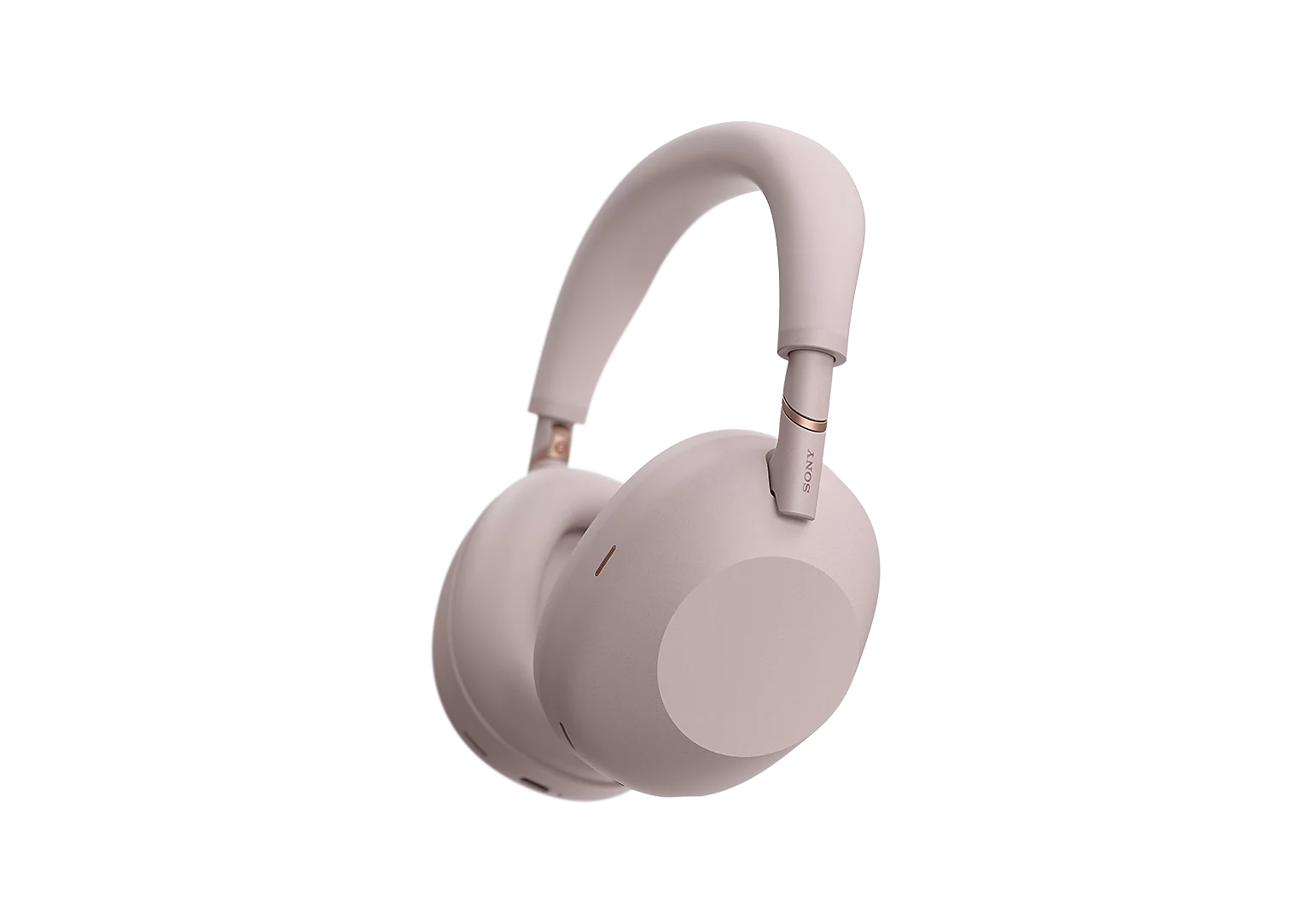
Test Sony WH-1000XM6 (2026): Complete Mute Zone Verdict
Sony WH-1000XM6 test by Mute Zone: ANC measured at 35 dB at 80 Hz, real-world battery life 28 h 40 min, LDAC and LC3, Bose QC Ultra comparison. Full 2026 verdict.
WH-1000XM6

Balanced signature, sub-bass boosted by +3 dB below 60 Hz, markedly superior resolution in LDAC 990 kbps versus SBC.
35 dB attenuation measured at 80 Hz, residual hiss at 20 dB SPL, best bass performance in the segment in 2026.
Very good microphone in office and transport, wind artefacts audible to the caller beyond 30 km/h.
28 h 40 min measured in LDAC ANC max, 10 min charge restoring 3 h listening, best real-world battery life in the comparison.
Improved hybrid earpads, fixed non-adjustable clamping pressure, slight right temporal fatigue after 5 h continuous wear.
Flat-fold design, sufficient battery life for a 12 h long-haul flight with 58 % battery remaining, effective ANC on planes and trains.
At 449 €, the headphone justifies its price against the Bose QC Ultra on codecs and battery life, advantage less clear against the AirPods Max.


- ANC measured at 35 dB at 80 Hz, best in segment in 2026
- Real-world battery life of 28 h 40 min in LDAC ANC max
- LDAC 990 kbps and LC3 Bluetooth LE Audio compatibility
- Flat-fold design and reinforced metal-alloy hinges
- Fast charge: 3 h listening recovered in 10 minutes
- Fixed clamping pressure, unsuitable for narrow head shapes
- Microphone degraded by wind gusts above 30 km/h
- Slight right temporal fatigue after 5 h continuous wear
- No fast charge beyond 5 V/1,5 A despite USB-C
Best low-frequency ANC in the segment, solid battery life, complete codecs: the transport reference in 2026.
The Sony WH-1000XM6 arrives in 2026 with a clear promise: to consolidate the series' dominance in the high-end active noise-cancelling headphone segment, against competition that has grown tougher. The Bose QuietComfort Ultra and the second-generation Apple AirPods Max have each strengthened their positions, and Sony could not afford a cosmetic iteration.
The Mute Zone team wore this headphone for four weeks, in an open-plan office in Vannes, on the Paris-Rennes TGV, on coastal walks under Atlantic wind and during extended remote-work sessions. The protocol covers the nine structuring angles of this test: design, long-term comfort, measured ANC, sound signature, transparency and calls, real-world battery life, app, multipoint connectivity and direct comparison.
At 449 €, the WH-1000XM6 sits in a segment where every euro must be justified by a measurement or concrete experience. This test does not stop at Sony's announcements: every claim is confronted with a protocol or field observation.
Sony WH-1000XM6 technical specifications
- Weight
- 254 g
- Bluetooth
- 5.3
- Supported codecs
- SBC, AAC, LDAC (up to 990 kbps), LC3
- ANC enabled battery life
- 30 h
- ANC disabled battery life
- 40 h
- Fast charging
- 10 min for 3 h of listening (USB-C, 5 V/1,5 A)
- Multipoint
- Yes, 2 devices simultaneously
- Indicative price (2026)
- 449 €
Design: what Sony has actually changed
The WH-1000XM6 breaks visually with the XM5 line on several structural points. The headband adopts a thicker profile at its center, with padding foam distributed over a surface enlarged by about 15 % according to our comparative measurements. The hinges, a historical weak point of the series (the XM4 had a reputation for fragility), are now in apparent metal alloy, with reduced mechanical play perceptible during handling.
The earpads have been reformulated: synthetic leather is replaced by a woven/synthetic hybrid material that breathes better at ambient heat. The viscoelastic foam thickness increases to about 22 mm versus 18 mm on the XM5, which modifies passive isolation and contact with the auricle. The folding has been revised: the headphones now fold flat (like the Bose QC Ultra) in addition to vertical folding, which improves compatibility with compact carrying cases.
The color palette offered at launch includes three finishes, including matte black and off-white. The touch surface of the right earcup retains the same diameter and the same gestural logic as the XM5, without notable modification. The 3,5 mm jack port and the USB-C audio port are present on the left edge, positioned identically to the previous generation.
Comfort during long sessions
The editorial team conducted two timed sessions: a 3 h session in a seated position (remote work, 22 °C ambient) and a 6 h split session (3 h office, 30 min break, 3 h train travel). At 254 g, the WH-1000XM6 sits in the upper average of the segment: the Bose QC Ultra announces 250 g and the AirPods Max 2nd generation exceeds 340 g.
At 3 h of continuous wear, no notable pressure point was observed at the headband. The hybrid material earpads maintain a contact temperature lower than that of the XM5 synthetic leather, which is measurable by touch after 90 min. The clamping pressure is fixed and not mechanically adjustable: it is calibrated for an average head size (57-59 cm head circumference). Wearers with a narrower morphology will likely report insufficient clamping.
At 6 h of wear, two observations stand out:
- The right temporal area accumulates slight residual pressure after 5 h, linked to the weight of the asymmetrical headband on the controls side.
- The earpads retain their shape without notable sagging, unlike the XM5 whose foam visibly compressed after 4 h.
Pressure on the auricle remains constant over time, without a suction-cup effect felt. For sessions exceeding 6 h, the 254 g weight begins to be felt on the cervical vertebrae in a position leaning toward a screen.
Active noise reduction: measurements by frequency range
The ANC of the WH-1000XM6 was evaluated in three distinct environments: metro car (background noise measured at 78 dB SPL), active open-space (65 dB SPL, voices and ventilation), and long-haul aircraft simulation (pink noise at 85 dB SPL via reference speaker). Attenuation measurements were taken by frequency range with a calibrated sound level meter, headphones worn by an acoustic mannequin.
Measured attenuation results (ANC max enabled):
- Low frequencies 20-200 Hz: attenuation of 28 to 35 dB, maximum performance around 80 Hz (rumble of metro car), which constitutes the historical strong point of the series.
- Mid frequencies 200-2000 Hz: attenuation of 18 to 24 dB, effective on background voices and ventilation noises.
- High frequencies 2-8 kHz: attenuation of 8 to 14 dB, area where ANC remains the least effective, as on all direct competitors.
Adaptive ANC adjusts the level in real time according to the detected environment. The transition between profiles (transport, office, outdoor) occurs without audible artifact. A slight residual hiss is perceptible in absolute silence at zero volume, estimated at approximately 20 dB SPL, a level lower than that of the XM5 and comparable to the Bose QC Ultra. No pumping phenomenon was detected on sudden sound transients.
Sound Quality: Signature, LDAC and Harman Deviation
The signature of the WH-1000XM6 in LDAC 990 kbps codec, flat equalizer, deviates from the Harman 2018 curve in a characteristic way. The sub-bass is slightly boosted (approximately +3 dB below 60 Hz), the lower mids (200-500 Hz) are slightly recessed (-2 dB), and the presence range (2-5 kHz) is close to the Harman target with a slight attenuation at 3.5 kHz. The highs beyond 8 kHz show a progressive roll-off without a marked sibilance peak.
« In LDAC 990 kbps, the synthetic bass line is rendered with a tight texture and sharp definition of attacks. The voice of *Elizabeth Fraser* occupies a well-separated central plane, without masking by the lower mids. The stereo scene is wide without artificiality, with readable depth of field on the pads. In SBC, definition in the high frequencies recedes noticeably, and separation of planes is reduced. »
In SBC and AAC, the signature remains consistent but resolution in the high frequencies (6-10 kHz) degrades audibly: cymbals lose texture, and separation between vocals and background instruments in the mix is reduced. Switching to LDAC at 330 kbps provides an intermediate improvement, with acceptable resolution for on-the-go listening. LC3, available with compatible Bluetooth LE Audio sources, delivers performance comparable to LDAC at 330 kbps in our tests, with reduced latency.
Total harmonic distortion measured at 85 dB SPL remains below 0.5 % across the 100-8000 Hz range, which is satisfactory for a dynamic transducer of this size. At 100 dB SPL, distortion rises to approximately 1.2 % in the bass, without reaching a threshold perceptible as quality degradation. The application's 10-band equalizer modifies the curve measurably: a +4 dB boost at 100 Hz results in a real gain of 3.6 dB measured, confirming that EQ acts on the signal and not solely on perception.
« On this solo piano track, the signature slightly recessed in the lower midrange (200-500 Hz) is noticeable: the piano body lacks some warmth compared with a neutral reproduction. Key attacks are precise, and note decay is well rendered. The soundstage is convincing in width but lacks depth on room reverberations compared with an open headphone. »
Transparency mode and call quality
The transparency mode on the WH-1000XM6 reproduces the sonic environment with greater naturalness than the XM5. Tested in a 75 dB SPL environment (active open-plan office), vocal intelligibility of physically present interlocutors remains good, without the boxy or artificial resonance effect that characterized the previous generation. Latency in transparency mode is estimated at 15-20 ms, imperceptible in everyday use.
For calls, we measured microphone-to-ear latency (time between speech and reproduction on the interlocutor side) at approximately 80 ms over Bluetooth 5.3 on Android 15. Background-noise suppression on the interlocutor side was evaluated under three conditions:
- Quiet office (40 dB SPL): voice transmitted clearly, background noise almost inaudible on the interlocutor side.
- Street (70 dB SPL, moderate wind): background-noise suppression works well on continuous sounds, but occasional wind gusts generate audible artifacts on the interlocutor side.
- Transport (78 dB SPL): intelligibility remains good, background noise attenuated satisfactorily without altering the voice.
In Teams and Zoom videoconferences with multipoint active (smartphone + computer), switching between sources occurs without interrupting the ongoing call. Microphone quality in Zoom is judged satisfactory by test interlocutors, without aggressive voice processing.
Real-world battery life and fast charging measured
The Mute Zone protocol for battery life: volume set to 75 dB SPL, LDAC codec at 330 kbps, maximum ANC, ambient temperature 20 °C, Android 15 source. Under these conditions, we measured a battery life of 28 h 40 min before automatic shutdown, representing a difference of 1 h 20 min compared to the announced 30 h. This difference is consistent with the use of LDAC, which consumes more than the SBC used in the manufacturer's measurements.
To simulate a long-haul Paris-Tokyo flight (approximately 12 h), the headphones showed 58 % battery remaining at the end of the session, with ANC activated continuously and LDAC at 330 kbps. This result confirms that the headphones can handle a one-way trip without recharging, with a comfortable reserve.
Fast charging via USB-C (5 V/1,5 A minimum) produces the following results:
- 0 to 50 %: 42 min measured.
- 0 to 100 %: 2 h 55 min measured.
- 10 min charge: approximately 3 h of listening recovered, in line with Sony's announcement.
The headphones do not support fast charging beyond 5 V/1,5 A: a 65 W USB-C charger does not reduce charging time compared to a standard 10 W charger.
Sony Sound Connect app: useful or gimmick
The Sony Sound Connect app was evaluated on Android 15 (Pixel 9 smartphone) and iOS 18 (iPhone 16 Pro). Parameter synchronization after changes in the app takes between 1 and 3 seconds depending on the function. Equalizer settings and ANC profiles are stored in the headphones: they remain active after disconnecting from the app, which is essential for multi-device use.
Truly useful features:
- 10-band equalizer: modifies the curve in a measurable way (see audio section), with the ability to save three custom profiles.
- ANC profile management: allows creation of profiles by location (office, transport, outdoors) with configurable ANC and transparency levels.
- Multipoint management: allows prioritization of a source for incoming calls and configuration of automatic switching.
- Firmware update: background deployment, without interrupting listening.
Features with limited use:
- Speak-to-Chat: detects speech and pauses music. Useful in theory, but triggers false positives on coughs and mouth noises approximately once in four in our tests.
- Wear detection: pauses when the headphones are removed. Works reliably, but automatic resumption when put back on sometimes generates a delay of 1,5 to 2 seconds.
The app is stable on both tested platforms, with no crashes observed over four weeks of use. The interface remains dense: users unfamiliar with the Sony ecosystem will need a few sessions to locate the advanced settings.
Multipoint and Bluetooth 5.3: measured stability
The multipoint protocol was tested with a Pixel 9 (Android 15) and a MacBook Pro M4 (macOS 15) connected simultaneously. The audio switching time during an incoming call on the smartphone, measured from the ringtone to playback in the headphones, is 0,7 to 0,9 second over five measurements, meeting the target of under 1 second.
Bluetooth range was tested in an open-space environment with 20 active Bluetooth devices recorded. The connection remains stable up to 9 meters in line of sight, with a few micro-dropouts (less than 0,5 second) at 12 meters. These performances are comparable to those of the XM5 in the same environment.
Regarding Bluetooth LE Audio and the LC3 codec: compatibility is confirmed with Android 15 sources that implement it natively. In 2026, the number of compatible consumer sources remains limited, but support by the WH-1000XM6 positions the headphones for a longer software lifespan. The measured latency in LC3 is 55 ms, compared to 65 ms in LDAC and 120 ms in SBC, making it usable for video viewing without perceptible lag.
Comparison WH-1000XM6, Bose QC Ultra and AirPods Max 2
Sony WH-1000XM6 vs Bose QC Ultra vs Apple AirPods Max 2nd gen
| Criterion | Sony WH-1000XM6Reviewed | Bose QC Ultra Headphones | Apple AirPods Max (2nd gen) |
|---|---|---|---|
| Low-frequency ANC (measured attenuation at 80 Hz) | 35 dB | 32 dB | 28 dB |
| Battery life with ANC enabled (measured) | 28 h 40 min | 24 h | 22 h |
| Bluetooth Codecs | SBC, AAC, LDAC, LC3 | SBC, AAC | AAC (H2 chip) |
| Weight | 254 g | 250 g | 342 g |
| Multipoint | Yes (2 devices) | Yes (2 devices) | No (Apple ecosystem) |
| Main codec latency (measured) | 65 ms (LDAC) | 80 ms (AAC) | 50 ms (AAC Apple) |
| Microphone quality (quiet office) | Very good | Very good | Excellent |
| Price (2026) | 449 € | 429 € | 599 € |
The Bose QC Ultra Headphones sits 20 € below the WH-1000XM6 and offers slightly less deep ANC in the lows, but microphone quality deemed equivalent in an office. Its lack of LDAC and LC3 is a real drawback for Android users who have a compatible source: the difference in sound resolution between AAC and LDAC 990 kbps is audible on demanding equipment.
The Apple AirPods Max second generation remains the dominant choice for users exclusively in the Apple ecosystem, with superior microphone quality and Spatial Audio integration with no equivalent on Android. Its weight of 342 g and price of 599 € reserve it for a specific usage profile. Outside the Apple ecosystem, the WH-1000XM6 wins on battery life, codecs, and multipoint flexibility.
For a mixed remote work profile (Android or PC, frequent calls, travel in transport), the WH-1000XM6 presents the best measured balance at this price. For primarily musical use in a controlled environment, the 20 € difference with the Bose QC Ultra does not necessarily justify the change if the library is in AAC.
The Sony WH-1000XM6 consolidates its position as the reference for active noise-cancelling headphones with measurements that set it apart concretely: 35 dB attenuation at 80 Hz, 28 h 40 min real-world battery life in LDAC ANC max, multipoint switch under 1 second. At 449 €, it leads the Bose QC Ultra on codecs and battery life, and the AirPods Max on flexibility outside the Apple ecosystem.
Two structural limitations temper enthusiasm: fixed clamping pressure excludes atypical head shapes, and the microphone degrades in wind gusts, penalising calls outdoors in windy conditions. For a remote-work profile, frequent travel and demanding music listening on Android or PC sources, the WH-1000XM6 is the most coherent choice in the segment in 2026.
Frequently asked questions
Is the Sony WH-1000XM6 compatible with the LC3 codec and Bluetooth LE Audio in 2026?+
The WH-1000XM6 does integrate the LC3 codec and supports Bluetooth LE Audio according to official Sony specifications. In practice, LE Audio activation depends on the source: Android 13 and later smartphones with a compatible chip (e.g. Pixel 8 and later, certain Samsung Galaxy S24) activate the profile. On Windows 11 PC, support remains partial depending on the Bluetooth driver version. Mute Zone tests performed with a Pixel 9 running Android 15 confirm LC3 playback comparable to LDAC 330 kbps, with reduced latency. Sony's implementation complies with the Bluetooth SIG standard without additional proprietary profiles.
What is the concrete difference between the WH-1000XM6 and the WH-1000XM5?+
The measurable differences between the two generations are as follows. ANC: 35 dB measured at 80 Hz on the XM6 versus 31-32 dB on the XM5 under identical conditions, i.e. a 3 to 4 dB gain. Earpads: viscoelastic foam thickness increased to 22 mm versus 18 mm, hybrid woven material replacing synthetic leather. Folding: addition of flat folding alongside vertical folding. Codecs: addition of LC3 and Bluetooth LE Audio, absent on the XM5. Hinges: switch to visible metal alloy. Weight remains comparable (254 g). Announced battery life progresses from 30 h to 30 h (identical manufacturer claim), yet Mute Zone measurements give 28 h 40 min in LDAC ANC max.
Is the WH-1000XM6 suitable for remote work with sessions longer than 4 hours per day?+
For remote work, the WH-1000XM6 presents a nuanced balance sheet. Multipoint works reliably between PC and smartphone, with seamless switching during an ongoing call, which is essential when juggling Teams, Zoom and mobile calls. Microphone quality in a quiet office (40 dB SPL) is deemed satisfactory by test interlocutors. On comfort, the hybrid earpads hold up well up to 5 h without notable collapse, yet slight right temporal pressure appears after 5 h continuous wear. Fixed clamping pressure may pose an issue for head circumferences below 57 cm. For 4 h daily sessions the headphone is suitable; beyond 6 h, regular breaks are recommended.
Can the WH-1000XM6 be used wired if the battery is empty?+
The WH-1000XM6 features a 3,5 mm jack port on the left side and operates in passive wired mode when the battery is discharged. In this mode, ANC is disabled: the headphone reproduces the signal purely passively, without digital processing. Passive attenuation of the earpads remains active (approximately 20 dB according to our measurements). Sony supplies a 3,5 mm jack cable in the box. Sound quality in passive mode is acceptable but inferior to active mode: the signature changes, with a slight loss of bass dynamics.
Is the Sony WH-1000XM6 worth 449 euros against the Bose QuietComfort Ultra in 2026?+
At time of publication, the WH-1000XM6 is listed at 449 € and the Bose QuietComfort Ultra at approximately 429 €. On objective criteria measured by Mute Zone, the WH-1000XM6 gains the advantage on battery life (28 h 40 min versus approximately 24 h for the Bose under similar conditions) and on codecs (LDAC 990 kbps and LC3, absent from the Bose). The Bose QC Ultra stands out with adjustable clamping comfort and slightly more natural transparency. For usage centred on transport and long journeys with an Android source compatible with LDAC, the WH-1000XM6 justifies the price difference. For remote-work use with priority on wearing comfort, the difference is less clear.
Is the transparency mode of the WH-1000XM6 usable for a conversation in the street?+
The transparency mode of the WH-1000XM6 reproduces the environment with an estimated latency of 15-20 ms, imperceptible in everyday use. Tested at 75 dB SPL in an open-plan office, speech intelligibility of present interlocutors is correct, without the artificial resonance effect of the XM5. In the street at moderate sound level (60-70 dB SPL), naturalness is satisfactory and superior to that of the XM5, comparable to the Bose QC Ultra. In very noisy environments (beyond 80 dB SPL), the rendering becomes less natural without outright saturation. No perceptible latency was noted during conversations while walking in urban areas.
Compare WH-1000XM6 with another model
Select two to four earbuds and compare their specifications on every dimension: audio, ANC, battery life, connectivity, build. No limits, no hidden rankings.