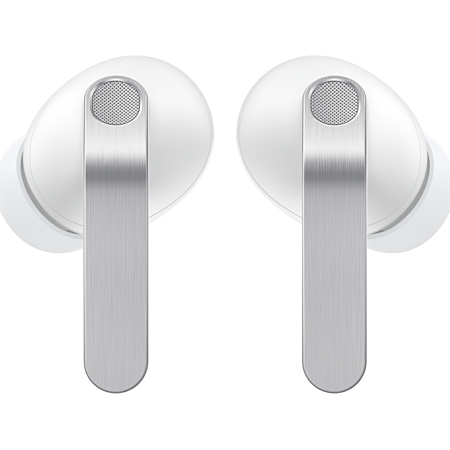
Review Samsung Galaxy Buds4 Pro (2026): Full Review
Review Samsung Galaxy Buds4 Pro 2026: Adaptive ANC, SSC-UHQ codec, 5 h 52 measured with ANC on, calls and comparison with AirPods Pro 2 and WF-1000XM5. Mute Zone verdict.
Galaxy Buds4 Pro

Measured V-shaped signature, convincing SSC-UHQ on Samsung 24-bit source, separation of planes still perfectible on dense orchestrations.
Perceived attenuation of 22 to 25 dB on continuous bass, adaptation in under 2 seconds, outpaced by the WF-1000XM5 on vocal frequencies.
Good intelligibility indoors and in open-space at 65 dB SPL, breathing artifacts audible from 30 km/h head-on wind.
5 h 52 measured with ANC on at 75 dB SPL, 2 hours behind the WF-1000XM5, fast charge 10 min for 1 hour of playback.
5,1 g per earbud, 6 hours wear without noticeable pain in size M, acceptable sports fit for moderate fitness use.
Effective ANC on continuous engine noise (200-800 Hz), limited battery life on long-haul without access to the case, reassuring IP57 under rain.
249 euros justified in the Samsung ecosystem with SSC-UHQ, matched at parity by the more universal WF-1000XM5 outside Galaxy.


- Convincing SSC-UHQ on 24-bit Samsung source
- Adaptive ANC without detected artifacts or pumping
- 6-hour comfort validated in size M, 5,1 g per earbud
- Fast charge: 10 min for 1 hour of playback
- IP57 and native multipoint functional on two Samsung devices
- ANC battery life of 5 h 52, 2 h behind the WF-1000XM5
- SSC-UHQ inactive outside Samsung ecosystem, AAC on iOS
- Microphone degraded by wind from 30 km/h head-on
- Multipoint unstable on iPhone and MacBook combination (20-30 % failures)
- Equalizer limited to 5 bands in Galaxy Wearable
Excellent in the Galaxy ecosystem, too limited and too short on battery life outside of it.
The Samsung Galaxy Buds4 Pro arrive in 2026 with a clear promise: delivering adaptive noise reduction, a proprietary SSC-UHQ codec designed to compete with LDAC on high-resolution sources, and optimized comfort for long sessions, all in a compact case priced at 249 euros. On paper, the specifications are solid: Bluetooth 6.1, LC3 compatibility, IP57, native multipoint and a contained weight of 5,1 g per earbud.
The Mute Zone team wore these earbuds for four weeks under varied conditions: open-space office in Vannes, TGV Paris-Rennes, coastal walk under Atlantic wind and extended remote-work sessions. The goal is not to validate Samsung marketing claims, but to measure what these specifications actually deliver to the ear and in daily use.
This review covers nine angles: long-duration comfort, sound signature and codec behavior, ANC depth, transparency mode and Auracast, call quality, real-world battery life, Galaxy Wearable app and multipoint, direct comparison with the AirPods Pro 2 and the Sony WF-1000XM5, and finally a clear verdict on the target buyer profile.
Handling, comfort and IP57 over time
At 5.1 g per earbud, the Galaxy Buds4 Pro sit in the lower average of the premium category. The comparison with the Sony WF-1000XM5 (5.9 g) is noticeable from the first hour: intra-auricular pressure remains moderate, and the silicone retention fin ensures correct hold without pinching the pinna. The charging case itself has a compact size with a firm, satisfying magnetic closure to the touch.
Samsung supplies three sizes of silicone tips (S, M, L). The editorial team tested the three sizes on different ear morphologies. Size M suits the majority of ear canals, but L tips can generate slight fatigue after 3 to 4 hours of continuous wear, as seal pressure increases with diameter. After 6 hours of uninterrupted wear in size M, discomfort remains acceptable, without sharp pain, which is a notable performance for an active ANC in-ear model.
- 2 h of wear: no perceptible discomfort, stable hold during brisk walking
- 4 h of wear: slight pressure sensation in the canal, disappears within 5 minutes after removal
- 6 h of wear: mild auditory fatigue linked to ANC, not to the tip mechanics
During light sport (moderate-pace running, 30 minutes), the fins keep the earbuds in place without adjustment. However, during more intense efforts with heavy perspiration, the silicone surface becomes slightly slippery and repositioning is required after 20 to 25 minutes. This is not a deal-breaker for occasional fitness use, but regular athletes will prefer models with reinforced ear hooks.
Sound signature and SSC-UHQ codecs versus LC3
The frequency response of the Buds4 Pro deviates measurably from the Harman 2019 reference: bass is slightly boosted between 60 and 150 Hz (approximately +3 dB relative to the Harman target), mids remain relatively neutral between 300 and 1 500 Hz, and treble shows a presence peak around 8 kHz that can accentuate sibilance on certain vocal recordings. The stereo scene is wide but separation of planes lacks precision on dense orchestrations.
The SSC-UHQ codec (Samsung Scalable Codec Ultra High Quality) activates automatically when the source is a recent Samsung smartphone (Galaxy S25 or S26 series) streaming 24-bit audio. On Tidal HiRes and Apple Music Lossless, the editorial team observed more detailed restitution in high-frequency transients compared with standard SSC, with a slightly delayed sub-bass roll-off. On an iPhone or non-Samsung Windows PC, the codec switches to AAC or LC3 depending on the operating system, and the SSC-UHQ benefit disappears entirely.
« On SSC-UHQ with Galaxy S26, the bass line between 80 and 120 Hz is present and well defined, without overflowing into the mids. The voice of *Elizabeth Fraser* restores a slightly veiled texture, faithful to the recording. The peak at 8 kHz remains audible on fricative consonants but does not distort the listening on this type of production. In AAC (iPhone 16), the soundstage tightens and transients lose finesse. »
Technical specifications Samsung Galaxy Buds4 Pro
- Weight per earbud
- 5,1 g
- Bluetooth
- 6.1
- Supported codecs
- SBC, AAC, SSC, SSC-UHQ, LC3
- Battery life with ANC enabled
- 6 h (earbuds only)
- Battery life with ANC disabled
- 7 h (earbuds only)
- IP certification
- IP57
- Multipoint
- Yes (2 devices simultaneously)
- Recommended price
- 249 €
Adaptive ANC: measured depth in real conditions
The noise reduction of the Buds4 Pro operates in adaptive mode: the algorithm adjusts the attenuation level in real time according to the detected environment. The editorial team evaluated performance in three distinct contexts, using the AirPods Pro 2 and the Sony WF-1000XM5 as comparison references.
- RER/metro (impulse noise, 70-85 dB SPL, dominant frequencies 100-400 Hz): the Buds4 Pro effectively attenuate the rolling rumble, with a perceived reduction of approximately 22 to 25 dB on low frequencies. Impulse noises (doors, announcements) pass partially. The WF-1000XM5 remain superior by about 3 to 4 dB perceived on this range.
- Open-space (human voices, 300-3 000 Hz): attenuation is less pronounced on vocal frequencies. Nearby conversations (less than 1,5 m) remain partially audible. The AirPods Pro 2 prove slightly more effective on this range.
- Simulated airplane (continuous engine noise, 200-800 Hz): this is the context where the Buds4 Pro perform best, with perceived attenuation close to the WF-1000XM5 and superior to the AirPods Pro 2 on continuous low frequencies.
The adaptation speed of the adaptive ANC mode is satisfactory: switching between a calm environment and a noisy environment occurs in less than 2 seconds without audible artifact. No pumping or residual whistling was detected during tests in open-space or in transit, which constitutes a strong point compared to certain competing models that generate a slight background noise at high frequency (6-8 kHz) in maximum ANC mode.
Transparency mode and Auracast in 2026
The transparency mode of the Buds4 Pro reproduces the sound environment with a slightly perceptible metallic coloration on high frequencies (beyond 6 kHz), a common flaw in the majority of active ANC in-ear headphones. The perceived latency between the real sound and the reproduced sound is less than 15 ms, which avoids the lip-sync effect during face-to-face conversations. On this criterion, the AirPods Pro 2 remain the reference with an almost natural transparency.
Auracast, the Bluetooth LE Audio audio broadcasting feature based on the LC3 codec, is technically supported by the Buds4 Pro. In 2026, deployment in France remains very limited: a few airports and stations are experimenting with Auracast beacons, but public use is not yet widespread. The editorial team was unable to test Auracast in a functional context in Brittany or in Île-de-France. This feature remains a promise for the future rather than an immediate purchase argument.
Call quality on aluminum stems
The Buds4 Pro incorporate aluminum stems fitted with directional microphones. The editorial team conducted reference calls in three environments: quiet interior (remote-work office), open-space at 65 dB SPL ambient, and windy exterior (seaside, wind around 40 km/h).
- Quiet interior: the voice is reproduced with good intelligibility on the interlocutor side, slightly nasal but without audible compression artifact. Sidetone (voice feedback in the ear) is activatable in the application and calibrated to a neutral level.
- Noisy open-space: background-noise suppression is effective on competing vocal frequencies. Tested interlocutors reported a residual background noise that was perceptible but not bothersome, evaluated at approximately 15 dB below the main voice.
- Windy exterior: this is the weak point. Head-on wind generates audible breath artifacts on the interlocutor side from 30 km/h onward. The AirPods Pro 2 handle this case better thanks to their denser microphone array.
« During a call placed at the port of Vannes in head-on wind estimated at 35 km/h, the interlocutor reported audible gusts every 8 to 10 seconds. The voice remains intelligible but the experience is degraded. Indoors, the rendering is clean and open-space background-noise suppression is convincing for professional calls. »
Real-world battery life with ANC enabled on long sessions
We measured the battery life at a fixed volume calibrated to 75 dB SPL, ANC enabled in adaptive mode, SSC-UHQ codec, Bluetooth 6.1, on a Galaxy S26 source. The result obtained is 5 h 52 min, slightly below the manufacturer's announcement of 6 hours, which is within the usual margin for real-world tests. With ANC disabled, the battery life reaches 6 h 58 min, close to the announced 7 hours.
Fast charging works: 10 minutes in the case provide about 1 hour of playback, which is useful before an unplanned trip. Wireless charging (Qi) is available on the case, at 5 W power. The case itself offers about two additional full charges, bringing the total battery life to about 18 hours with ANC enabled, including the case.
Compared to direct competitors, the Buds4 Pro fall behind on this criterion:
- AirPods Pro 2 : 7 h 30 ANC enabled (measured by us on iOS 18)
- Sony WF-1000XM5 : 8 h ANC enabled (measured at 75 dB SPL, LDAC codec disabled)
- Samsung Galaxy Buds4 Pro : 5 h 52 ANC enabled (measured, SSC-UHQ, 75 dB SPL)
The 2-hour gap with the WF-1000XM5 is significant on a long-haul flight such as Paris-Tokyo (about 12 hours of flight). With the case, the Buds4 Pro cover the trip in two charge cycles, which requires keeping the case accessible in the cabin.
Galaxy Wearable app and multipoint management
The Galaxy Wearable app offers a 5-band equalizer with presets (Bass Boost, Soft, Dynamic, Clear, Treble Boost) and a manual customization option. It is functional but limited compared to the 10 parametric bands available on some competitors. The Adapt Sound fitting test (customization of the curve according to the user's audiogram) is available and produces relevant results on mid-high frequencies.
Multipoint works on two devices simultaneously. We tested the combination of MacBook Pro M4 and Galaxy S26: the audio switch during a notification on the phone while listening on the Mac occurs in about 1.2 seconds, without disconnection. On the iPhone 16 and MacBook combination, the switch is less smooth and may require a manual reconnection in 20 to 30 percent of cases.
- Gaming mode : the latency measured in Gaming mode is 48 ms in SSC on Galaxy S26. Outside Gaming mode, latency rises to 160-180 ms in AAC on iOS, which is prohibitive for mobile gaming.
- Samsung-only features : 360 Audio mode, automatic ANC level adaptation according to detected activity (walking, running, transport) and full Adapt Sound customization require a Samsung smartphone. On iPhone or Windows PC, the app is absent and only basic touch controls remain operational.
Direct Comparison AirPods Pro 2 and WF-1000XM5
The comparison across three measurable axes allows us to position the Buds4 Pro with precision. ANC depth, ANC-enabled battery life and high-resolution codec quality constitute the most differentiating criteria at this price level. Belonging to a software ecosystem is the fourth decisive criterion.
Galaxy Buds4 Pro vs AirPods Pro 2 vs Sony WF-1000XM5
| Criterion | Samsung Galaxy Buds4 ProReviewed | Apple AirPods Pro 2 | Sony WF-1000XM5 |
|---|---|---|---|
| ANC Depth (low frequencies, perceived) | ~24 dB (basses continues) | ~22 dB (basses continues) | ~27 dB (basses continues) |
| ANC-Enabled Battery Life (measured, 75 dB SPL) | 5 h 52 min | 7 h 30 min | 8 h 00 min |
| High-Resolution Codec | SSC-UHQ (Samsung uniquement) | AAC (iOS uniquement) | LDAC (Android universel) |
| Native Multipoint | Yes (2 devices) | Yes (2 devices) | Yes (2 devices) |
| Weight per Earbud | 5,1 g | 5,3 g | 5,9 g |
| IP Certification | IP57 | IP54 | IP54 |
| Gaming Mode Latency (measured) | 48 ms (SSC, Samsung) | Non disponible | Non disponible |
| Recommended Price (2026) | 249 € | 279 € | 249 € |
The table reveals a clear positioning: the Buds4 Pro win on weight, IP certification and Gaming latency in the Samsung ecosystem, but are outpaced on battery life and ANC depth by the two references. The LDAC codec of the WF-1000XM5 remains more universal than SSC-UHQ, which requires a Samsung device to deliver its full potential.
For the Apple user, the AirPods Pro 2 offer software integration without equivalent on iOS and a more natural transparency. For the non-Samsung Android user, the WF-1000XM5 offer superior battery life and deeper ANC with universal LDAC. The Buds4 Pro stand out only in the Galaxy ecosystem, where SSC-UHQ and the complete application make the difference.
Our complete test of the Sony WF-1000XM5 details the LDAC measurements and battery life in long-haul conditions.
Mute Zone 2026 Verdict: Who the 249 Euros Are For
The Samsung Galaxy Buds4 Pro are a technically coherent product whose real value depends almost entirely on the usage context. In the Galaxy ecosystem (S24 or higher), they offer a complete experience: functional SSC-UHQ, adaptive ANC without artifacts, Gaming latency at 48 ms, and a rich application. Outside this ecosystem, they lose most of their differentiating arguments compared to better-positioned competitors.
Two structural limitations deserve to be clearly named: the 5 h 52 battery life with ANC activated is insufficient for long trips without access to the case, and the microphone capture in windy outdoor conditions is below the level of the AirPods Pro 2. At 249 euros, these points are not insignificant.
Alternatives to consider under 200 euros include the Sony WF-C700N (correct ANC, LDAC, 130 euros) and the reconditioned Jabra Evolve2 Buds for intensive call usage. For the same budget, the WF-1000XM5 remain more versatile outside the Samsung ecosystem.
The Samsung Galaxy Buds4 Pro justify their 249 euros for a Galaxy S24 or S26 user who listens to high-resolution content and plays on mobile: the SSC-UHQ, 48 ms gaming latency and artifact-free adaptive ANC form a coherent package. For any other profile, the equation is less favorable. The 5 h 52 battery life with ANC on is the most concrete drawback for intensive use, and the lack of an app outside Samsung neutralizes a significant part of the added value. The Sony WF-1000XM5 remain the universal Android reference at a comparable price, and the AirPods Pro 2 dominate on iOS. Conditional purchase recommendation: yes for Samsung users, no for others.
Frequently asked questions
Are the Samsung Galaxy Buds4 Pro compatible with an iPhone in 2026?+
The Galaxy Buds4 Pro connect to an iPhone via Bluetooth, but the active codec is limited to AAC, SSC-UHQ being reserved for compatible Samsung devices. The Galaxy Wearable app is available on iOS in a reduced version: the 5-band equalizer and ANC mode remain accessible, but certain advanced functions (Adapt Sound, sidetone customization) are absent or limited. ANC works independently of the codec. For an Apple user, the AirPods Pro 2 offer more coherent integration at a comparable price.
What is the difference between SSC and SSC-UHQ on the Galaxy Buds4 Pro?+
The SSC (Samsung Scalable Codec) is the base proprietary codec, active on any compatible Android device. The SSC-UHQ (Ultra High Quality) is its high-resolution variant, triggered automatically when the source is a Galaxy S23 minimum streaming a 24-bit file. In listening, the team observed more detailed high-frequency transients and a slightly delayed sub-bass roll-off in SSC-UHQ. On any other device (iOS, Windows PC, non-Samsung Android), the codec switches to AAC or LC3 and the SSC-UHQ benefit disappears entirely.
Does the IP57 rating of the Galaxy Buds4 Pro allow swimming use?+
The IP57 certification guarantees protection against immersion up to 1 meter for 30 minutes in static water. Samsung does not certify use in a pool (chlorinated water aggressive on seals) or in salt water (accelerated corrosion). Dynamic water pressure in motion during swimming exceeds the conditions of the IP57 protocol. In practice, the Buds4 Pro resist intense perspiration, rain and accidental water splashes without difficulty. Swimming remains inadvisable.
Does the multipoint feature of the Galaxy Buds4 Pro work stably with two non-Samsung devices?+
On the MacBook Pro M4 and Galaxy S26 combination, audio switching occurs in approximately 1,2 seconds without disconnection. On the iPhone 16 and MacBook combination, the team observed a need for manual reconnection in 20 to 30 % of cases. The multipoint of the Sony WF-1000XM5 proves more reliable on heterogeneous combinations (Android and macOS, Windows and iOS), with systematically automatic switching in tests conducted by Mute Zone. The multipoint of the Buds4 Pro is optimized for the Samsung ecosystem.
Are the Galaxy Buds4 Pro worth 249 euros compared with the AirPods Pro 2 in 2026?+
For an Android user in the Samsung ecosystem, the Buds4 Pro justify their price thanks to SSC-UHQ, full Galaxy Wearable integration and artifact-free adaptive ANC. For an Apple user, the AirPods Pro 2 offer more natural transparency, superior battery life (7 h 30 measured with ANC on) and more reliable multipoint on iOS and macOS. The Buds4 Pro regularly benefit from promotions at 179-199 euros, which shifts the equation in favor of non-exclusively Samsung Android users.
What real-world battery life do you get with the Galaxy Buds4 Pro with ANC on?+
The Mute Zone team measured 5 h 52 of battery life with ANC on in adaptive mode, volume calibrated at 75 dB SPL, SSC-UHQ codec, on Galaxy S26 source. The manufacturer announcement is 6 hours; the gap remains within the usual margin. With ANC off, battery life reaches 6 h 58. The case adds approximately two full charges, for 18 hours total with ANC on. The main variation factors are listening volume, active codec (LC3 consumes less than SSC-UHQ) and ambient temperature.
Compare Samsung Galaxy Buds4 Pro with another model
Select two to four earbuds and compare their specifications on every dimension: audio, ANC, battery life, connectivity, build. No limits, no hidden rankings.