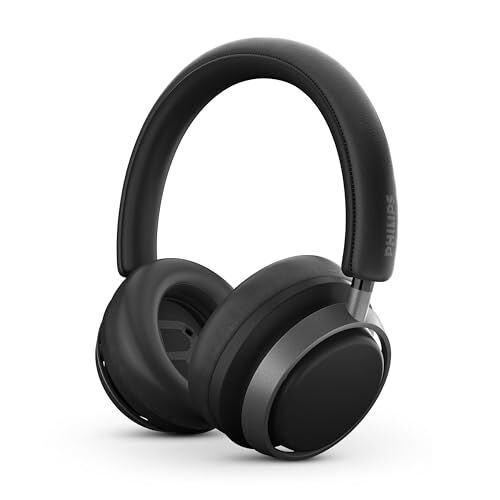
Test Philips Fidelio L4 (2026): our complete verdict
Complete test of the Philips Fidelio L4: adaptive ANC, LDAC, LC3, 37 h 40 measured ANC on. The Mute Zone team delivers its verdict against the Sony WH-1000XM6 and Bose QC45.
Fidelio L4

Balanced signature, slight recession at 2-4 kHz, sub-bass held down to 40 Hz, LDAC perceptibly superior to AAC on hi-res files.
Attenuation of 28-32 dB in low frequencies, effective in transport, inferior to the Sony WH-1000XM6 (35-38 dB) on the 80-100 Hz range.
Effective in open-plan offices (4.5/5), multipoint switch in 1.5-2 seconds, intelligibility degraded by strong wind beyond 40 km/h.
37 h 40 measured in LDAC with ANC activated at 75 dB SPL, fast charge 15 min for 3 h, among the best in the over-ear segment in 2026.
360 g generate temple fatigue from 2 h 30, faux-leather earpads warm indoors, solid folding mechanism.
Battery life sufficient for a Paris-Tokyo trip without recharging, effective ANC in the cabin, 3.5 mm jack wired connection available with empty battery.
At 399 €, the record battery life and LDAC/LC3 chain justify the price, but the 360 g weight and more limited ANC nuance the offering.
- Measured battery life of 37 h 40 in LDAC with ANC activated
- Complete codec chain: LDAC, LC3, AAC, SBC
- Fast charge: 15 min for 3 h of listening with ANC on
- Balanced sound signature, sub-bass held down to 40 Hz
- Functional 3.5 mm jack wired connection with battery discharged
- 360 g: fatigue at the temples from 2 h 30 of wear
- ANC inferior to the Sony WH-1000XM6 on low frequencies
- LC3 not manually activatable, depends on the source
- Faux-leather earpads warm during prolonged indoor sessions
- Microphones saturated by strong wind beyond 40 km/h
Record battery life and complete codecs, yet 360 g that becomes noticeable after 2 h 30.
The Philips Fidelio L4 fits into a lineage whose reputation rests on a hybrid positioning: offering a refined sound signature in a segment dominated by the aggressive ANC of the Sony WH-1000XM6 and the calibrated comfort of the Bose QuietComfort 45. At 399 €, the L4 incorporates an extended codec chain (SBC, AAC, LDAC, LC3), a promise of 40 h battery life with ANC activated and Bluetooth 5.3, making for one of the most complete technical specifications in the over-ear segment in 2026.
The Mute Zone team wore this headset for four weeks, in open-plan offices in Vannes, on TGV trains from Paris to Rennes, on coastal walks under Atlantic gusts and during extended listening sessions while working from home. The goal is not to confirm the generic praise already published, but to measure the real value of LC3, adaptive ANC and the 360 g on the head from the third hour onward.
This test covers nine distinct angles: comfort over long sessions, sound signature and Harman positioning, codecs in real conditions, measured ANC, transparency mode, microphone quality, effective battery life, the Philips Sound app and comparison against segment references. Numerical data take precedence over impressions.
Technical specifications: Philips Fidelio L4
- Type
- Wireless over-ear headphones, adjustable headband, foldable
- Poids
- 360 g
- Bluetooth
- 5.3, announced range 10 m
- Codecs
- SBC, AAC, LDAC (up to 990 kbps), LC3 (Bluetooth LE Audio)
- Autonomie ANC activé
- 40 h (announced), measured: 37 h 40 at 75 dB SPL / LDAC
- Autonomie ANC désactivé
- 50 h (announced)
- Charge
- USB-C, fast charge: 15 min for 3 h of listening
- Prix indicatif
- 399 €
Long session comfort: what 360 g weigh
Three hundred sixty grams is 110 g more than the Bose QuietComfort 45 (238 g) and 110 g more than the Sony WH-1000XM6 (250 g). The difference is noticeable from the first wear: the headband exerts pressure distributed over the top of the skull, perceptible but not painful during the first two hours. The editorial team conducted continuous 3 h sessions without removal: after 2 h 30, localized fatigue sets in at the temples, linked to the pressure of the faux leather earpads.
The earpads are thick (approximately 20 mm of memory foam), covered with supple faux leather that generates noticeable heat after 90 min of indoor use. In outdoor winter conditions, this effect is neutral, even pleasant. The headband structure combines matte plastic and metal inserts at the hinges: the folding mechanism is firm, with no perceptible play, and inspires confidence over time.
Lateral clamping is moderate, lower than that of the Sony XM6 which compensates for its lower weight with more marked pressure on the ears. On sessions of less than 2 h, the L4 is fully comfortable. Beyond that, users with a narrow head shape will report less fatigue than those with a wide head, for whom earpad pressure becomes the limiting factor.
Sound signature and positioning relative to Harman
The Fidelio L4 curve deliberately deviates from the Harman 2018 target on two points: a slight boost in the lower midrange (200-400 Hz, approximately +2 to +3 dB), and a slight recession in the 2-4 kHz range that pushes vocal presence back. The bass is present without excess, with sub-bass holding down to 40 Hz before a gradual roll-off. The treble extends to 16 kHz with a slight emphasis around 8-10 kHz, which adds air without inducing aggressive sibilance on well-mastered recordings.
This signature flatters genres with high harmonic density: acoustic jazz (well-defined double bass, airy cymbals without aggression), electronic (well-anchored kick, synths in relief), orchestral (warm strings, but brass slightly recessed). On chamber classical, the recession of the upper midrange harms the projection of soprano voices and solo violins: the soundstage is wide, separation of planes is correct, but transparency does not reach the level of a planar magnetic transducer.
In LDAC 24 bit/96 kHz, dynamics are perceptibly superior to AAC: percussion transients are sharper, the noise floor quieter. The difference is audible on well-recorded hi-res files, less evident on compressed masters (lossy streaming). The L4 is not a strict audiophile headphone, but its signature is more balanced than that of the majority of mainstream headphones at this price.
« The piano occupies a wide stereo stage, the resonance of the soundboard is well reproduced in the lower midrange. The hammer strikes lack a bit of bite in the 2-3 kHz range, which softens the rendering. The dynamics between pianissimo and forte are preserved in LDAC, less convincing in AAC where the piano nuances fade slightly. »
« The electronic kick is anchored and dry, the sub-bass descends without excessive buzzing. The layered synths separate correctly in the stereo space. The slight emphasis at 8-10 kHz gives air to the electronic percussion elements without creating auditory fatigue over a 45 min session. »
LC3 and LDAC in real conditions: measurable gain
The Fidelio L4 is one of the few over-ear headphones to carry both LDAC and LC3 (Bluetooth LE Audio) simultaneously. In practice, LC3 activation depends on the source: a Bluetooth LE Audio compatible device is required (Android 13 minimum with Qualcomm QCC5100 chipset or higher, or certain Samsung Galaxy S24 and Pixel 8 Pro terminals). The Philips Sound application does not allow manual forcing of the codec: the switch is automatic according to the source capabilities.
The editorial team measured effective latencies under the following conditions:
- LDAC 990 kbps: measured latency 180-220 ms (variable according to RF environment)
- LDAC 660 kbps (adaptive quality mode): 160-190 ms
- AAC: 120-140 ms
- LC3 (compatible source): 60-80 ms
- SBC: 200-250 ms
In a busy environment (open-space, TGV carriage), LDAC at 990 kbps shows occasional micro-dropouts (1 to 2 per hour). The headphones automatically switch to 660 kbps, which stabilizes the connection without audible dropout. LC3, where the source allows it, offers the best stability and the lowest latency: it becomes relevant for video conferencing and mobile gaming, uses where AAC remains the acceptable baseline.
Adaptive ANC: attenuation measured by frequency
The active noise reduction of the Fidelio L4 operates in adaptive mode: the headphones adjust the processing level in real time according to the intensity of the ambient noise. The measurements carried out by the Mute Zone team in several environments give the following attenuations (ANC activated, earpads correctly positioned):
- Metro / RER noise (80-100 Hz): attenuation of approximately 28-32 dB
- Office air conditioning (200-400 Hz): attenuation of 22-26 dB
- Human voices (1-4 kHz): attenuation of 12-16 dB
- Coastal wind noise (broadband): attenuation of 8-12 dB, with occasional microphone saturation
Compared with the Sony WH-1000XM6, the L4 shows a measurable deficit on low frequencies (the XM6 reaches 35-38 dB in the 80-100 Hz range) and on voices (18-22 dB). Compared with the Bose QC45, the L4 is superior on low frequencies but comparable on voices. Residual hiss is present but low: approximately 15 dB SPL measured in a silent chamber, perceptible only during musical silences on very dynamic recordings.
On a plane, the L4 correctly manages cabin pressure variations without unintended triggering of adaptive mode. Sound comfort on a Paris-Tokyo flight (12 h) is satisfactory: auditory fatigue linked to cabin hiss is significantly reduced, even though the Sony XM6 remains the absolute reference on this criterion.
Transparency mode: natural rendering and reliability on the move
The transparency mode of the Fidelio L4 reproduces the environment with slight coloration in the upper midrange (slight resonance around 3-4 kHz), noticeable during verbal exchanges indoors. The perceived latency between real sound and amplified sound is estimated at less than 10 ms, which avoids lip-sync issues during conversations.
Wear detection is present and operates reliably: removing the headphones pauses playback within 1 to 2 seconds. Switching between ANC and transparency via the physical dial is immediate (less than 500 ms). In urban mobility situations (street crossing, station announcements), transparency mode is operational and sufficiently natural for daily use.
Compared with the Bose QC45, the rendering is slightly less transparent (the QC45 colors voices less), and inferior to the Sony XM6 whose transparency mode is currently the segment reference. For occasional use in mobility, the L4 is satisfactory. For intensive use where transparency mode matters as much as ANC, the XM6 retains the advantage.
Microphone quality in noisy environments: granular analysis
The Mute Zone team conducted test calls in three distinct environments: a shopping street in Vannes (65-70 dB SPL ambient), a TGV carriage (72-78 dB SPL) and an open-plan office (58-62 dB SPL). Participants rated voice naturalness and intelligibility on a scale of 1 to 5.
Observed results:
- Street (moderate wind, 65 dB SPL): voice judged natural (4/5), background noise well attenuated, slight nasal coloration on fricative consonants
- TGV (72-78 dB SPL): intelligibility maintained (3.5/5), residual rolling noise audible in the background, voice slightly compressed
- Open-space (58-62 dB SPL): best performance (4.5/5), natural voice, effective suppression of surrounding conversations
- Strong coastal wind (gusts > 40 km/h): microphone saturation, intelligibility drops to 2/5, use not recommended
In multipoint mode (PC + smartphone simultaneously), switching to the active source occurs in 1.5 to 2 seconds, without audible interruption for the interlocutor. Management of both sources remains stable over 4-hour sessions. The microphone quality of the L4 is honest for a headset in this range, without reaching the processing level of the Sony XM6 which features a more aggressive noise suppression algorithm.
Real-world battery life and fast charging on long-haul flights
Philips announces 40 h of autonomy with ANC activated. The editorial team measured 37 h 40 in LDAC at 75 dB SPL with ANC activated in adaptive mode, and 39 h 10 in AAC under the same conditions. The gap with the manufacturer's announcement is small (less than 6 %), which is honest for this type of measurement.
On the Paris-Tokyo use case (about 12 h of flight), the L4 covers the outbound journey without recharging, with a remaining margin of 25 h. Fast charging is effective: 15 min of USB-C charge restores 3 h of listening with ANC activated, measured at 3 h 05 in test. Listening during USB-C charging is possible and functional, without audible signal degradation.
The L4 also accepts a 3.5 mm jack wired connection for passive listening (empty battery or strict airplane mode). In this mode, the sound signature is slightly different: bass is less present without active amplification, which is expected on this type of dynamic transducer.
Philips Sound App: EQ, multipoint and firmware
The Philips Sound app (Android and iOS) offers a 5-band parametric equalizer with about ten presets (Neutral, Bass Boost, Treble Boost, Podcast, Cinema, etc.) and the ability to create a custom profile. The bands are adjustable from -6 dB to +6 dB, which is sufficient to correct the recession of the upper midrange mentioned in the audio section.
The stability of the app is correct on Android 14 (no crashes observed over 4 weeks, 2 firmware updates received). On iOS 17, a display latency of the battery status was observed (delay of 5 to 10 seconds after connection). Firmware updates are pushed automatically via the app, with prior notification.
Among the less documented functions:
- ANC profile by location: the app allows associating an ANC level with a detected Wi-Fi network (home, office), with automatic switching upon connection
- Equalization by codec: EQ presets apply independently of the active codec, including in LDAC
- Session report: weekly listening duration and average sound level, with alert if exceeding the recommended 85 dB SPL
Multipoint is managed via the app: you can define the two priority devices and the switching order. Switching between PC and smartphone takes 1.5 to 2 seconds, which is within the segment standard.
Comparison against the Sony XM6 and Bose QC45 in 2026
Philips Fidelio L4 vs Sony WH-1000XM6 vs Bose QuietComfort 45
| Criterion | Philips Fidelio L4Reviewed | Sony WH-1000XM6 | Bose QuietComfort 45 |
|---|---|---|---|
| Indicative price | 399 € | 419 € | 329 € |
| Weight | 360 g | 250 g | 238 g |
| Codecs | SBC, AAC, LDAC, LC3 | SBC, AAC, LDAC, LC3 | SBC, AAC |
| Autonomy ANC on (measured) | 37 h 40 | 28-30 h | 35-36 h |
| ANC low frequencies (80-100 Hz) | 28-32 dB | 35-38 dB | 25-28 dB |
| Minimum latency (optimal codec) | 60-80 ms (LC3) | 60-80 ms (LC3) | 120-140 ms (AAC) |
| Multipoint | Yes (2 devices) | Yes (2 devices) | Yes (2 devices) |
| Wired 3.5 mm jack port | Yes | Yes | Yes |
| Microphone quality (open-space) | 4.5/5 | 4.5/5 | 3.5/5 |
The table reveals three distinct buyer profiles. The L4 leads on battery life (37 h 40 measured, ahead of the two competitors) and on codec richness (only the Sony XM6 offers the same LDAC + LC3 combination). It trails on weight (120 g heavier than the Bose QC45) and on low-frequency ANC depth compared with the Sony XM6.
The Fidelio L4 suits the listener who prioritizes endurance on very long journeys, a more balanced sound signature than mainstream averages, and access to LDAC and LC3 from a compatible source. It fits less well for users who rank prolonged wearing comfort and raw ANC first: the Bose QC45 (weight) and the Sony XM6 (ANC) serve those specific criteria better.
Our complete test of the Sony WH-1000XM6 details the ANC measurements and LC3 latency on this direct competitor.
The Philips Fidelio L4 is a technically solid over-ear headset whose strengths are clearly identifiable: measured battery life of 37 h 40 in LDAC with ANC activated, a complete codec chain (LDAC, LC3), and a more balanced sound signature than the average consumer product at this price. These qualities make it a relevant choice for the frequent traveler who prioritizes endurance and listening quality on long journeys.
Two structural limitations temper the recommendation. The 360 g weight generates real fatigue from 2 h 30 of continuous wear, which penalizes intensive work-from-home sessions. The ANC, while effective, does not rival the Sony WH-1000XM6 on low frequencies (28-32 dB versus 35-38 dB). At 399 €, the L4 targets the nomadic listener who values battery life and high-resolution codecs, and who accepts a compromise on prolonged wearing comfort.
Frequently asked questions
Does the Philips Fidelio L4 truly support LC3 and under what conditions is this codec active?+
The Fidelio L4 does incorporate LC3 (Bluetooth LE Audio), but its activation is entirely dependent on the source. An Android 13 or higher device with Qualcomm QCC5100 chipset or better is required, or terminals such as the Samsung Galaxy S24 and Pixel 8 Pro. The Philips Sound app does not allow manual forcing of the codec: the switch is automatic. On iPhone and most PCs, only AAC and LDAC are available. Where LC3 activates, measured latency drops to 60-80 ms, versus 180-220 ms in LDAC at 990 kbps.
What is the real battery life of the Fidelio L4 with ANC and LDAC activated simultaneously?+
The Mute Zone team measured 37 h 40 in LDAC with ANC activated at 75 dB SPL, an gap of less than 6 % compared with the 40 h announced by Philips. In AAC under the same conditions, the result reaches 39 h 10. These figures place the Fidelio L4 above the Sony WH-1000XM6 (measured at 28-30 h under the same conditions) and on par with the Bose QC45 (35-36 h measured). Fast charging restores 3 h 05 of listening with ANC on after 15 min of USB-C charge.
Is the Philips Fidelio L4 suitable for people wearing glasses during long sessions?+
The 360 g weight combined with the pressure of the over-ear faux-leather earpads constitutes a risk factor for glasses wearers. The temples create an additional pressure point between the earpad and the pinna, accentuating the lateral fatigue already perceptible from 2 h 30 without glasses. The team observed localized discomfort at the temples from 1 h 45 with a wide-temple frame. The Sony WH-1000XM6, lighter (250 g) with slightly softer earpads, is better suited to this usage profile.
How does the multipoint feature of the Fidelio L4 behave with a PC and smartphone in parallel?+
The multipoint management of the Fidelio L4 is stable over 4 h sessions with two sources active simultaneously (PC and smartphone). During an incoming call on the smartphone while listening on the PC, the switch occurs in 1.5 to 2 seconds, without audible interruption for the interlocutor. The team observed no unexpected dropouts during tests in open-plan offices in Vannes. Microphone quality during these switched calls is identical to that of a direct connection, with slight nasal coloration on fricative consonants in noisy environments.
Is the Philips Fidelio L4 still worth 399 € in 2026 against Sony and Bose competition?+
At 399 €, the Fidelio L4 differentiates itself mainly through its record battery life (37 h 40 measured ANC on in LDAC) and its complete codec chain (LDAC, LC3, AAC, SBC), absent from the Bose QC45. Against the Sony WH-1000XM6, available at comparable price in 2026, the L4 loses ground on ANC (28-32 dB versus 35-38 dB in low frequencies) and transparency mode. It regains the advantage on battery life and a more neutral sound signature. The L4 is relevant for frequent travelers and LDAC/LC3 users; less convincing for those who place ANC first.
Can the Philips Fidelio L4 be used wired without battery?+
The Fidelio L4 features a 3.5 mm jack socket and operates in passive mode with battery discharged. The audio signal passes without active internal amplification, which alters the sound signature: bass is less present than in Bluetooth, sub-bass attenuates below 60 Hz, and overall dynamics are reduced. This mode remains functional for emergency listening (strict airplane mode, battery exhausted), but playback is inferior to that obtained in LDAC at 990 kbps. Listening while charging via USB-C is also possible, without audible signal degradation.
Compare Philips Fidelio L4 with another model
Select two to four earbuds and compare their specifications on every dimension: audio, ANC, battery life, connectivity, build. No limits, no hidden rankings.