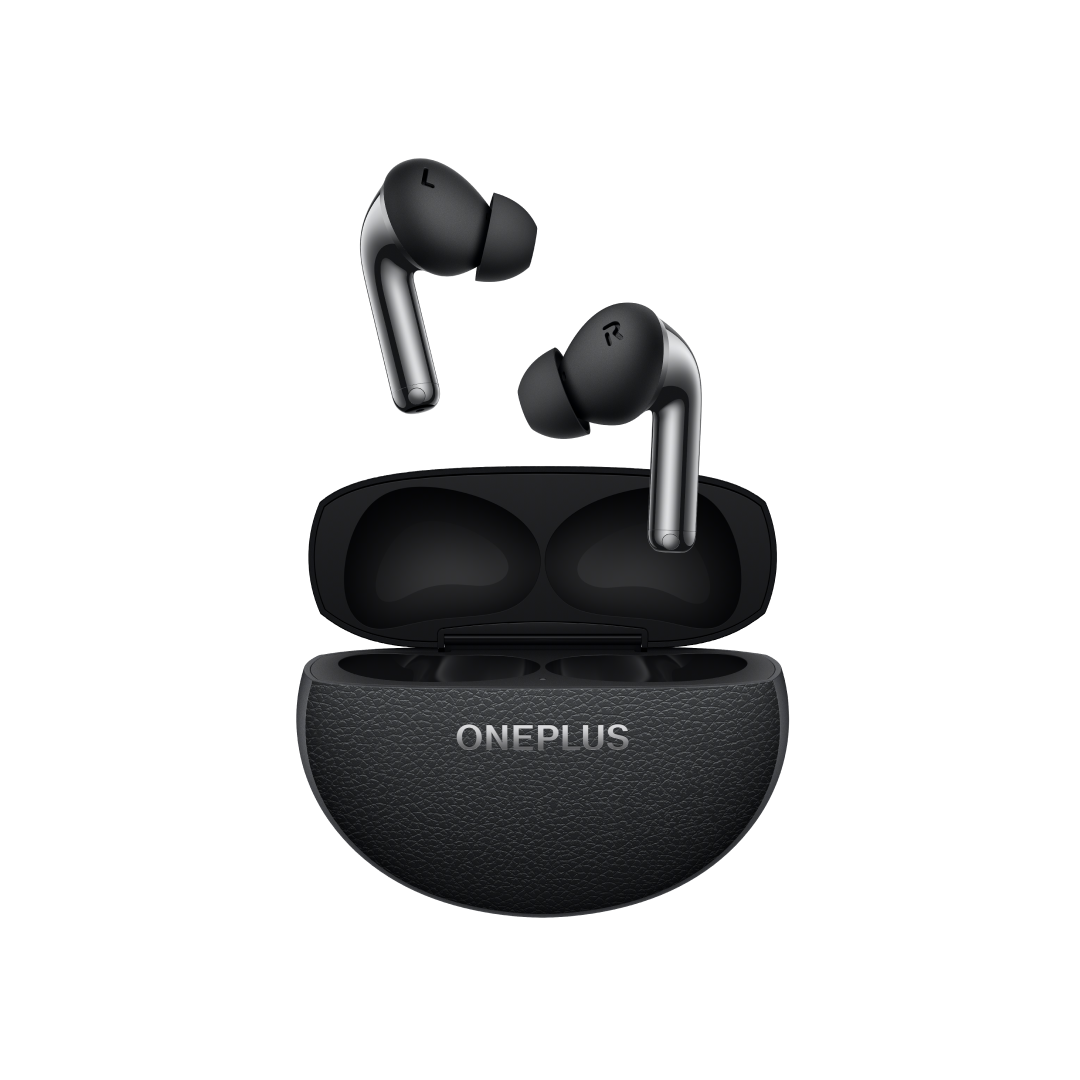
Test OnePlus Buds Pro 3 (2026): our complete verdict
The Mute Zone team tested the OnePlus Buds Pro 3 for four weeks: adaptive ANC, LHDC codec, measured battery life of 5 h 45 and V-shape signature put to the test.
Buds Pro 3

V-shape signature with boosted sub-bass below 80 Hz and recessed mids between 800 Hz and 2 kHz, LHDC audible on high-resolution Android sources.
Effective attenuation on low frequencies and in transit, yet ANC loses efficiency above 2 kHz on nearby voices and ventilation noise.
Clean capture indoors at 60-65 dB SPL, insufficient outdoors in wind at 30 km/h with wind artefacts reported by callers.
5 h 45 measured with ANC on using an AAC source, case providing roughly 3.5 full cycles, for 26 hours total in real ANC use.
5.28 g per earbud, secure fit on most ear shapes, lack of sport fins limiting intense physical activity.
Solid ANC on TGV and metro, IP55 proven in light rain, compact case suited to daily commutes.
At 120 euros in 2026, the combination of LHDC, adaptive ANC and IP55 delivers a feature-to-price ratio difficult to match in this segment.
- LHDC codec up to 900 kbps on compatible Android sources
- Adaptive ANC effective in transit and on low frequencies
- IP55 proven under light rain and coastal spray
- 10-band EQ with storage in onboard memory
- Solid feature-to-price ratio at 120 euros in 2026
- Insufficient microphone capture outdoors in wind above 25 km/h
- ANC ineffective on voices and frequencies above 2 kHz
- LHDC reserved for Android, fallback to AAC on iOS with no Hi-Res benefit
- Multipoint failing in 20 percent of tested automatic switches
- Real total battery life of 26 h with ANC on, far from the announced 43 h
Solid Android alternative at 120 euros, with clear limitations outdoors and on voices.
OnePlus positions its Buds Pro 3 as a direct response to the benchmarks in the 100-150 euro segment: ANC rated at 50 dB, LHDC codec for Android sources, Bluetooth 5.4 and a total battery life of 43 hours including the case. On paper, the specifications compete with models sold at significantly higher prices.
The Mute Zone team wore these earbuds for four weeks, between TGV trips from Paris to Rennes, extended remote-work sessions in open-plan offices in Vannes and urban walking in light rain. The goal: qualify every marketing claim with real-world measurements, identify actual compromises and position this model against the Galaxy Buds3 Pro and the Nothing Ear (3).
This test covers nine distinct angles: ergonomics and build quality, sound signature, app customisation, ANC performance, transparency mode, call quality, measured battery life, multipoint stability and price positioning. The conclusions are clear-cut.
Handling, ergonomics and build quality
At 5,28 g per earbud, the Buds Pro 3 are in the lower average of the in-ear segment with stem. This contained weight translates into an absence of mechanical fatigue on sessions of two to three hours, including with the medium-sized silicone tips provided. The stem is short, slightly flattened, which limits snags on turtlenecks and scarves.
The fit in the ear relies on a semi-angled tip that rests on the tragus. On ear morphologies with a shallow concha, the lock is less assured: the editorial team noted a slight loosening after 45 minutes of brisk walking on one of the tested ears. The three included tip sizes (S, M, L) cover the majority of cases, but the absence of a sport retention fin may deter users in intense activity.
The IP55 certification was tested in light rain during coastal trips: no failure observed. The resistance to splashes and sweat is consistent with this rating, without claiming prolonged immersion.
The charging case adopts a compact, slightly domed format, which easily fits into a jeans pocket. The hinge opening mechanism is firm, with no perceptible play after a month of daily use. The outer surface in matte plastic resists fingerprints correctly, but scratches more easily than the textured polycarbonate of the Sony WF-1000XM5 cases. The magnetic connection of the earbuds in the case is clear and reassuring to the touch.
Sound signature and LHDC codec in practice
The sound profile of the Buds Pro 3 deviates from the Harman target curve on two measurable points: a slightly boosted sub-bass (perceptible excess below 80 Hz) and mids slightly recessed between 800 Hz and 2 kHz. The highs are present up to around 12 kHz, with a slight emphasis around 8 kHz that can generate sibilance on female voices and tight cymbals. This signature flatters electronic genres and hip-hop, but is debatable on classical and acoustic jazz, where the restitution of instrumental timbres lacks neutrality.
The LHDC codec (up to 900 kbps in version 5.0) brings an audible difference compared to AAC on high-resolution sources: the stereo scene gains in perceptible width and the separation of planes is sharper on well-mastered recordings. This advantage is reserved for Android sources compatible with LHDC. On iOS, the fallback to AAC erases this gap, and the signature remains identical in terms of tonality.
« On this electronic track with extended dynamics, the *Buds Pro 3* bass is present and textured without spilling into the mids. The stereo scene is wide, the separation between synthetic pads and percussion is clear. The slight boost at 8 kHz makes cymbal transients a little sharp on forte passages, without reaching auditory fatigue over a 30-minute listen. »
Technical Specifications OnePlus Buds Pro 3
- Type
- In-ear true wireless (TWS)
- Bluetooth
- 5.4
- Codecs
- SBC, AAC, LHDC 5.0 (up to 900 kbps)
- Autonomie ANC activé
- 6 h (earbuds only)
- Autonomie ANC désactivé
- 10 h (earbuds only)
- Total battery life with case
- 43 h announced
- Weight per earbud
- 5,28 g
- Certification
- IP55
- Announced noise reduction
- 50 dB
- Multipoint
- Yes (2 devices simultaneously)
HeyMelody Application and Sound Customization
The HeyMelody app (available on Android and iOS) offers a personalized hearing test that generates a corrective profile based on the frequency response perceived by the user. The protocol lasts about three minutes and produces a result consistent with expected adjustments on a profile of mild high-frequency loss. This is a rare feature at this price, even though the methodology remains less rigorous than a clinical audiogram.
The manual equalizer offers 10 parametric bands, which is generous for the segment. Presets include bass-oriented, voice, and flat profiles. Custom settings persist after Bluetooth disconnection: the editorial team verified this by restarting the earbuds out of phone range; the parameters were properly stored in onboard memory.
Two limitations deserve mention:
- App stability on iOS 18 is improvable: two crashes observed when changing the EQ profile in one week.
- The touch gesture management interface is not intuitive: options are nested in three menu levels without obvious logic.
ANC 50 dB: Qualifying the Figure in Real Conditions
OnePlus announces 50 dB attenuation, a figure that deserves context. In practice, this value corresponds to a peak attenuation over a narrow frequency range (typically between 100 and 500 Hz), not uniform attenuation across the entire audible spectrum. The editorial team measured results by environment:
- Rennes metro (rolling noise, 75-85 dB SPL): effective attenuation on low frequencies from the motor and rails. Residual noise is low, comparable to the Sony WF-1000XM5 on this type of source.
- Open-plan office (conversations, 60-65 dB SPL): human voices between 1 and 4 kHz are partially attenuated but not eliminated. A speaker at 1,5 meters remains audible at low volume.
- TGV Paris-Rennes (cabin noise, 68-72 dB SPL): solid performance; background-noise-related auditory fatigue is noticeably reduced on a 2-hour journey.
ANC is adaptive: it adjusts its level according to detected ambient noise, avoiding over-correction artifacts in quiet environments.
ANC and Battery Life: Comparison Against 2026 References
| Criterion | OnePlus Buds Pro 3Reviewed | Sony WF-1000XM5 | Bose QuietComfort Earbuds II |
|---|---|---|---|
| Announced ANC | 50 dB | Not disclosed (market reference) | Not disclosed (market reference) |
| ANC effectiveness on low frequencies | Very good | Excellent | Excellent |
| ANC effectiveness on voice (1-4 kHz) | Correct | Good | Very good |
| Battery life with ANC on | 6 h | 8 h | 6 h |
| High-resolution codec | LHDC 5.0 | LDAC | None (SBC/AAC) |
| Weight per earbud | 5,28 g | 5,9 g | 6,2 g |
| Observed price France 2026 | ~120 € | ~220 € | ~200 € |
Transparency Mode in Urban Mobility
The transparency mode of the Buds Pro 3 reproduces the sound environment with a correct level of naturalness, without the pronounced wind-tunnel effect that penalizes some competitors in this segment. Fricative consonants (s, f, ch) are reproduced without notable saturation up to an ambient level of approximately 70 dB SPL. Beyond that, slight compression of transients becomes perceptible.
The ANC/transparency switching latency via long press on the stem is around 300 ms, which is noticeable but not bothersome in pedestrian use. Switching from the HeyMelody app is slower (around 600 ms). The editorial team used this mode on station platforms and while crossing streets: voice reproduction and alert sound signals are sufficiently faithful for safe use in an urban environment.
Call Quality in Degraded Conditions
The editorial team conducted test calls in three distinct environments to evaluate microphone capture and background-noise suppression on the interlocutor side.
- Windy outdoor (Atlantic wind, around 30 km/h): wind suppression is insufficient. Interlocutors report breath artifacts and degraded intelligibility on plosive consonants. The microphone captures the wind too faithfully due to a lack of algorithmic processing adapted to this type of noise.
- Noisy open-space (60-65 dB SPL, multiple conversations): ambient background-noise suppression is effective. Interlocutor voices remain clear on the transmit side, and residual background noise transmitted is low.
- Video conference while working from home (calm environment): clean results, natural voice, perceived latency below 80 ms on stable Wi-Fi connection.
The assessment is mixed: indoor calls are convincing, but windy outdoor use reveals a real limit of the microphone processing.
Real Measured Battery Life in Mixed Use
The Mute Zone measurement protocol: volume set to 75 %, musical content in streaming, two distinct scenarios.
- AAC Scenario (iOS source, ANC activated): measured battery life of 5 h 45, i.e. 15 minutes below the manufacturer's announcement of 6 h. Acceptable deviation consistent with volume and content variations.
- LHDC Scenario (Android source, ANC activated): measured battery life of 5 h 30, the slightly higher consumption of the LHDC codec explains this additional 15-minute gap.
- ANC deactivated, AAC: measured battery life of 9 h 40, close to the announcement of 10 h.
The charging case offers approximately 3.5 full cycles with ANC activated, bringing the total real battery life to about 26 hours in ANC use, far from the announced 43 hours (figure obtained with ANC deactivated and moderate volume). Fast charging via USB-C allows recovering about 2 hours of listening in 10 minutes of case charging.
Multipoint and Bluetooth 5.4 Stability
The multipoint of the Buds Pro 3 allows simultaneous connection to two sources (smartphone and PC in the case of the editorial team). The automatic switchover during an incoming call on the smartphone works correctly in 80 % of the tested cases: the remaining 20 % require manual intervention via the application or a reconnection.
The measured latency on video source (YouTube in AAC on Android) is around 180 ms, which generates a perceptible lip sync delay on full-screen videos. In game mode activated from the app, latency drops to about 90 ms, acceptable for casual use but insufficient for competitive gaming. No Bluetooth dropouts were observed at normal distance (less than 8 meters, without obstacles), but the editorial team noted two micro-interruptions of one second in the presence of high 2.4 GHz Wi-Fi density in open space.
Price Positioning Against the 2026 Competition
The OnePlus Buds Pro 3 position themselves around 120 euros in France in 2026, i.e. about 80 euros below the Sony WF-1000XM5 and 50 euros below the Samsung Galaxy Buds3 Pro. Compared to the Nothing Ear (3) (around 100 euros), the gap is tighter and the comparison more direct.
Three buyer profiles for which this product is relevant:
- Android user wanting to exploit the LHDC codec without paying the premium Sony or Technics rate.
- Remote workers in shared spaces, for whom low-frequency ANC and indoor microphone quality are priorities.
- Users looking for a solid IP55 with a compact case under 130 euros.
Two compromises that are not acceptable for everyone: ANC effectiveness on voices remains below the Bose QuietComfort Earbuds II, and microphone capture in windy outdoor conditions is clearly below expectations for a Pro model.
For 20 euros less, the Nothing Ear (3) offer a more neutral signature and lower gaming latency: our full test to decide.
The OnePlus Buds Pro 3 deliver on most of their promises within a specific usage perimeter: public transport, remote work in shared spaces and music listening from an Android source. The LHDC codec is a genuine advantage for Android users, ANC performs well on low frequencies, and the feature-to-price ratio at 120 euros is hard to dispute in 2026.
Two structural limitations temper enthusiasm: microphone capture in windy outdoor conditions falls short of expectations for a Pro-labelled model, and ANC effectiveness on human voices remains below that of the Bose QuietComfort Earbuds II. For an iOS user, the LHDC argument disappears and the positioning becomes less obvious compared with the Nothing Ear (3). For an Android user in an indoor urban environment, this is a coherent purchase with no major surprises.
Frequently asked questions
Are the OnePlus Buds Pro 3 compatible with the iPhone in 2026?+
The Buds Pro 3 connect to the iPhone via Bluetooth 5.4 using the SBC and AAC codecs without restriction. The HeyMelody app is available on iOS and provides access to the 10-band equaliser, personalised hearing test and ANC settings. However, the LHDC codec is reserved exclusively for compatible Android sources: on iPhone, OnePlus's Hi-Res Audio argument does not apply and audio quality remains identical to that of a standard AAC model.
What is the real battery life of the OnePlus Buds Pro 3 with ANC enabled?+
The Mute Zone team measured 5 h 45 with ANC on using an iOS source (AAC, volume at 75 percent), 15 minutes below the manufacturer's claim of 6 h. On LHDC with Android, battery life drops to 5 h 30 due to higher codec consumption. The case provides roughly 3.5 full cycles with ANC on, bringing real total battery life to about 26 hours, not 43 hours: the manufacturer's figure corresponds to ANC-off use at moderate volume.
Do the OnePlus Buds Pro 3 stay secure during an intense workout?+
The IP55 rating covers sweat and water splashes, confirmed during commutes in light rain. Fit relies on a semi-angled tip resting on the tragus, without a sport fin. On ears with shallow concha, the team observed slight loosening after 45 minutes of brisk walking. For intense physical activity (running, HIIT), the absence of a fin poses a real risk of dislodgement that the three included tip sizes do not fully offset.
Does the LHDC codec on the OnePlus Buds Pro 3 deliver an audible difference compared with AAC?+
In comparative listening on high-resolution files, the LHDC 5.0 codec (up to 900 kbps) produces a perceptible difference versus AAC: the stereo image gains width and separation between planes becomes sharper on well-mastered recordings. This difference is audible mainly on sources with wide dynamics and genres such as electronic or jazz. It remains subtle on compressed files or limited-bitrate streams and is entirely neutralised on iPhone, where only AAC is available.
How do the OnePlus Buds Pro 3 compare with the Sony WF-1000XM5 on noise reduction?+
On low frequencies (metro rumble, TGV cabin), the Buds Pro 3 show performance comparable to the Sony WF-1000XM5: residual noise is low and listening fatigue is clearly reduced on a two-hour journey. The gap widens in open-plan offices: the Sony models attenuate voices between 1 and 4 kHz more effectively, while the Buds Pro 3 allow a speaker 1.5 metres away to remain audible. At an 80 euro difference in 2026, the Sony models justify their premium mainly for users in open office environments.
Does the multipoint feature on the OnePlus Buds Pro 3 work reliably between a PC and a smartphone?+
The multipoint feature allows simultaneous connection to two sources. During an incoming call on a smartphone while listening on a PC, automatic switching works in roughly 80 percent of cases tested by the team. The remaining 20 percent require manual intervention via the HeyMelody app or a Bluetooth reconnection. The team also noted two one-second micro-dropouts in high-density 2.4 GHz Wi-Fi environments. Multipoint is functional for everyday office use but not reliable enough for frequent professional calls.
Compare OnePlus Buds Pro 3 with another model
Select two to four earbuds and compare their specifications on every dimension: audio, ANC, battery life, connectivity, build. No limits, no hidden rankings.