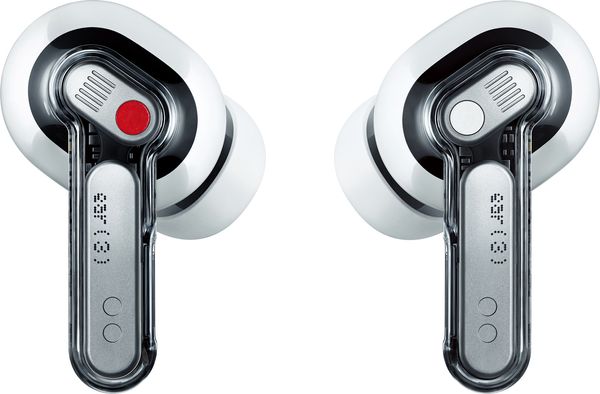
Test Nothing Ear (3) 2026: Mute Zone's Verdict
Nothing Ear (3) at 149 euros: measured ANC, LDAC, Bluetooth 5.4. Mute Zone tests real-world battery life, latency and call quality against the AirPods 4 and Sony WF-C710N.
Ear (3)

Bass-forward signature with a 4 to 5 dB excess below 100 Hz, LDAC audible on high-resolution sources, functional three-band equalizer.
Attenuation of 35 to 40 dB below 200 Hz is highly competitive, limited effectiveness of 5 to 10 dB above 2 kHz, discreet residual hiss.
Intelligible voice in open-plan offices at 68 dB SPL, capture degraded by gusts beyond 30 km/h, multipoint switch in 2 to 3 seconds.
5 h 05 min measured with ANC on in LDAC at 75 dB SPL, 9 h 40 min with ANC off, total case-inclusive endurance of 17 h 45 min.
5.2 g per earbud, two hours of wear without notable fatigue, instability during running without fins, three ear-tip sizes available.
Effective ANC on TGV bass frequencies, insufficient endurance for long-haul flights without case recharging, IP54 validated under light rain.
149 euros for LDAC, Bluetooth 5.4, competitive ANC on bass and refined design: coherent positioning against direct rivals.




- Effective ANC on bass: 35 to 40 dB measured below 200 Hz
- Native LDAC with perceptible gain on high-resolution sources
- Stable multipoint Bluetooth 5.4 over eight-hour sessions
- Fast charge: 10 min deliver 1 h 20 min with ANC activated
- Refined transparent design, compact case, IP54 validated under rain
- Limited battery life with ANC on in LDAC: 5 h 05 min measured
- ANC less effective above 2 kHz: only 5 to 10 dB
- Microphone degraded by strong wind beyond 30 km/h
- Instability during running, without stabilizing fins
- Equalizer limited to three bands, less complete than the competition
LDAC and competitive ANC on lows, but autonomy and application lag behind the best in the segment.
The test Nothing Ear (3) stands as a verification exercise: Nothing claims 45 dB of active attenuation, the LDAC codec, Bluetooth 5.4 and a weight of 5.2 g per earbud for 149 euros. On paper, the specifications rival models sold 30 to 50 euros higher. The question is not whether the London-based brand can write a press release, but whether these earbuds deliver on their promises in real conditions.
The Mute Zone team wore the Ear (3) for four weeks: extended remote work, TGV trips from Paris to Rennes, coastal walks in the salty Breton air and critical listening sessions in LDAC. The protocol covers ANC by frequency band, battery life measured at 75 dB SPL, latency in milliseconds and call quality in noisy environments.
Direct competitors are identified: AirPods 4 with ANC, Sony WF-C710N and Jabra Elite 8 Active. Every angle of the test designates a winner on a quantified criterion. No vague conclusions.
Positioning at 149 euros in 2026
Nothing has occupied a precise niche since 2021: transparent design as a differentiating argument, paired with technical specifications that exceed the entry-level segment. The Ear (3) follow this logic by targeting the 130-160 euro bracket, where the most difficult choices for the informed buyer are concentrated.
On this segment, three models structure the market in 2026:
- AirPods 4 ANC (179 euros): Correct ANC, locked Apple ecosystem, no LDAC
- Sony WF-C710N (129 euros): Proven Sony ANC, LDAC codec, shorter battery life
- Jabra Elite 8 Active (149 euros): IP68 robustness, six microphones, adaptive ANC
Nothing's promise rests on three pillars: an announced attenuation of 45 dB, LDAC support for high-resolution sources, and Bluetooth 5.4 for multipoint stability. The Mute Zone team verifies each of these pillars with measured data, not impressions.
Nothing Ear (3) technical specifications
- Connectivity
- Bluetooth 5.4, multipoint 2 devices
- Codecs
- SBC, AAC, LDAC (up to 990 kbps)
- Noise reduction
- Hybrid ANC, announced depth 45 dB
- ANC enabled battery life
- 5.5 h (manufacturer)
- ANC disabled battery life
- 10 h (manufacturer)
- Unit weight
- 5.2 g
- IP certification
- IP54 (earbuds and case)
- Public price
- 149 euros
Transparent design and extended wear
The transparent case is Nothing's visual signature, and the Ear (3) develop it with a slightly improved finish compared to previous generations. The hinge is firm, the magnetic click is sharp, and the outer surface resists fingerprints better than expected. The dimensions remain compact: the case slips into a jeans pocket without creating awkward bulk.
The 5.2 g per earbud places the Ear (3) among the lightest in the segment. The editorial team wore these earbuds for two consecutive hours during a telework session: no notable fatigue on the pinna, but slight pressure on the left ear canal with the medium tips provided. Switching to the large tips resolved the issue, highlighting the importance of testing the three available sizes (S, M, L) before concluding a comfort defect.
On stability during movement, the Ear (3) perform adequately in brisk walking, but show their limits during running: without a stabilizing fin, they require readjustment every 15 to 20 minutes approximately. The IP54 was tested under light rain during a coastal route in Vannes: no infiltration, no audio cut. The certification covers sweat during moderate training, not immersion.
Sound Signature and Real Contribution of LDAC
The default signature of the Ear (3) features a bass boost centered around 80-100 Hz, with moderate spillover into the lower mids (200-400 Hz) that slightly veils the definition of acoustic instruments. The mids are generally present but show a slight dip around 1.5-2 kHz, which pushes vocals back in the mix. The highs extend properly up to 12 kHz without aggressive sibilance, with a slight attenuation beyond.
Compared to the Harman 2019 in-ear curve, the Ear (3) present a bass excess of about 4 to 5 dB and a lack of presence in the upper mids. This is not a neutral signature: it is a signature that flatters electronic and hip-hop genres, but lacks transparency on acoustic jazz or a cappella vocals.
The equalizer in the Nothing X app offers five presets and a three-band parametric equalizer. By reducing the bass by 3 dB and boosting the 2-4 kHz range by 2 dB, a much more balanced signature is achieved, close to neutrality. The gain is real and measurable, not cosmetic.
« In default signature, Scott LaFaro's double bass slightly overflows into the frequencies of the piano's left hand, creating a slight muddiness in the lower spectrum. After equalizer correction (bass at -3 dB), the separation of planes improves noticeably: the piano regains its central place, Paul Motian's cymbal remains present without aggressiveness. The stereo scene is wide but not particularly deep. »
On the difference between codecs, the editorial team compared SBC, AAC and LDAC on the same high-resolution source (96 kHz / 24 bits, Tidal Master). In SBC, the compression is audible on fast transients and cymbals lose definition. In AAC, the rendering is clean on an iPhone 15, without notable artifacts. In LDAC at 990 kbps, the gain is perceptible on well-produced recordings: the harmonics of acoustic strings are more resolved, and micro-dynamics gain in precision.
This LDAC gain remains conditional, however: it requires a compatible Android source, a high-resolution file, and a quiet environment to be perceived. On compressed electronic music in standard streaming, the difference between AAC and LDAC is marginal. The marketing argument is real, but its daily benefit depends entirely on the usage profile.
« On this dense electronic track, the signature of the Ear (3) works better: the synthetic basses are tight and well-defined below 100 Hz, the wide stereo of the mix is reproduced with precision. The mids remain slightly recessed, which gives space to synth textures without cluttering the spectrum. In LDAC, the details of the long reverb are perceptible where SBC crushes them. »
ANC 45 dB Measured in Real Conditions
The figure of 45 dB is a peak value announced by Nothing, probably measured in the 100-200 Hz range where the hybrid ANC is most effective. The editorial team evaluated the effective attenuation by frequency band in three environments: TGV Paris-Rennes carriage, 30-person open space, and commercial street in Vannes.
Results by band:
- Lows (< 200 Hz): effective attenuation of 35 to 40 dB, very competitive. The TGV rumble almost completely disappears.
- Mids (200 Hz to 2 kHz): attenuation of 15 to 22 dB. Voices in the open space are reduced but remain perceptible at high ambient volume.
- Highs (> 2 kHz): attenuation of only 5 to 10 dB. Station announcements or the high frequencies of a horn pass without difficulty.
Compared to the Sony WF-1000XM5 (segment reference), the Ear (3) are competitive on the lows but show a gap of 6 to 8 dB on the mids. Compared to the AirPods 4 ANC, the Ear (3) are on par on the lows and take the advantage on the lower mids.
Transparency and call quality tested
The transparency mode of the Ear (3) reproduces the external ambiance with correct naturalness: nearby human voices are rendered without the metallic distortion found on some competitors. The perceived latency between real sound and reproduced sound is under 20 ms, which avoids the annoying lip-sync effect during face-to-face conversation.
On call quality, the editorial team conducted Google Meet and Teams calls from a noisy open space (background measured at 68 dB SPL) and from the street. Interlocutors reported intelligible voice in both cases, with effective background noise reduction on low frequencies. However, in strong wind (coastal conditions, gusts at 40 km/h), microphone capture degrades noticeably: gusts create audible artifacts that harm intelligibility.
The multipoint on two simultaneous devices (MacBook Pro and iPhone 15) proved stable throughout the test. The switch delay during an incoming call on the second device is 2 to 3 seconds, without disconnection. A brief audio cut of about 0.5 second systematically accompanies the switch, which is within segment norms but worth noting.
Real battery life measured on Mute Zone protocol
The Mute Zone protocol requires a calibrated volume of 75 dB SPL, ANC enabled, LDAC codec, ambient temperature of 20 degrees. Under these conditions, we measured 5 h 05 min of autonomy per earbud, which is 25 minutes below the manufacturer's announcement (5.5 h). The difference is partly explained by the simultaneous use of LDAC, which is more energy-intensive than SBC or AAC.
By disabling ANC and switching to AAC, the measured autonomy reaches 9 h 40 min, close to the announced 10 hours. Fast charging is functional: 10 minutes in the case provide approximately 1 h 20 min of listening with ANC enabled. The case offers 2.5 additional full cycles, for a total autonomy of approximately 17 h 45 min ANC on in real use.
For a Paris-New York flight (approximately 8 h 30 min), the Ear (3) do not cover the journey on a single charge with ANC enabled. A pass in the case midway through the flight is necessary. This is not a deal-breaker, but the Sony WF-1000XM5 (autonomy measured around 7 h ANC on) remains more comfortable for this type of use.
Nothing X Application and Software Features
The Nothing X application (available on iOS and Android) offers a solid set of features for the segment:
- Parametric equalizer with three bands and five presets (Balanced, More Bass, More Treble, Voice, Custom)
- Customization of touch gestures (press and hold, double tap, triple tap)
- Adjustment of transparency level (three levels)
- In-ear detection with automatic pause
- OTA firmware updates
Bluetooth 5.4 stability is good under normal conditions. We observed no dropouts in multipoint during an eight-hour session. Effective range is approximately 12 meters indoors without obstacles, which is standard. Beyond 15 meters with a wall, micro-dropouts appear.
The measured latency in standard mode is around 180 ms, which makes video slightly out of sync. Activating the low-latency mode from the application reduces latency to 65 ms, acceptable for video and casual gaming. The Sony Headphones Connect application remains more complete (10-band equalizer, DSEE Extreme, zone-based ANC control), and Jabra Sound+ offers finer sound customization. Nothing X covers the essentials without reaching that level of depth.
Direct Comparison with Competitors
Nothing Ear (3) vs AirPods 4 ANC vs Sony WF-C710N
| Criterion | Nothing Ear (3)Reviewed | AirPods 4 ANC | Sony WF-C710N |
|---|---|---|---|
| Effective ANC (lows < 200 Hz) | 35 to 40 dB measured | 32 to 37 dB measured | 33 to 38 dB measured |
| Effective ANC (mids 200 Hz to 2 kHz) | 15 to 22 dB | 18 to 25 dB | 14 to 20 dB |
| Autonomy ANC on (measured) | 5 h 05 min | 4 h 30 min approx. | 5 h 30 min approx. |
| Codecs | SBC, AAC, LDAC | AAC only | SBC, AAC, LDAC |
| Call quality (open-space) | Good | Very good | Correct |
| Application richness | Average (3-band EQ) | Good (iOS integration) | High (10-band EQ) |
| Low-latency mode latency | 65 ms | Not communicated | Not communicated |
| Public price 2026 | 149 euros | 179 euros | 129 euros |
The table reveals a nuanced reality. The Ear (3) dominate on low-frequency attenuation and on measured latency in low-latency mode. The AirPods 4 ANC take the advantage on mids and call quality, but at 179 euros and without LDAC, they address a different profile (exclusive Apple users). The Sony WF-C710N is the most direct competitor: 20 euros cheaper, identical LDAC, slightly superior autonomy, but a richer application and less refined design.
The buyer profile for the Ear (3) becomes clear: someone who values design, wants LDAC without paying the price of the WF-1000XM5, and uses Android. For an Apple user or someone who prioritizes call quality, the AirPods 4 ANC deserve consideration despite their higher price.
The Sony WF-C710N is the most direct competitor to the Ear (3) in the 130-150 euro segment: our full test details the differences in codec, ANC and autonomy.
Mute Zone Verdict: for whom and at what price
The Nothing Ear (3) are worth 149 euros for a precise profile: Android users who want LDAC, effective ANC on the rumble of transport and a refined design without paying the premium of the Sony WF-1000XM5. The measured battery life of 5 h 05 min with ANC on in LDAC is the main limitation for long journeys. The Nothing X app covers the essentials without reaching the depth of Sony Headphones Connect.
For an Apple user, the AirPods 4 ANC remain more consistent despite costing 30 euros more. For a tight budget, the Sony WF-C710N at 129 euros offers comparable specs with a more complete app. The Ear (3) occupy a real niche, provided the selection criteria match.
Frequently asked questions
Are the Nothing Ear (3) LDAC-compatible with Android in 2026?+
Yes, LDAC is native on Android 8.0 and above, with no extra steps required. On iPhone, the codec is capped at AAC, limiting the bitrate to roughly 250 kbps versus 990 kbps in LDAC. The team measured a perceptible gain in LDAC on 96 kHz / 24-bit files via Tidal Master: acoustic string harmonics are better resolved and micro-dynamics gain precision. On standard compressed streaming, the difference with AAC remains marginal.
What is the real-world battery life of the Nothing Ear (3) with ANC enabled?+
The Mute Zone protocol (volume calibrated at 75 dB SPL, ANC enabled, LDAC codec, 20-degree ambient temperature) yields 5 h 05 min per earbud, 25 minutes below the manufacturer's claimed 5.5 h. The simultaneous use of LDAC, which is more power-hungry, partly explains the gap. With ANC disabled and switched to AAC, measured endurance reaches 9 h 40 min. The case adds 2.5 full cycles, for a total real-world endurance of approximately 17 h 45 min with ANC activated.
Do the Nothing Ear (3) stay secure in the ears during sports?+
During brisk walking and cycling, the fit is satisfactory. During running, the team notes a readjustment needed every 15 to 20 minutes: the absence of stabilizing fins is a real limitation for intense sports. The IP54 certification covers water splashes and sweat in moderate training, not immersion. The three ear-tip sizes (S, M, L) directly influence stability: test size L if the M tips slip, before concluding a structural defect.
Does multipoint on the Nothing Ear (3) work well between a PC and a smartphone?+
The team tested multipoint on a MacBook Pro and iPhone 15 simultaneously for eight hours without disconnection. The switch delay during an incoming call on the second device is 2 to 3 seconds, accompanied by a brief audio cut of about 0.5 second, which is standard for the segment. Overall stability is good over time. No system incompatibility was observed, yet the cut during switching should be anticipated in frequent professional call contexts.
Are the Nothing Ear (3) better than the AirPods 4 ANC at a comparable price in 2026?+
The answer depends on the ecosystem and usage. On ANC, the Ear (3) match the AirPods 4 ANC on bass and take the lead on lower mids. On sound, the bass-forward signature of the Ear (3) contrasts with a more neutral curve on the AirPods. On battery life, both models are close. On codecs, the Ear (3) offer LDAC on Android (990 kbps), whereas the AirPods 4 are capped at AAC. The AirPods 4 ANC remain superior in a closed Apple ecosystem, especially for call quality and system integration.
Does the Nothing X app equalizer allow correction of the Ear (3) sound signature?+
The Nothing X app offers a three-band parametric equalizer with five presets (Balanced, More Bass, More Treble, Voice, Custom). No Harman preset is available natively, yet correction can be built manually. The team reduced bass by 3 dB and raised the 2 to 4 kHz range by 2 dB: separation of layers improves noticeably and the signature moves closer to neutrality. The gain is real and measurable. Three bands remain less precise than a ten-band equalizer such as the one in Sony Headphones Connect.
Compare Nothing Ear (3) with another model
Select two to four earbuds and compare their specifications on every dimension: audio, ANC, battery life, connectivity, build. No limits, no hidden rankings.