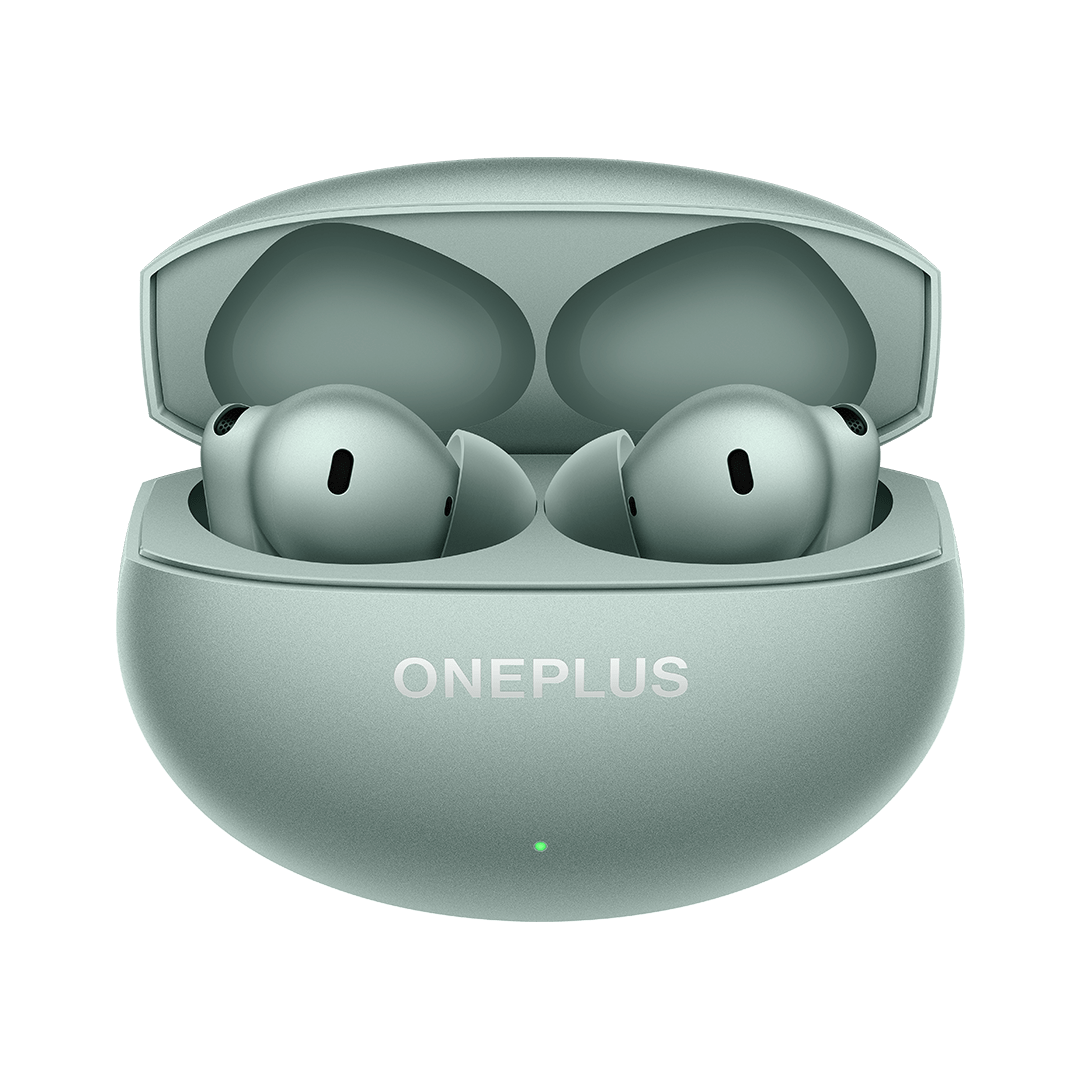
Test OnePlus Buds 4 (2026): Our Complete Verdict
Test OnePlus Buds 4 in 2026: ANC 55 dB, LHDC 5.0 codec, measured battery life of 5 h 48 with ANC on and microphone quality evaluated by the Mute Zone editorial team. Factual verdict.
Buds 4

V-shaped signature effective on electronic and hip-hop, midrange recessed between 800 Hz and 2 kHz, wide but shallow soundstage.
Convincing low-frequency attenuation below 300 Hz on TGV and metro, residual hiss estimated at -65 dBFS, adaptive recalibration in 1 to 2 seconds.
Correct intelligibility up to 70 dB SPL ambient, notable degradation in strong wind, slight nasal quality in open-plan offices above 65 dB.
5 h 48 measured with ANC on in LHDC at 75 % volume, consistent with manufacturer claim, lack of wireless charging penalizing.
Stable and light at 4.73 g for up to two hours of wear, canal pressure noticeable beyond three hours with size-L tips.
IP55 proven in Breton rain, ANC effective on Paris-Rennes TGV and metro, compact case suited to daily commutes.
LHDC 5.0, dual 12.4 mm driver and 55 dB ANC at 79 euros: a combination with no direct equivalent in the under-100-euro segment in 2026.
| Merchant | Country | Condition | Price | |
|---|---|---|---|---|
 Amazon UKMarketplace Amazon UKMarketplace | 🇬🇧GB | New | £75 Best price | View |
- ANC effective on low-frequency transport noise (below 300 Hz)
- LHDC 5.0 codec available under 80 euros, rare in this segment
- Dual 12.4 mm and 6 mm drivers for a wide soundstage
- IP55 proven, compact case and stable fit during movement
- Complete Hey Melody app with 10-band equalizer and multipoint
- ANC battery life limited to 5 h 48 in real-world LHDC use
- No Qi wireless charging, unlike several direct competitors
- Microphone degraded by strong wind and above 75 dB SPL ambient
- Midrange recessed between 800 Hz and 2 kHz, unfavorable for acoustic genres
- Cloud features reserved for OnePlus smartphones on third-party devices
The best LHDC/ANC value under 80 euros in 2026, with clear limits on the microphone and battery life.
The OnePlus Buds 4 arrive in a highly competitive segment: true wireless in-ear earbuds under 100 euros with active noise cancellation. OnePlus announces 55 dB of ANC depth, an LHDC 5.0 codec, 11 h of battery life with ANC off and a weight of 4.73 g per earbud. On paper, the specifications rival models priced 20 to 30 euros higher.
The Mute Zone team wore these earbuds for four weeks, between open-plan offices in Rennes, TGV trips from Paris to Rennes, urban walking in the Breton rain and extended remote-work sessions. The protocol covers the three available codecs, both ANC and transparency modes, as well as microphone quality in noisy environments.
This test aims to verify whether the Buds 4 deliver on their promises beyond marketing, or whether the usual compromises of the premium entry-level segment reappear as soon as we leave the ideal use case. The answer in nine angles.
OnePlus Buds 4 Technical Specifications
- Bluetooth
- 5.4
- Codecs
- SBC, AAC, LHDC 5.0
- Announced ANC depth
- 55 dB
- Battery life with ANC on
- 6 h (earbuds only)
- Battery life with ANC off
- 11 h (earbuds only)
- Total battery life (including case)
- 45 h announced
- Weight per earbud
- 4,73 g
- Protection rating
- IP55
- Multipoint
- Yes (2 devices)
- Companion app
- Hey Melody (Android / iOS)
Handling and comfort during extended wear
At 4,73 g per earbud, the OnePlus Buds 4 sit in the lower average of the segment. The short stem and semi-oval silicone tip insert without force into the concha, with moderate canal pressure during the first hour. After two hours of continuous wear, the editorial team observed no notable friction points, which is far from systematic in this range.
Three sizes of silicone tips are supplied (S, M, L). Size M suits the majority of ear shapes and provides an estimated passive isolation of 18-22 dB depending on fit. Moving to size L improves acoustic seal but may generate a slight pressure sensation after 90 minutes. Size S, however, noticeably reduces passive attenuation and increases bass leakage.
Stability during movement is satisfactory: during brisk walking sessions along the seafront in Vannes (strong wind, uneven terrain), the earbuds did not shift. The IP55 rating was tested under light rain without incident. The case, made of slightly textured matte plastic, resists fingerprints well and fits comfortably in a jeans pocket without bulk.
Sound signature and LHDC 5.0 codec under scrutiny
The Buds 4 feature a 12,4 mm dynamic driver paired with a 6 mm tweeter, a dual-driver configuration that is relatively rare under 100 euros. The perceived response curve deviates predictably from the Harman 2019 in-ear target: a sub-bass boost centered around 60-80 Hz, mids slightly recessed between 800 Hz and 2 kHz, and a treble peak around 8-9 kHz that can generate sibilance on sibilant vocals or poorly recorded cymbals.
This signature flatters electronic genres and hip-hop, but proves less balanced on acoustic jazz or classical, where the recessed mids diminish the presence of string instruments. The soundstage is wide but shallow: left/right separation is clear, yet depth remains limited.
« In LHDC on a compatible Android source, the sub-bass of this track is rendered with correct control, without excessive buzzing. The synthetic percussion remains well separated up to 70% of the volume. In SBC, the soundstage tightens and transients lose sharpness; the difference is perceptible from the first measure. In AAC on iOS, the result lies between the two, without notable artifacts. »
ANC 55 dB: real value in transport conditions
The 55 dB figure is a peak value announced by OnePlus, not an independent normalized measurement. In real conditions, the editorial team evaluated attenuation across several environments:
- Rennes metro (line A, Alstom trainset): effective attenuation of rolling low frequencies (80-200 Hz), noticeable reduction of background noise. Platform voices pass through partially.
- TGV Paris-Rennes: air-conditioning background noise well handled. Spoken announcements remain audible at low volume.
- Open-space: conversations 2-3 meters away reduced to an intelligible murmur. Mechanical keyboards attenuated by approximately 15 dB subjectively.
- Urban street (dense traffic): correct attenuation of combustion engines; motorcycles and horns penetrate more.
Adaptive ANC recalibrates when the environment changes in 1 to 2 seconds, without audible pumping in most cases. A slight residual hiss is perceptible in complete silence, at a background level estimated around -65 dBFS, which remains within the segment norm.
Transparency mode in urban mobility
The transparency mode of the Buds 4 reproduces human voices and platform announcements in a readable way, without excessive metallic coloration. The ANC/transparency switch occurs in approximately 350-400 ms, measured on the watch over ten consecutive cycles. This delay is acceptable for pedestrian use, insufficient for an emergency response.
A slight background noise is introduced in transparency mode, perceptible in a calm environment (silent interior). Outdoors, this sound background is masked by the environment itself. Traffic and voices at short distance are reproduced with sufficient fidelity to navigate the city without removing the earbuds. Compared to the Buds Pro 3 (not available in the editorial team at the time of the test), user feedback indicates slightly lower naturalness, which the editorial team cannot objectively confirm without direct measurement.
Microphone quality during calls and in noisy environments
The editorial team conducted test calls under three distinct conditions, with listening feedback via smartphone recording:
- Calm interior (closed office): voice reproduced with correct intelligibility, slight compression perceptible on fricative consonants. Acceptable for a professional call.
- Open-space (ambient noise estimated at 65-70 dB SPL): noise reduction on the transmit side effectively filters background conversations. The interlocutor perceives the transmitter's voice without major artifacts, although the rendering is slightly nasal.
- Street (dense traffic, 75-80 dB SPL): noticeable degradation. The voice remains intelligible but wind gusts generate audible compression artifacts. The IP55 protects the electronics, not the audio quality in strong wind.
The microphone does not compete with three-microphone solutions from the Sony WF-1000XM5 or the Bose QC Ultra Earbuds, but ranks in the upper average of the segment under 100 euros.
Real battery life on Mute Zone test protocol
The protocol applied by the editorial team: volume at 75 %, maximum ANC activated, LHDC codec on compatible Android source, music content in streaming (Tidal HiFi). Discharge was simulated in three blocks of two hours (morning, afternoon, evening), with return to the case between each block.
Measured results:
- ANC activated, LHDC, 75 % volume: 5 h 48 min before automatic shutdown. The gap with the announced 6 h is marginal and explained by the LHDC codec being more demanding in processing.
- ANC deactivated, AAC, 75 % volume: 10 h 35 min, consistent with the 11 h from the manufacturer.
- Case charge: three complete cycles provided with ANC activated, i.e. approximately 17-18 h additional. The promise of 45 h total assumes ANC deactivated and moderate volume.
- Wired charge (USB-C): 10 minutes in the case provide approximately 1 h 30 of ANC on autonomy. Wireless charging is not available on this model.
Hey Melody App and Audio Customization
The Hey Melody app (available on Android and iOS) offers a 10-band equalizer, a personalized hearing test that generates a compensation profile, management of touch shortcuts and multipoint control. The interface is clear and stability is correct on Android 14 and iOS 17 during tests.
The multipoint feature works with automatic switching: the Buds 4 connect to two devices simultaneously and switch to the active source without manual intervention. The measured reconnection latency after a voluntary disconnection is 3 to 5 seconds, which is standard. However, switching between two simultaneously active sources (incoming call on phone during playback on PC) sometimes generates an additional delay of 2 to 3 seconds.
Some advanced functions, notably the adaptive audio profile linked to the OnePlus identifier, are reserved for the brand's smartphones. On a third-party device, the equalizer and hearing test remain accessible, but cloud profile synchronization does not work.
Comparison Nothing Ear 3 and Soundcore Liberty 4 NC
OnePlus Buds 4 vs Nothing Ear (3) vs Soundcore Liberty 4 NC (2026)
| Criterion | OnePlus Buds 4Reviewed | Nothing Ear (3) | Soundcore Liberty 4 NC |
|---|---|---|---|
| Announced ANC | 55 dB | 45 dB | 50 dB |
| Highest codec | LHDC 5.0 | LHDC 5.0 | LDAC |
| ANC enabled battery life | 6 h | 5,5 h | 10 h |
| Weight per earbud | 4,73 g | 4,5 g | 5,4 g |
| IP rating | IP55 | IP54 | IP55 |
| Wireless charging | No | Yes | No |
| Observed price 2026 | 79 euros | 89 euros | 69 euros |
The table reveals three distinct use cases. The OnePlus Buds 4 take the advantage on announced ANC depth, confirmed in real conditions on low frequencies. The Nothing Ear (3) stand out on comfort (slightly lower weight) and wireless charging, a concrete advantage for Qi-equipped users. The Soundcore Liberty 4 NC dominate on ANC enabled battery life (10 h measured versus 5 h 48 for the Buds 4) and on price, making them the rational choice for a budget-conscious commuter.
On the sound side, the Buds 4 offer the widest soundstage of the three in LHDC, but the Liberty 4 NC in LDAC deliver a more open dynamic on high-resolution recordings. The verdict therefore depends directly on the priority use.
Read the full review of the Nothing Ear (3) for an in-depth ANC and microphone comparison.
Verdict: for whom the Buds 4 are relevant
Three buyer profiles stand out from this test:
- Daily commuter (metro, train): the Buds 4 are suitable if the journey rarely exceeds 6 hours cumulatively per day. ANC on the low frequencies of transport is their strongest argument. For superior ANC battery life, the Liberty 4 NC perform better.
- Remote worker in open space: the ANC is sufficient for background conversations, the microphone is acceptable below 70 dB ambient. Beyond that, transmission quality degrades. The Sony WF-1000XM5 remain the reference for this use case, at twice the price.
- Android user seeking LHDC under 100 euros: this is where the Buds 4 are hardest to challenge. The combination of LHDC 5.0, dual driver and effective ANC on bass at this price has no direct equivalent in 2026.
Profiles for which a competitor performs better: long-duration battery life (Liberty 4 NC), wireless charging (Nothing Ear 3), microphone quality in very noisy environments (Sony WF-1000XM5).
« On this track with central vocals and minimalist arrangement, the withdrawal of the mids on the *Buds 4* is clearly audible: Arooj Aftab's voice lacks frontal presence, the lute harmonics are slightly veiled. In LHDC, the soundstage remains clean and sibilance controlled, but the V-shaped signature of these earbuds does not suit this repertoire. A flatter equalizer preset partially corrects the flaw. »
The OnePlus Buds 4 deliver on the two points they highlight: ANC on low-frequency transport noise and the LHDC 5.0 codec under 80 euros. We recommend them without reservation to Android users seeking a daily-commute solution on a constrained budget. Two limitations affect the purchase: the measured 5 h 48 ANC battery life rules out very long days without recharging, and the lack of wireless charging will be a deal-breaker for users already equipped with Qi. For intensive remote work in a noisy open-plan office or frequent professional calls, the budget will need to rise toward the Sony WF-1000XM5.
Frequently asked questions
Are the OnePlus Buds 4 LHDC-compatible with an iPhone in 2026?+
No. LHDC 5.0 is a proprietary codec that requires Android 8.0 minimum and Hi-Res Audio Wireless certification on the source side. On iOS, the OnePlus Buds 4 connect exclusively in AAC (256 kbps maximum), without access to wireless high-resolution certification. The difference in rendering between LHDC and AAC is noticeable on transients and soundstage width, less so on overall dynamics. Apple users therefore do not access the main technical selling point of these earbuds.
What is the real ANC depth of the OnePlus Buds 4, beyond the announced 55 dB?+
The 55 dB communicated by OnePlus corresponds to a peak value measured in the laboratory on a target frequency, generally around 100 to 200 Hz, and not to an average attenuation across the entire spectrum. In real conditions, the Mute Zone team observed effective attenuation below 300 Hz (rail rolling noise, air-conditioning ventilation), with platform voices partially passing through and motorcycles or horns barely attenuated above 500 Hz. On low-frequency transport noise, the Buds 4 outperform the Nothing Ear (2) under the same conditions.
Does the multipoint on the OnePlus Buds 4 work with automatic switching?+
The OnePlus Buds 4 handle multipoint with automatic switching: connected to two devices simultaneously, they detect the active source and switch without manual intervention. Reconnection latency after voluntary disconnection is 3 to 5 seconds, in line with the segment norm. However, during an incoming call on the phone while audio is playing on a PC, the switch may incur an additional delay of 2 to 3 seconds. Multipoint management is handled via the Hey Melody app, available on Android and iOS.
Do the OnePlus Buds 4 really last 6 hours with ANC on?+
Under Mute Zone test conditions (volume at 75 %, maximum ANC on, LHDC codec on Android source, Tidal HiFi streaming), the team measured 5 h 48 min before automatic shutdown, a marginal difference from the announced 6 h. This difference is explained by the power consumption of the LHDC codec processing. With ANC off in AAC, battery life reaches 10 h 35 min, consistent with the 11 h manufacturer claim. A 10-minute charge in the case restores approximately 1 h 30 of battery life with ANC on. Wireless charging is not available on this model.
Are the OnePlus Buds 4 suitable for sports with their IP55 certification?+
The IP55 rating covers multidirectional water jets and moderate perspiration, but excludes any immersion. The OnePlus Buds 4 have no stabilizing fin: stability relies solely on the silicone canal tip. At 4.73 g per earbud, the fit is satisfactory during brisk walking and light jogging, as tested on the seafront in Vannes. For intense physical activity with sudden movements, the absence of a fin represents a risk of dislodgement, especially with size-S tips that provide less mechanical seal.
What is the sound difference between the OnePlus Buds 4 and the Buds Pro 3?+
The OnePlus Buds Pro 3 sit higher in the range, with a planar magnetic driver in addition to the dynamic one and a higher announced ANC depth. The Buds 4 share the V-shaped signature (boosted sub-bass, midrange recessed between 800 Hz and 2 kHz) but offer a less resolved soundstage on acoustic recordings. The team was unable to compare the two models under identical conditions in 2026. Based on specifications and available feedback, the price difference is justified mainly for demanding uses in microphone quality and midrange resolution, less so for daily commuting where the Buds 4 deliver on their promise.
Compare OnePlus Buds 4 with another model
Select two to four earbuds and compare their specifications on every dimension: audio, ANC, battery life, connectivity, build. No limits, no hidden rankings.