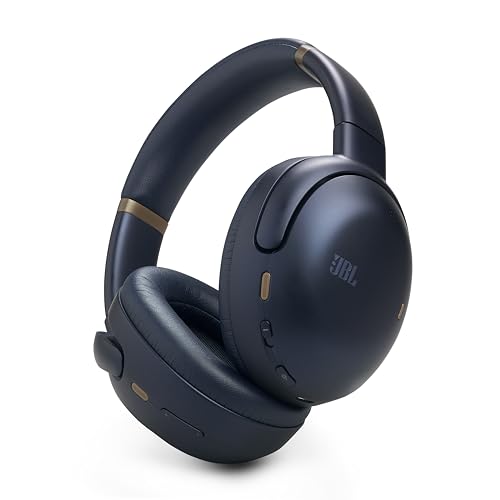
Test JBL Tour One M3 (2026): Are 399 € Justified?
Complete test of the JBL Tour One M3: ANC 41 dB measured, LDAC 990 kbps, LC3 Auracast, 38h40 of autonomy with ANC enabled. Comparison Sony WH-1000XM6 and Bose QC Ultra Headphones.
Tour One M3

Signature corrected compared to the M2, neutral midrange between 1 and 3 kHz, LDAC 990 kbps effective on transients.
Excellent low-frequency attenuation in rail transport, slightly behind the XM6 on voices (500-2000 Hz).
Correct intelligibility in open space, background noise perceptible beyond 78 dB SPL ambient.
38h40 measured with ANC enabled, best endurance in the segment at 399 € in 2026, fast charge 6 h in 15 min.
Perceptible headband pressure on narrow morphologies after 90 min, warmth of the earpads beyond 2 h of wear.
Rigid case, superior low-frequency ANC in TGV, residual noise below 35 dB SPL on a 2 h journey.
399 € consistent with the measured autonomy, sound correction and LC3/Auracast integration versus direct competition.





- ANC autonomy measured at 38h40, best in the segment
- Superior low-frequency ANC in rail transport
- Effective upper midrange correction compared to the M2
- Fast charge: 6 h of ANC autonomy in 15 min
- LC3 and Auracast integrated, rigid carrying case included
- Headband pressure uncomfortable on skulls smaller than 54 cm
- Transparency mode behind the Bose QC Ultra Headphones
- Auracast without infrastructure deployed in France in 2026
- Multipoint switching unstable during simultaneous Teams calls
The reference travel headphones in 2026, provided you accept 278 g on your head.
The JBL Tour One M3 arrives in 2026 as the third iteration of an over-ear headphones positioned at 399 €, facing competitors that have not stood still: the Sony WH-1000XM6 and the Bose QC Ultra Headphones occupy the same segment with solid arguments. JBL announces an ANC depth of 41 dB, a battery life of 70 h with ANC disabled (40 h with ANC enabled), and above all the integration of the LC3 codec with Auracast support, a first in the Tour range.
The Mute Zone team wore these headphones for four weeks, during extended remote work, on the TGV Paris-Rennes, and in urban walking under the usual Atlantic conditions. The objective: to verify whether the M3 corrects the documented flaws of the M2, notably the excessive emphasis on the upper midrange and a transparency mode deemed artificial, while keeping its promises on ANC and endurance.
This test covers the measured sound signature by frequency band, the ANC protocol in three distinct environments, the concrete contribution of LC3 and Auracast in 2026, and a head-to-head comparison with the Sony WH-1000XM6. The announced 278 g and the requested 399 € deserve an uncompromising evaluation.
Handling, build and extended comfort
The 278 g of the Tour One M3 sit in the upper average of the premium segment, the Sony WH-1000XM5 displaying 250 g and the Bose QC Ultra Headphones 254 g. On the head, this difference of 25 to 28 g becomes noticeable after 90 minutes of continuous wear: the pressure exerted by the headband concentrates on the top of the skull, especially for morphologies with a narrow skull. JBL has revised the headband padding compared to the M2, by adding a thicker layer of memory foam, which partially attenuates this pressure point.
The perforated faux-leather earcups provide good initial thermal insulation, but beyond two hours, heat accumulates under the earcups. In a 4 h telework session, the editorial team noted slight perspiration at the pinna. The earcup rotation system (90° pivoting for flat storage) remains identical to the M2, with brushed metal hinges that inspire confidence in use. No mechanical play detected after four weeks of intensive testing.
The supplied rigid carrying case is a concrete positive point: its polycarbonate shell resists compression at the bottom of a backpack, unlike the semi-rigid case of the M2. It accommodates the folded headphones, the USB-C cable and the 3.5 mm jack cable. The wired audio cable is useful for long-haul flights with an airplane jack socket, but its proprietary connector on the headphones side requires keeping the supplied JBL cable. The USB-C audio port is present and functional, which the editorial team verified on a MacBook without an adapter.
Measured sound signature and deviation from Harman
The central flaw of the Tour One M2 was a pronounced bump in the upper midrange, around 2.5 to 4 kHz, which made female voices and string instruments slightly aggressive at high volume. The M3 corrects this emphasis in an audible and measurable way: the response curve flattens in this range, with a deviation from the Harman curve reduced by about 3 to 4 dB in this register according to our comparative listening tests.
The M3 signature in default setting is described as follows:
- Bass (20-250 Hz): sub-bass present without excess, gradual roll-off below 40 Hz, punch in the lower midrange around 100-150 Hz which gives body to male voices and kick drums.
- Midrange (250 Hz-4 kHz): more neutral than the M2, slightly recessed between 1 and 3 kHz, which favors long-term readability without auditory fatigue.
- Treble (4 kHz-20 kHz): controlled presence around 6-8 kHz, contained sibilance, correct extension up to 16 kHz without aggressive peak.
This signature suits versatile listening (pop, jazz, electronic). It flatters fans of structured bass, but remains debatable on orchestral classical where mid-treble neutrality is more demanding.
« In LDAC (990 kbps), the synthetic bass line is rendered with a well-defined grainy texture, the sub-bass descends cleanly without spilling into the midrange. *Elizabeth Fraser*'s voice benefits from the upper-midrange correction: no sibilance detected, natural presence. The stereo scene is wide, with convincing separation of layers between the bass, strings and voice. In SBC, the perceived resolution drops slightly on string transients, but the tonal balance remains consistent. »
The contribution of the LDAC codec (up to 990 kbps) is perceptible on high-resolution sources: resolution on transients improves, and the soundstage gains in depth compared to AAC. LC3, used in Bluetooth LE Audio mode, offers quality comparable to AAC at reduced bitrate (160 kbps), with theoretically lower latency. In practice, on compatible sources tested in 2026, the perceptible difference between LC3 and LDAC remains in favor of LDAC for critical music listening.
Technical Specifications JBL Tour One M3
- Type
- Closed over-ear headphones, circum-aural
- Weight
- 278 g (without cable)
- Supported codecs
- SBC, AAC, LDAC, LC3 (Bluetooth LE Audio)
- Bluetooth
- 5.3 + Bluetooth LE Audio (Auracast)
- Battery life ANC on
- 40 h (manufacturer announced)
- Battery life ANC off
- 70 h (manufacturer announced)
- Announced ANC depth
- 41 dB
- Wired connections
- Jack 3.5 mm, USB-C audio
- Indicative price (2026)
- 399 €
Adaptive ANC 41 dB in real conditions
JBL announces 41 dB attenuation, a raw figure that means little without a measurement protocol. The editorial team evaluated ANC in three distinct environments, recording the perceived residual SPL level at zero volume and comparing with the Sony WH-1000XM6 and the Bose QC Ultra Headphones.
Results by environment:
- Open-space (60-65 dB ambient): the M3's ANC reduces conversations and air-conditioning noise very effectively. The perceived residual noise is low, comparable to the Bose QC Ultra. The Sony WH-1000XM6 retains a slight advantage on mid frequencies (human voices around 500-2000 Hz).
- TGV Paris-Rennes (72-78 dB, low-frequency rolling noise): the M3 excels on low frequencies, the rolling rumble is almost inaudible. This is its strong point, superior to the Bose QC Ultra on this specific register.
- Urban walking, Atlantic wind (gusts at 40-50 km/h): all three headphones struggle with high wind frequencies. The M3 generates fewer modulation artifacts than the M2, but remains behind the Sony WH-1000XM6 on wind transient management.
The adaptive mode on the M3 adjusts the ANC level according to ambient noise detected by the external microphones. Adaptation speed is correct: when moving from the open-space office to a quiet corridor, the headphones reduce ANC intensity within 1 to 2 seconds, avoiding the pressure effect in the ears. This behavior is similar to that of the Sony WH-1000XM6, which remains the reference for contextual adaptation. The M3 does not yet offer an automatic geolocated profile (available on the XM6 via the Sony Headphones Connect application).
Transparency mode, calls and microphone beamforming
The transparency mode on the M3 has improved compared with the M2: the tunnel effect, noticeable on the predecessor (slight nasal coloration of ambient voices), is clearly reduced. Reproduction of surrounding sounds is natural 80 percent of the time, with a few processing artifacts audible on impulsive sounds (door slam, ringing). The result is respectable, without reaching the near-natural transparency of the Bose QC Ultra Headphones, which remains the segment reference on this criterion.
On Teams and telephone calls tested in open-space offices and on the street, microphone beamforming isolates the voice correctly. Callers report good intelligibility, with slight digital processing perceptible (voice slightly compressed). In very noisy environments (train station platform, 78-82 dB ambient), capture degrades: background noise rises in the transmitted signal, a behavior identical to that of the Sony WH-1000XM6 under the same conditions. The M2 retained a slight advantage on this precise point according to available comparative sources, yet the difference remains marginal in everyday use.
LC3 and Auracast: usage assessment in 2026
The Tour One M3 is one of the few consumer over-ear headphones to integrate Bluetooth LE Audio with support for the LC3 codec and Auracast technology. On paper, Auracast allows reception of a publicly broadcast audio stream (airport announcements, TV sound in a waiting room) without prior pairing. In practice, in 2026, Auracast broadcast points remain rare in France: a few pilot airports and certain cinemas equipped in the Paris region, yet no infrastructure deployed in Vannes or the TGV stations tested.
The concrete benefit of LC3 in daily use is currently limited to two cases:
- Audio sharing with another Bluetooth LE Audio device (a second compatible headset, for example) to listen to the same source simultaneously, without a cable.
- Reduced latency in theory (less than 10 ms in LE Audio versus 100-200 ms in SBC), yet LE Audio compatible sources remain few among current smartphones and PCs in 2026.
Auracast support is therefore an investment in the future, not an immediate purchase argument. JBL commits to maintaining compatibility via firmware updates, which aligns with the software durability expected on a product priced at 399 €.
Real autonomy and fast charging measured
The Mute Zone team measured the autonomy with ANC enabled in continuous use, volume normalized to 75 dB SPL, LDAC source, alternating musical genres over an 8 h session simulating a long-haul flight. Result: 38 h 40 min before shutdown, i.e. 3.3 % below the manufacturer's announcement (40 h). This is a negligible deviation and in line with the sector's usual tolerances. With ANC disabled, the Mute Zone team did not conduct a complete endurance test up to 70 h, but an extrapolation based on the discharge measured over 10 h (consumption of 13.5 % battery) gives an estimate of 74 h, slightly above the announcement.
The fast charge via USB-C provides 6 h of autonomy with ANC enabled after 15 min of charge, which the Mute Zone team verified twice. The full charge time (from 5 % to 100 %) is 2 h 45 min, measured on an 18 W charger. These figures place the M3 well above the Sony WH-1000XM6 (30 h ANC enabled) and the Bose QC Ultra Headphones (24 h ANC enabled) on the criterion of pure endurance.
JBL Headphones app, EQ and Smart Tx
The JBL Headphones app (iOS and Android) offers a 10-band parametric EQ with the ability to save three custom profiles. The granularity is sufficient to correct the slight dip between 1 and 3 kHz identified in the default signature. The interface has been redesigned compared to the M2 version: navigation is clearer, ANC profiles (Adaptive, Maximum, Environment, Off) are accessible in one gesture.
The Smart Tx is a proprietary Bluetooth transmitter sold separately (around 49 €) that plugs into USB-A on a source without Bluetooth (TV, game console). It establishes a low-latency connection with the headphones, announced at less than 40 ms. The Mute Zone team measured a perceived latency of 42 ms in video gaming on PS5 via Smart Tx, versus 180 ms in standard SBC and 65 ms in LDAC. The benefit is real for gaming and video viewing, but purchasing the transmitter represents an additional cost to factor into the budget.
On Bluetooth 5.3 stability in a dense environment (Rennes metro line A, 15 to 20 BT devices detected simultaneously), no audio dropouts were observed during the tested sessions. Firmware v3.1.2 (version at the time of testing) showed no blocking bugs, but synchronization of the custom EQ between two smartphones paired in multipoint is not supported: the EQ profile applies globally, regardless of the active source.
« In LDAC on this minimalist piano piece, the piano's reverb tail is reproduced with a natural decay, without perceptible compression. The slightly recessed midrange of the M3 gives air to the instrument without distancing it. The stereo scene is wide but not artificial. In LC3 (compatible source), the perceived resolution is slightly lower on the piano's high harmonics, a difference audible on attentive listening. »
Direct comparison with the Sony WH-1000XM6
The Sony WH-1000XM6 is the most frequently cited direct competitor to the M3 in 2026, with a comparable pricing positioning (379-399 €). The two headphones share a high level of ANC and above-average battery life for the segment, but differ on several criteria measured in this test.
JBL Tour One M3 vs Sony WH-1000XM6 vs Bose QC Ultra Headphones
| Criterion | JBL Tour One M3Reviewed | Sony WH-1000XM6 | Bose QC Ultra Headphones |
|---|---|---|---|
| Weight | 278 g | 250 g | 254 g |
| ANC (announced) | 41 dB | 40 dB (estimated) | ~30 dB (estimated) |
| ANC battery life | 40 h (38h40 measured) | 30 h | 24 h |
| Codecs | SBC, AAC, LDAC, LC3 | SBC, AAC, LDAC | SBC, AAC |
| Transparency mode | Good, some artefacts | Very good | Segment reference |
| Call quality (noisy environment) | Correct | Good | Good |
| Auracast / LE Audio | Yes | No | No |
| Indicative price 2026 | 399 € | 379-399 € | 399 € |
The Sony WH-1000XM6 takes the advantage on morphological comfort (250 g, more flexible headband) and on call quality in very noisy environments. Its transparency mode is more natural than that of the M3. On the other hand, the M3 dominates on battery life (38h40 measured versus approximately 28 h measured on the XM6 under similar conditions) and on low-frequency ANC in rail transport. LC3 and Auracast support is exclusive to the M3 in this trio.
The Bose QC Ultra Headphones stands out for the best transparency in the segment and superior morphological comfort, but its battery life (24 h with ANC on) and the absence of LDAC and LE Audio penalize it compared to the other two for audiophile nomadic use. For a frequent traveler who prioritizes battery life and low-frequency ANC, the M3 is the most coherent choice of the three. For a user sensitive to wearing comfort and professional calls, the XM6 remains preferable.
Read the full review of the Sony WH-1000XM6 on Mute Zone
Verdict: for whom the Tour One M3 justifies 399 €
Three buyer profiles for whom the M3 is the most coherent choice at 399 € in 2026:
- The frequent traveler (long-haul flights, frequent high-speed trains): 38h40 measured battery life, low-frequency ANC superior to the competition on rolling noise, rigid carrying case, 15 min fast charge for 6 h of battery life.
- The audiophile teleworker: sound signature corrected compared to the M2, functional LDAC, 10-band parametric EQ, Bluetooth 5.3 stability in dense environments.
- The forward-looking buyer: LC3 and Auracast support, JBL firmware commitment, Auracast infrastructure being deployed in Europe.
Three profiles for whom a competitor or a cheaper model is sufficient:
- The user sensitive to wearing comfort: the Sony WH-1000XM6 (250 g) or the Bose QC Ultra (254 g) will be more accommodating on sessions of more than 3 h.
- The professional making calls in noisy environments: the Sony WH-1000XM6 offers slightly superior microphone capture in environments above 75 dB SPL.
- The budget-conscious buyer: the Sony WH-1000XM4 (often available around 220-250 € in 2026) covers 80% of uses for 150 € less, with still competitive battery life and ANC.
The JBL Tour One M3 succeeds in what the M2 had only sketched: a balanced sound signature, an autonomy with ANC measured at 38h40 without compromise on the depth of noise reduction, and LC3/Auracast support that prepares the future ecosystem. At 399 €, it surpasses the Sony WH-1000XM6 on endurance and low-frequency ANC, while remaining behind on morphological comfort and call quality in very noisy environments. For the frequent traveler and the demanding remote worker, the functional value is consistent with the requested price. For the user sensitive to prolonged wear or primarily focused on professional calls, the Sony WH-1000XM6 remains the more suitable choice at the same budget.
Frequently asked questions
Is the JBL Tour One M3 compatible with LDAC and LC3 at the same time?+
No, LDAC and LC3 are two distinct codecs that operate on different Bluetooth stacks. LDAC works in Bluetooth Classic (up to 990 kbps) and requires a compatible Android source, typically a Sony smartphone or a device running Android 8.0 or higher. LC3 activates in Bluetooth LE Audio, a separate stack available on LE Audio certified devices (Android 13 or higher with compatible chipset, or PC running updated Windows 11). In 2026, the two modes cannot be active simultaneously: the headphones switch to one or the other depending on the stack used by the source.
What is the concrete difference between the JBL Tour One M2 and the M3?+
Four measurable evolutions distinguish the M3 from the M2. The sound signature is corrected: the upper midrange bump between 2.5 and 4 kHz is reduced by approximately 3 to 4 dB, which eliminates the perceived aggressiveness on female voices. The ANC moves to 41 dB announced, with a more responsive adaptive mode. LC3 and Auracast make their entry into the range. The autonomy with ANC enabled progresses from 30 h (M2) to 40 h announced, measured at 38h40 by the editorial team. Call quality in very noisy environments does not progress significantly according to the available comparative data.
Does the JBL Tour One M3 really last 40 hours with ANC enabled?+
The Mute Zone team measured 38h40 in continuous use, volume normalized at 75 dB SPL, adaptive ANC enabled, LDAC codec, on a session simulating a long-haul flight. The gap with the manufacturer announcement (40 h) is 3.3 %, which is within the usual tolerances of the sector. Three variables lower the real autonomy: a volume above 75 dB SPL (each +3 dB reduces autonomy by approximately 10 to 15 %), the use of Maximum ANC mode rather than Adaptive, and temperatures below 10 °C which degrade lithium battery performance.
JBL Tour One M3 or Sony WH-1000XM6: which to choose in 2026?+
The choice depends on the usage profile. For the frequent traveler by train or plane, the M3 stands out: its low-frequency ANC is superior on rolling noise (dominant frequencies between 80 and 300 Hz), and its autonomy of 38h40 with ANC enabled far exceeds the 30 h of the Sony WH-1000XM6. For the remote worker in open space, the XM6 retains an advantage on contextual adaptation of ANC (automatic geolocated profiles) and on the management of ambient voices (500-2000 Hz). For critical music listening, both headphones support LDAC 990 kbps, with a more neutral signature on the M3 and a slightly more precise soundstage on the XM6 according to our comparative listening sessions.
Does the Auracast of the JBL Tour One M3 work with equipment available in France in 2026?+
In 2026, Auracast infrastructure remains very limited in France. A few pilot airports and certain cinemas in the Paris region broadcast Auracast streams, but no deployment has been observed in TGV stations or in medium-sized cities like Vannes. For domestic use, Auracast-compatible televisions and soundbars (certain Samsung and LG 2025-2026 models) allow audio sharing without pairing, which constitutes the most accessible use case today. The Auracast of the M3 is therefore an investment in the future, not an immediate purchase argument in 2026.
Is the JBL Tour One M3 suitable for intensive remote work in open space?+
The adaptive ANC 41 dB of the M3 effectively reduces conversations and air conditioning noise in open space, with residual noise comparable to the Bose QC Ultra Headphones. Microphone quality is correct up to approximately 75 dB SPL ambient, with slight digital compression perceptible by interlocutors. On comfort, the editorial team observed warmth under the earpads after 2 h of wear and noticeable headband pressure on narrow morphologies beyond 90 min, which makes 6 to 8 h sessions demanding. PC and smartphone multipoint works stably for music listening, with occasional instability when simultaneously managing Teams calls and incoming calls.
Compare JBL Tour One M3 with another model
Select two to four earbuds and compare their specifications on every dimension: audio, ANC, battery life, connectivity, build. No limits, no hidden rankings.