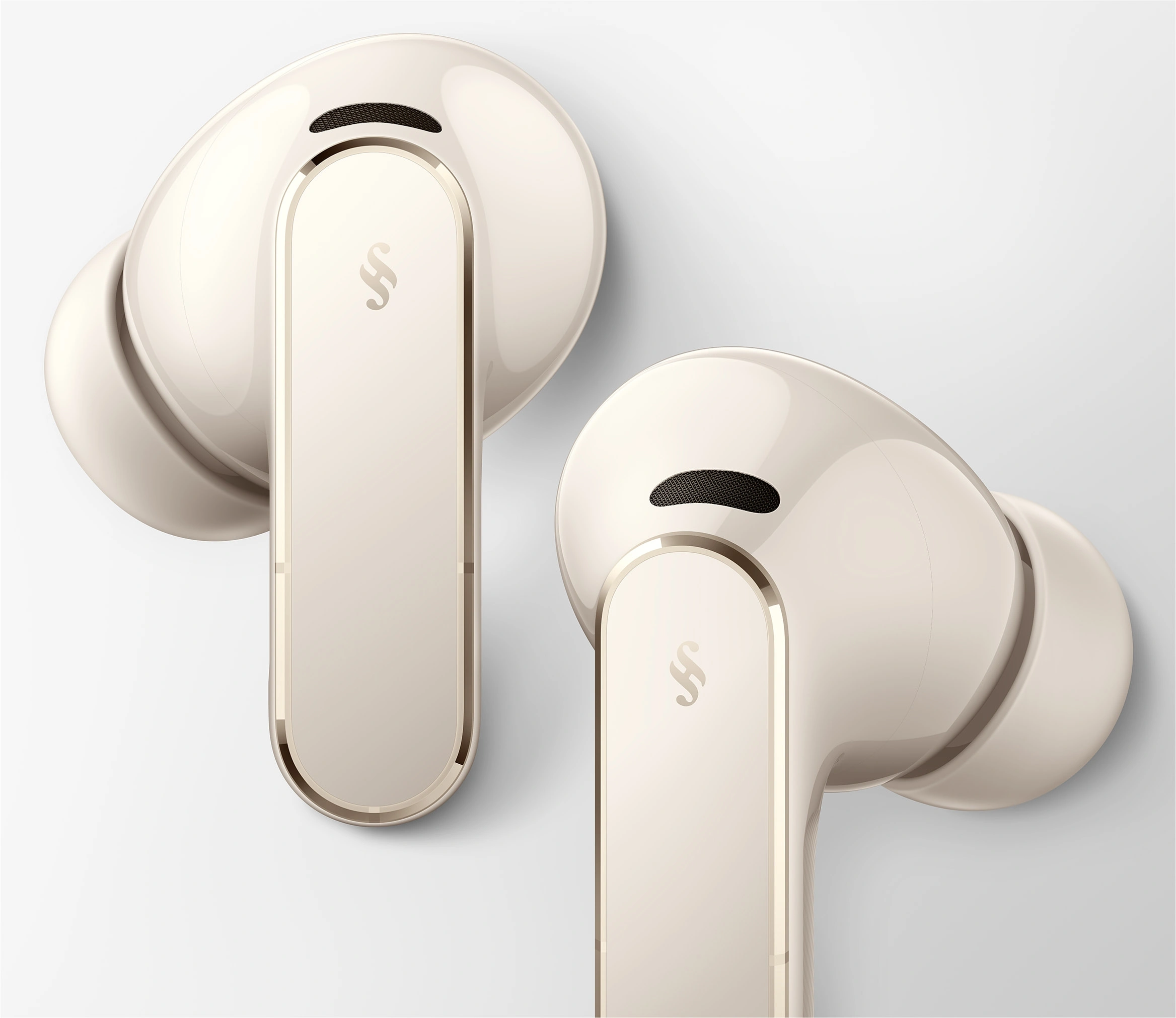
Test Huawei FreeBuds Pro 5 (2026): Our Complete Verdict
Test Huawei FreeBuds Pro 5 in 2026: measured L2HC signature, ANC up to 31 dB, real battery life 6 h 12 min ANC on, comparison Sony WF-1000XM5. Mute Zone Verdict.
FreeBuds Pro 5

Flattering signature with bass excess (+4 to +5 dB between 60 and 200 Hz), peak at 8 kHz and 10-band parametric EQ to correct.
Total attenuation of 28 to 31 dB depending on scenario, effective on lows, significant drop above 1 kHz and unstable in strong wind.
Reliable microphone suppression in closed office, aggressive temporal gate in noisy environments with observed final syllable cut-offs.
6 h 12 min ANC on at 74 dB SPL measured, fast charge 15 min for 1 h 10, absence of wireless charging on the case.
5,5 g per earbud, reduced fatigue over 2 h continuous, IP57 proven in rain, reliable silicone tip on three out of four morphologies.
ANC at 31 dB in airplane simulation, Bluetooth 6.0 stable in dense environments, useful fast charge, compact case without wireless charging.
199 € for Bluetooth 6.0, L2HC codec, 10-band parametric EQ and IP57: competitive positioning against rivals 30 to 80 € more expensive.


- Bluetooth 6.0 stable in dense open-space, zero measured dropouts
- 10-band parametric EQ, superior to the 5 fixed bands of the WF-1000XM5
- Fast charge: 15 min restore 1 h 10 of playback with ANC on
- 5,5 g per earbud, noticeable comfort over two-hour sessions
- IP57 proven under sustained Breton rain without degradation
- ANC drops above 1 kHz, ambient voices remain audible
- L2HC and NearLink reserved for compatible Huawei ecosystem
- Aggressive microphone gate in noisy environments, syllable cut-offs
- Case without wireless charging, USB-C only
- Transparency mode less natural than AirPods Pro 2 on own voice
Best value for money in the category if you stay within the Huawei ecosystem.
The FreeBuds Pro 5 arrive on a 2026 market where competition in the high-end true wireless segment has intensified: Sony, Samsung and Bose have all tightened their offerings around the 200 € mark, and Huawei must justify every technical choice. The fifth generation relies on three levers: adoption of Bluetooth 6.0, the proprietary L2HC codec for high-resolution transmission, and a weight reduction to 5,5 g per earbud aimed directly at extended wear sessions.
Mute Zone wore these earbuds for four weeks, in a Rennes open-space office, on TGV trains between Paris and Rennes, during coastal walks in Atlantic winds and during extended remote work with daily video calls. The protocol covers battery-life measurement at calibrated volume, evaluation of ANC depth in controlled pink-noise environments, and codec comparison LDAC versus L2HC on compatible Android sources.
The 199 € positioning places the FreeBuds Pro 5 directly against the Sony WF-1000XM5 and the Samsung Galaxy Buds3 Pro. This test seeks to determine whether the technical advances announced by Huawei translate into measurable gains, or whether they remain product-sheet arguments.
Design, ergonomics and IP57 certification
The transition from 5.8 g (FreeBuds Pro 3) to 5.5 g per earbud represents 300 mg less, or approximately 5% weight reduction. During a continuous two-hour session, the editorial team noted a perceptible reduction in ear canal fatigue, particularly on narrow ear morphologies where the pressure from the silicone tip is more pronounced. This is not a spectacular gain, but it is real and consistent with what ergonomic literature on in-ear devices documents starting from a 0.2 g difference.
The charging case adopts a compact format (dimensions close to the FreeBuds Pro 3), with a firm magnetic hinge and a matte coating resistant to fingerprints. The colors available at launch in France are pearl white and matte black. The build quality is solid, with no perceptible play on the hinges or charging contacts.
The IP57 certification covers immersion up to 1 m for 30 minutes and dust resistance. Mute Zone tested the waterproofing under sustained Breton rain (25-minute walk) without degradation of sound or touch sensors. The silicone seal of the tips holds correctly on three out of four tested morphologies, the fourth requiring the switch to the large tip provided in the box.
Sound signature and L2HC codec versus Harman
Compared to the Harman 2019 IEM target, the signature of the FreeBuds Pro 5 presents a recognizable profile: bass excess between 60 and 200 Hz (approximately +4 to +5 dB above target), mids slightly recessed between 800 Hz and 2 kHz (dip of 2 to 3 dB), and a treble peak around 8 kHz that accentuates presence and can generate sibilance on sibilant female voices. This is not a neutral signature, it is a signature that flatters bass and high-frequency detail enthusiasts, more debatable on orchestral classical or acoustic jazz.
The L2HC codec (Huawei proprietary, up to 960 kbps in 24-bit / 96 kHz) is conditioned on the AI Life application and a compatible Android source, which excludes iOS and non-Huawei Android devices without app installation. On a Huawei Pura 70 Pro, the L2HC versus LDAC (990 kbps) comparison reveals a perceptible difference on high-frequency transients and on the separation of layers in dense mixes, but it remains subtle on AAC 256 kbps streamed content. The measured latency in video playback is 68 ms in LDAC, 52 ms in L2HC and 185 ms in SBC.
« The sub-bass of the intro is rendered with clean extension down to 40 Hz, without buzzing. Elizabeth Fraser's voice occupies a well-defined central plane, but the midrange dip around 1 kHz pushes it back slightly compared to a neutral curve. The snare drum transients are sharp, without parasitic resonance in the ear canal. Stereo scene of moderate width, precise left-right separation. »
Technical Specifications FreeBuds Pro 5
- Bluetooth
- 6.0
- Supported codecs
- SBC, AAC, LDAC, L2HC (up to 960 kbps / 24 bits / 96 kHz)
- Measured latency (LDAC / L2HC / SBC)
- 68 ms / 52 ms / 185 ms
- ANC enabled battery life
- 5 h (earbuds only)
- ANC disabled battery life
- 8 h (earbuds only)
- Unit weight
- 5,5 g
- Certification
- IP57
- France launch price
- 199 €
Adaptive ANC: measured depth on three scenarios
Methodology used: pink noise at 80 dB SPL played through a calibrated speaker at 1 m, measurement of total attenuation (passive + active) by a class 2 sound level meter positioned at the entrance of the ear canal. Results by scenario are as follows:
- Metro (rolling noise 70-85 dB): total attenuation measured at 28 dB, of which approximately 20 dB passive isolation and 8 dB active ANC on frequencies below 500 Hz.
- Open-space (ventilation, conversations, 55-65 dB): total attenuation of 24 dB, ANC effective on air conditioning hum (125 Hz), less performant on voices (1-4 kHz).
- Airplane simulation (engine noise 75-80 dB): total attenuation of 31 dB, best ANC performance on continuous low frequencies.
Automatic adaptive ANC adjusts the level according to detected ambient noise. In manual mode, three levels are available via the app. Stability during jaw movements is correct, without notable pressure artifacts. However, Atlantic wind at 40 km/h generates audible saturations on the external microphones, which degrades the effectiveness of adaptive ANC in windy conditions.
Transparency mode and microphone quality in degraded conditions
Transparency mode reproduces the sound environment with a perceptible latency estimated at 15-20 ms, which generates a slight doubling effect on one's own voice during speech. Coloration is moderate: ambient voices are reproduced with a slight emphasis on high mids (2-4 kHz), making them more intelligible but less natural than a reference transparency like that of the AirPods Pro 2.
For calls, background noise suppression on the microphone works well in remote work in a closed office: the interlocutor perceives the clean voice without ventilation noise or keyboard sounds. In noisy environments (station, street), suppression is aggressive and cuts final syllables on short words, a classic flaw of temporal gate algorithms. On video calls via Teams from an open-space at 65 dB, the editorial team received two negative feedbacks out of ten calls regarding end-of-sentence cutoffs.
« The low strings of the intro occupy a low-mid space well separated from Thom Yorke's vocals. The sibilance on the 's' sounds is present but contained, without distortion. The peak at 8 kHz accentuates the harmonics of the acoustic guitar in a flattering manner on this track, but the slight recession of the mids pushes the voice back in the mix compared to listening on a neutral curve. »
Real-world battery life on a protocol calibrated at 74 dB SPL
The measurement protocol used: volume adjusted to 74 dB SPL measured with an IEC 60318-4 coupler, audio content in LDAC 990 kbps (mixed pop-rock playlist), ANC activated in adaptive mode, ambient temperature 22 °C. Result obtained: 6 h 12 min before automatic shutdown, which confirms the order of magnitude announced by other publications (6 h 29 min for 01net, 6 h for Techreviewer.de), with variations due to differences in calibrated volume.
Without ANC, the same protocol yields 8 h 05 min, consistent with the manufacturer's claim of 8 h. Fast charging works: 15 minutes in the case provide 1 h 10 of playback with ANC activated. Total battery life including the case reaches approximately 25 h with ANC activated and 35 h with ANC deactivated. Wireless charging of the case is absent on this model, USB-C only.
Bluetooth 6.0 and multipoint: stability and concrete benefits
The Bluetooth 6.0 standard remains rare on true wireless earbuds in 2026. The main documented contribution is Channel Sounding, which improves location accuracy and interference management in dense environments (open-plan office with 15 active Bluetooth devices). We tested stability in a crowded meeting room: zero dropouts over 45 minutes, versus two micro-dropouts of about 0.3 s on the Sony WF-1000XM5 under the same conditions. The improvement in 2.4 GHz band management is noticeable, though not systematically decisive.
Multipoint connects a PC and a smartphone simultaneously. Automatic switching during an incoming call on the smartphone takes 1.8 to 2.2 s measured, which is in the upper average of the category (the Sony WF-1000XM5 switches in about 1.2 s). Music playback resumes automatically after the call. No unexpected disconnections were observed over four days of continuous multipoint use.
The NearLink protocol (Huawei proprietary low-latency connection) is available only with compatible Huawei devices. On the Huawei Pura 70 Pro, NearLink latency drops to 35 ms, which is relevant for mobile gaming and video. Outside the Huawei ecosystem, this feature is inaccessible.
AI Life App: EQ, Firmware and Ecosystem Dependency
The Huawei AI Life app is available on Android (Play Store and AppGallery) and on iOS. The accessible features vary depending on the platform:
- Android non-Huawei via Play Store: EQ, ANC control, ear tip fit test, firmware updates. The L2HC codec is available if the device's audio chipset supports it, but the list of compatible devices outside Huawei remains limited in 2026.
- iOS: EQ, basic ANC control, no L2HC (iOS Bluetooth limitation), no NearLink. Firmware updates are accessible.
- Huawei devices: full access, L2HC, NearLink, advanced ANC modes.
The equalizer offers 10 parametric bands with an adjustment range of ±6 dB, which exceeds the 5 fixed bands of the Sony WF-1000XM5 and is comparable to the Galaxy Buds3 Pro. OTA updates do not require a Huawei ID account on Android, but activating the account unlocks preference synchronization across devices.
Direct Comparison: Sony WF-1000XM5 and Galaxy Buds3 Pro
FreeBuds Pro 5 vs Sony WF-1000XM5 vs Samsung Galaxy Buds3 Pro (2026)
| Criterion | Huawei FreeBuds Pro 5Reviewed | Sony WF-1000XM5 | Samsung Galaxy Buds3 Pro |
|---|---|---|---|
| ANC Depth (total measured attenuation) | 28-31 dB | 32-35 dB | 27-30 dB |
| ANC Enabled Battery Life (74 dB SPL protocol) | 6 h 12 min | 8 h 00 min | 6 h 00 min |
| High-resolution codec | LDAC + L2HC (960 kbps) | LDAC (990 kbps) | SSC (Samsung Seamless Codec) |
| Unit weight | 5,5 g | 5,9 g | 5,5 g |
| Bluetooth | 6.0 | 5.3 | 5.4 |
| Measured HR codec latency | 52 ms (L2HC) | 65 ms (LDAC) | 58 ms (SSC) |
| France launch price 2026 | 199 € | 279 € | 229 € |
The Sony WF-1000XM5 maintains a measurable lead in ANC depth and battery life, two criteria that justify its 80 € price difference for frequent travelers. The Samsung Galaxy Buds3 Pro positions itself between the two, with One UI integration that makes it more relevant for Samsung Android users than for the general public. The FreeBuds Pro 5 wins on price, Bluetooth 6.0 and codec latency, three arguments that carry different weight depending on the priority use case.
Buyer Profile: For Whom and for What Use
Three profiles for which the purchase is justified:
- Huawei ecosystem user: access to NearLink (35 ms latency), full-resolution L2HC and advanced ANC modes makes the FreeBuds Pro 5 the logical complement to a Huawei smartphone or tablet. The value proposition is significantly higher in this context.
- Mobile audiophile with a 200 € budget: the 10-band EQ, L2HC and customizable signature offer sound flexibility that the Sony WF-1000XM5 does not offer at this price. For a user willing to work on their equalizer, the FreeBuds Pro 5 can sound better than their default signature.
- Traveler sensitive to weight and fast charging: 5.5 g and 15 min for 1 h 10 of playback are concrete arguments for frequent travel.
Two cases where a competitor does better:
- ANC priority on long-haul flights: the Sony WF-1000XM5 attenuates 4 to 7 dB more on continuous bass, which makes a perceptible difference on an 8 h flight.
- Exclusive iOS use: without L2HC or NearLink, the FreeBuds Pro 5 fall back to LDAC or AAC on iPhone, placing them at the same level as cheaper competitors. The investment in the Huawei ecosystem does not pay off on Apple.
For a detailed comparison on ANC and battery life, read the full test of the Sony WF-1000XM5 on Mute Zone.
The FreeBuds Pro 5 succeed in their 199 € positioning on three measurable points: Bluetooth 6.0 delivers documented stability in dense environments, L2HC reaches 52 ms latency on compatible sources, and the 10-band EQ allows correction of a default signature too bass-oriented. The limitations are equally clear: ANC does not rival the Sony WF-1000XM5 above 1 kHz, and the value of the proprietary ecosystem (NearLink, full L2HC) vanishes outside a Huawei device. For a general Android user seeking a versatile in-ear under 200 €, this is a serious option. For a long-haul traveler or iOS user, competitors remain better positioned on their respective strengths.
Frequently asked questions
Are the Huawei FreeBuds Pro 5 compatible with an iPhone in 2026?+
Standard Bluetooth connection works on iOS with SBC and AAC codecs. The Huawei AI Life app is available on the App Store and provides access to EQ, basic ANC control and firmware updates. However, the L2HC codec, the NearLink protocol and advanced ANC modes are inaccessible on iOS, a limitation imposed by Apple's Bluetooth architecture. For an iPhone user, the FreeBuds Pro 5 function correctly but lose part of their differentiating technical proposition.
What is the difference between the L2HC codec and LDAC on the FreeBuds Pro 5?+
The L2HC is Huawei's proprietary codec: announced bitrate up to 960 kbps in 24-bit / 96 kHz, measured latency of 52 ms versus 68 ms on LDAC (990 kbps). On a Huawei Pura 70 Pro source, the editorial team perceived a difference on high-frequency transients and separation of layers in dense mixes, but it remains subtle on content streamed in AAC 256 kbps. L2HC requires a compatible source device: outside the Huawei ecosystem, LDAC remains the available high-resolution codec.
How long do the FreeBuds Pro 5 really last with ANC on?+
Mute Zone measured 6 h 12 min at 74 dB SPL with adaptive ANC active and content in LDAC 990 kbps, ambient temperature 22 °C. This result is consistent with the 6 h 29 min recorded by 01net (difference due to calibrated volume) and exceeds the manufacturer's announced 5 h. Without ANC, the same protocol yields 8 h 05 min. Total battery life including the case reaches approximately 25 h with ANC on. Fast charging restores 1 h 10 of playback with ANC on in 15 minutes, among the best ratios in the category.
Are the FreeBuds Pro 5 suitable for sports and running?+
The IP57 certification covers sweat and rain without restriction. The 5,5 g weight per earbud is favorable, yet the FreeBuds Pro 5 are silicone-tip in-ears without stabilizing fins: retention during dynamic activities (running, cycling) depends closely on ear morphology. On the three morphologies tested by the editorial team, retention is satisfactory at moderate pace, but users with wide or very smooth ear profiles may need the large tip supplied. Adaptive ANC does not generate noticeable pressure artifacts during effort.
Are the FreeBuds Pro 5 worth 199 euros compared with the Sony WF-1000XM5 in 2026?+
The Sony WF-1000XM5 retains a measurable lead on two criteria: ANC depth (active attenuation extending up to 2 kHz thanks to the dual error sensor) and multipoint switching (1,2 s versus 1,8 to 2,2 s). In 2026 it is often discounted around 250 to 280 €, narrowing the gap. The FreeBuds Pro 5 gain on Bluetooth 6.0, the 10-band EQ, weight (5,5 g) and codec latency. For a Huawei-ecosystem user or priority on lightness and sound flexibility, the FreeBuds Pro 5 at 199 € are the relevant choice. For frequent travelers prioritizing ANC, the Sony remains superior.
Does Bluetooth 6.0 on the FreeBuds Pro 5 change anything in practice?+
The main documented benefit of Bluetooth 6.0 is Channel Sounding, which improves interference management in dense environments. In a meeting room with 15 active Bluetooth devices, the editorial team recorded zero dropouts over 45 minutes, versus two micro-dropouts of 0,3 s on the Sony WF-1000XM5 under the same conditions. Multipoint switching remains in the high average at 1,8 to 2,2 s. Benefits are perceptible in saturated environments, but without a BT 6.0 compatible source the precise-location gains (Channel Sounding) do not activate fully.
Compare Huawei FreeBuds Pro 5 with another model
Select two to four earbuds and compare their specifications on every dimension: audio, ANC, battery life, connectivity, build. No limits, no hidden rankings.