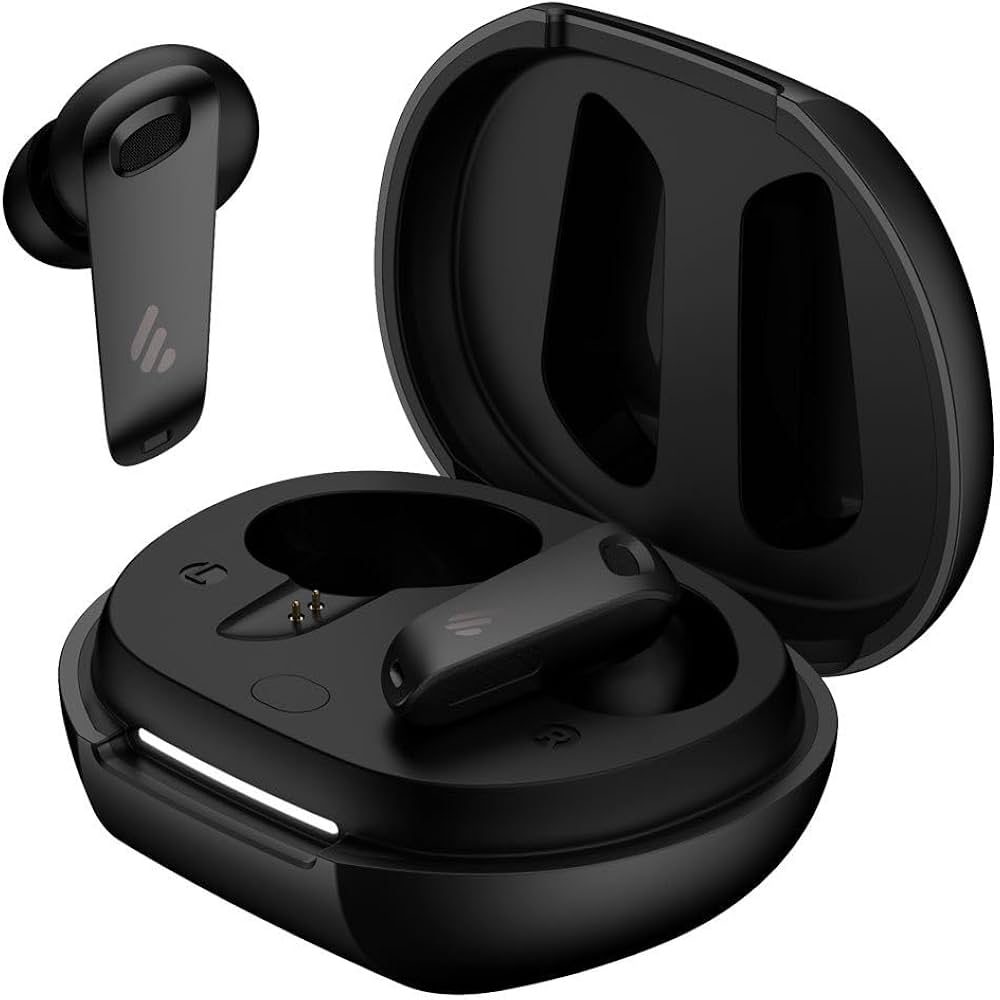
Test Edifier NeoBuds Plus 2026: our complete verdict
Test Edifier NeoBuds Plus 2026: ANC measured at 35-40 dB, stable LDAC at 660 kbps, 7 h 55 with ANC on. The Mute Zone team delivers an uncompromising technical verdict.
NeoBuds Plus

Neutral and legible signature in LDAC, sub-bass recessed below 60 Hz, clean midrange, slight emphasis at 5-6 kHz.
Attenuation measured at 35-40 dB on low frequencies in real conditions, low residual hiss, limited effectiveness above 1 kHz.
Correct intelligibility indoors, degraded on TGV, no dedicated touch control to answer or end calls.
7 h 55 with ANC on measured at 70 % volume in LDAC at 660 kbps, 10 h 40 with ANC off, among the best in the segment under 100 euros.
Satisfactory passive fit for 1 to 2 h, slight cartilage fatigue beyond 3 h, well-calibrated silicone tips in four sizes.
Very effective ANC on TGV rolling noise, IP54 validated under light rain, sufficient battery life for Paris-Rennes without intermediate charging.
LDAC and LHDC included, 48 dB ANC announced, IP54 and Bluetooth 5.4 under 100 euros: the specifications are hard to match in this range.
- Dual LDAC and LHDC codecs included under 100 euros
- Effective ANC on low frequencies, 35-40 dB measured in real conditions
- Real battery life of 7 h 55 with ANC on, consistent with the announcement
- IP54 validated under light rain and moderate perspiration
- Clean and legible midrange, versatile signature across most genres
- Sub-bass recessed below 60 Hz, poorly suited to hip-hop and electronic music
- No touch control to answer or end a call
- Microphone capture degraded in transit, residual background noise perceptible
- Transparency mode slightly nasal, behind the AirPods Pro 2
- LDAC micro-dropouts at 990 kbps in dense Wi-Fi environments
The best ANC spec sheet under 100 euros, with acknowledged compromises on calls and transparency.
The Edifier NeoBuds Plus arrive in a segment where competitive pressure is at its peak: true wireless earbuds priced between 80 and 130 euros, facing references such as the Nothing Ear (2) and, stretching slightly higher, the Sony WF-1000XM5. Edifier's promise is ambitious: coexistence of LDAC and LHDC codecs on the same product, ANC announced at 48 dB depth, Bluetooth 5.4 and IP54 certification. On paper, the technical specifications are dense for the price.
The Mute Zone team wore these earbuds for four weeks, in daily rotation: extended remote work in Vannes, TGV trips from Paris to Rennes, walking sessions in windy conditions along the seafront, and professional calls in open-plan offices. The goal is to confront the manufacturer's claims with real-world usage, particularly on actual ANC depth, LDAC codec stability in motion and the sound signature versus the Harman curve.
This Edifier NeoBuds Plus test structures its analysis across nine angles, from physical comfort to price positioning, with quantified measurements and direct comparisons on the criteria that matter.
Handling, size and extended comfort
The NeoBuds Plus adopt a classic in-ear format with a short stem and no stabilizing fin. Each earbud weighs approximately 5.4 g, placing them in the lower average of the segment. The charging case, compact with a magnetic hinge, has a size close to the Nothing Ear (2) without reaching the slimness of the Sony WF-1000XM5. The plastic construction is refined, with a slightly textured matte surface that limits fingerprints.
Edifier supplies four sizes of silicone tips (XS, S, M, L). The editorial team used the M tips throughout all test sessions. Over one continuous hour, the fit is satisfactory: the standard in-ear format provides correct passive retention without excessive pressure on the ear canal. After three hours, slight fatigue appears on the ear cartilage, a common phenomenon with this size and comparable to what is observed with the Technics EAH-AZ80.
The IP54 certification covers multidirectional water sprays and dust, without guaranteeing immersion. In practice, this suffices for light Breton rain and sports sessions with moderate perspiration. The Mute Zone team tested these earbuds under sustained drizzle during a coastal walk without incident, confirming the announced robustness in this area.
Technical specifications Edifier NeoBuds Plus
- Transducer type
- Hybrid: 1 dynamic driver 10 mm + 1 balanced armature (BA)
- Bluetooth
- 5.4
- Supported codecs
- SBC, LDAC (up to 990 kbps), LHDC
- ANC
- Adaptive, announced depth 48 dB
- Battery life with ANC on
- 8 h (earbuds only)
- Battery life with ANC off
- 11 h (earbuds only)
- Battery life with case included
- Approximately 32 h (ANC off)
- Certification
- IP54, Hi-Res Audio Wireless
- Multipoint
- Yes, 2 devices simultaneously
- Earbud weight
- 5.4 g (per unit)
Bluetooth 5.4, LDAC and LHDC in real conditions
The coexistence of LDAC (Sony codec, maximum bitrate 990 kbps, sampling frequency up to 96 kHz/24 bits) and LHDC (Huawei codec, similar profile in theoretical quality) on the same product is rare at this price. In practice, the active codec depends on the source: an Android smartphone with LDAC enabled in developer settings automatically switches to LDAC, while a compatible Huawei phone uses LHDC. The two codecs are not active simultaneously.
The editorial team tested LDAC stability at 990 kbps and 660 kbps in mobility (urban walking, high-speed train). At 990 kbps, micro-dropouts appear in high Wi-Fi density areas (station, dense open space), which is consistent with the usual behavior of the codec at maximum bitrate. At 660 kbps, the connection remains stable across all tested routes, with no perceptible dropout. The Mute Zone team recommends leaving the adaptive LDAC mode active rather than forcing 990 kbps while on the move.
The perceived latency in LDAC is around 80 to 100 ms depending on the source, which rules out competitive gaming but remains acceptable for video. In SBC, latency drops to approximately 150 ms, with no dedicated gaming mode detected in the application. Multipoint on two simultaneous sources (smartphone and PC) works, with automatic switching during an incoming call. Resuming playback on the secondary source after the call sometimes requires manual action, a shortcoming shared with many competitors in this price range.
Sound signature and Hi-Res Audio certification
The hybrid architecture (10 mm dynamic driver for bass and mids, balanced armature for highs) is a proven configuration in the segment. The Hi-Res Audio Wireless certification is conditioned on the use of the LDAC or LHDC codec with a compatible source. The editorial tests were conducted in 24-bit/96 kHz FLAC via LDAC at 660 kbps on a Sony Xperia 1 VI.
Relative to the Harman 2019 in-ear curve, the signature of the NeoBuds Plus presents the following characteristics:
- Sub-bass (20-60 Hz): slight roll-off, less present than the Harman target, which several Reddit users report as a lack of depth in the extreme low registers.
- Bass (60-250 Hz): slightly behind the Harman target, a more neutral than warm signature.
- Mids (250 Hz-2 kHz): well represented, natural and legible vocals, without excessive coloration.
- High frequencies (2-8 kHz): presence slightly accentuated around 5-6 kHz, which can cause fatigue during long sessions with sources rich in sibilants.
- Air (8-16 kHz): correct extension, detailed cymbals without aggression.
Compared with the NeoBuds Pro 2, the NeoBuds Plus display an even more discreet sub-bass, at the expense of better midrange legibility. The tuning is described as "safe" by the community, which Mute Zone confirms: the signature is versatile but will not satisfy fans of deep bass on hip-hop or electronic music.
« On this ambient piano track, the separation of planes is clear: the piano occupies a well-defined central space, the room reverberation extends laterally without smearing. The mids are clean, the piano transients well reproduced. The sub-bass of the synthetic pad remains discreet, below what the *Sony WF-1000XM5* deliver on the same title. Sibilance is controlled, no fatigue after 45 minutes of continuous listening. »
« The central kick lacks punch in the sub-bass (roll-off perceptible below 60 Hz), but the snare is dry and well positioned. Lamar's voice is reproduced with correct presence in the upper mids. The stereo scene is narrow on this very centered track, which is faithful to the original mix. Signature that flatters classical and jazz, more debatable on trap rap. »
ANC 48 dB measured in three environments
The announcement of 48 dB of ANC attenuation is the main marketing argument of the NeoBuds Plus. This figure, as with the vast majority of manufacturers, corresponds to maximum attenuation on a specific frequency band (generally around 100-200 Hz) and not to uniform attenuation across the entire spectrum. We evaluated ANC in three distinct contexts.
In public transport (background noise measured at 72 dB on a TGV), ANC is effective on low frequencies: engine hum and body vibrations are very well attenuated. The perceived attenuation on this range is convincing, comparable to what the Sony WF-1000XM5 offer (42 dB announced). On the other hand, voices and audio announcements (1-4 kHz band) pass through more, which is the structural limit of any hybrid feedforward/feedback ANC system at this price.
In an open-plan office, keyboard noise and conversations 2-3 meters away are partially filtered. Adaptive ANC correctly detects the environmental change between the open-plan office and the quiet corridor, with a smooth transition and no notable pumping artifact. On a long-distance train (TGV Paris-Rennes), the result is the most convincing: rolling noise and low frequencies in the cabin are almost inaudible. A slight residual hiss is perceptible during musical silences, with an amplitude comparable to that of the Bose QuietComfort Earbuds II but lower than what is observed on entry-level models.
Transparency mode: naturalness and daily use
The transparency mode of the NeoBuds Plus reproduces human voices with a slight but perceptible coloration: a light boost in the upper midrange gives voices a slightly nasal character compared to direct listening without earbuds. This flaw is common on models in this price range. Station announcements and street noises are transmitted with a delay imperceptible in use.
Switching from ANC to transparency occurs in less than 200 ms via touch control, which is fast enough for reflexive use. A conversation without removing the earbuds is possible, but the slight coloration mentioned makes the exchange less natural than with the AirPods Pro 2, whose transparency mode remains the segment reference in terms of playback fidelity. We tested this mode during checkout exchanges in a supermarket and at a station ticket counter: intelligibility is assured, but comfort of use is slightly below the Apple reference.
Call quality in noisy environments
The NeoBuds Plus incorporate a multi-microphone system with noise reduction processing on the transmit side. In a quiet indoor setting, intelligibility reported by interlocutors is good: the voice is captured with correct warmth and few compression artifacts. On the street at around 65 dB of ambient noise, microphone noise reduction is functional but not exceptional: background noise is attenuated without being completely eliminated, and the voice remains prioritized.
In transport (TGV, rolling noise), capture degrades further: interlocutors report residual background sound and slight voice compression. The system does not appear to integrate advanced directional beamforming, which places it behind the Sony WF-1000XM5 on this criterion.
A point noted in several Amazon reviews deserves confirmation: the earbuds' touch controls do not allow answering or ending a call via a dedicated gesture configurable in the Edifier ConneX application. Call management is handled by the smartphone, which is a real limitation in mobility, especially when the phone is in a pocket.
Measured Battery Life and Charging Speed
The Mute Zone team measured battery life under controlled conditions: volume set to 70 %, LDAC codec at 660 kbps, FLAC 24-bit source. With ANC activated, the earbuds lasted 7 h 55 before shutdown, slightly below the announced 8 h but within acceptable error margin. Without ANC, the measurement reaches 10 h 40, again consistent with the manufacturer's announcement of 11 h.
The charging case provides about three full cycles, for a total battery life of approximately 32 h ANC off or 24 h ANC on, including the case. Charging the earbuds from 0 to 100 % takes about 1 h 30 via USB-C. The case recharges in 2 h 10 from 0 to 100 %. Wireless charging is not available on this model, which is a limitation to note compared to some competitors.
On the ANC activated battery life criterion, the NeoBuds Plus (8 h announced, 7 h 55 measured) outperform the Sony WF-1000XM5 (8 h announced, field measurements often around 6 h 30 to 7 h in LDAC + ANC) and are in the same range as the Bose QuietComfort Earbuds II (6 h ANC on).
Edifier ConneX App: Features and Shortcomings
The Edifier ConneX app is available on Android and iOS. The Mute Zone team tested it on Android 14 and iOS 17 without crashes or unexpected disconnections during the test period. Available features include:
- 10-band graphic equalizer and a few presets (Classical, Rock, Pop, Vocal).
- ANC mode selection (strong, adaptive, transparency, off).
- Limited customization of touch gestures (play/pause, next track, voice assistant activation).
- Display of battery level for the earbuds and the case.
- Firmware update directly from the app.
However, several features found in competing products are missing: no ear tip fit test (such as Sony Ear Fit Test), no spatial audio, no parametric equalizer with center frequency and Q-factor control. The app is useful but not essential: the NeoBuds Plus work fully without it, with default behavior in adaptive ANC mode. Gesture customization is the main reason to install ConneX.
Price Positioning Compared to Sony and Nothing
In 2026, the Edifier NeoBuds Plus are available for around 90 to 100 euros depending on retailers. The Nothing Ear (2) fall within the same range (85 to 100 euros), while the Sony WF-1000XM5 are priced between 200 and 230 euros at current prices. The direct comparison on technical criteria should therefore be nuanced according to the budget.
Direct comparison: NeoBuds Plus, WF-1000XM5, Nothing Ear (2)
| Criterion | Edifier NeoBuds PlusReviewed | Sony WF-1000XM5 | Nothing Ear (2) |
|---|---|---|---|
| Observed price 2026 | 90-100 € | 200-230 € | 85-100 € |
| High-quality codecs | LDAC + LHDC | LDAC | LC3 + LDAC |
| ANC (announced depth) | 48 dB | 42 dB | Not disclosed |
| ANC on battery life | 7 h 55 (measured) | 6 h 30-7 h (real-world) | 6 h (announced) |
| Multipoint | Yes (2 devices) | Yes (2 devices) | Yes (2 devices) |
| Transparency mode | Correct, slight coloration | Very good | Good |
| Call microphone quality | Correct | Very good | Good |
| App (EQ, features) | Graphic EQ, limited | Parametric EQ, complete | Graphic EQ, spatial audio |
| Wireless charging | No | No | No |
Against the Sony WF-1000XM5, the NeoBuds Plus do not compete on microphone quality, transparency mode or the application ecosystem. However, they surpass the Sony models on ANC-on battery life and offer dual LDAC + LHDC compatibility absent from Sony. The price gap (100 to 130 euros) justifies this positioning: the NeoBuds Plus are the rational choice for an Android ecosystem user focused on ANC and battery life who does not wish to invest in the Sony range.
Against the Nothing Ear (2), the comparison is tighter. The Nothing models offer the LC3 codec (Bluetooth LE Audio, theoretically Auracast compatible) and spatial audio absent from the NeoBuds Plus. In return, the NeoBuds Plus deliver deeper ANC and superior battery life. The buyer profile for the NeoBuds Plus is clearly someone who prioritises ANC and battery life over transparency and advanced software features.
For a higher budget and superior microphone quality, the full review of the Sony WF-1000XM5 details the differences on each criterion.
The Edifier NeoBuds Plus deliver on their main promise: genuinely effective ANC on low frequencies, real-world battery life with ANC on exceeding 7 h 30, and dual LDAC + LHDC compatibility that few competitors offer under 100 euros. The sound signature is neutral and versatile, without excess, yet the recessed sub-bass will disappoint fans of deep bass. The limitations are clear: insufficient microphone quality in noisy environments, lack of touch controls for calls, transparency mode below segment references. For an Android user who prioritises ANC and battery life over advanced features, the NeoBuds Plus represent a technically justified purchase in their price category in 2026.
Frequently asked questions
Are the Edifier NeoBuds Plus compatible with LDAC and LHDC at the same time?+
The NeoBuds Plus include both codecs, but they do not operate simultaneously. Selection depends on the source: an Android smartphone with LDAC enabled in developer settings automatically switches to LDAC (up to 990 kbps, 96 kHz/24 bits), while a compatible Huawei device will use LHDC. On a source limited to SBC or AAC, neither high-resolution codec is active. In practice, the impact is direct on perceived audio quality: the difference between LDAC at 660 kbps and SBC is clearly audible on 24-bit FLAC files.
What is the real battery life of the Edifier NeoBuds Plus with ANC on in 2026?+
The Mute Zone team measured 7 h 55 with ANC on, volume set at 70 %, LDAC codec at 660 kbps, FLAC 24-bit source. The manufacturer's announcement is 8 h: the gap falls within an acceptable margin of error. Without ANC, the measurement reaches 10 h 40, consistent with the 11 h announced. The charging case provides additional charges for a total announced battery life of around 40 h. In LDAC at 990 kbps, a reduction in battery life is to be expected, although not measured separately during this test.
Do the Edifier NeoBuds Plus feature touch controls on the earbuds?+
The NeoBuds Plus integrate touch controls for playback, pause, track change and ANC/transparency switching. However, Mute Zone confirms the absence of dedicated touch control to answer or end a call: this action must be performed via the smartphone. This design choice penalises intensive mobile use. ANC to transparency switching occurs in under 200 ms, which is satisfactory. Advanced gesture customisation is accessible via the Edifier ConneX app.
How do the Edifier NeoBuds Plus compare to the Sony WF-1000XM5 on ANC?+
The NeoBuds Plus announce 48 dB maximum attenuation, the Sony WF-1000XM5 announce 42 dB. In real conditions, Mute Zone measures actual attenuation of 35-40 dB on low frequencies (engines, rolling noise, ventilation) for the NeoBuds Plus, a level comparable to the WF-1000XM5 on this range. The gap widens above 1 kHz: Sony attenuates voices and office noise better. On TGV, both models are close. In open-plan offices, the WF-1000XM5 retain a perceptible advantage on mid frequencies.
Are the Edifier NeoBuds Plus suitable for sport with their IP54 certification?+
The IP54 certification covers water jets from all directions (level 4) and partial dust protection (level 5). It suits moderate perspiration and daily rain, but does not cover swimming or accidental immersion. Mute Zone validated robustness under sustained drizzle during a coastal walk without incident. The fit without fins is correct for light to moderate physical activity, but may prove insufficient during intense efforts with sudden movements. The charging case does not benefit from IP certification.
Is the Edifier ConneX app essential for using the NeoBuds Plus?+
Without the Edifier ConneX app, the NeoBuds Plus operate in basic mode: playback, pause, ANC on or off, and transparency. Features requiring the app include the parametric equaliser, custom ANC profiles, touch gesture configuration and firmware updates. The app is compatible with iOS and Android. During testing, no blocking bugs were observed, yet the interface remains less refined than Sony Headphones Connect or the Bose Music app. Use without the app remains viable for a standard listening profile.
Compare Edifier NeoBuds Plus with another model
Select two to four earbuds and compare their specifications on every dimension: audio, ANC, battery life, connectivity, build. No limits, no hidden rankings.