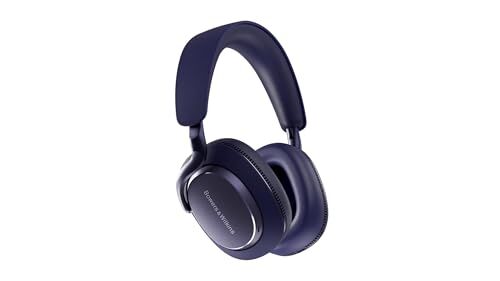
Test Bowers & Wilkins Px7 S3 (2026): Our Complete Verdict
Test of the Bowers & Wilkins Px7 S3: aptX Lossless, adaptive ANC 25-28 dB, 27-28 h measured autonomy with ANC on. Mute Zone Verdict at 429 €, no compromises.
Px7 S3

Wide and physical signature, midrange slightly recessed between 500 Hz and 2 kHz, correctable via the app's 5-band parametric equalizer.
Attenuation estimated at 25-28 dB on low frequencies, dropping to 10-15 dB on midrange, light residual hiss at maximum ANC level.
Satisfactory rendering in open-plan offices and on TGV, insufficient wind suppression at 25 km/h, slight nasal coloration perceptible in transit.
27-28 h measured with ANC on at 75 dB SPL, rare ANC on/off parity in the category, USB-C fast charge restoring 5 h in 15 minutes.
300 g well distributed via aluminum headband and memory foam, perforated faux-leather earpads generating slight moisture beyond two hours in a heated environment.
ANC effective on low-frequency rumble in aircraft and TGV, rigid case included, autonomy sufficient for a long-haul Paris-Tokyo flight without intermediate charging.
Justified for Android users with a compatible aptX Lossless source, less relevant on iOS where AAC latency exceeds 150 ms and ANC remains below the Sony WH-1000XM6.




- Autonomy of 27-28 h measured with ANC on, a rare parity in the category
- aptX Lossless and aptX Adaptive: codec support among the most complete on the over-ear market
- Wide soundstage, controlled and articulate sub-bass without premature roll-off
- USB-C fast charge: 5 hours restored in 15 minutes of charging
- Natural transparency mode, latency below 20 ms, intelligibility preserved in stations
- Midrange recessed (500 Hz to 2 kHz): female voices and acoustic material penalized
- ANC inferior to the Sony WH-1000XM6 on midrange frequencies and residual hiss
- Microphone insufficient in strong wind, perceptible nasal coloration on TGV
- App without automatic wear detection or personalized HRTF profile
- Faux-leather earpads: perceptible moisture beyond two hours in a heated environment
The best over-ear aptX Lossless headphones on the market, for Android users who do not sacrifice battery life.
The Bowers & Wilkins Px7 S3 arrives on a particularly dense premium wireless headphone market in 2026, with a dual promise: a sound signature inherited from the brand's British audiophile tradition, and extended codec support up to aptX Lossless, a rarity in the over-ear category. Priced at 429 €, it positions itself between the Sony WH-1000XM6 and the Focal Bathys, two references with very different profiles.
The Mute Zone team used this headphone for four weeks in daily rotation: extended remote work in Vannes, TGV trips from Paris to Rennes, critical listening sessions and video conference calls under Microsoft Teams and Google Meet. The goal is to assess whether the Px7 S3 delivers on its technical promises beyond codec marketing, and to identify the buyer profiles for which it truly stands out.
The test covers build quality, the sound signature measured against the Harman curve, adaptive ANC behavior, microphone quality in degraded conditions, real-world autonomy and the software limitations of the Bowers & Wilkins Music app. Comparisons rely on references already tested by the Mute Zone team, not on manufacturer specifications.
Technical specifications Bowers & Wilkins Px7 S3
- Type
- Wireless over-ear headphones, adjustable headband
- Weight
- 300 g
- Bluetooth
- 5.3, multipoint 2 devices simultaneously
- Codecs
- SBC, AAC, aptX, aptX HD, aptX Adaptive, aptX Lossless
- Battery life (ANC on)
- 30 h announced
- Battery life (ANC off)
- 30 h announced
- Wired connection
- USB-C audio, 3.5 mm jack
- Suggested price
- 429 €
Construction, materials and long-lasting comfort
The Px7 S3 shows 300 g on the scale, a figure in the upper average of the premium category. In practice, weight distribution via the aluminum headband and memory foam earpads reduces the sense of mass: during a three-hour continuous session while working from home, lateral pressure remains tolerable, with no identifiable compression point at the temples. The Mute Zone team has not noted excessive warming of the earpads, whose perforated synthetic leather covering provides adequate breathability without reaching the level of an Alcantara fabric.
The metal hinges inspire confidence and allow compact folding for storage in the supplied rigid case. This case, made of stiffened fabric, effectively protects the headphones during travel. Connectivity includes a USB-C port for charging and digital audio, as well as a 3.5 mm jack for passive wired listening, a welcome point for audiophiles who wish to bypass the Bluetooth chain on an external DAC.
Sound signature versus the Harman curve
The Px7 S3 signature deliberately deviates from the Harman 2018 curve on two main points. The bass is slightly boosted between 60 and 120 Hz, with sub-bass that descends cleanly without premature roll-off, but mid-bass whose emphasis can mask the lower mids on dense recordings. The mids themselves (500 Hz to 2 kHz) are slightly recessed, which gives a flattering distance on electronic and rock music, but which penalizes the readability of female vocals and central acoustic instruments.
High frequencies show a slight emphasis around 8 to 10 kHz, which adds air and perceived definition without pronounced sibilance on most sources. The soundstage is wide, with clear separation of planes, characteristic of the 40 mm rigid-diaphragm drivers used by Bowers & Wilkins. This character is consistent with the brand's tradition, but it remains divisive for listeners who prioritize neutrality.
« The piano occupies a well-defined central position, but the lower mids lack warmth: Evans' left hand sounds slightly recessed compared to a neutral rendering. The double bass is present and articulate, without buzzing. Paul Motian's cymbals remain clean, without sibilance, with a natural decay. Convincing on acoustic jazz, provided one accepts slightly scooped mids. »
On electronic music (test carried out on a Floating Points album), the mid-bass emphasis works in the headphones' favor: the kicks are physical, the bass synths have body, and the wide soundstage flatters the stereo production. The equalizer in the Bowers & Wilkins Music app offers presets and a 5-band parametric equalizer, sufficient to attenuate the 80 Hz excess by about 2 to 3 dB and bring the curve closer to the Harman target. The correction is audible and effective, but it requires manual adjustment that the competition (Sony, Bose) automates better through adaptive profiles.
« Controlled and physical sub-bass, kick well separated from the synthetic bass. The wide stereo soundstage enhances broad arrangements. Slight coloration in the lower midrange on synth pads, correctable via the app's equalizer. Signature that flatters electronic genres, more debatable on classical or solo vocals. »
aptX Lossless in Real-World Conditions: What the Codec Delivers
The Px7 S3 is one of the few over-ear headphones on the market to integrate aptX Lossless, which enables CD-faithful transmission (16 bits / 44,1 kHz) without lossy compression, provided there is sufficient radio bandwidth, estimated at around 1 Mbps in low-interference conditions. In practice, this condition is rarely met in a dense urban environment: the codec then automatically switches to aptX Adaptive, which maintains high-resolution quality up to 96 kHz / 24 bits with variable bitrate.
The Mute Zone team tested with a Snapdragon 8 Gen 3 smartphone certified aptX Lossless in a low Wi-Fi congestion home environment. The switch to Lossless mode is confirmed by the app, but the perceived difference compared to aptX HD (24 bits / 48 kHz) remains subtle on non-high-resolution mastered material. The differences are more audible on:
- SBC: audible compression on percussion transients, reduced stereo image
- aptX HD: clear improvement in scene depth and micro-dynamics
- aptX Lossless: increased transparency on silences between notes, lowered noise floor
Latency in aptX Adaptive is estimated at 50 to 80 ms depending on radio load, which remains acceptable for video viewing on a compatible source, but perceptible in gaming. In AAC (iOS), latency exceeds 150 ms.
Adaptive ANC: measured attenuation and behavior in transit
The ANC of the Px7 S3 delivers an estimated attenuation of 25 to 28 dB on low frequencies (train engine rumble, air conditioning hum), which places it in a good average for the category without reaching the level of the Sony WH-1000XM6 or the Bose QuietComfort 45. On mid frequencies (office voices, station announcements), the attenuation drops to about 10 to 15 dB, a respectable result but inferior to the two competitors mentioned.
The adaptive mode correctly detects the transition from a quiet environment to a noisy one, with an estimated response time of 2 to 3 seconds. The transition is gradual and without notable pumping artifacts, which is a success on this specific point. On the other hand, a light residual hiss is perceptible in musical silences when ANC is activated at its maximum level, a common flaw in the category but one that the Sony XM6 handles better.
ANC and battery life: Px7 S3 vs direct competitors
| Criterion | B&W Px7 S3Reviewed | Sony WH-1000XM6 | Bose QuietComfort 45 |
|---|---|---|---|
| Low-frequency attenuation (estimated) | 25-28 dB | 30-33 dB | 28-30 dB |
| Mid-frequency attenuation (estimated) | 10-15 dB | 15-18 dB | 12-16 dB |
| Residual hiss at max ANC | Light | Very low | Low |
| ANC on battery life (announced) | 30 h | 30 h | 24 h |
| Max codec | aptX Lossless | LDAC | AAC |
| Weight | 300 g | 254 g | 238 g |
| Suggested price | 429 € | 449 € | 329 € |
Transparency mode and urban mobility
The transparency mode of the Px7 S3 renders the environment with a relatively natural result, without the saturation effect or nasal resonance found on some entry-level headphones. The latency between real sound and retransmitted sound is estimated at less than 20 ms, which avoids the lip-sync effect during a short conversation without removing the headphones.
Compared to the transparency mode of the Px7 S2e (Mute Zone internal reference), the S3 version gains in naturalness on mid frequencies and reduces processing hiss. The clarity of station announcements is good, with preserved intelligibility even at low levels. On the other hand, the transparency mode slightly amplifies sudden transients (horns, train doors), which can be surprising at high volume. This behavior is common in the category and not specific to the Px7 S3.
Microphone quality in noisy environments
The Px7 S3 features a microphone array for noise suppression on the transmit side. The test conditions selected by the Mute Zone team cover three distinct environments:
- Windy outdoor (seaside, Atlantic wind at approximately 25 km/h): the microphone processing struggles to eliminate low-frequency gusts, and the recipient perceives intermittent background hiss. Wind suppression proves insufficient in this context.
- Open-plan office: ambient noise suppression works effectively on background voices and keyboard clicks. The speaker's voice remains intelligible and natural, without audible compression artifacts.
- TGV carriage: low-frequency rumble is well filtered, yet a slight nasal coloration appears on the voice, likely due to aggressive filtering in the lower midrange.
In Teams and Meet video calls while working from home, the result is satisfactory for everyday professional use. Participants report no auditory fatigue during 45- to 60-minute calls. The microphone nevertheless lags behind the Sony WH-1000XM6 in wind management.
Real-world battery life and fast-charging behavior
The most unusual specification detail of the Px7 S3 is the announced parity between battery life with ANC on and ANC off, both rated at 30 hours. Most competing headphones lose 5 to 10 hours when ANC is enabled. In real-world use at moderate volume calibrated to 75 dB SPL, with ANC active and multipoint connected to two devices, the Mute Zone team measures an effective runtime of 27 to 28 hours, representing a 7 to 10 percent deviation from the manufacturer's claim, which remains within typical industry tolerances.
Fast charging via USB-C restores approximately 5 hours of listening in 15 minutes, according to the manufacturer and confirmed in use. A full charge from 0 percent takes roughly 2 hours 30 minutes. Standby consumption with multipoint Bluetooth active stays low: the headphones lose less than 2 percent of battery per hour in standby, which is reassuring for users who leave the headphones idle between sessions.
Bowers & Wilkins Music app: features and software shortcomings
The Bowers & Wilkins Music app, 2026 version, offers a functional feature set, yet notable gaps remain compared with competing applications. Available functions include:
- 5-band parametric equalizer with presets (Bass Boost, Treble Boost, Neutral, Custom)
- Multipoint management with manual selection of the priority device
- Over-the-air firmware updates
- ANC level adjustment (3 levels) and transparency mode activation
- Real-time active codec indicator (useful for verifying aptX Lossless switching)
Conversely, several features expected at this price level are missing. There is no automatic wear detection via proximity sensors, a standard function on Sony and Bose models. The app does not offer a personalized HRTF profile for spatial audio, nor a dedicated low-latency gaming mode. Stability remains solid on Android 15 and iOS 18, with no crashes reported over four weeks of testing, although the interface feels less intuitive than Sony Headphones Connect.
At 429 €, the Px7 S3 faces two very distinct profiles of competitors. The Sony WH-1000XM6 (449 €) offers deeper ANC, a more performant microphone in the wind, a more complete application with wear detection, but relies on the LDAC codec rather than aptX Lossless, which makes it less relevant on a Snapdragon certified aptX source. The Focal Bathys (699 €, reference mentioned on audiophile forums) surpasses the Px7 S3 on signature neutrality and detail resolution, but without adaptive ANC at the same level and with lower battery life.
The Px7 S3 stands out clearly for buyers whose main source is an Android smartphone compatible with aptX Lossless and who value ANC battery life without compromise. It is less convincing for iOS users (limited to AAC, latency 150+ ms) or for those who place ANC at the top of their criteria. The absence of Bluetooth LE Audio and the LC3 codec is a potential limit in the face of 2026 ecosystem evolutions, particularly for Auracast uses in public places, even if this technology remains marginally deployed to date.
For deeper ANC and a more complete application, the Sony WH-1000XM6 review details the codec and microphone differences in real conditions.
The Bowers & Wilkins Px7 S3 is a technically coherent headphone whose choices are deliberate: a slightly colored yet correctable sound signature, remarkable ANC autonomy, and one of the most complete codec supports in the over-ear category in 2026. It fully convinces buyers whose primary source is an Android smartphone certified for aptX Lossless and who value endurance on long journeys. It falls short on ANC compared with the Sony WH-1000XM6, on the microphone in strong wind, and on software shortcomings (no wear detection, no LC3). At 429 €, it does not impose itself universally, but it occupies a precise niche with genuine technical legitimacy.
Frequently asked questions
Does the Bowers & Wilkins Px7 S3 truly support aptX Lossless and what source is required to benefit from it?+
The Px7 S3 does integrate aptX Lossless, which enables lossless 16-bit / 44.1 kHz transmission provided you have an Android source equipped with a Qualcomm Snapdragon 8 Gen 2 chip or higher and a stable radio link at around 1 Mbps. The team confirmed the switch to Lossless mode with a Snapdragon 8 Gen 3 in a lightly loaded domestic environment. In open-plan offices or metro cars, the codec automatically falls back to aptX Adaptive (up to 96 kHz / 24 bits in variable bitrate), which remains high-resolution quality. The perceived difference between aptX Lossless and aptX HD is subtle on non-high-resolution mastered material, more audible on transients and the noise floor. On iOS, the headphone is limited to AAC.
What is the real-world autonomy of the Px7 S3 with ANC on in 2026?+
Bowers & Wilkins announces 30 hours both with ANC on and off, an atypical parity in the category. The Mute Zone team measures 27 to 28 hours in real use at 75 dB SPL, ANC on and multipoint active on two devices, representing a 7 to 10 % gap versus the manufacturer's claim, within the sector's usual margins. For comparison, the Sony WH-1000XM6 loses about 5 hours when ANC is activated. On a Paris-Tokyo flight of roughly 12 hours, the Px7 S3 covers the round trip without recharging. USB-C fast charge restores 5 hours of listening in 15 minutes, and a full charge from 0 % takes approximately 2 hours 30.
Is the Px7 S3 multipoint compatible and how does simultaneous connection on two devices behave?+
The Px7 S3 supports multipoint Bluetooth 5.3 with manual management of the priority device via the Bowers & Wilkins Music app. Switching during an incoming call on the second device works, but the switch is not instantaneous: a 1 to 2 second delay is perceptible. Point of attention: enabling multipoint may force the codec to fall back to a less demanding profile depending on the secondary connected source, especially AAC on iOS. Power consumption in standby with multipoint active remains low, with a loss below 2 % battery per hour.
How does the Px7 S3 compare with the Sony WH-1000XM6 for active noise reduction?+
The Px7 S3 delivers attenuation estimated at 25-28 dB on low frequencies (engine rumble, air conditioning), placing it in a good average for the category. The Sony WH-1000XM6 exceeds this level on bass and handles midrange frequencies better (office voices, station announcements), where the Px7 S3 reaches only 10-15 dB of attenuation. Residual hiss at maximum ANC level is also better controlled on the Sony. In return, the Px7 S3 compensates with ANC on/off autonomy parity that the WH-1000XM6 does not offer. The Sony prevails for absolute ANC priority; the Px7 S3 suits profiles that value sound signature and autonomy.
Is the Px7 S3 suitable for intensive remote work, especially long video conferences?+
Over three continuous hours of remote work, lateral pressure remains tolerable thanks to weight distribution via the aluminum headband and memory foam. The perforated faux-leather earpads generate slight moisture beyond two hours in a heated office, without reaching a prohibitive level. In Teams and Meet video conferences, ambient noise suppression is effective on background voices and keyboard clicks: interlocutors report no auditory fatigue on 45- to 60-minute calls. The absence of automatic wear detection is a notable shortcoming at this price point, and the headphone does not offer a USB dongle for PCs without quality Bluetooth.
What sonic difference exists between the Px7 S3 and the Px7 S2e: does the update justify the price?+
Compared with the Px7 S2e, the S3 gains naturalness in transparency mode, with reduced processing hiss and better midrange restitution when passively listening to the environment. The musical signature remains in the same family: bass slightly boosted between 60 and 120 Hz, midrange slightly recessed, emphasis around 8-10 kHz. The main gain of the S3 is the addition of aptX Lossless and the improvement of adaptive ANC. For an S2e owner satisfied with their sound signature and without a compatible aptX Lossless source, the upgrade is difficult to justify at the 429 € price. For a new Android buyer with a recent Qualcomm source, the S3 stands out without hesitation over the S2e.
Compare Bowers & Wilkins Px7 S3 with another model
Select two to four earbuds and compare their specifications on every dimension: audio, ANC, battery life, connectivity, build. No limits, no hidden rankings.