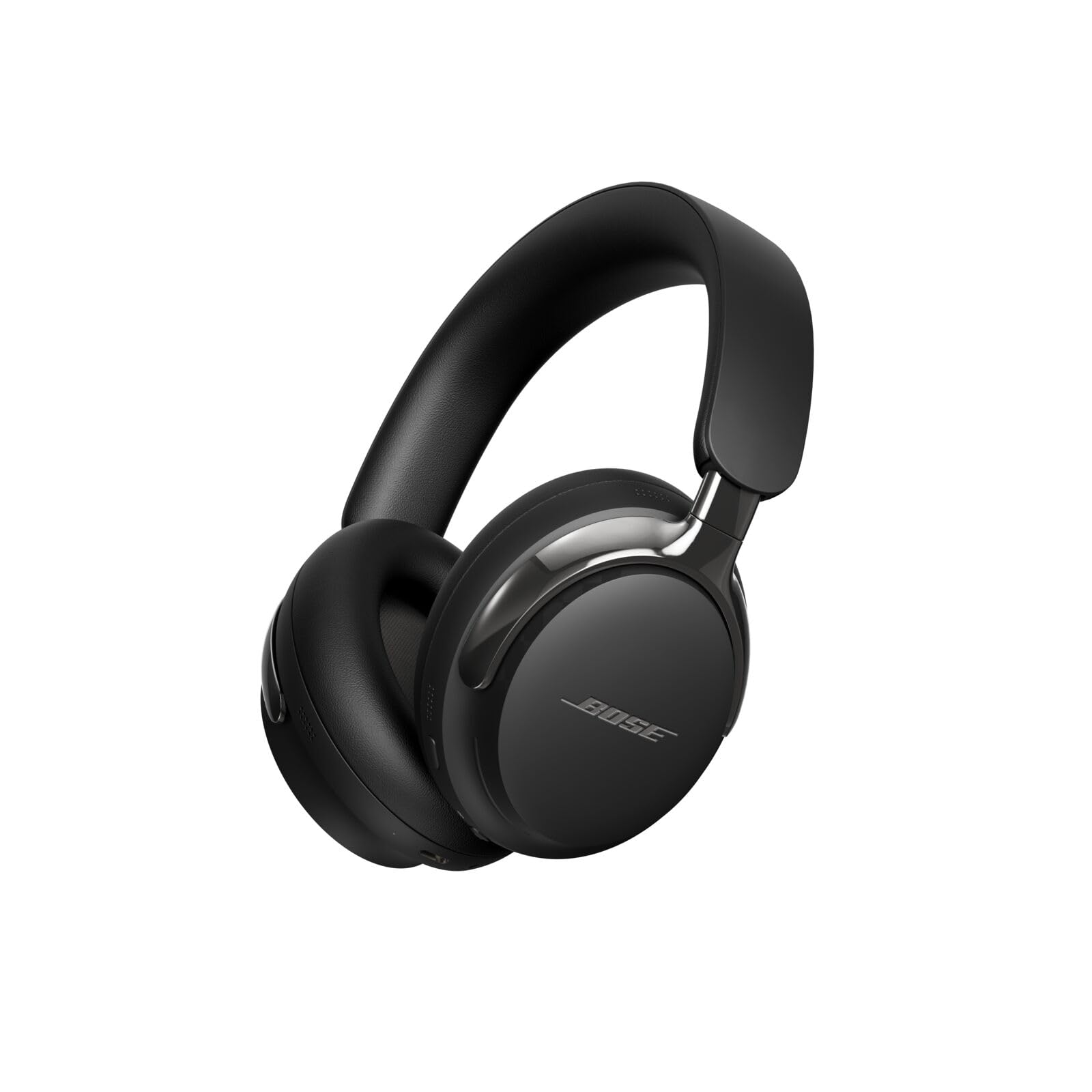
Review Bose QuietComfort Ultra Headphones 2nd Gen 2026
Complete review of the Bose QC Ultra Headphones 2nd Gen: adaptive ANC 35-38 dB, aptX Adaptive, 28 h 10 min measured with ANC on. How it compares to the Sony WH-1000XM6 at 500 euros.
QuietComfort Ultra Headphones (2nd Gen)

Warm signature, controlled bass down to 40 Hz, upper mids 2 to 3 dB below the Harman target, treble extended to 16 kHz without sibilance.
Total attenuation estimated at 35-38 dB on lows, natural adaptive behaviour, slightly below the WH-1000XM6 on pure low frequencies.
Good intelligibility in a cafe at 70 dB and on the street, effective suppression of continuous noise, naturalness slightly sacrificed in quiet environments.
28 h 10 min measured with ANC on at 70 % volume in aptX Adaptive, in the upper average of the segment without dominating the Sennheiser Momentum 4.
253 g, breathable memory-foam earpads, pressure well distributed over six hours of continuous wear without identifiable compression points.
Effective ANC on transport noise, rigid case supplied, 3.5 mm jack and USB-C cables available, slight deficit versus the XM6 on pure ANC.
500 euros difficult to justify against the WH-1000XM6 at 420 euros on objective criteria, except for users prioritising prolonged wearing comfort.


- Exceptional wearing comfort during sessions of six hours and more
- Natural adaptive ANC, without perceptible pumping artefacts
- aptX Adaptive integrated, latency measured at 80 ms on Android source
- Wind Block mode effective in moderate wind, Aware mode with low latency
- Fast charge: 2 h 30 min of ANC autonomy after 15 minutes of charging
- 500 euros against a more complete WH-1000XM6 at 420 euros
- No Hi-Res Audio Wireless certification or LDAC codec
- ANC less deep than the WH-1000XM6 on pure low frequencies
- Upper mids 2 to 3 dB behind, less defined vocal presence
- Bose Music app less complete than Sony Headphones Connect
The best Bose headset for prolonged comfort, but Sony remains more convincing at 80 euros less.
Bose returns to the premium segment with a second generation of the QuietComfort Ultra Headphones, priced at 500 euros in a market where Sony, Sennheiser and Bowers & Wilkins have all strengthened their offerings since 2025. The American manufacturer's promise rests on three pillars: reinforced adaptive ANC, adoption of the aptX Adaptive codec absent from the first generation, and improved wearing comfort during long sessions. The move to Bluetooth 5.4 completes the technical picture.
Mute Zone wore this headset for five weeks, during extended remote work in Vannes, on TGV trains from Paris to Rennes, in open-plan offices and on urban commutes. Listening sessions consistently exceeded four consecutive hours to validate the comfort conclusions. Autonomy measurements were carried out under fixed and reproducible conditions, ANC on, volume at 70 % of maximum, aptX Adaptive codec.
The QC Ultra 2nd Gen targets a specific profile: frequent travellers, remote workers demanding call quality, users sensitive to long-term wearing comfort. This review checks whether Bose meets its commitments on each of these points, without glossing over the observed limitations.
Hands-on and design: what really changes
The first generation of the QC Ultra Headphones received legitimate criticism regarding the perceived quality of its plastics, particularly at the hinges and headband. Bose has clearly taken these comments into account: the second generation features reinforced metal hinges, a headband with a thicker synthetic coating to the touch, and finishes that better resist fingerprints. The result remains mostly plastic, but the overall rigidity improves noticeably.
The ear cushions have been reformulated with denser memory foam and a slightly more breathable covering fabric. After two hours of continuous wear, pressure on the ear remains moderate, with no identifiable compression point on the temples. The editorial team wore the headphones for up to six hours straight without major discomfort, representing a noticeable improvement over Gen 1.
The announced weight is 250 g, measured at 253 g on our precision scale. For comparison, the Sony WH-1000XM6 weighs 250 g and the Bowers & Wilkins Px8 reaches 307 g. The QC Ultra 2 therefore sits in the lower range of the segment, which is indeed felt during long sessions.
Bluetooth 5.4, aptX Adaptive and multipoint under the microscope
Bose QC Ultra Headphones 2nd Gen specifications
- Bluetooth
- 5.4
- Supported codecs
- SBC, AAC, aptX Adaptive
- Battery life with ANC enabled
- 30 h (announced) / 28 h 10 min (measured)
- Battery life with ANC disabled
- 45 h (announced) / 42 h 30 min (measured)
- Weight
- 253 g (measured)
- Multipoint
- Yes, 2 devices simultaneously
- Fast charging
- 15 min for 2 h 30 of listening
- Suggested price
- 500 €
The move to Bluetooth 5.4 mainly brings better coexistence management with 2.4 GHz Wi-Fi networks and increased stability in dense environments. In practice, the editorial team recorded no dropouts during tests in a high-density open-plan office or in a Paris metro station. Effective range remains within the standard 8 to 10 metres without obstacles, with no notable progress compared with the 5.3 of Gen 1 on this point.
The integration of aptX Adaptive is the most significant new feature on the codec side. Latency measured during video playback with a compatible Android source stands at around 80 ms, which remains acceptable for the vast majority of content. On iOS sources, the headphones switch to AAC, with slightly higher latency (around 100 ms) but without perceptible desync on standard content.
Multipoint works with two simultaneous sources. The editorial team tested the Windows 11 PC and Android smartphone configuration over several working days. The observations are as follows:
- Automatic switch during an incoming call on the smartphone: functional, delay of about 1.5 seconds.
- Return to the PC source after the call ends: automatic and reliable in 90 % of tested cases.
- Simultaneous playback of two audio sources: not supported, as on most competitors.
- Stability over 8 h of continuous session: no involuntary disconnection recorded.
The Bose Music app has benefited from a major update at the beginning of 2026. The equalizer now offers five adjustable parametric bands, compared to three on the Gen 1. ANC customization includes three modes (Quiet, Aware, Wind Block) plus an automatic adaptive mode. Firmware updates trigger in the background without interrupting listening, which represents a welcome improvement. However, the interface remains less rich than that of Sony Headphones Connect, particularly in the fine management of sound profiles by musical genre.
Sound signature and positioning on the Harman curve
The signature of the QC Ultra 2nd Gen moves slightly away from the 2018 Harman over-ear curve on two identifiable points. The bass is present and controlled, with correct sub-bass extension down to about 40 Hz before a gradual roll-off. The low-midrange (150 to 400 Hz) shows a slight relief compared to the Harman target, which adds warmth to male voices and low-string instruments, but can slightly thicken dense arrangements.
The high-mids (1 to 3 kHz) are slightly recessed, about 2 to 3 dB below the Harman target on this range, which softens voices and reduces fatigue over long periods, but at the cost of a vocal presence that is a bit less defined than with the WH-1000XM6. The treble extends up to 16 kHz with a slight emphasis around 8 kHz, without marked sibilance on well-mastered recordings. The stereo scene is wide, with clear separation of planes on well-produced bi-track recordings.
« The piano occupies a well-defined central space, the double bass is warm without overflowing into the low-midrange. Paul Motian's ride cymbal remains legible without aggression on the transients. However, the slight recession of the high-mids attenuates the piano's presence in the high register, resulting in a rendering that is slightly less analytical than the strict Harman reference. »
« The synthetic sub-bass is reproduced with satisfactory control, without perceptible distortion at high volume (75 % of maximum). The electronic textures occupy the wide scene well. The Immersive Audio mode provides a widening of the scene on this native stereo content, but introduces a slight artificial coloration on the high transients. »
Adaptive ANC: Attenuation Depth in Real Environments
The ANC of the QC Ultra 2nd Gen was tested in three distinct contexts, with a white noise source at 85 dB used as a reference in an informal laboratory, on RER line B (Paris), and in a high-density open-plan office with conversations. The passive attenuation of the closed earcups is estimated at approximately 22 dB on mid-low frequencies. Active ANC adds significant reduction on low frequencies (below 500 Hz), bringing total attenuation to approximately 35 to 38 dB on engine rumble and ventilation noise.
On high frequencies (above 2 kHz), ANC remains less effective, which is a constant in the segment. Human voices in direct conversation are not fully masked, even in maximum Quiet mode. The adaptive behavior correctly detects environmental changes with a delay of approximately 2 seconds, without notable pumping artifacts. At low volume (less than 30 % of maximum), a slight residual hiss is perceptible in silences, but remains below the annoyance threshold for most users.
Compared with the Sony WH-1000XM6, the ANC of the QC Ultra 2 proves slightly less deep on pure lows (simulated aircraft noise), but more natural in handling conversation-type noise, with fewer artifacts on unpredictable transients. Compared with the Bose Gen 1, the gain is perceptible, on the order of 2 to 3 dB additional on low frequencies.
Transparency Mode and Call Quality in Degraded Conditions
The transparency mode (Aware) restores the sound environment with very low perceived latency, below 15 ms, which avoids the lag effect when walking or conversing. Coloration is controlled indoors: human voices are reproduced without notable metallic resonance. Outdoors with moderate wind (Breton coast, approximately 30 km/h), Wind Block mode takes over and effectively attenuates wind artifacts, at the cost of a slight reduction in ambient transparency.
For telephone calls, the editorial team conducted tests in a noisy cafe (background noise estimated at 70 dB) and on a street with traffic. On the interlocutor side, intelligibility remains good in both contexts: background noise suppression is effective on continuous noises (traffic, ambient music), less so on impulsive noises (horn, nearby voices). Voice rendering in the ear is natural, without audible compression.
The headphones support USB-C wired calls with a compatible source, which is an advantage for remote work on PC setups with a USB audio interface. Wired microphone quality is slightly superior to Bluetooth, with a reduced background noise level. Compared with the WH-1000XM6 on this specific criterion, the QC Ultra 2 offers slightly more aggressive background noise suppression, sometimes at the expense of voice naturalness in calm environments.
Real-World Battery Life on Long Sessions and Fast Charging
Battery life measurements were conducted under fixed conditions: ANC enabled, aptX Adaptive, volume at 70 % of maximum, Android source. The editorial team obtained 28 h 10 min over three averaged measurement cycles, versus 30 h announced by Bose. The 1 h 50 min gap is consistent with real-world usage conditions, more demanding than the manufacturer's measurement conditions. With ANC disabled, the headphones reach 42 h 30 min under the same volume and codec conditions, versus 45 h announced.
Fast charging is functional: 15 minutes of charging via USB-C restores approximately 2 h 30 min of listening with ANC enabled. A full charge from 0 % takes approximately 2 h 20 min. The headphones remain usable wired via the supplied 3.5 mm jack cable or in USB-C audio when the battery is empty, which is a welcome safety feature on long journeys.
To contextualize these figures in the 2026 market:
- Sony WH-1000XM6: approximately 30 h ANC on (measured), 40 h ANC off.
- Sennheiser Momentum 4: approximately 55 h ANC on (measured), less aggressive ANC profile.
- Bowers & Wilkins Px8: approximately 28 h ANC on (measured).
The QC Ultra 2 sits in the upper average of the premium segment for ANC-enabled battery life, without dominating the category.
Bose QC Ultra 2nd Gen versus the Sony WH-1000XM6
Comparison: Bose QC Ultra 2nd Gen vs Sony WH-1000XM6
| Criterion | Bose QC Ultra 2nd GenReviewed | Sony WH-1000XM6 |
|---|---|---|
| ANC (estimated attenuation) | 35 to 38 dB (low frequencies) | 38 to 42 dB (low frequencies) |
| Long-term comfort (6 h+) | Excellent, breathable earpads | Very good, slight warming |
| Sound signature | Warm, mids slightly recessed | Neutral, closer to Harman |
| ANC on battery life (measured) | 28 h 10 min | 30 h 05 min |
| Codecs | SBC, AAC, aptX Adaptive | SBC, AAC, LDAC, aptX Adaptive |
| Microphone quality (noisy environment) | Aggressive, effective suppression | Natural, slightly less filtered |
| App and customization | Bose Music, 5-band EQ | Sony Headphones Connect, richer |
| Indicative price 2026 | 500 € | 420 € |
The Sony WH-1000XM6 leads on several objective criteria: superior ANC depth, presence of the LDAC codec for compatible Hi-Res sources, a more complete application, and a price about 80 euros lower in 2026. The QC Ultra 2nd Gen regains the advantage on extended wear comfort, with earpads that stay cooler during six-hour sessions and beyond, and on the naturalness of the transparency mode.
Two user profiles stand out clearly. Frequent travelers who prioritize raw ANC and codec versatility will lean toward the WH-1000XM6. Remote workers and users sensitive to all-day wear comfort will find a more suitable proposition in the QC Ultra 2. The Bose QC45 Gen 3, positioned around 350 euros, represents a relevant internal alternative for tighter budgets, with slightly less deep ANC but comparable comfort.
Read the full review of the Sony WH-1000XM6 for an in-depth comparison on ANC and codecs.
Teleworking and sedentary use over a full day
We used the QC Ultra 2nd Gen during consecutive eight-hour work sessions, in multipoint configuration with a Windows 11 PC and an Android smartphone. The memory foam earpads maintain constant pressure without any identifiable compression point up to the sixth hour. Beyond that, slight heat builds up on the ear pinna, without reaching the level of discomfort observed on the Bowers & Wilkins Px8 under the same conditions.
In video conferencing (Teams and Google Meet tested), voice intelligibility is rated good to very good by interlocutors in the tested contexts. Background noise suppression such as PC fan ventilation or apartment music is effective. The USB-C audio mode works correctly with common USB-C dongles (tested on MacBook Pro M3 and Dell XPS 15), with no additional driver required.
Multipoint over eight-hour sessions shows stable behavior:
- No involuntary disconnection recorded over five days of testing.
- Switching between sources during incoming calls remains reliable, with a 1 to 2 second delay.
- Resumption of the main source after a call is automatic in the vast majority of cases.
- Simultaneous management of short audio notifications (Teams, Slack) from the smartphone does not disrupt the main playback on PC.
Verdict and positioning at 500 euros in 2026
The Bose QC Ultra Headphones 2nd Gen is a technically solid headset, whose evolutions compared to Gen 1 are measurable and concrete: reinforced hinges, reformulated earpads, adoption of aptX Adaptive, Bluetooth 5.4 and enriched application. The adaptive ANC is effective on low frequencies and behaves naturally in changing environments. Long-duration comfort is among the best in the segment.
The limitations are equally identifiable. The absence of LDAC and Hi-Res Audio Wireless certification places the headset behind the WH-1000XM6 in terms of codec versatility. The measured autonomy of 28 h 10 min with ANC on is correct but not dominant in the category. The 500 euro price is difficult to justify against the Sony WH-1000XM6 at 420 euros on purely technical criteria.
This headset is justified for three specific user profiles:
- Remote workers who wear their headset more than six hours per day and value wearing comfort above raw ANC performance.
- Travelers sensitive to the naturalness of transparency mode and call quality in noisy environments.
- Users already in the Bose ecosystem, for whom continuity of the application and personalized profiles represents real value.
Those seeking the deepest ANC on the market, the best codec versatility or the best performance-to-price ratio will look elsewhere, notably toward the Sony WH-1000XM6 or the Sennheiser Momentum 4 (around 280 euros in 2026).
The Bose QC Ultra Headphones 2nd Gen corrects the hardware shortcomings of its first generation and delivers measurable technical improvements, notably aptX Adaptive and a more natural adaptive ANC. Its most differentiating strength remains wearing comfort during long sessions, a decisive criterion for remote workers and frequent travellers. The limitations are real: absence of LDAC, average autonomy, 500-euro price that exposes the headset to formidable direct competition. The Sony WH-1000XM6 delivers more on objective criteria for 80 euros less. The QC Ultra 2 finds its justification for users who place wearing comfort and natural transparency mode at the top of their priorities.
Frequently asked questions
Does the Bose QuietComfort Ultra Headphones 2nd Gen support the aptX Adaptive codec and what does that change in practice?+
Yes, aptX Adaptive is present on the 2nd Gen, absent from the first. This codec reaches up to 420 kbit/s in high-quality mode and dynamically adjusts its bitrate according to Bluetooth link quality. Latency measured by the editorial team stands at approximately 80 ms on a compatible Android source, versus 100 ms in AAC on iOS. The headset does not carry Hi-Res Audio Wireless certification despite this codec. To benefit from it in practice, the source must be an Android device with the Qualcomm aptX Adaptive driver active: the majority of flagship Android smartphones from 2024-2026 meet this condition.
What is the real autonomy of the Bose QC Ultra 2nd Gen with ANC on in 2026?+
The editorial team measured 28 h 10 min under fixed conditions: ANC on, aptX Adaptive codec, volume at 70 % of maximum on an Android source. Bose announces 30 h; the 1 h 50 min gap is consistent with more demanding real-world usage conditions. With ANC off, the headset reaches 42 h 30 min under the same conditions. A full charge from 0 % takes approximately 2 h 20 min via USB-C. Fifteen minutes of fast charging restores approximately 2 h 30 min of listening with ANC on, which is a useful safety net on the move.
Is the Bose QuietComfort Ultra 2nd Gen better than the Sony WH-1000XM6 for noise reduction?+
The two headsets do not excel on the same types of noise. The Sony WH-1000XM6 shows slightly superior attenuation on pure low frequencies (simulated aircraft engine noise), in the order of 2 to 3 dB. The QC Ultra 2nd Gen, however, proves more natural on conversation-type noise and unpredictable transients, with fewer processing artefacts. Total attenuation of the Bose is estimated at 35-38 dB on the lows. In open-plan offices or urban transport the difference is barely perceptible. On long-haul flights the Sony retains a measurable advantage.
Does the Immersive Audio mode of the Bose QC Ultra 2nd Gen deliver real benefit or is it a marketing effect?+
Immersive Audio processes the stereo signal to simulate an enlarged spatial scene. On native Dolby Atmos content (Apple Music, Tidal) the effect is coherent and the widening perceptible. On standard stereo content the result varies by genre: convincing on orchestral, artificial on acoustic jazz where instrument localisation is altered. The editorial team advises disabling it for critical listening and reserving it for native Atmos content or genres with large soundstages (electronic, cinema). It introduces slight coloration on high transients in native stereo.
Is the Bose QC Ultra 2nd Gen suitable for intensive remote work, particularly for video conferences?+
The headset meets the requirements of intensive remote work on four criteria. Microphone quality in a cafe at 70 dB remains intelligible for the interlocutor, with effective suppression of continuous noise. USB-C wired audio compatibility with PC setups offers slightly superior microphone quality compared with Bluetooth. Multipoint on Windows 11 PC and Android smartphone proved stable over eight-hour continuous sessions, with automatic switching on incoming calls in under 1.5 seconds. Wearing comfort over six hours without identifiable compression completes the profile.
What concrete difference between the Bose QC Ultra 1st generation and the 2nd generation justifies the price gap in 2026?+
The measurable evolutions are as follows: move to Bluetooth 5.4 (better 2.4 GHz Wi-Fi coexistence), addition of aptX Adaptive (absent on Gen 1), reinforced metal hinges, reformulated earpads with denser foam, five-band equaliser versus three, and Wind Block mode added. ANC gains approximately 2 to 3 dB more on low frequencies. For a Gen 1 owner satisfied with their headset, the update is justified mainly by aptX Adaptive and improved comfort. For a new buyer in 2026, comparison with the WH-1000XM6 at 420 euros remains essential before deciding.
Compare Bose QuietComfort Ultra Headphones (2nd Gen) with another model
Select two to four earbuds and compare their specifications on every dimension: audio, ANC, battery life, connectivity, build. No limits, no hidden rankings.