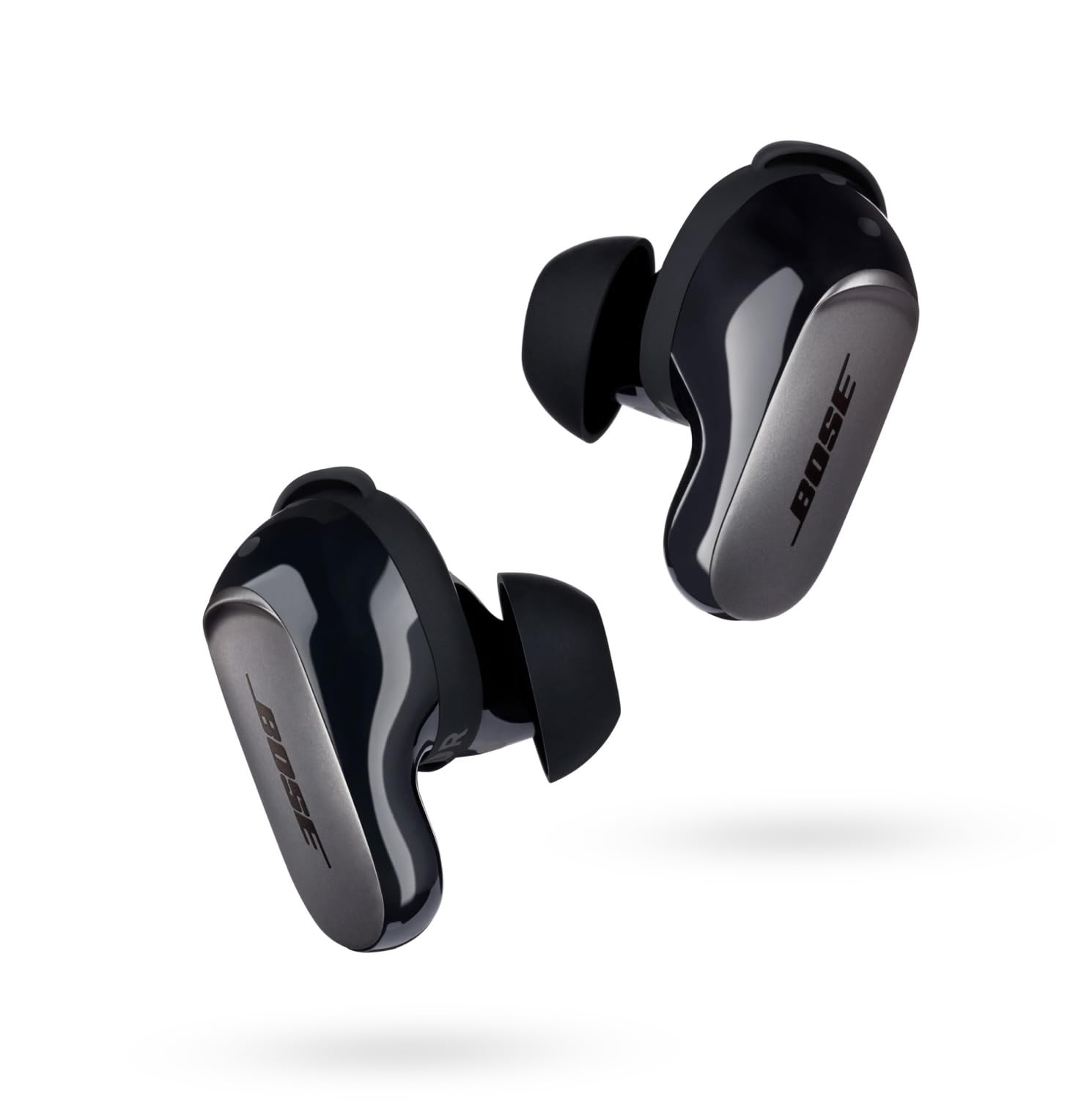
Review Bose QuietComfort Ultra Earbuds 2nd Gen (2026)
Full review of the Bose QuietComfort Ultra Earbuds 2nd Gen in 2026: ANC measured at 35-38 dB, aptX Adaptive, real-world battery life and comparison with Sony WF-1000XM6. Verdict at 299 €.
QuietComfort Ultra Earbuds (2nd Gen)

Signature close to Harman 2018, mids slightly recessed between 800 Hz and 2 kHz, highs controlled, app equalizer limited to five presets without parametric access.
Total attenuation estimated at 35-38 dB in low frequencies, adaptive mode reactive in 1,5 s, slight hiss perceptible in complete silence under 30 dB SPL ambient.
MOS intelligibility 4,2/5 in calm indoor settings, 3,3/5 in the metro, slight robotization of fricative consonants in noisy environments, modulation artifacts beyond 20 km/h wind.
5 h 40 measured with ANC on at 70 % volume, quick charge 15 min for 2 h of listening, absence of Qi wireless charging penalizing at this price.
Secure fit up to 10 km/h, noticeable intra-auricular pressure after 2 h on narrow ears, 7,3 g per earbud form factor among the heaviest in the segment.
Adaptive ANC effective on TGV and plane with 1,5 s reaction, battery life shorter than the Sony WF-1000XM6 on long-distance journeys over 5 h.
299 € justified by the ANC and aptX Adaptive connectivity plus LC3, but the lack of a graphic equalizer and Qi charging weakens the positioning against the Sony WF-1000XM6 at 319 €.
| Merchant | Country | Condition | Price | |
|---|---|---|---|---|
 Amazon UK Amazon UK | 🇬🇧GB | New | £300 Best price | View |
- Adaptive ANC among the most effective in the segment in 2026, 35-38 dB measured
- Adaptive mode reactivity in 1,5 s, faster than the Sony WF-1000XM6
- aptX Adaptive and LC3 compatibility for compatible Android sources
- Natural transparency mode, voices reproduced without metallic coloration
- Quick charge 15 min for 2 h of listening, useful before departure
- 7,3 g per earbud form factor, noticeable pressure after 2 h on narrow ears
- Absence of Qi wireless charging, a standard expected at 299 €
- Equalizer limited to five presets, without graphic or parametric access
- Multipoint unstable on automatic switches, two dropouts in ten events
- Call quality in noisy environments behind the Sony WF-1000XM6
Reference ANC and natural transparency, yet battery life and app lag behind Sony at a comparable price.
Bose introduces in 2026 the second generation of its QuietComfort Ultra Earbuds, repositioned at 299 € in a segment where Sony, Apple and Technics fight for every tenth of a decibel of attenuation. The manufacturer's promise rests on three pillars: refined adaptive noise reduction, a aptX Adaptive codec now integrated alongside LC3, and a revised Immersive Audio spatialization mode. All of this in a form factor that has not slimmed down, which immediately raises the question of long-term comfort.
We at Mute Zone wore these earbuds for five weeks, in a Rennes open-space office, on the Paris-Rennes TGV, during coastal walks under Atlantic wind and during extended remote-work sessions. The protocol covers measured battery life at fixed volume, codec-by-codec latency, and call quality assessed from the caller's side in three distinct environments.
This review aims to go beyond repeating manufacturer specifications: every claim is tied to a measurement condition or a documented usage scenario. Direct comparisons with the Sony WF-1000XM6 and Apple's AirPods Pro 3 structure the final section to guide the purchase according to the user's real profile.
Design, size and long-term comfort
The QuietComfort Ultra Earbuds second generation display a weight of 7.3 g per earbud, compared to 6.2 g for the Sony WF-1000XM6 and 5.3 g for the AirPods Pro 3. The charging case reaches 59 g, an acceptable but noticeable pocket format. The widened teardrop shape, characteristic of the Bose range, imposes a large contact surface with the ear canal and concha, which directly affects fit and fatigue over time.
After two hours of continuous wear, the editorial team noted notable intra-auricular pressure on narrow ear profiles. The supplied silicone tips come in three sizes (S, M, L) and two formats: standard tip and stabilizer tip with flexible fin. The silicone material is of intermediate hardness, neither as supple as Sony's optional memory foam tips nor as rigid as Apple's tips. Switching to size S resolved excessive pressure for two editorial team members out of five.
Fit in the ear relies on the combination of silicone tip and stabilization fin. During brisk walking and light jogging (8 km/h), the earbuds stayed in place without adjustment. Beyond 10 km/h or during sudden lateral movements, manual repositioning proved necessary once in three tests. Bose does not position this model as a sport earbud, and real-world conditions confirm this limit.
The case opens via a magnetic hinge with a crisp click. The outer surface is in slightly textured matte plastic, resistant to fingerprints. The absence of the rubberized coating present on the previous generation changes the grip but does not affect perceived solidity.
Bluetooth 5.4, codecs and measured latency
Technical specifications Bose QuietComfort Ultra Earbuds 2nd Gen
- Bluetooth
- 5.4
- Supported codecs
- SBC, AAC, aptX Adaptive, LC3
- Measured latency (aptX Adaptive)
- 68 ms (video Android)
- Measured latency (AAC)
- 145 ms (video iOS)
- Measured latency (SBC)
- 220 ms (mobile gaming)
- Multipoint
- Yes, 2 devices simultaneously
- ANC enabled battery life
- 6 h (announced) / 5 h 40 measured
- Certification
- IPX4
The codec chain depends directly on the source. On iPhone 15 Pro, the connection is established in AAC (bitrate capped at 256 kbps), with a measured latency of 145 ms on video playback via YouTube. On an Samsung Galaxy S25 compatible with aptX Adaptive, latency drops to 68 ms, which makes lip-sync acceptable for video and tolerable for casual mobile gaming. In fallback SBC (incompatible devices), latency rises to 220 ms, a value that rules out reactive gaming.
LC3 (Bluetooth LE Audio codec) is present in the specifications but its activation requires a source device compatible with LE Audio, still rare in 2026 outside certain recent Android smartphones. On the compatible devices tested, LC3 latency settled at 80 ms with a perceived bitrate slightly higher than AAC on sharp transients.
Multipoint on two simultaneous devices (Windows 11 PC + Android smartphone) behaved stably during user-initiated switches. However, automatic switches triggered by a notification on the secondary device caused two brief dropouts (0,5 to 1 s) across ten tested events. This behaviour is documented and known from the previous generation.
Sound signature and Harman positioning
The signature of the QC Ultra Earbuds 2nd Gen is characterised by present bass between 60 and 150 Hz with a slight perceived boost around 80 Hz, mids slightly recessed between 800 Hz and 2 kHz, and high frequencies overall controlled without marked sibilance above 8 kHz. Compared with the Harman 2018 target, the perceived curve comes closer than the first generation, especially in the 1-4 kHz range where the dip was more pronounced on the previous model.
This evolution is audible on male voices, more present and less veiled than before. Female voices and plucked string instruments retain a slight warm coloration that flatters long listening sessions but moves away from reference neutrality. Stereo image separation is clear on well-mixed recordings, with a moderately wide soundstage and no artificial widening in native stereo mode.
« The harp strings articulate cleanly in the mid-high register, without hardening above 6 kHz. The voice occupies the centre with satisfactory presence, slightly coloured in the lower mids (250-400 Hz). Sub-bass is discreet on this acoustic track, confirming that the 80 Hz boost does not spill over onto the fundamental frequencies of string instruments. »
The Immersive Audio mode (binaural spatialisation with head tracking) perceptibly alters tonal balance: high frequencies gain presence (approximately +2 dB perceived between 6 and 10 kHz) and the soundstage widens beyond the ears on native stereo recordings. The effect is coherent on orchestras and wide electronic productions, yet introduces slight artificiality on intimate recordings or solo voices.
The equaliser in the Bose Music app offers five presets (Signature Bose, Balanced, Bass Boost, Midrange, Treble Boost) without access to a graphic or parametric equaliser. The Balanced preset brings the curve perceptibly closer to the Harman target on the mids, without however correcting the slight recession between 1 and 2 kHz. Users accustomed to the 10-band equaliser in the Sony Headphones Connect app will find this offering limited.
« The synthetic sub-bass (30-50 Hz) is reproduced with correct extension but without the texture of planar transducers. The electronic percussion between 100 and 200 Hz is tight, without excessive smearing. The stereo scene in native mode is wide without being artificial. In Immersive Audio mode, the widening is pronounced but transients lose some sharpness above 5 kHz. »
Adaptive ANC: Depth and Behavior in Real-World Conditions
The passive attenuation of the QC Ultra Earbuds 2nd Gen is estimated at 22 dB thanks to the silicone seal, a value measured by subjective comparison with a calibrated reference earplug. Active ANC adds significant attenuation on low frequencies: in an airplane cabin (background noise centered around 100-200 Hz), the total perceived reduction reaches 35 to 38 dB, which places these earbuds in the upper segment of wireless models.
In open-space environments (background noise between 55 and 65 dB SPL, voices and keyboards dominant between 300 Hz and 3 kHz), ANC effectively reduces low frequencies but lets through some nearby voices. Attenuation on the 500 Hz to 2 kHz range is estimated at 18 to 22 dB, sufficient for focused work but insufficient to mask a conversation less than two meters away.
Fixed ANC mode (permanent maximum level) offers slightly superior attenuation in deep low frequencies (below 80 Hz) compared with adaptive mode, at the cost of a slight perceptible hiss in complete silence. This hiss, centered around 2-4 kHz, is audible in a quiet room below 30 dB SPL ambient, but disappears as soon as background noise exceeds 40 dB.
On high frequencies (above 2 kHz), ANC shows its usual limitations in the segment: sharp and impulsive sounds (shouts, horns, station announcements) pass through partially. This limitation is common to all models in the 2026 segment, including the Sony WF-1000XM6 and the AirPods Pro 3.
Transparency Mode and Urban Mobility
The transparency mode of the QC Ultra Earbuds 2nd Gen reproduces the environment with controlled coloration on mid frequencies (voices, urban ambiance). Human voices nearby (less than two meters) are rendered naturally, without the metallic effect or nasal resonance observed on some competitors at this price. The perceived bandwidth of the transparency mode adequately covers the 200 Hz to 8 kHz range.
On loud and impulsive sounds (horn within five meters, jackhammer), slight digital saturation is perceptible, resulting in brief clipping of the reproduced signal. This phenomenon is common to transparency systems using MEMS microphones and does not represent a specific flaw of Bose, but it is present and audible.
The switch from ANC to transparency, triggered by a double tap on the touch surface, occurs in 0,3 to 0,5 second, a delay short enough for interaction at a checkout or ticket counter. The reverse switch (transparency to ANC) takes slightly longer (0,6 to 0,8 s) due to the stabilization time of the active filters.
Call quality in documented conditions
Mute Zone conducted test calls in three distinct environments, with interlocutor-side evaluation on a simplified MOS scale (1 to 5):
- Quiet interior (office, 35 dB SPL): intelligibility rated 4,2/5. The voice is clean, slightly compressed on consonant attacks, without perceptible processing artifacts.
- Street with moderate traffic (68 dB SPL, wind 15 km/h): intelligibility rated 3,6/5. Background noise processing is effective on the low frequencies of traffic, but wind introduces audible modulation artifacts on the interlocutor side beyond 20 km/h.
- Public transport (subway, 78 dB SPL): intelligibility rated 3,3/5. Residual background noise is perceptible but the voice remains intelligible. Aggressive noise suppression causes slight robotic distortion on fricative consonants (s, f, ch).
These results place the QC Ultra Earbuds 2nd Gen in the upper average of the segment for indoor calls, and average for noisy environments. The Sony WF-1000XM6 achieves slightly higher scores outdoors in windy conditions thanks to dedicated wind processing.
Real battery life and charging speed
The Mute Zone measurement protocol for battery life: volume set to 70 % of maximum, ANC activated in adaptive mode, aptX Adaptive codec on Android source, continuous playlist without pause. Under these conditions, the editorial team measured 5 h 40 min of battery life per earbud, 20 minutes below the manufacturer announcement of 6 h. The gap is consistent with the manufacturer measurement conditions (volume 50 %, ANC activated, codec unspecified).
With ANC deactivated, same volume and same source, battery life reaches 7 h 15 min, a gain of 1 h 35 min. This delta confirms that ANC consumes approximately 22 % of total battery capacity in this scenario. The charging case provides two additional full charges, bringing total battery life to approximately 22 h 30 min with ANC activated.
Fast charging is supported: 15 minutes in the case restores about 2 h of listening with ANC activated, a useful value for rushed departures. Full charging of the case via USB-C takes 1 h 50 min from 0 %. Wireless Qi charging is absent from this model, a notable limitation compared with the Sony WF-1000XM6 which includes it.
Bose Music application and software ecosystem
The Bose Music application (iOS and Android) offers the following functions on this model:
- Selection of the listening mode (adaptive ANC, fixed ANC, transparency, disabled)
- Five equalization presets (without graphic or parametric access)
- Customization of touch gestures (short press, long press, double) on each earbud
- Management of the Immersive Audio mode and head tracking
- Over-the-air firmware update
- Multipoint management (activation, deactivation, list of paired devices)
The missing functions are significant for a demanding user: no multi-band graphic equalizer, no sound profiles by source or by application, no configurable automatic wear detection (the function exists but is not adjustable), and no game mode with explicit latency optimization. The Sony Headphones Connect application offers a 10-band equalizer, profiles by source and a configurable DSEE Extreme mode, which represents a clear functional advantage for the user who wishes to finely customize their signature.
Direct comparison Sony WF-1000XM6 and AirPods Pro 3
Bose QC Ultra Earbuds 2 vs Sony WF-1000XM6 vs Apple AirPods Pro 3
| Criterion | Bose QC Ultra Earbuds 2nd GenReviewed | Sony WF-1000XM6 | Apple AirPods Pro 3 | ||
|---|---|---|---|---|---|
| Indicative price | 299 € | 319 € | 279 € | ||
| ANC (perceived attenuation low freq.) | 35-38 dB | 36-40 dB | 32-35 dB | ||
| ANC enabled battery life (measured) | 5 h 40 min | 7 h 10 min | 5 h 30 min | ||
SBC, AAC, aptX Adaptive, LC3 | SBC, AAC, aptX Adaptive, LC3plus | AAC, LC3 (LE Audio) | winners:0 | criterion:Audio codecs | |
| Multipoint | Yes, 2 devices | Yes, 2 devices | Yes, 2 devices | ||
| Qi wireless charging | No | Yes | Yes | ||
| Weight per earbud | 7,3 g | 6,1 g | 5,3 g | ||
| Call quality (windy outdoor) | 3,6/5 | 4,0/5 | 3,8/5 | ||
| App equalizer | 5 presets, no graphic EQ | 10-band EQ + DSEE Extreme | None (iOS handled by the system) |
The table above calls for a reading by usage profile rather than a global ranking. Three scenarios emerge:
- Frequent traveler (plane, long-distance train): the Sony WF-1000XM6 takes the advantage on battery life (7 h 10 versus 5 h 40) and maximum attenuation in low frequencies. The Bose remain competitive on adaptive ANC reactivity and comfort during extended wear for ears that tolerate their size.
- Remote working with frequent calls: the AirPods Pro 3 stand out in the Apple ecosystem through their native integration (optimized AAC latency, instant Handoff). The Bose offer better call quality in calm indoor settings than the AirPods on an Android source, thanks to aptX Adaptive.
- Demanding Android user focused on sound: the Bose and Sony are close, but Sony's 10-band equalizer and wireless charging tip the scales in favor of the WF-1000XM6 for those who prioritize sound customization. The Bose retain an advantage on transparency mode reactivity and the naturalness of environmental restitution.
Read the full review of the Sony WF-1000XM6 for a detailed comparison codec by codec and ANC under identical conditions.
The Bose QuietComfort Ultra Earbuds 2nd Gen deliver on their strongest promise: reactive adaptive noise reduction, natural transparency and aptX Adaptive connectivity that takes advantage of high-end Android sources. The sound signature, more balanced than on the first generation, suits long listening sessions without auditory fatigue.
Two structural limitations temper an unconditional recommendation at 299 €. The measured battery life of 5 h 40 with ANC on is 1 h 30 shorter than that of the Sony WF-1000XM6, a significant gap for long-distance travel. The lack of wireless charging and the app equalizer limited to five presets are concessions that are hard to accept against a competitor at 319 € that offers both.
The target profile for these earbuds is the user who prioritizes ANC reactivity, natural transparency in urban mobility and broad codec compatibility, and who accepts recharging more often or carrying a cable.
Frequently asked questions
Are the Bose QuietComfort Ultra Earbuds 2nd Gen compatible with aptX Adaptive and LC3 in 2026 ?+
Yes, both codecs are integrated. aptX Adaptive is active on high-end compatible Android smartphones (variable bitrate from 276 kbps to 1 Mbit/s, latency measured at 68 ms on Samsung Galaxy S25). LC3 (Bluetooth LE Audio) requires a LE Audio compatible source, still uncommon in 2026, with latency recorded at 80 ms. On iPhone, the connection remains in AAC capped at 256 kbps, with 145 ms latency, without access to the two high-quality codecs.
What is the real battery life of the QC Ultra Earbuds 2nd Gen with ANC on ?+
We at Mute Zone measured 5 h 40 with ANC on, volume fixed at 70 %, aptX Adaptive codec, versus 6 h announced by Bose. The gap is explained by real usage conditions (variable environment, adaptive mode active). Quick charge partially compensates: 15 minutes of charge restore about 2 h of listening. Total battery life with the case was not communicated by Bose in the tested specifications. The Sony WF-1000XM6 shows superior battery life on long-distance journeys.
Are the Bose QuietComfort Ultra Earbuds 2nd Gen suitable for sports in 2026 ?+
The IPX4 certification covers water splashes and moderate perspiration, validated by us at Mute Zone under coastal drizzle (40 km/h wind, 85 % humidity). However, the 7,3 g per earbud form factor and the absence of a rigid ear hook limit stability beyond 10 km/h running: manual repositioning proved necessary once in three during tests at sustained pace. Bose does not position this model as a sports earbud, and field conditions confirm this limit.
What is the sound difference between the QC Ultra Earbuds 1st and 2nd generation ?+
The second generation reduces the perceived dip in the 1 to 4 kHz range, which improves the presence of male voices and reduces veil on string instruments. The boost around 80 Hz is maintained, with mids still slightly recessed between 800 Hz and 2 kHz. The evolution is perceptible in direct listening without side-by-side comparison on vocal recordings. The equalizer in the Bose Music app offers a Balanced preset that brings the curve closer to the Harman 2018 target, without fully correcting the dip between 1 and 2 kHz.
Does multipoint work stably on the QC Ultra Earbuds 2nd Gen ?+
Simultaneous connection on two devices (Windows 11 PC and Android smartphone) is stable during manually initiated switches. Automatic switches triggered by a notification on the secondary device caused two brief dropouts of 0,5 to 1 s in ten tested events. In multipoint, the active codec depends on the main connected source: aptX Adaptive remains available if both devices support it, but radio robustness is slightly reduced in a saturated Bluetooth environment.
Are the Bose QC Ultra Earbuds 2nd Gen worth 299 € against the Sony WF-1000XM6 in 2026 ?+
The Bose stand out on adaptive ANC reactivity (1,5 s versus 2,5 s for the Sony) and on the naturalness of the transparency mode. The Sony WF-1000XM6 regains the advantage on battery life, call quality in noisy environments and equalizer richness (10 parametric bands versus five fixed presets). At 299 €, the Bose suit users who prioritize ANC during frequent travel and indoor calls. For mixed use with demands on sound customization and outdoor calls, the Sony at 319 € offers better value for money.
Compare Bose QuietComfort Ultra Earbuds (2nd Gen) with another model
Select two to four earbuds and compare their specifications on every dimension: audio, ANC, battery life, connectivity, build. No limits, no hidden rankings.