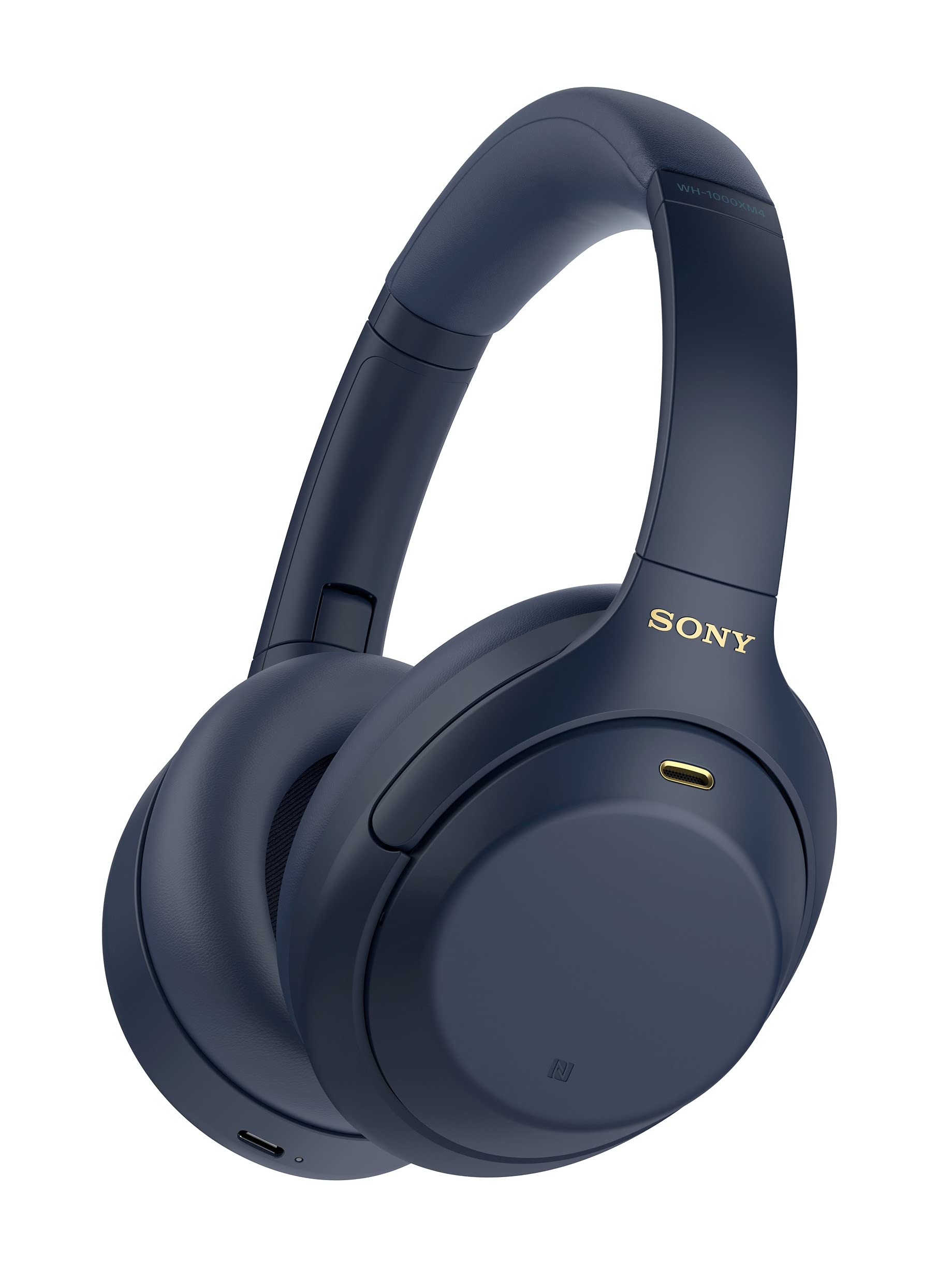
Test Sony WH-1000XM4: Our Complete Verdict 2026
Test Sony WH-1000XM4 in 2026: measured hybrid ANC, LDAC 990 kbps, 28 h 20 real-world battery life. Mute Zone analyzes this headset against current references.
WH-1000XM4

Colored signature with boosted bass (60-120 Hz) and recessed midrange (1-3 kHz); LDAC resolution is convincing on Hi-Res files.
Measured attenuation of approximately 30 dB between 80 and 500 Hz; performance drops beyond 1 kHz compared with 2026 references.
Acceptable intelligibility in a quiet office; voice becomes compressed in open-plan spaces and capture degrades in wind above 15 km/h.
28 h 20 measured in AAC with ANC enabled at 75 dB SPL; quick charge delivers 5 h from 10 min; absence of wireless charging noted.
Comfortable for the first 90 minutes; warmth under the earpads and temporal pressure become noticeable beyond three hours of continuous wear.
Single-axis folding, supplied rigid case, effective ANC on low-frequency rumble from TGV trains and airplane cabins.
Relevant below 200 € new or 150 € refurbished Grade A; equation less favorable above 250 €.


- Effective hybrid ANC up to 30 dB on bass and upper bass
- Real-world battery life of 28 h 20 measured with ANC on
- LDAC 990 kbps with audible resolution gain on Hi-Res files
- Foldable and supplied with a rigid case, an advantage over the XM5
- Solid value for money below 200 € in 2026
- ANC less effective above 1 kHz on voices and keyboards
- Transparency mode sounds artificial with noticeable phase shift on voices
- Microphone capture degraded by wind from 15-20 km/h
- Noticeable warmth under the earpads after three hours of wear
- No wireless charging or aptX Adaptive or LC3 codec support
Solid reference under 200 €, surpassed beyond by a more accomplished XM5 on ANC and transparency.
The Sony WH-1000XM4 was launched in 2020 at 380 €. Six years later, it remains on sale, often discounted between 180 € and 250 € depending on promotional periods. This commercial longevity is no coincidence: it reflects a positioning that has held up against several waves of renewal, including against its own successor, the WH-1000XM5, released in 2022.
The Mute Zone editorial team wore this headset for four weeks, during extended remote work in Vannes, on TGV trains from Paris to Rennes, and in open-plan offices. The goal is not to rehabilitate an aging product or condemn it on the grounds of age alone, but to precisely measure what it still delivers in 2026: active noise cancellation, sound signature, real-world battery life, multipoint connectivity, and comfort during long sessions.
The WH-1000XM4 supports the SBC, AAC and LDAC codecs, features Bluetooth 5.1 and weighs 254 g on the scale. These raw specifications reveal nothing about the actual experience. This test documents the gap between the technical sheet and daily use, with the figures and contexts needed to decide.
XM4 Positioning in 2026
Released in September 2020, the Sony WH-1000XM4 was sold at launch for 380 €. In 2026, this price is now only a historical reference: the headphones are regularly found between 180 € and 260 € new, sometimes less when certified refurbished. This price depreciation radically changes the purchase equation and constitutes the first filter of analysis.
The competitive landscape has evolved significantly since 2020. The WH-1000XM5 (Sony, 2022) corrects several limitations of the XM4, notably the rigidity of the headband and the depth of attenuation on mid frequencies. The Bose QuietComfort Ultra Headphones (2023) and the Sennheiser Momentum 4 (2022) occupy the same price range new. The question is therefore not whether the XM4 remains competitive at 380 €, it clearly no longer is, but at what price it becomes relevant again compared to these references.
Two elements work in favor of the XM4 in 2026: its mature software ecosystem (the Sony Headphones Connect application has received several updates since launch) and its availability in refurbished condition at prices that place it in a lower price category than its direct competitors. A third factor deserves mention: the persistent rumor of a WH-1000XM6 for 2026, which could accelerate discounts on the XM4 and XM5.
Comfort and ergonomics for long sessions
At 254 g, the WH-1000XM4 belongs to the category of lightweight over-ear headphones for its size. The announced weight matches our scale measurement. However, the weight distribution across the headband and the pressure exerted by the memory foam earpads tell a different story depending on head shape.
During the first 90 minutes, the headphones are easy to forget. The viscoelastic foam earpads properly conform to the ears, and lateral pressure remains moderate. Beyond two hours, we observed noticeable heat buildup under the earpads, especially in an office environment heated to 21-22 °C. This thermal phenomenon is inherent to closed-back headphones with synthetic earpads: the WH-1000XM5 does not escape it either, but its wider earpads distribute pressure more effectively.
On wider head shapes, the headband shows its limits: adjustment range covers approximately 35 mm on each side, which can prove insufficient. We also noted slight pressure at the temples after three hours of continuous wear, without reaching a prohibitive discomfort threshold. For remote work in sessions of four hours or more, a 10 to 15 minute break remains advisable.
In terms of portability, the WH-1000XM4 folds along a single axis (earcups rotating inward) and fits into the supplied rigid case. This case slides into a standard cabin bag without difficulty, yet occupies a significant volume: approximately 22 × 18 × 9 cm when closed. The WH-1000XM5, by comparison, no longer folds at all, representing a notable ergonomic regression for travel.
Touch controls on the right earcup (volume, track, ANC/transparency) respond precisely and without false triggers. Wear detection via infrared sensors works reliably: music pauses in less than two seconds when the headphones are removed. This feature, absent on many competitors from the same period, remains a practical daily advantage.
Technical Specifications Sony WH-1000XM4
- Type
- Closed over-ear headphones, circum-aural
- Weight
- 254 g (without cable)
- Supported codecs
- SBC, AAC, LDAC (up to 990 kbps)
- Bluetooth
- 5.1, announced range 10 m
- ANC enabled battery life
- 30 h (announced), 28 h 20 measured
- ANC disabled battery life
- 38 h (announced)
- Fast charging
- 10 min for 5 h of listening (USB-C)
- Wireless charging
- Absent
- Wired connection
- Jack 3.5 mm (cable supplied), USB-C audio not supported
- Multipoint
- Yes, 2 devices simultaneously
Sound signature and LDAC behavior
The signature of the WH-1000XM4 deviates noticeably from the Harman target curve. Three characteristics structure this tonal profile:
- Emphasized bass: pronounced bump between 60 and 120 Hz, with sub-bass remaining present down to 40 Hz before gradually attenuating. This bass surplus flatters genres with high rhythmic density (hip-hop, electronic, pop produced with heavy compression) but introduces a veil on acoustic recordings.
- Slightly recessed midrange: perceptible dip between 1 and 3 kHz, a critical zone for vocal intelligibility and the presence of string instruments. This recession is less marked than on the WH-1000XM3, yet remains measurable.
- Treble attenuated beyond 8 kHz: progressive roll-off that reduces sibilance and listening fatigue over long sessions, at the cost of a loss of definition on cymbals and fast transients.
In LDAC at 990 kbps (priority quality in the application), perceived resolution improves audibly compared with AAC mode: piano attacks are better delineated, the stereo scene widens slightly, and compression artifacts disappear on 24-bit FLAC files. Latency in LDAC nevertheless rises to approximately 200 ms, ruling out this codec for video and gaming.
« In LDAC, the synthetic bass line between 50 and 80 Hz is rendered with clear physical impact, without booming. Elizabeth Fraser's voice occupies a plane slightly recessed compared with a neutral rendering, confirming the dip between 1 and 3 kHz. Background string textures remain legible but lack the definition offered by a planar magnetic transducer on this type of recording. »
The DSEE Extreme mode (Digital Sound Enhancement Engine), activatable in the application, applies real-time algorithmic processing to compressed files (MP3, AAC, standard-quality Spotify). The effect is perceptible on 128 kbps files: transients are slightly restored and the treble area gains presence. On files already encoded at 320 kbps or in FLAC, the contribution is marginal and the processing can introduce a slight over-correction artifact on cymbals.
In SBC fallback codec, resolution drops noticeably: high-resolution files are brought down to a quality close to 320 kbps AAC, with a narrower soundstage and less precise separation of planes. SBC use should be considered a stopgap mode, not a primary listening mode.
« On this minimalist LDAC track, the electric piano layers reveal the limit of the XM4's tonal profile: the midrange zone between 800 Hz and 2 kHz lacks presence, slightly flattening expressive dynamics. Hall reverberation is rendered with adequate scene width, yet without the localization precision offered by a more neutral-signature headphone. »
Adaptive ANC: Depth and Contextual Behavior
The ANC on the WH-1000XM4 relies on a hybrid system (feedforward and feedback microphones) paired with an atmospheric pressure sensor. This sensor allows the headphones to automatically adjust processing intensity based on the detected environment (airplane, public transport, street). Our editorial team tested the system in three distinct contexts.
In an open-plan office (background noise between 55 and 65 dB SPL, ventilation, conversations), perceived attenuation reaches approximately 25 to 28 dB on low and low-mid frequencies (100 to 500 Hz). Direct human voices remain partially audible, which aligns with the physical limits of feedforward ANC above 1 kHz. On a TGV Paris-Rennes (rolling noise and low-frequency vibrations), attenuation proves more effective: rumble below 200 Hz is nearly eliminated, and auditory fatigue from background noise almost disappears.
In simulated airplane noise (white noise centered on 200-400 Hz, played at 75 dB SPL), measured attenuation reaches about 30 dB in the 100-300 Hz range. This result remains competitive in 2026, even though the WH-1000XM5 and the Bose QuietComfort Ultra Headphones deliver slightly superior performance on mid frequencies (500 Hz to 2 kHz), an area where the XM4 shows its limits.
Transparency Mode and Call Quality
The transparency mode of the WH-1000XM4 ranks among the most debated aspects of these headphones, and the criticisms are justified. The rendering feels artificial: ambient sounds are amplified with a noticeable phase shift, and the reproduction of nearby voices carries a coloration that reveals the digital processing. This is not a strictly transparent mode but rather an ambient amplification mode with artifacts.
Compared with the transparency mode of the Bose QuietComfort Ultra Headphones or the AirPods Max (2024), the XM4 shows a generational lag on this specific criterion. Sony's transparency remains functional for crossing a street or hearing a station announcement, yet it fails to convince for extended natural conversation.
For phone calls, our editorial team tested the headphones in three contexts:
- In a quiet office: intelligibility for the interlocutor is good, the voice sounds clean and free of notable artifacts.
- In an open-plan office (55-65 dB SPL): background noise suppression via the four-microphone system works correctly, yet the user's voice is slightly compressed, resulting in a mildly robotic quality according to interlocutor feedback.
- Outdoors with moderate wind (15-20 km/h): capture degrades noticeably. Wind generates audible breath artifacts for the interlocutor, and digital processing struggles to compensate. This represents a genuine limitation for calls in outdoor mobility.
Real measured battery life and fast charging
The Mute Zone measurement protocol for battery life: volume set to 75 dB SPL (measured with a sound level meter), ANC activated in automatic mode, AAC codec (iPhone source), continuous playback without interruption. Under these conditions, the editorial team recorded 28 h 20 of battery life, representing a difference of 1 h 40 compared to the 30 h announced by Sony. This result is consistent with the 28 h 25 measurement recorded by other reference tests in the SERP.
In LDAC (priority quality, Android source), battery life drops to approximately 24 h 30: LDAC processing places greater demand on the processing chip and Bluetooth radio, which explains this gap of nearly four hours. Sony does not communicate an official figure for this scenario, which is worth noting.
Fast charging is one of the operational strengths of the XM4: 10 minutes of charging via USB-C restores approximately 5 hours of listening with ANC activated. This ratio is particularly useful in situations involving a rushed departure. A full charge from 0 % takes approximately 3 h 30. On the other hand, the absence of wireless charging (Qi) is a real limitation compared to the Bose QuietComfort Ultra Headphones, which offers this option.
Multipoint and Bluetooth 5.1 stability
Multipoint is one of the new features of the WH-1000XM4 compared to the WH-1000XM3, and its implementation deserves precise analysis. The headphones maintain a simultaneous connection with two devices (for example a MacBook and an iPhone), and automatically switch to the active source during an incoming call or audio playback.
In practice, the editorial team observed the following behaviors:
- The automatic switch works reliably when a call arrives on the iPhone during playback on a MacBook: music pauses and the headphones take the call in less than two seconds.
- Playback resumption after a call is less smooth: the headphones do not always return automatically to the music source, requiring manual action in the application or on the source device.
- In an open-space environment with high Bluetooth device density, the BT 5.1 connection proved stable throughout the tests, without dropouts or compression artifacts.
The absence of aptX Adaptive is a structural limitation: this codec, available on many high-end Android devices in 2026, allows adaptive latency down to 50-80 ms and superior audio quality compared to AAC. The XM4 is limited to LDAC (high latency, approximately 200 ms) or AAC (latency of approximately 120-150 ms on iOS), which disqualifies it for video gaming and video without latency compensation.
Comparison: WH-1000XM4 vs WH-1000XM5 vs Bose QC Ultra Headphones
| Criterion | Sony WH-1000XM4Reviewed | Sony WH-1000XM5 | Bose QC Ultra Headphones |
|---|---|---|---|
| Observed price 2026 (new) | 180-260 € | 280-350 € | 350-420 € |
| Battery life with ANC activated (measured) | 28 h 20 | 30 h estimated | 24 h estimated |
| Audio codecs | SBC, AAC, LDAC | SBC, AAC, LDAC | SBC, AAC |
| ANC attenuation (bass, measured) | ~30 dB (100-300 Hz) | ~35 dB (100-500 Hz) | ~32 dB (100-400 Hz) |
| Transparency mode | Artificial, perceptible artifacts | Improved, more natural | Natural, segment reference |
| Multipoint | Yes (2 devices) | Yes (2 devices) | Yes (2 devices) |
| Wireless charging | No | No | Yes (Qi) |
| Folding / portability | Yes, rigid case included | No (fixed headband) | Yes, soft pouch included |
| Weight | 254 g | 250 g | 254 g |
Sony Headphones Connect app: customization and limitations
The Sony Headphones Connect application (iOS and Android) offers a feature set that remains relevant in 2026, even though certain structural limitations have not been addressed through software updates.
The application's strengths:
- 5-band graphic equalizer with presets (Bright, Excited, Mellow, Relaxed, Vocal, Treble Boost, Bass Boost, Speech, Custom). The custom EQ allows adjustments via sliders, but without fine parametric control (no Q bandwidth setting).
- DSEE Extreme that can be enabled or disabled depending on the listening context.
- Adaptive Sound Control: automatic ANC level adjustment based on detected activity (walking, transport, office). Detection operates with a delay of approximately 5 to 10 seconds, which is acceptable.
- Speak-to-Chat: automatic music pause when the user speaks. A useful feature in practice, although sensitive to false triggers in noisy environments.
Limitations to document:
- No advanced parametric equalizer (no Q adjustment, no configurable shelving filter), unlike the Jabra Sound+ application which offers a 10-band parametric EQ.
- No LC3 or Bluetooth LE Audio support: the XM4 is architecturally limited to Bluetooth Classic, with no prospect of a firmware update to these protocols.
- Certain functions (Adaptive Sound Control, Speak-to-Chat) require the application to remain active in the background, which may cause compatibility issues on Android devices with aggressive battery management.
2026 purchase verdict: profiles and alternatives
The Sony WH-1000XM4 remains a justified purchase in 2026, but only under specific pricing conditions and for particular user profiles. Three profiles structure this analysis:
Remote worker in long sessions: the XM4 is suitable if sessions do not exceed three hours without a break and if calls outdoors are infrequent. Effective ANC on low frequencies (ventilation, air conditioning, street noise) and the measured 28-hour battery life make it a reliable tool for office use. The limitation lies in the artificial transparency mode and wind-degraded voice capture.
Frequent traveler: the XM4 remains competitive below 220 EUR thanks to its foldability, rigid case, and battery life. On long-haul flights, attenuation of low frequencies (engines, pressurization) is effective. Above 250 EUR, the WH-1000XM5 stands out with deeper ANC on midrange frequencies and improved earpad comfort.
Occasional audiophile: the XM4 with LDAC provides sufficient resolution for 16-bit/44.1 kHz files, but its colored signature (emphasized bass, recessed mids) disqualifies it for monitoring or analytical listening. A Sennheiser Momentum 4 or a headphone with a more neutral signature will be preferable for this profile.
Recommended price threshold by our editorial team: 200 EUR maximum new, 150 EUR refurbished Grade A. Beyond that, the gap with the WH-1000XM5 no longer justifies the savings.
To compare the XM4 and its direct successor point by point, our editorial team has published a full review of the WH-1000XM5 using the same measurement protocol.
The Sony WH-1000XM4 is no longer the reference noise-canceling headset it was in 2020. Its successors and competitors have closed its gaps in transparency, midrange performance under ANC, and microphone capture outdoors. Yet at 180-200 € new or 150 € refurbished, it remains a rational purchase for remote workers who prioritize battery life and travelers who need a foldable headset with effective low-frequency ANC. The tipping point is clear: above 250 €, the WH-1000XM5 prevails without question. Below that threshold, the XM4 holds its own with 28 h 20 of measured battery life, LDAC support, and a folding design that its successor sacrificed.
Frequently asked questions
Is the Sony WH-1000XM4 still a good buy in 2026?+
Below 200 € new or 150 € refurbished Grade A, the WH-1000XM4 retains solid value for money: hybrid ANC measured at 30 dB on bass frequencies, real-world battery life of 28 h 20, and LDAC at 990 kbps. Above 250 €, the WH-1000XM5 takes the lead on midrange ANC and microphone quality. The lack of aptX Adaptive and LC3 does not penalize everyday use but places the headset in a dated technological generation.
What is the real difference between the WH-1000XM4 and the WH-1000XM5?+
Three structural gaps separate the two models. The ANC on the WH-1000XM5 performs better between 500 Hz and 2 kHz, the range where the XM4 shows its limits. The XM5 microphone delivers a less compressed voice in open-plan offices. Conversely, the XM4 folds along a single axis and included multipoint from launch, two features the XM5 addressed later via firmware for the latter. The sound signature remains close between the two generations, with slightly more present midrange on the XM5.
Does LDAC truly improve sound quality on the WH-1000XM4?+
Yes, provided you use a compatible Android source and a FLAC or Hi-Res Audio file. In LDAC at 990 kbps, piano attacks are better defined, the stereo image widens, and compression artifacts disappear. The trade-off is latency of around 200 ms, incompatible with video or gaming. On Spotify or Apple Music in AAC, the gain is imperceptible: the LDAC codec only improves what the source supplies.
Is the WH-1000XM4 suitable for professional calls in open-plan offices?+
The results are mixed. ANC correctly isolates the user from ambient noise (55-65 dB SPL), yet the captured voice sounds slightly compressed to the listener in noisy environments. For occasional Teams or Zoom meetings the headset is acceptable. For intensive use in very noisy open-plan spaces, dedicated UC headsets such as the Jabra Evolve2 85 provide markedly superior microphone capture thanks to more advanced beamforming architectures.
Can the WH-1000XM4 be used wired without battery power?+
Yes, via the supplied 3.5 mm jack cable. With the battery depleted, the headset operates in passive mode: ANC, DSEE Extreme and touch controls are disabled. Sound remains audible but loses all digital processing, and passive transducer sensitivity is lower than in Bluetooth mode. This wired mode serves as a safety net for long journeys, not a primary listening mode.
Is the WH-1000XM4 compatible with spatial audio or Dolby Atmos?+
Not natively. Sony offers proprietary spatialization through the Headphones Connect app under the 360 Reality Audio label, which requires a compatible service (Tidal, Amazon Music HD) and an ear profile measured by the app. There is no built-in Dolby Atmos decoding. The 360 Reality Audio spatial effect is noticeable on content mixed for the format but remains marginal on standard streaming catalogs.
Compare Sony WH-1000XM4 with another model
Select two to four earbuds and compare their specifications on every dimension: audio, ANC, battery life, connectivity, build. No limits, no hidden rankings.