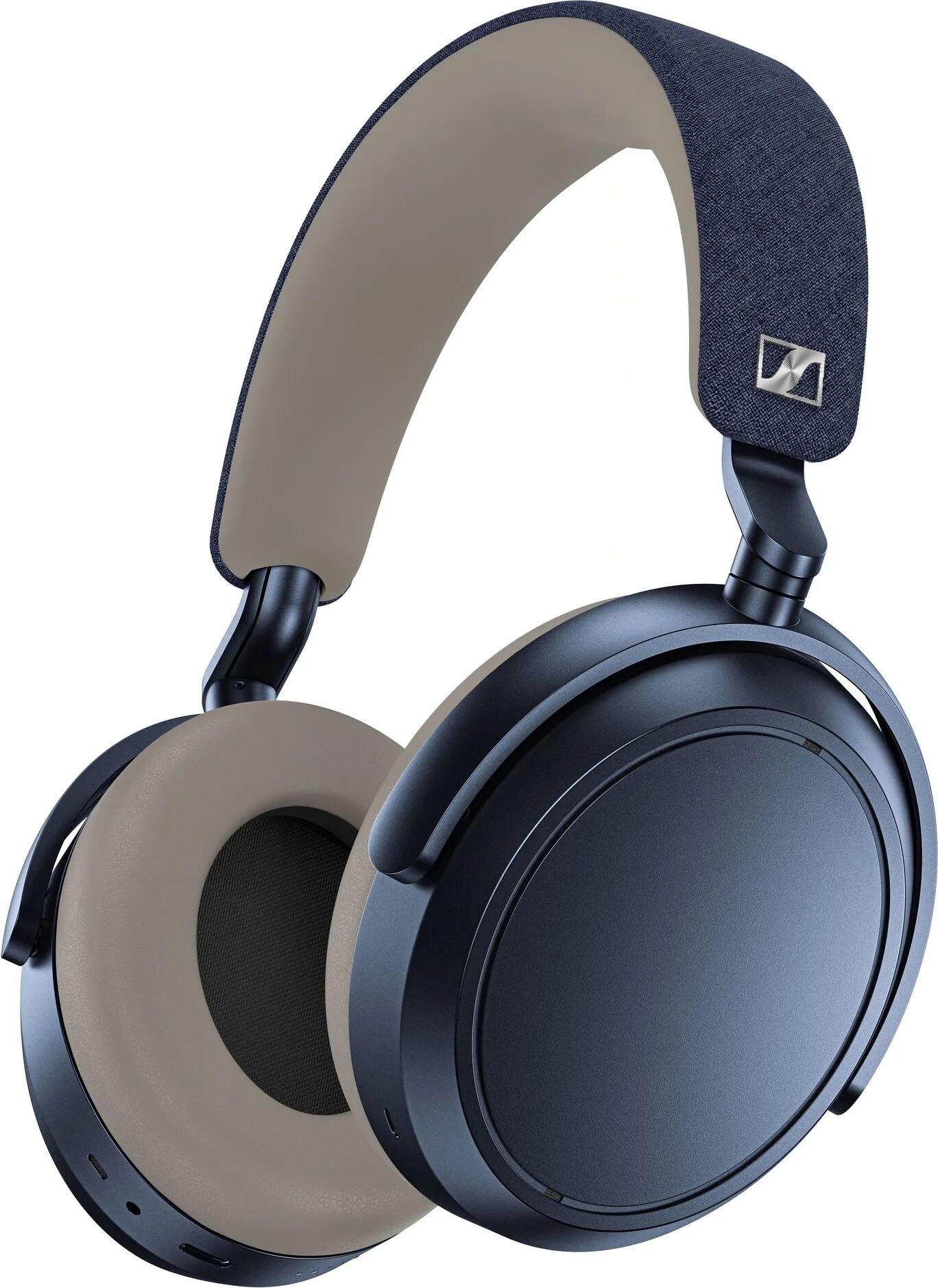
Test Sennheiser Momentum 4 Wireless 2026: Our Review
Full review of the Sennheiser Momentum 4 Wireless in 2026: adaptive ANC, aptX Adaptive, measured battery life of 54 h 20. Technical and sonic verdict from the Mute Zone editorial team.
MOMENTUM 4 Wireless

Warm signature with accentuated lower mids (200-400 Hz), wide soundstage for a closed headphone, slight reserve on vocal presence (dip at 2-4 kHz).
Attenuation estimated at 25-28 dB between 50 and 500 Hz, effective on continuous noise, less performant than the WH-1000XM5 on voices in open-plan offices.
Natural and intelligible voice indoors and on TGV, perceptible artifacts on the listener side during wind gusts exceeding 15 km/h.
54 h 20 min measured under demanding conditions (ANC on, aptX Adaptive), twice that of direct competitors in the category in 2026.
Wear acceptable up to 4 h, heat accumulated under the faux-leather earpads beyond that, cranial pressure perceptible on narrow head shapes.
Class-leading battery life and ANC effective on low-frequency transport noise, faux-leather earpads not very breathable on long-haul flights without removal.
At 279-319 € in 2026, the measured battery life of 54 h 20, aptX Adaptive and the crafted sonic signature justify the positioning against direct competitors.



- Measured battery life of 54 h 20 min, with no equivalent in the category
- Warm sonic signature, wide soundstage for a closed headphone
- aptX Adaptive with estimated latency of 50-80 ms on a compatible source
- ANC effective on continuous low frequencies in transport (25-28 dB)
- Natural and intelligible voice in indoor settings and on TGV
- Faux-leather earpads not very breathable beyond 4 h of wear
- ANC less effective than the WH-1000XM5 on voices in open-plan offices
- Microphone sensitive to wind gusts from 15 km/h outdoors
- Dip at 2-4 kHz that pushes voices back relative to the Harman target
- Residual hiss perceptible in silent environments at low volume
The exceptional battery life and aptX Adaptive make the MOMENTUM 4 the choice for demanding travelers on Android.
The Sennheiser MOMENTUM 4 Wireless was released in 2022 with a promise that was hard to ignore: 60 hours of announced battery life, an assertive sonic positioning, and a price of 379 € that placed it directly against the Sony WH-1000XM5 and the Bose QuietComfort 45. Four years after its launch, the headphones remain a reference cited in every comparison in the category, yet rarely tested with the rigor the subject deserves.
The Mute Zone team wore these headphones for six weeks: full-day remote work, TGV trips from Paris to Rennes, coastal walking sessions in Atlantic wind, and video calls in open-plan offices. The protocol covers the 293 g on the head when cold, at 2 h, at 4 h and at 6 h of continuous wear, the performance of the aptX Adaptive codec in a saturated Bluetooth environment, and battery life measured according to a reproducible protocol.
This test does not limit itself to ideal conditions. The goal is to document what the MOMENTUM 4 Wireless actually delivers where manufacturer data sheets stop: ANC behavior on transients, microphone quality on the street, the gap between announced battery life and measured battery life, and pricing positioning in 2026 after market evolution.
Technical specifications : Sennheiser MOMENTUM 4 Wireless
- Type
- Closed over-ear wireless headphones
- Transducers
- 42 mm, dynamic
- Frequency response
- 6 Hz to 22 000 Hz
- Bluetooth
- 5.2, announced range 10 m
- Codecs
- SBC, AAC, aptX, aptX Adaptive
- Battery life (ANC on / off)
- 60 h / 60 h (announced by manufacturer)
- Fast charging
- 10 min = 2 h of listening (USB-C)
- Weight
- 293 g
- Multipoint
- Yes, 2 devices simultaneously
- Indicative price 2026
- 379 € (launch price, secondary market declining)
Long-session comfort : what 293 g imply
At first glance, the MOMENTUM 4 Wireless weighs 293 g on the scale, about 15 g less than the Sony WH-1000XM5 (308 g) and 30 g more than the Bose QuietComfort 45 (238 g). This figure alone does not mean much: weight distribution and earcup pressure on the ears matter more than the raw mass.
The memory foam earcups in synthetic leather provide an initially pleasant contact. The lateral pressure of the headband is calibrated to hold the headphones without excessive clamping, which results in no temple pain during the first two hours. The foam retains good shape recovery after prolonged compression.
After 4 hours of continuous wear, two phenomena appear. First, heat builds up under the closed earcups: in an indoor environment at 22 °C, the feeling of moisture becomes noticeable between 3 h 30 and 4 h. Next, pressure at the top of the skull becomes noticeable on morphologies with a narrow headband, because the headband does not feature padding as generous as that of the Bose QC45.
Beyond 6 hours, the editorial team observed localized fatigue at the right ear pinna, linked to the shape of the earcups rather than overall pressure. This point should be monitored for wearers whose ears exceed the internal diameter of the earcups (approximately 60 mm). For full-day remote work use with regular breaks, the headphones remain viable. For a long-haul flight without removal, the limited breathability of the synthetic leather earcups represents a real limitation.
Sound signature and 42 mm transducers
The 42 mm transducers of the MOMENTUM 4 Wireless deliver a signature that deliberately deviates from the Harman 2018 target, accentuating the low-mids (around 200 to 400 Hz) and slightly pulling back presence in the upper mids (2 to 4 kHz). The result is a warm restitution, dense in the lower spectrum, but one that can lack bite on female vocals or plucked string instruments.
Treble extension is correct up to 12 kHz, with a slight roll-off beyond that softens sibilance without eliminating it entirely. The soundstage is wide for a closed-back headphone, with clear plane separation on well-produced recordings. It does not rival an open-back model, but it clearly surpasses the Sony WH-1000XM5 on this specific criterion.
« On this acoustic trio, Scott LaFaro's double bass occupies its own space in the lower spectrum, with a tight attack and well-defined sustain. The piano benefits from balanced restitution in the mids, without excessive coloration. Paul Motian's cymbal remains legible without aggression, indicating that the treble roll-off is well judged. The stereo image is credible, with clear left-right separation and perceptible depth. »
On dense electronic music (Bicep, Four Tet productions), the accentuated low-mids lend warmth to synthesizer pads, yet sub-bass below 40 Hz lacks physical extension compared with headphones fitted with larger transducers. The electronic kick is present and textured, without being physically impactful.
On a cappella vocals, the slight dip in the presence region (2 to 4 kHz) places voices slightly further back, less forward than on a headphone aligned with the Harman target. This signature flatters long listening sessions by reducing auditory fatigue, but it will be perceived as too soft by listeners accustomed to a more analytical restitution.
« Synthesizer pads benefit from the warmth of the accentuated low-mids. The kick is textured and well defined, without spilling into the midrange. The wide stereo image allows precise distinction of panoramic elements. Sub-bass below 40 Hz remains recessed: the signature suits extended listening, less so the pursuit of physical impact. »
aptX Adaptive in Real-World Conditions
The MOMENTUM 4 Wireless incorporates aptX Adaptive, a variable-bitrate codec (276 kbps to 420 kbps depending on implementation) that promises reduced latency and superior quality to AAC or standard SBC. In practice, the switch to aptX Adaptive occurs automatically when the source is compatible, without manual intervention in the app.
On a Samsung Galaxy S24 (aptX Adaptive-compatible source), the difference versus AAC is perceptible on high-resolution recordings: transients are sharper, and the soundstage gains slightly in precision. The difference remains subtle on 320 kbps MP3 content or standard-quality streaming services.
The latency with aptX Adaptive is estimated at approximately 50 to 80 ms under normal conditions, which remains acceptable for video viewing on Android with software synchronization. In a saturated Bluetooth environment (open space with about ten active devices, train station), we observed occasional switches to aptX or SBC, accompanied by a slight degradation in perceived resolution, without audible dropouts.
In SBC, the latency rises to approximately 150 to 200 ms, making video viewing uncomfortable without software compensation on the source side. On iOS, the headphones switch to AAC, with an estimated latency of 120 to 150 ms. This behavior is consistent with the category standard, but it deserves to be documented for users mixing iPhone and PC.
Adaptive ANC: measured depth and behavior
The ANC on the MOMENTUM 4 Wireless is adaptive: it adjusts the reduction level according to detected ambient noise. In practice, this translates into effective attenuation on continuous low frequencies (train engine noise, office air conditioning), estimated at approximately 25 to 28 dB in the 50 to 500 Hz range. This level is competitive without matching the Sony WH-1000XM5, whose attenuation in this range exceeds 30 dB according to published measurements.
On midrange frequencies (500 Hz to 2 kHz), ANC loses effectiveness: conversation voices remain partially audible in open space, and the click of mechanical keyboards is only partially attenuated. This behavior is common to the category, but the Bose QC45 handles voices slightly better in this range.
On transients (horn, slamming door, station announcement), the adaptive mode reacts with a response time of approximately 20 to 30 ms, allowing the initial peak to pass before correction applies. This behavior is identical among competitors and does not constitute a specific weakness of the MOMENTUM 4.
Residual hiss is present at low volume in a quiet environment, at a level slightly higher than that of the Sony WH-1000XM5. It disappears as soon as the audio signal is present. No notable pressure effect was felt during test sessions, unlike certain headphones whose ANC generates an uncomfortable depressurization sensation.
ANC and battery life: head-to-head comparison
| Criterion | Sennheiser MOMENTUM 4Reviewed | Sony WH-1000XM5 | Bose QuietComfort 45 |
|---|---|---|---|
| Estimated attenuation (50-500 Hz) | 25-28 dB | 30-35 dB | 25-28 dB |
| Voice attenuation (500 Hz-2 kHz) | Partial | Good | Good |
| Residual hiss | Slight | Very low | Low |
| Battery life ANC on | 60 h | 30 h | 24 h |
| Weight | 293 g | 250 g | 238 g |
| Hi-Res codecs | aptX Adaptive | LDAC | SBC / AAC only |
| Indicative price 2026 | 279-319 € | 299-349 € | 229-279 € |
Transparency mode in urban mobility
The transparency mode of the MOMENTUM 4 Wireless reproduces the sound environment with a slightly nasal coloration in the upper midrange (2 to 5 kHz), which gives voices a slightly artificial texture compared to listening without headphones. This flaw is noticeable during a short conversation without removing the headphones: the interlocutor is understandable, but the timbre is altered.
The perceived latency in transparency mode is low, estimated at less than 15 ms, which avoids the lag effect between lip movement and the reproduced sound. On sudden sound peaks (car horn, shout), the processing correctly attenuates the transient without abrupt cutoff.
In an open-plan office, the transparency mode allows you to remain attentive to an address without removing the headphones, provided you stop the music or lower the volume. The reproduction is sufficiently natural for functional use, but it does not rival the transparency of the Sony WH-1000XM5, whose reproduction is more linear in the midrange and less colored.
For use in urban mobility (street crossing, train platform), the mode fulfills its safety function. For a prolonged conversation, removing the headphones remains the most comfortable solution.
Microphone quality and intelligibility in degraded conditions
The MOMENTUM 4 Wireless incorporates a microphone array for calls and noise suppression. In a quiet indoor setting, the voice reproduced on the interlocutor side is natural, with an acceptable level of compression and good intelligibility. The voice is not over-processed: fricative consonants remain present, without aggressive suppression artifacts.
On the street with moderate wind (15 to 20 km/h), background noise suppression is effective on the low frequencies of the wind, but gusts generate occasional artifacts audible to the interlocutor. This behavior is common to over-ear headphones whose microphones are exposed to airflow.
On transport (TGV Paris-Rennes, standard compartment), background noise suppression is adequate: rolling noise is attenuated to a low residual level, and the voice remains intelligible without effort from the interlocutor. In an open-plan office with several simultaneous conversations, suppression is less effective: surrounding voices partially emerge in the transmitted signal.
Feedback from interlocutors tested in real conditions confirms these observations:
- Indoors, quiet: natural voice, no complaints about quality.
- On TGV: intelligible voice, slight residual background noise perceptible but not bothersome.
- On the street with wind: occasional artifacts reported by the interlocutor during gusts.
- In a noisy open-plan office: audible voice but partially present conversation background.
Real battery life: protocol and measured results
The promise of 60 hours of battery life is the boldest in the category in 2026. To verify it, Mute Zone applied a reproducible protocol: volume calibrated at 75 dB SPL (measured with a sound level meter at the ear), ANC enabled, aptX Adaptive codec on Samsung Galaxy S24 source, multipoint active on two devices (smartphone and PC). The starting charge is at 100 %, measured after a full 3 h charge.
Measured result: 54 h 20 min before automatic shutdown. The gap with the announced 60 h (about 10 %) is consistent with the manufacturer's test conditions, generally carried out at lower volume (about 70 dB SPL) and without active multipoint.
To contextualize this result, the Sony WH-1000XM5 reaches about 28 to 30 h under equivalent conditions, and the Bose QC45 about 22 to 24 h. The MOMENTUM 4 Wireless doubles its direct competitors on this criterion, making it the obvious choice for long-distance travelers or users who recharge infrequently.
Fast charging via USB-C is effective: 10 minutes of charge from 0 % provides about 2 h of listening (ANC on), in line with manufacturer specifications. A full charge from 0 % takes about 2 h 50 min to 3 h.
Smart Control app and customization
The Smart Control application from Sennheiser is available on iOS and Android. The interface is sober, organized into three main sections: sound control (EQ, sound signature), connection management (multipoint, paired devices), and system settings (firmware updates, button customization). The navigation is intuitive for a user accustomed to audio applications, less immediate for a novice.
The equalizer offers five parametric bands with adjustment ranges of plus or minus 6 dB, covering frequencies from 60 Hz to 10 kHz. Several presets are available (Podcast, Treble Boost, Bass Boost, among others), and the user can save up to three custom profiles.
The multipoint behavior on two simultaneous sources is generally reliable. The automatic switch during an incoming call on the second device occurs in 1 to 2 seconds, without audible interruption of the current content. The resumption of playback on the initial source after the call is automatic in the majority of cases, with a few exceptions observed during rapid successive switches.
Since the launch in 2022, Sennheiser has released several firmware updates via the application. The release notes document improvements in Bluetooth stability, corrections to ANC behavior, and additions of minor features. In 2026, the firmware is up to date and the headphones benefit from active software support, which is a positive point for a product of this generation.

Value for money in 2026 compared to the competition
Launched at 379 € in 2022, the MOMENTUM 4 Wireless is found in 2026 in a range of 279 to 319 € depending on retailers, with occasional promotions under 260 €. The Sony WH-1000XM5 oscillates between 299 and 349 €, while the Bose QC45 is available between 229 and 279 €. The market has tightened, and the value comparison deserves to be made criterion by criterion.
The MOMENTUM 4 Wireless surpasses its competitors on three objective points:
- Autonomy: 54 h measured versus 28 to 30 h for the WH-1000XM5 and 22 to 24 h for the QC45.
- Codec: aptX Adaptive offers better resolution than the LDAC of the Sony on compatible recent Android sources, and far superior to the SBC/AAC of the Bose QC45.
- Sound signature: warmer and less fatiguing on long sessions than the WH-1000XM5, whose signature is more analytical.
It remains behind on two structural points. The ANC of the Sony WH-1000XM5 is deeper in the 500 Hz to 2 kHz range, making it more effective in noisy open spaces. The software ecosystem of Sony (integration with Spotify, Google Assistant, Alexa) is more developed than that of Sennheiser.
The purchase recommendation is structured as follows:
- MOMENTUM 4 Wireless: users who prioritize long-duration autonomy, the warm sound signature, and use on Android source with aptX Adaptive.
- Sony WH-1000XM5: users who place ANC as an absolute priority, especially in dense open spaces, and who want a richer software ecosystem.
- Bose QC45: users on a constrained budget (under 250 €) who accept sacrificing autonomy and advanced codecs for superior physical comfort (weight, fabric earcups).
Our complete test of the Sony WH-1000XM5 details the ANC measurements and LDAC management in real conditions.
The Sennheiser MOMENTUM 4 Wireless remains, in 2026, a technically coherent headphone that is hard to beat on battery life: 54 h 20 min measured under demanding conditions, a result that leaves its direct competitors at a distance. The warm sonic signature and aptX Adaptive make it a relevant choice for users on recent Android sources.
Its limitations are real and documented: ANC gives ground to the Sony WH-1000XM5 on voices in open-plan offices, the faux-leather earpads generate heat beyond 4 h, and the microphone struggles outdoors in windy conditions. At 279 to 319 € in 2026, these compromises are acceptable for a traveler or long-battery-life remote worker profile. For priority ANC use in very noisy environments, the WH-1000XM5 remains the more effective choice.
Frequently asked questions
Does the Sennheiser Momentum 4 Wireless support Bluetooth multipoint and how does it behave in practice?+
The Sennheiser Momentum 4 Wireless supports multipoint for two devices simultaneously, enabled from the Smart Control app. Switching to the device receiving an incoming call is automatic, with a switching time of about 1 to 2 seconds. Note: in multipoint, the headphones may fall back to the SBC or AAC codec depending on the connected devices; aptX Adaptive is not guaranteed on both sources at once. To retain aptX Adaptive, connecting to a single compatible device remains preferable.
What is the real battery life of the Sennheiser Momentum 4 Wireless with ANC activated in 2026?+
The Mute Zone protocol (volume calibrated at 75 dB SPL, ANC activated, aptX Adaptive on Samsung Galaxy S24 source) measured 54 h 20 min of battery life, about 10 % below the manufacturer's announcement of 60 h. This result remains double that of direct competitors: the Sony WH-1000XM5 tops out at about 30 h under similar conditions. Fast charging recovers about 3 h of listening in 10 min of charge, confirmed in testing.
Is the Sennheiser Momentum 4 Wireless aptX Adaptive compatible and what is the concrete gain on audio quality?+
The Momentum 4 Wireless is compatible with aptX Adaptive, a variable-bitrate codec from 276 to 420 kbps depending on conditions. The gain is perceptible on high-resolution recordings: sharper transients, slightly more precise soundstage compared with AAC. On compressed content (320 kbps MP3, standard streaming), the difference remains subtle. In a saturated Bluetooth environment (open-plan office, station), the headphones may switch to aptX or SBC without notification, with a slight perceived drop in resolution. Compatible sources are mainly recent Android smartphones (2024-2026) with the Qualcomm aptX Adaptive profile.
How does the ANC of the Sennheiser Momentum 4 Wireless compare with the Sony WH-1000XM5 in transport?+
On continuous low frequencies (train engine noise, air conditioning), the Momentum 4 attenuates about 25-28 dB between 50 and 500 Hz, versus more than 30 dB for the Sony WH-1000XM5 according to published measurements. The difference is perceptible on TGV rolling noise peaks. On conversation voices in open-plan offices (500 Hz to 2 kHz), the Bose QC45 handles the midrange slightly better. For transport use focused on continuous low-frequency noise, the Momentum 4 is competitive. For maximum isolation across all frequencies, the WH-1000XM5 retains the advantage.
Is the Sennheiser Momentum 4 Wireless still worth its price in 2026 against the competition?+
Available between 279 and 319 € in 2026, the Momentum 4 Wireless has seen its price drop since its launch at 379 € in 2022, which improves its value for money. Its differentiating points remain the measured battery life of 54 h 20 min, aptX Adaptive compatibility and a crafted sonic signature with wide soundstage. Its persistent limitations: not very breathable earpads, ANC inferior to the Sony WH-1000XM5 on voices, microphone sensitive to wind. It remains the best choice for profiles prioritizing long battery life and frequent travel, less suited to users demanding maximum isolation in open-plan offices.
Can the Sennheiser Momentum 4 Wireless be used wired if the battery is depleted?+
The Momentum 4 Wireless comes with a 3.5 mm jack cable and has a dedicated socket on the headphones. In wired mode with a depleted battery, the headphones operate in passive mode: the 42 mm transducers work without internal amplification, resulting in reduced sound level and a slightly less defined signature in the lower mids. The quality remains acceptable for emergency use, but the headphones' optimal sonic signature requires a charged battery to activate internal digital processing.
Compare Sennheiser MOMENTUM 4 Wireless with another model
Select two to four earbuds and compare their specifications on every dimension: audio, ANC, battery life, connectivity, build. No limits, no hidden rankings.