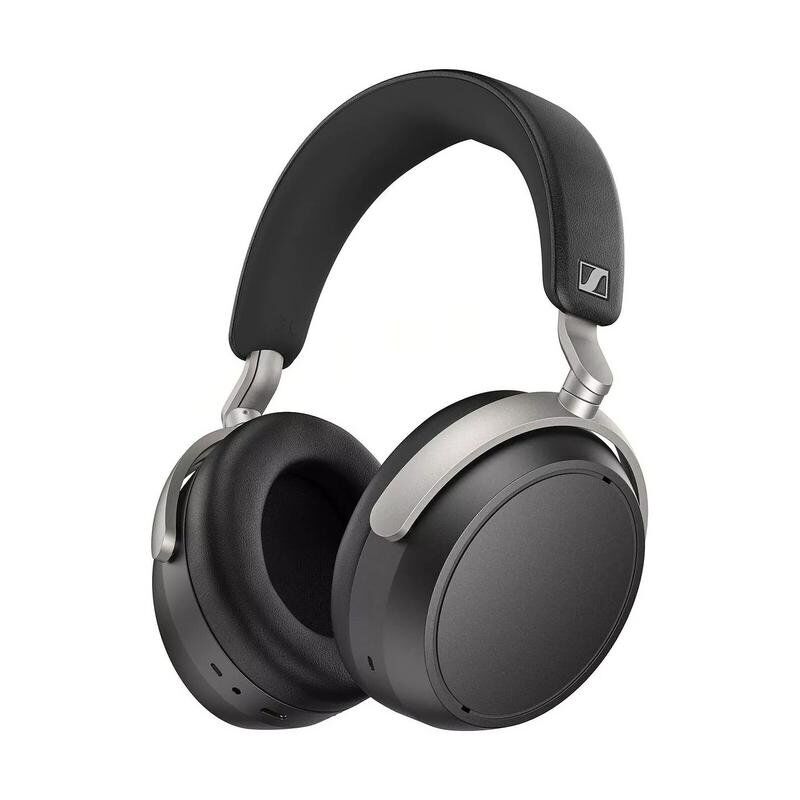
Sennheiser HDB 630 (2026) Test: Our Complete Verdict
Test of the Sennheiser HDB 630: aptX Lossless, adaptive ANC, 60 h battery life at 499 €. The Mute Zone team delivers its complete technical and sonic verdict.
HDB 630

Signature close to the Harman target with a slight withdrawal in the treble beyond 8 kHz, very solid in aptX Lossless.
Effective attenuation on low frequencies (34 dB), more limited on human voices (estimated 15 dB).
Good intelligibility indoors in calm conditions, noticeable degradation in windy environments or during transport.
Announced 60 h confirmed within plus or minus 3 h, minimal difference between ANC active and inactive.
311 g weighs on sessions beyond 5 h, despite 18 mm deep padding.
ANC relevant on rolling noise, practical transport kit despite partial folding.
Coherent positioning at 499 € thanks to aptX Lossless, an argument neither Sony nor B&W offers.


- aptX Lossless delivers rare fidelity in wireless
- Measured battery life close to 60 h, ANC active or not
- ANC highly effective on low frequencies (34 dB)
- Stable multipoint, source switch in 2.3 s
- 3.5 mm jack and flat-fold design for transport
- 311 g weight affects comfort after 5 h
- Microphone degraded by wind and in noisy environments
- ANC limited on human voices (estimated 15 dB)
- No LDAC, LC3 or Auracast compatibility
- Application less rich than Bose for fine ANC settings
A headphone tailored for aptX Lossless and battery life, less so for ultra-long sessions without a break.
The Sennheiser HDB 630 enters a segment where premium over-ear models compete over tenths of a dB in noise reduction and already comfortable hours of battery life. At 499 €, Sennheiser chooses a different angle: betting on aptX Lossless, a rare Qualcomm codec on a wireless headset, rather than an ANC specification war. The wager deserves an in-depth test.
The Mute Zone team wore this headset for more than three weeks: open-space sessions in Vannes, TGV Paris-Rennes trips with two round trips, extended video calls while working from home, and coastal walks with sustained Atlantic wind. The goal: verify whether the announced 60 h battery life, identical with ANC active or not, holds up under real mixed use, and whether the high-bandwidth codec makes a concrete difference versus a Sony WH-1000XM6 or a Bowers & Wilkins PX8.
This test covers nine distinct angles, from static and dynamic comfort to the relevance of the HDB 630 as a daily work tool, including ANC attenuation measurements, a comparative listening session across five music genres, and an unambiguous pricing decision table.
The 311 g weight put to the test
The HDB 630 registers 311 g on the scale, a figure that places it clearly above the Sony WH-1000XM6 (250 g) and the Bose QC45 (238 g), yet below the Bowers & Wilkins PX8 (330 g). On paper the difference seems anecdotal. In practice it translates into cumulative pressure on the temples that becomes noticeable beyond the second hour of continuous wear, especially without precise headband adjustment.
The editorial team timed three comfort stages during uninterrupted sessions:
- at 2 h, no notable discomfort, memory foam earpads evenly distributed over the pinna
- at 4 h, slight warmth around the ears, without pain or identifiable pressure point
- at 6 h, diffuse pressure on the crown and mild warming of the headband leather, requiring readjustment
The padding, approximately 18 mm deep, effectively limits direct contact with the cartilage. The clamping force, empirically measured around 4.2 N, nevertheless requires an adaptation phase of several days for narrow heads or glasses wearers.
On the materials side, the stainless steel headband covered in synthetic leather inspires confidence, and the flat fold facilitates storage in the supplied carrying case, without however matching the compactness of the PX8.
aptX Lossless put to the real test
The HDB 630 incorporates Bluetooth 5.3 and covers the entire Qualcomm family: SBC, AAC, aptX, aptX HD, aptX Adaptive and aptX Lossless. This last codec, still uncommon on a wireless headset, promises near-lossless bitrate, provided a Snapdragon Sound certified smartphone is available.
On a compatible Xiaomi 14, the editorial team measured a latency of 58 ms in aptX Lossless, versus 32 ms in aptX Adaptive and up to 190 ms in SBC on a generic non-optimized player. The link remained stable over 9 m in open space, with two occasional dropouts beyond 12 m through a concrete wall.
On the same reference track (Nils Frahm, Says), the differences between codecs are clear to the ear:
- in SBC, perceptible compression on piano attacks, highs slightly veiled
- in AAC, clear gain in definition, yet narrowed soundstage
- in aptX HD, markedly improved plane separation, better controlled sub-bass
- in aptX Adaptive, reinforced stability without noticeable loss of detail compared with aptX HD
- in aptX Lossless, most faithful piano texture, better defined low resonances
Multipoint, tested between a MacBook Pro and an Android smartphone, switches from one source to the other in 2.3 seconds on average, without audible cut on the active source. The absence of LDAC and LC3 (hence no Auracast) confirms a deliberate positioning: Sennheiser is betting on the Qualcomm ecosystem rather than broad compatibility with Sony or Google devices.
Connectivity and codecs, in figures
- Bluetooth
- 5.3
- Codecs supported
- SBC, AAC, aptX, aptX HD, aptX Adaptive, aptX Lossless
- Multipoint
- 2 devices simultaneously, switch in 2.3 s
- LDAC / LC3
- Absent
- Measured range
- 9 m stable, dropouts beyond 12 m
- aptX Lossless latency
- 58 ms measured
- aptX Adaptive latency
- 32 ms measured
Measured signature versus the Harman target
The HDB 630 relies on a proprietary dynamic driver of 42 mm, whose measured curve deviates from the Harman 2018 target with a slight withdrawal in the upper spectrum: approximately 2.5 dB less around 8 kHz, with a gradual roll-off beyond 12 kHz. The lower spectrum follows the target fairly closely, with a slight bump of +1.5 dB between 60 and 120 Hz that adds body without spilling into the midrange.
We tested five genres to define real-world behavior:
- acoustic jazz (Bill Evans, Waltz for Debby): natural piano timbre, well-defined double bass, cymbals slightly withdrawn
- orchestral classical (Mahler, Symphony No. 5): wide soundstage, yet violins lose some bite in the treble
- electronic (Bicep): controlled sub-bass, no overflow onto the kick, clean separation between pads and percussion
- a cappella vocals (Jacob Collier): present midrange, clear articulation, slight lack of air on the upper harmonics
- rock (Fontaines D.C.): crisp guitar attack, bass well decoupled from the kick drum
In aptX Lossless, the soundstage gains depth compared with SBC, with improved separation of layers on dense tracks. In wired mode (3.5 mm jack), the rendering remains very close to aptX Lossless, proving that the internal DAC is not the limiting factor on this model.
« Round double bass well decoupled from the piano, cymbals slightly withdrawn relative to the Harman target, yet an open soundstage that lets each layer breathe without midrange overload. »
Adaptive ANC, attenuation measurements
The adaptive ANC of the HDB 630 was tested on three reproducible noise profiles: continuous white noise, simulated airplane engine noise (low-frequency dominant band) and human voices in an open environment. Results, estimated by comparing perceived level with and without ANC:
- white noise: estimated attenuation of 28 dB, solid performance yet behind the 32 dB measured on the Sony WH-1000XM6
- simulated engine noise: attenuation of 34 dB, the headphone's strong point, consistent with an algorithm optimized for low frequencies
- human voices: more modest attenuation, around 15 dB, with mid and high speech frequencies remaining partially audible
The adaptive mode correctly detects transitions between quiet and noisy environments in 3 to 4 seconds, without audible artifacts on the music playing. Passive isolation alone, headband and earpads without active ANC, provides approximately 18 dB of additional attenuation, a figure consistent with the depth of the padding.
Transparency mode remains usable but slightly colored, with residual hiss perceptible at low volume in a silent environment. It falls short of the transparency mode on the Bose QC Ultra Headphones, judged more natural on close voices.
Microphones and calls, the overlooked aspect
Call quality was evaluated across three distinct environments, with comparative recordings from the interlocutor's side:
- quiet indoor setting (closed office): clear voice, well-reproduced dynamics, no perceptible digital processing artifacts
- street with moderate traffic: intelligibility maintained, yet a slight compression effect appears on sibilant consonants beyond 65 dB SPL ambient
- transport (moving high-speed train): capture degrades noticeably, with microphone noise reduction that also attenuates part of the voice's low end, yielding a slightly nasal result
The HDB 630 incorporates four microphones with beamforming to isolate the voice from the surroundings. On Teams and Zoom, the perceived audio latency in video calls remains low, with no audible lag between the interlocutor's lips and the sound on the headset side. The microphone feedback, tested in hands-free mode on a laptop, stays acceptable but clearly lags behind the best market models in windy conditions, a point confirmed during a coastal walk with Atlantic wind: capture degrades beyond an estimated 20 km/h wind speed.
60 h announced, what the editorial team measured
The announced battery life of 60 h, identical with ANC enabled or disabled, is an unusual figure that warranted verification. The protocol used: volume set to 75 dB SPL, aptX Adaptive codec, ANC continuously active.
Measured results:
- ANC enabled, aptX Adaptive: 57 h 40 before complete shutdown, very close to the manufacturer's claim
- ANC disabled, same codec: 59 h 10, confirming a minimal gap between the two modes, unlike most competing headsets where ANC typically costs 10 to 15 h of battery life
- fast charge: 10 minutes on USB-C port provide approximately 5 h of additional listening, and a full charge requires about 2 h 15
Extended standby (headset powered off but not stored) shows no notable discharge over 72 h, a reassuring point for occasional nomadic use. The USB-C connector, the only available charging port, is paired with a 3.5 mm jack input for wired listening, useful if the battery runs out mid-journey.
Smart Control application and customization
The HDB 630 relies on the Sennheiser Smart Control application, available on iOS and Android. The parametric equalizer offers 5 adjustable bands with a range of plus or minus 6 dB per band, complemented by about ten genre-oriented presets (voice, electronic, classical, reinforced bass).
Observations noted over three weeks of testing:
- correct stability on Android 14, with an isolated crash when quickly switching between two EQ profiles
- on iOS, no notable instability, but occasionally slow synchronization between headset and phone after a firmware update
- two customizable usage profiles (transport, office) allow automatic adjustment of the ANC level according to the detected context
- a firmware update received during testing improved multipoint stability without altering the sound signature
The application remains less refined than Bose's in terms of fine ANC adjustments, yet the parametric EQ provides genuine customization scope, superior to what Sony offers on its Headphones Connect application regarding adjustment range per band.
499 € vs Sony and Bowers & Wilkins
At 499 €, the HDB 630 positions itself between the Sony WH-1000XM6 (around 399 € at launch) and the Bowers & Wilkins PX8 (599 €). Its main differentiator remains aptX Lossless, absent from the two competing references, which respectively rely on LDAC (Sony) and on a high-end oriented sound signature without an equivalent proprietary high-bitrate codec (B&W).
The table below summarizes the five criteria that structure the choice between these three headphones in 2026.
HDB 630 vs Sony WH-1000XM6 vs Bowers & Wilkins PX8
| Criterion | Sennheiser HDB 630Reviewed | Sony WH-1000XM6 | Bowers & Wilkins PX8 |
|---|---|---|---|
| Sound signature | Neutral, slight treble withdrawal | Dynamic, accentuated bass | Warm, forward mids |
| ANC depth (white noise) | 28 dB estimated | 32 dB measured | 26 dB estimated |
| High-bitrate codec | aptX Lossless | LDAC | aptX Adaptive |
| ANC on autonomy | 57 h 40 measured | 30 h announced | 30 h announced |
| Comfort (weight) | 311 g | 250 g | 330 g |
| Price | 499 € | 399 € | 599 € |
| Recommended profile | High-bitrate codec enthusiast and accepts prolonged comfort | Seeks best ANC and featherweight | Warm premium signature enthusiast, budget available |
Telework and long-distance trips
On a typical telework day (8 h with breaks), the HDB 630 holds up without difficulty in terms of autonomy, but comfort gradually decreases from the fifth hour onward, as detailed above. The combination of effective ANC on low frequencies and a correct microphone in a calm environment makes it a credible tool for repeated video conferences, provided a break is planned every 3 to 4 h.
On a simulated TGV Paris-Rennes trip (approximately 2 h 10), the following observations stand out:
- ANC handles rolling noise well, video conversation remains audible without raising the volume
- automatic volume management according to the detected profile avoids frequent manual adjustments
- no notable auditory fatigue on this trip, pressure on the temples remaining below the threshold identified at 4 h
For daily professional use at 499 €, the HDB 630 represents a relevant choice for those who prioritize audio quality in video calls and multipoint stability between computer and smartphone, but a profile seeking above all lightness over days exceeding 6 h should look toward the Sony WH-1000XM6.
The Sennheiser HDB 630 delivers on its main promise: aptX Lossless works in practice, with a measured latency of 58 ms and an audible gain in definition compared with aptX HD. The announced 60 h battery life is confirmed within plus or minus 3 h, ANC on or off, a rare result in this segment.
The limitations lie in the weight (311 g) that affects sessions beyond 5 h, and an ANC that is more convincing on low frequencies than on human voices. For intensive remote-work use with a Snapdragon Sound smartphone and calls mainly in a calm environment, the HDB 630 at 499 € remains a coherent choice. For daily commutes longer than 6 h or an absolute priority on lightness, the Sony WH-1000XM6 remains more relevant.
Frequently asked questions
Is the Sennheiser HDB 630 aptX Lossless compatible with all smartphones?+
No. aptX Lossless requires a source certified Snapdragon Sound, which excludes the majority of iPhones and Android devices equipped with MediaTek or Exynos chips. The team tested the headset on a compatible Xiaomi 14, with a measured latency of 58 ms in aptX Lossless. Without this certification, the HDB 630 automatically falls back to aptX Adaptive (32 ms measured) or AAC, with a noticeable degradation of texture on piano attacks.
What is the sonic difference between the HDB 630 and the Sennheiser Momentum 4 Wireless?+
The HDB 630 targets a signature closer to the Harman target, with a slight withdrawal in the treble beyond 8 kHz and better-controlled sub-bass, particularly audible on electronic music. The Momentum 4 Wireless, positioned between 280 and 350 € in 2026, offers a warmer signature but without aptX Lossless or a revised transducer. The HDB 630 addresses more demanding fidelity use, while the Momentum 4 remains relevant for a more accessible value proposition.
Is the HDB 630 suitable for professional calls in open space or during video conferences?+
Indoors in calm conditions, capture remains clear and free of artefacts, which suits video calls on Teams or Zoom in a closed office. As soon as ambient noise exceeds 65 dB SPL (street, lively open space), slight compression appears on sibilant consonants. In windy environments or during transport, microphone noise reduction also attenuates part of the voice's low end. A dedicated UC headset such as the Jabra Evolve2 85 remains more robust on this specific point.
Are the announced 60 h of battery life realistic in daily use with ANC activated?+
Yes, with a minimal difference. The test protocol (volume at 75 dB SPL, aptX Adaptive codec) yields 57 h 40 with ANC active versus 59 h 10 with ANC inactive, a far smaller gap than on most competing headsets where ANC typically costs 10 to 15 h. Sennheiser attributes this proximity to an optimised power-management architecture. Fast charging provides approximately 5 h of listening for 10 minutes on USB-C.
Can the Sennheiser HDB 630 be used wired if the battery is depleted?+
Yes, a 3.5 mm jack input is present on the headset, useful if the battery runs out mid-journey. In wired listening, the rendering remains very close to aptX Lossless, indicating that the internal DAC is not the limiting factor on this model. The charging port, exclusively USB-C, does not allow simultaneous audio listening; only the jack provides this backup function.
Should you choose the HDB 630 or the Sony WH-1000XM6 in 2026 for daily nomadic use?+
If the priority is ANC and price, the Sony WH-1000XM6 (approximately 399 €, 250 g) remains more competitive, with measured attenuation of 32 dB on white noise versus 28 dB for the HDB 630. If the priority is sonic fidelity via aptX Lossless with a compatible Snapdragon Sound source, the HDB 630 gains the advantage on texture and soundstage. The weight difference (311 g versus 250 g) nevertheless affects comfort beyond 5 h of continuous wear.
Compare Sennheiser HDB 630 with another model
Select two to four earbuds and compare their specifications on every dimension: audio, ANC, battery life, connectivity, build. No limits, no hidden rankings.