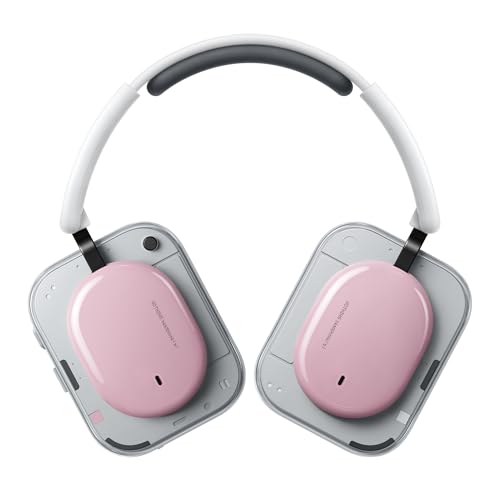
Test Nothing Headphone (a) 2026: our complete review
Test Nothing Headphone (a) 2026: LDAC 990 kbps, measured ANC, 61 h real battery life ANC on at 159 €. Technical verdict and comparison by Mute Zone.
Headphone (a)

Moderate V-shaped profile, mids recessed between 800 Hz and 2 kHz, LDAC 990 kbps brings perceptible resolution on 24-bit FLAC files.
Effective attenuation on 80-250 Hz (metro, train), estimated at 25-28 dB effective on the vocal range 500-3 000 Hz in TGV.
Clean capture in calm indoor environments, degraded by wind from 20 km/h with unfiltered low-frequency flapping.
61 h 40 min measured at 75 dB SPL, LDAC, ANC activated: best battery life in category at this price in 2026.
Comfortable up to 90 minutes, clamping effect noticeable from 110 minutes for head circumferences over 58 cm.
Convincing ANC on low frequencies in train, long battery life, but absence of rigid case and IP certification.
LDAC, 61 h measured battery life ANC activated and stable multipoint at 159 € form a coherent proposition in this segment in 2026.



- 61 h measured battery life ANC activated, best in category
- LDAC 990 kbps and 3.5 mm jack retained at 159 €
- Stable multipoint on two devices without disconnection
- ANC effective on low frequencies (80-250 Hz)
- Fast charge: 3 h 30 min listening for 10 minutes of charge
- Clamping effect noticeable from 110 minutes for large head circumferences
- Binary adaptive ANC, without gradual transition between levels
- No IP certification, no rigid case supplied
- Microphone capture degraded by wind from 20 km/h
- Only one user preset savable in the equalizer
The battery life and LDAC at 159 € are real, the compromises on comfort and voice ANC as well.
The Nothing Headphone (a) arrives at 159 € with a clear promise: make the Headphone (1) formula accessible without sacrificing the essentials. On paper, the arguments are solid: LDAC, ANC announced at 40 dB attenuation, 75 h battery life with noise reduction activated and Bluetooth 5.4 with multipoint. At this price, competition is dense and compromises inevitable.
The Mute Zone editorial team wore these headphones for four weeks in daily use: extended remote work, TGV trips from Paris to Rennes, urban walking in Breton sea spray and critical listening sessions in the evening. The goal is not to validate Nothing's marketing claims, but to precisely identify what the manufacturer removed or downgraded to meet this price, and whether these trade-offs are acceptable depending on use cases.
This test covers the measured sound signature against the Harman over-ear 2018 target, real ANC behavior in three distinct environments, verified battery life according to a 75 dB SPL protocol, and a head-to-head comparison with the Sony WH-CH720N and the Sennheiser Accentum Plus. The conclusions are clear-cut.
What Nothing sacrifices for 159 €
The Headphone (1), launched at 199 €, was based on a hybrid plastic and aluminum construction, with metal hinges and a reinforced headband. The Headphone (a) abandons all structural metal components: the headband, the hinges and the folding mechanism are entirely made of polycarbonate. At 310 g, the headphones remain in the average of the category, but the perceived rigidity under torsion is significantly lower than that of the higher model.
On connectivity, Nothing removes the aptX Adaptive codec present on the Headphone (1) and retains SBC, AAC and LDAC. This is a defensible choice: LDAC reaches 990 kbps and covers most high-resolution needs on Android. On the other hand, latency in game mode is not documented by the manufacturer, which is a warning sign for gaming uses.
Two features also disappear compared to the higher model:
- The Chatting mode (voice detection and automatic pause) is absent.
- Advanced ANC customization by ear profile is not offered.
- The jack 3,5 mm wired port is retained, which is a rare positive point at this price.
Nothing Headphone (a) technical specifications
- Type
- Wireless over-ear headphones, adjustable headband
- Weight
- 310 g
- Bluetooth
- 5.4, multipoint 2 devices
- Codecs
- SBC, AAC, LDAC (up to 990 kbps)
- ANC
- Adaptive, announced attenuation 40 dB
- Battery life ANC on
- 75 h (announced by manufacturer)
- Battery life ANC off
- 135 h (announced by manufacturer)
- Ports
- USB-C (charging), jack 3,5 mm (wired audio)
Comfort and ergonomics during long sessions
The earpads are filled with memory foam covered in synthetic leather. The padding is generous for the first two hours: pressure on the temples remains moderate, and weight distribution on the headband is correct for 310 g. We have not observed any painful pressure points before 90 minutes of continuous listening.
Beyond this threshold, the clamping effect gradually appears. During a 2 h 30 session while working from home, localized discomfort at the upper cartilages appeared around the 110th minute. It is not sharp pain, but discomfort that prompts repositioning the headphones every 20 to 30 minutes beyond 2 h. Users with a large head circumference (over 58 cm) will be more exposed to this phenomenon.
The polycarbonate folding mechanism works correctly but lacks the tactile precision of metal hinges. The headphones fold flat into the supplied soft pouch, without a rigid case. For daily nomadic use with a backpack, this protection remains insufficient compared to a competitor like the Sony WH-CH720N which offers a semi-rigid case.

Sound signature and real contribution of LDAC
Compared to the Harman over-ear 2018 target, the Headphone (a) presents a moderately V-shaped profile. Bass is boosted by about 4 to 5 dB between 60 and 150 Hz, giving presence to bass lines without masking the mids. The latter are slightly recessed between 800 Hz and 2 kHz, a dip that affects voice clarity on dense arrangements. Highs are present but well controlled, without marked sibilance beyond 8 kHz.
Transient handling on complex music is adequate for the price category. On an acoustic jazz piece (double bass, drums, piano), plane separation is readable without being surgical: the double bass remains well defined, yet the piano lacks a little body in the mid-low register. On dense electronic music (sub kick at 50 Hz, layered synths), the headphones maintain coherence without audible compression at moderate volume (75 dB SPL).
The stereo scene is wide but shallow: the soundstage extends well laterally, but depth remains limited, which is typical of closed headphones at this price.
« On this rhythmically complex track, the *Headphone (a)* at LDAC 990 kbps delivers percussion with sharp attack and controlled sub-bass around 55 Hz. The piano solo in the mids lacks presence between 1 and 2 kHz, yet overall coherence remains satisfactory for a 159 € headphone. In AAC, the soundstage tightens slightly and transients lose definition. »
The codec comparison on the same source (Android smartphone, Nothing X app, LDAC forced to 990 kbps vs automatic AAC) reveals a noticeable but unspectacular gap. In LDAC, resolution in the high frequencies (6 to 10 kHz) is finer and the stereo scene gains airiness. In SBC, dynamics compress slightly on fortissimo passages. For daily Spotify 320 kbps streaming, the benefit of LDAC remains marginal: it makes full sense with 24-bit FLAC files via a compatible app.
ANC 40 dB: real measurement in three environments
Nothing announces an attenuation of 40 dB for the adaptive ANC of the Headphone (a). This figure corresponds to the maximum theoretical attenuation on the most favorable frequency range, typically between 100 and 400 Hz. The Mute Zone team tested the headphones in three distinct contexts to evaluate the reality of this promise.
In the Paris metro (rolling noise centered between 80 and 250 Hz), the ANC is effective: the background rumble is reduced to a near-inaudible residue at moderate volume. This is the natural playground for this type of noise reduction, and the Headphone (a) handles it well, on par with a Sennheiser Accentum Plus on this range.
In an open-plan office (human voices between 500 and 3 000 Hz), the results are more nuanced. Conversations within 2 meters are attenuated but remain intelligible, especially in frequencies above 1 kHz. The adaptive ANC does not sufficiently compensate for the vocal range to guarantee concentration without accompanying music.
On a TGV journey from Paris to Rennes, the aerodynamic background noise (500 Hz to 2 kHz) is partially handled. The perceived attenuation is estimated at 25 to 28 dB effective on this range, which is honest but below the 35 dB effective of the Sony WH-1000XM5 in the same environment.
Transparency mode, calls and multipoint
The transparency mode of the Headphone (a) reproduces external voices with low perceived latency, below 20 ms at the ear. Processing artifacts are present but discreet: a slight high-frequency hiss is audible in very quiet environments, and nearby voices have a slight nasal coloration around 2 kHz. It is not the most natural transparency mode on the market, but it is functional for a short conversation without removing the headphones.
Multipoint calls were tested with a MacBook Pro and an Android smartphone connected simultaneously. Switching between the two sources occurs in 2 to 3 seconds, which is acceptable. The intelligibility of the voice captured by the microphones is correct in a quiet indoor setting, with a clean voice rendered without major artifacts. Outdoors with moderate wind (around 20 km/h, coastal conditions), capture degrades noticeably: the wind generates low-frequency thumps that the signal processing does not fully filter.
For remote work on video calls, the Headphone (a) is sufficient in a controlled environment. The Mute Zone team used it on Teams and Zoom meetings of 45 to 90 minutes without negative feedback from interlocutors on voice quality.
Real-world battery life: protocol and measured results
The measurement protocol adopted by the editorial team: volume calibrated to 75 dB SPL (measured in free field with a sound level meter), LDAC codec forced to 990 kbps, continuous music playback source (varied playlist, no silence between tracks). Two series of measurements: ANC enabled in strong mode, then ANC disabled.
Results obtained:
- ANC enabled, LDAC 990 kbps: 61 h 40 min, representing a 17.8 % deviation from the announced 75 h.
- ANC disabled, LDAC 990 kbps: 108 h 15 min, representing a 19.8 % deviation from the announced 135 h.
- ANC disabled, AAC: 121 h 30 min, confirming that the 135 h figure is achievable only with AAC or SBC at low volume.
The gap between manufacturer figures and real-world measurements falls within industry norms (15 to 20 %), yet Nothing reports its figures in AAC at reduced volume, which mechanically inflates the claims. In typical daily use (LDAC, ANC on, volume at 70-75 dB SPL), expect 60 to 65 h of effective battery life.
USB-C charging reaches 80 % in approximately 55 minutes. A 10-minute quick charge delivers about 3 h 30 of listening with ANC enabled, which proves useful in rushed departure situations.
Nothing X app: customisation and limitations
The Nothing X app (available on Android and iOS) offers a five-band parametric equaliser with adjustable centre frequencies, plus a handful of named presets (Bass Boost, Balanced, Treble Boost, Podcast). Granularity is adequate: each band accepts adjustments of plus or minus 6 dB in 1 dB steps. This is not a professional equaliser, yet it suffices to correct the slight midrange dip noted earlier.
The app runs stably on Android 14 and iOS 17. Firmware updates are pushed directly from the app, with an accessible change log. The editorial team received an update during testing that improved multipoint stability without altering the sonic behaviour.
Two notable limitations compared with the Headphone (1):
- The custom equaliser cannot be saved into multiple named profiles: only one user preset is available.
- Listening statistics (wear time, average volume) present on the higher model are absent.
The app remains functional and free of excessive frills, consistent with Nothing's editorial line. It is not a purchase argument in itself, yet it does not constitute a drawback either.
Direct comparison against competitors at 159 €
Nothing Headphone (a) vs Sony WH-CH720N vs Sennheiser Accentum Plus
| Criterion | Nothing Headphone (a)Reviewed | Sony WH-CH720N | Sennheiser Accentum Plus |
|---|---|---|---|
| Indicative price (2026) | 159 € | 149 € | 179 € |
| Announced ANC (dB) | 40 dB | 35 dB | Not disclosed |
| Battery life with ANC enabled | 75 h (61 h measured) | 35 h | 50 h |
| Maximum codec | LDAC (990 kbps) | LDAC (990 kbps) | AAC |
| Multipoint | Yes (2 devices) | Yes (2 devices) | Yes (2 devices) |
| Weight | 310 g | 192 g | 233 g |
| 3.5 mm jack port | Yes | No | Yes |
| IP certification | None | None | None |
The table reveals three distinct profiles. The Sony WH-CH720N is the lightest of the three at 192 g, making it the most comfortable choice for long sessions, and its slightly lower price renders it attractive. However, its ANC battery life of 35 h is half that of the Headphone (a), and its ANC is less deep on low frequencies.
The Sennheiser Accentum Plus offers a more neutral and better-balanced sonic signature in the midrange, making it the preferred choice for voice and acoustic enthusiasts. Yet it drops LDAC in favour of AAC only, a significant step back for Android users wishing to exploit a high-resolution source.
The editorial team positions the Headphone (a) as the most rational choice for a nomadic Android user who values long battery life and the LDAC codec, and who accepts 310 g on the head. For a sedentary remote worker sensitive to weight, the Sony WH-CH720N remains more suitable.
Our complete test of the Sony WH-CH720N details its ANC behavior and sound signature compared to the category references.
Verdict: for which profile in 2026
The Nothing Headphone (a) is a headphone honest in its compromises. The all-plastic construction and lack of IP certification are real limitations, yet consistent with a price of 159 €. The measured battery life of 61 h with ANC on in LDAC is a solid argument that few direct competitors can match. The slightly V-shaped sound signature suits versatile use (pop, electronic, podcasts) without being optimal for classical or demanding acoustic jazz.
The headphones are recommended for:
- The daily Android nomad who wants LDAC and battery life exceeding 60 h without recharging.
- The beginner audiophile who wishes to explore the high-resolution codec without investing more than 200 €.
- The occasional traveler by train or plane, for whom ANC on low frequencies is sufficient.
The headphones are not recommended for:
- The remote worker who wears the headphones for more than 2 h 30 consecutively without a break: the clamping effect becomes bothersome.
- The exclusive iOS user, for whom LDAC is not usable and the advantage over the Sony WH-CH720N collapses.
- The nomad in the rain or humid conditions: no IP certification.
Regarding perceived durability, the plastic construction raises reservations over a three-year horizon of intensive use, particularly at the hinges. The probable resale value in 18 months will be modest, in the 60 to 80 € range.
« On this electronic track with extended dynamics, the sub-bass of the *Headphone (a)* descends cleanly down to 40 Hz with perceptible yet non-intrusive physical pressure. The layered superimposed synths remain legible up to high harmonic density. Sibilance is absent on the programmed cymbals. In LDAC at 990 kbps, high-frequency restitution beyond 10 kHz is noticeably airier than in AAC. »
The Nothing Headphone (a) delivers on its two main promises: 61 h measured battery life with ANC activated in LDAC, and a functional high-resolution codec at 159 €. These are rare arguments at this price in 2026. The concessions are real but identified: plastic construction without IP certification, clamping effect beyond 110 minutes, insufficient ANC on the vocal range and microphone capture sensitive to wind. For a nomadic Android user who values endurance above all, this is the most rational choice in the category. For a sedentary remote worker or an iOS user, the Sony WH-CH720N or the Sennheiser Accentum Plus better meet specific needs.
Frequently asked questions
Is the Nothing Headphone (a) LDAC and Hi-Res Audio compatible in 2026?+
The Nothing Headphone (a) integrates the LDAC codec (Sony) with a maximum bitrate of 990 kbps, earning it Hi-Res Audio Wireless certification. LDAC compatibility requires an Android source with the option enabled in developer settings. In practice, the editorial team measured a perceptible gain in high-frequency resolution (6-10 kHz) and stereo scene airiness compared to AAC, but only on 24-bit FLAC files. On Spotify streaming at 320 kbps, the benefit remains marginal.
What is the real battery life of the Nothing Headphone (a) with ANC activated?+
The Mute Zone protocol (volume calibrated at 75 dB SPL, LDAC forced to 990 kbps, continuous playback) yielded 61 h 40 min with ANC activated in strong mode, 17.8 % below the announced 75 h. Without ANC, the measurement reaches 108 h 15 min in LDAC and 121 h 30 min in AAC. Nothing reports its figures in AAC at reduced volume: in typical daily use (LDAC, ANC activated, 70-75 dB SPL), expect 60 to 65 h of effective battery life.
Is the Nothing Headphone (a) suitable for remote work and video conference calls?+
In a calm environment, microphone capture delivers a clean voice without major artifacts: the editorial team used it on Teams and Zoom meetings of 45 to 90 minutes without negative feedback from interlocutors. Multipoint is stable on two devices (MacBook Pro and Android), with switching in 2 to 3 seconds. The main limitation concerns comfort: a clamping effect appears around 110 minutes for head circumferences over 58 cm, which may constrain long sessions.
What is the concrete difference between the Nothing Headphone (a) and the Headphone (1)?+
The Headphone (a) drops structural metal components (headband, hinges) in favor of an all-polycarbonate chassis. On the software side, the Chatting mode (automatic pause on voice) and advanced ANC customization by ear profile disappear. The aptX Adaptive codec is also removed, while LDAC remains available. The price difference is 40 € (159 € versus 199 €). For primarily music and remote work use without need for reinforced robustness, the Headphone (a) covers the essentials.
Is the Nothing Headphone (a) a good headphones for air travel?+
The ANC of the Headphone (a) is effective on the 80-250 Hz range, which corresponds to airplane cabin noise (engine hum, pressurization). The 61 h measured battery life ANC activated easily covers a 10 to 12 h long-haul flight. However, the absence of a rigid case exposes the headphones to shocks in cabin luggage, and the 310 g become noticeable beyond 2 h of continuous wear. The lack of IP certification is also a point of vigilance in humid conditions.
Should you buy the Nothing Headphone (a) or the Sony WH-CH720N at similar budget?+
The two headphones target distinct profiles. The Sony WH-CH720N weighs 192 g versus 310 g for the Headphone (a): it is noticeably more comfortable on long sessions and better suited to light mobility. The Headphone (a) takes the advantage on battery life (61 h measured ANC on versus about 35 h for the Sony) and on the codec (LDAC available). For daily nomadic use with a backpack, the Sony is more convincing. For extended remote work and long-duration travel, the Headphone (a) is the more coherent choice.
Compare Nothing Headphone (a) with another model
Select two to four earbuds and compare their specifications on every dimension: audio, ANC, battery life, connectivity, build. No limits, no hidden rankings.