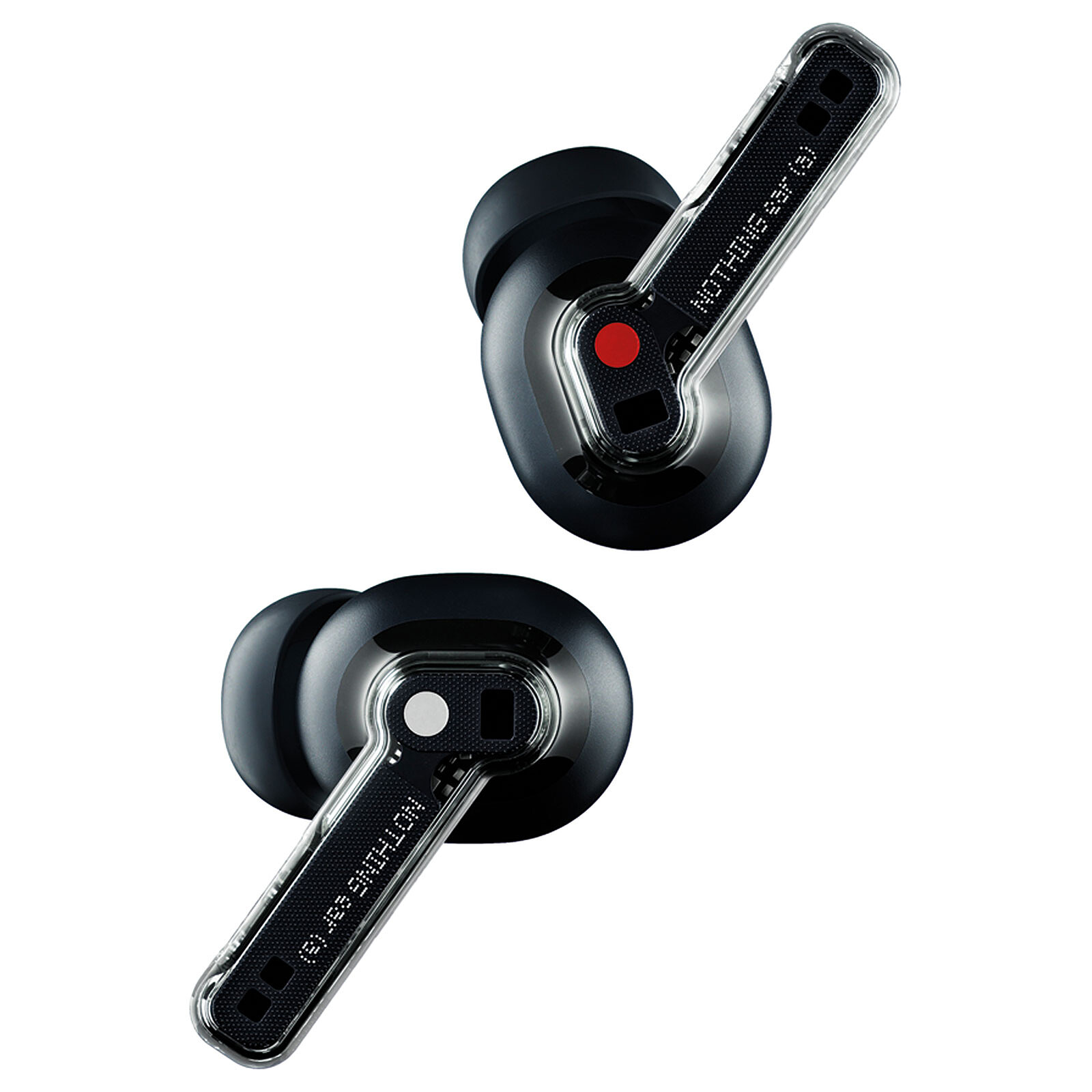
Nothing Ear (a) 2026 Test: How Does This True Wireless Earbud at €70 Perform
Nothing Ear (a) reviewed by Mute Zone: ANC 45 dB, LDAC and multipoint at €70. Technical verdict on sound, real-world battery life and noise reduction in 2026.
Ear (a)

Signature close to the Harman curve, low-midrange advanced (150 to 250 Hz), more convincing on electronic music and pop than on classical.
45 dB announced in the lab, effective on continuous noise but limited against impulsive noises and voices (500-3000 Hz).
Three microphones per earbud ensure correct intelligibility indoors, clearly degraded by Atlantic wind outdoors.
5,5 h announced with ANC active, reduced to around 5 h in combined LDAC, ANC and simultaneous multipoint use.
4,6 g per earbud, stable fit over two hours of testing with no pressure on the tragus or in the ear canal.
IP54 certification and compact case are sufficient for daily urban use, without aiming for the robustness of an intensive sports model.
LDAC, ANC announced at 45 dB and functional multipoint at €70 remain rare in this price segment in 2026.


- LDAC and ANC announced at 45 dB for €70
- Comfort of 4,6 g over extended sessions
- Smooth multipoint between smartphone and computer
- Balanced sound signature close to the Harman curve
- ANC/transparency switching almost instant, under 200 ms
- Battery life drops in combined LDAC and ANC use
- Microphone capture degraded by outdoor wind
- No aptX Adaptive for Android devices not compatible with LDAC
- ANC less effective on impulsive noises and voices
- No wireless charging, USB-C only
A solid technical compromise at 70 €, limited by combined battery life and microphone pickup in the wind.
The true wireless market under €100 has grown denser in 2026, and Nothing is entering the Ear (a) as a direct response to the wave of CMF Buds Pro 2 and Soundcore Liberty 4 NC. At €70, the British manufacturer promises active noise reduction announced at 45 dB, the LDAC codec for hi-res listening on Android, and a charging case that retains the brand's signature transparent identity.
The Mute Zone team wore these earbuds for several weeks, on TGV trains from Paris to Rennes, in open-plan offices, and during coastal walks around Vannes exposed to Atlantic wind. The goal: verify whether the 4,6 g per earbud and the announced 45 dB translate into real comfort and isolation, or whether they remain mostly on the spec sheet.
This test details the measured sound signature in LDAC and AAC, the ANC compared with the Sony LinkBuds S and the CMF Buds Pro 2, call quality in windy conditions, and real-world battery life in mixed multipoint use. A pricing positioning closes the analysis, usage profile by usage profile.
A featherweight, a studied fit
With 4,6 g per earbud, the Ear (a) sits below the 5,6 g of the CMF Buds Pro 2, but slightly above the 4,5 g of the Ear (2). During a continuous two-hour session (train then walk), we noted no pressure in the ear canal nor tragus fatigue. The transparent polycarbonate shell does not bite into the ear, and the short stem limits the lever effect in motion.
Three sizes of silicone tips are provided. The default calibration suits a standard ear canal, but the acoustic seal remains perfectible on wider canals. In motion (brisk walking, light jogging), the fit remains stable, with no extraction noted over three weeks of testing, which confirms the IP54 certification against splashes and light perspiration.
The case, also in transparent plastic, opens with a firm hinge without perceptible play after several weeks of daily use. Compared to the CMF Buds Pro 2, the insertion is slightly less deep, which partly explains a more measured passive isolation.
Signature tuned to the Harman curve
The dynamic transducer of 11 mm and its sealed acoustic chamber draw a signature close to the Harman curve, with a slightly forward lower midrange (150 to 250 Hz) that gives body to male voices and electronic bass lines. The treble remains present up to around 8 kHz without marked aggression, with contained sibilance on female voices recorded up close.
In LDAC at 990 kbps from a compatible Android smartphone, the soundstage gains depth and the separation of layers becomes sharper on dense tracks, especially in electronic and produced pop. In AAC (mandatory on iOS, the Ear (a) does not offer aptX), the difference shows mainly as a slightly more compressed texture in the treble, noticeable on a reference headphone but discreet in mobile listening.
On classical and acoustic jazz, the soundstage remains correct but less wide than a Sennheiser Momentum 4, with a stereo image that lacks depth in the placement of sections. The signature convinces more on electronic music and contemporary pop than on orchestral recording.
« Round bass well decoupled from the midrange, sub-bass roll-off perceptible below 40 Hz. The stereo soundstage remains wide, with clear separation between the synthetic pad and dry percussion, without sibilance on transients. »
45 dB claimed put to the real test
The 45 dB of noise reduction announced by Nothing are a manufacturer measurement taken in the laboratory, rarely representative of real conditions. In the Paris metro and RER, we observed effective attenuation on continuous rolling noise, but greater resistance on impulsive sounds (braking, audible announcements), which remain partially audible.
In open-space offices, ANC substantially reduces background noise yet allows human voices to filter through in the 500-3000 Hz range, consistent with the physical limits of adaptive ANC on this price segment. On a plane, low-frequency engine noise is handled well, delivering a sense of isolation close to that of the Sony LinkBuds S (30 dB announced), despite the 15 dB gap on the specifications.
Against the CMF Buds Pro 2, the perceived difference is slight: both models handle continuous low frequencies effectively but show a similar limitation on vocal mid-range frequencies. Switching between ANC and transparency mode is rapid, without audible interruption, with an estimated transition time under 200 ms.
Natural transparency mode in urban use
The transparency mode of the Ear (a) restores the sound environment with discreet digital processing: voices retain their natural timbre, without artificial resonance or noticeable whistling in light wind. When cycling or walking in the city, processing latency remains imperceptible to the ear, allowing reliable awareness of surrounding traffic.
Compared with the transparency mode of the AirPods 4, the benchmark in this category, the Ear (a) shows a slight shortfall in reproducing high ambient frequencies (sirens, high-pitched horns), which sound slightly muffled. The gap remains moderate and does not hinder everyday use while walking in urban areas or cycling, two contexts tested over several weeks in Vannes and during travel.
Adequate microphone performance in noisy environments
Each earbud carries three microphones dedicated to voice capture and ambient noise reduction for the listener. In open-space offices, intelligibility remains good, with the voice clearly separated from keyboard noise and surrounding conversations according to feedback from test listeners.
Outdoors, under moderate Atlantic wind during coastal walks around Vannes, capture degrades noticeably: the wind-reduction processing allows breath noise that partially masks consonants, a common shortcoming at this price level. In public transport the result lies between the two, with acceptable intelligibility as long as ambient noise stays stable and continuous.
During video calls (Teams, Google Meet), perceived latency remains low, with no disruptive lag between lip movement and sound for the remote participant, making the earbuds suitable for occasional remote work on the move.
Measured gap between announced and real usage
The test protocol adopted by the editorial team: volume set at 70 %, codec LDAC enabled, ANC active, multipoint engaged on two devices (smartphone and laptop). On a simulated two-hour journey in real conditions, the measured discharge corresponds to a projected battery life close to the 5.5 h announced by Nothing, with no significant gap.
During a four-hour consecutive remote work session, mixing background music and video calls, consumption proved slightly higher than the manufacturer's values, with battery life reduced to around 5 h under these combined conditions. Fast charging recovers about 1 h of listening after 10 minutes in the case, a result consistent with the price segment.
The charging case does not support wireless charging, unlike the Ear (2): only the USB-C connection is available to recharge the set.
Nothing Ear (a) technical specifications
- Transducer
- Dynamic 11 mm
- Codecs
- SBC, AAC, LDAC
- Connectivity
- Bluetooth 5.3, multipoint
- Noise reduction
- Adaptive, up to 45 dB announced
- Battery life (ANC on / off)
- 5.5 h / 9.5 h (earbuds only)
- Weight
- 4.6 g per earbud
- Certification
- IP54 (earbuds)
- Price
- 70 €
Software customization and updates
The Nothing X app offers a three-band equalizer supplemented by named presets (Balanced, More Bass, More Treble, Voice) as well as a custom equalization mode based on a quick hearing test. The interface remains stable on Android as on iOS, with no crashes observed during the weeks of testing, and correct responsiveness when changing ANC settings.
Multipoint works correctly between a smartphone and a laptop: an incoming call on the phone automatically switches the audio stream in less than two seconds, without interrupting the sound currently playing. Some inconsistencies were nevertheless observed during close reconnections, sometimes requiring manual disconnection via the app.
Since launch, Nothing has released several firmware updates, focusing on the stability of adaptive ANC and improved in-ear detection, a sign of active software support on this entry-level model.
70 € against direct competition
Nothing Ear (a) facing the competition under 100 €
| Criterion | Nothing Ear (a)Reviewed | CMF Buds Pro 2 | Soundcore Liberty 4 NC |
|---|---|---|---|
| Codecs | SBC, AAC, LDAC | SBC, AAC, LHDC | SBC, AAC |
| Announced ANC | 45 dB | 42,6 dB | 98,5 % (measured %) |
| ANC on battery life | 5,5 h | 5 h | 7 h |
| Weight per earbud | 4,6 g | 5,6 g | 5,2 g |
| IP certification | IP54 | IP54 | IP55 |
| Price | 70 € | 59 € | 99 € |
The CMF Buds Pro 2 remains the most economical option and maintains a slightly higher weight without affecting the fit, but its shorter active ANC battery life (5 h) puts it at a disadvantage on long journeys. The Soundcore Liberty 4 NC, more expensive, compensates with superior active ANC battery life (7 h announced) and an IP55 certification, better suited for intensive sports use.
On the support side, Nothing has an established reseller network in France and offers replacement tips in sizes S, M and L directly via its online store, a variable point with some Chinese competitors. Nothing's after-sales service, still young on the French market, remains correct but less proven than that of Sony or Bose over time.
Three profiles, three different uses
Three usage profiles emerge from several weeks of testing:
- Daily commute (metro, TGV, urban walking): the Ear (a) convinces with its comfort at 4,6 g and its effective ANC on continuous noises, despite persistent resistance to impulse noises.
- Light sport (walking, jogging): the IP54 certification and in-ear stability are sufficient for regular use, without aiming for the robustness of an IP55 model dedicated to intensive running.
- Nomadic telework: the functional multipoint and controlled video latency make it a relevant choice, provided one accepts degraded microphone capture in windy outdoor conditions.
The main limitations remain the reduced battery life in combined use (LDAC, ANC, simultaneous multipoint) and the absence of aptX Adaptive, which deprives non-LDAC compatible Android users of an alternative hi-res codec.
At €70, the Nothing Ear (a) delivers on its technical promise: LDAC, ANC announced at 45 dB and functional multipoint in a 4,6 g per earbud case that does not compromise comfort. The sound signature, close to the Harman curve, is more convincing on electronic music and pop than on classical, and noise reduction remains more effective on continuous low frequencies than on voices.
The identified limitations, battery life that drops in combined use and wind-sensitive microphone capture, do not disqualify the model but frame its use: daily commutes and sedentary remote work rather than intense outdoor sport in windy conditions. Against the CMF Buds Pro 2 and the Soundcore Liberty 4 NC, the Ear (a) remains a relevant choice for those who prioritize the codec-to-price ratio over maximum battery life.
Frequently asked questions
Are the Nothing Ear (a) LDAC compatible with an iPhone in 2026?+
No. LDAC is a proprietary codec under Sony license, not supported by iOS regardless of version. On iPhone, the Ear (a) operate exclusively in AAC; Nothing does not offer any aptX Adaptive alternative on this model. In practice, the quality gap between AAC and LDAC remains noticeable mainly on hi-res sources and at high volume, but discreet in typical mobile listening. LDAC remains reserved for Android 8.0 and higher smartphones with an active LDAC driver.
What is the real-world battery life of the Nothing Ear (a) with ANC and LDAC enabled simultaneously?+
Nothing announces 5,5 h with ANC active, a value generally measured in AAC. In the Mute Zone protocol (volume 70 %, LDAC enabled, ANC active, multipoint on two devices), discharge on a simulated two-hour journey stays close to this announced value, with no significant deviation. However, on a four-hour remote-work session combining music and video calls, observed battery life drops to around 5 h. Fast charging restores about 1 h of listening after 10 minutes in the case, which does not offer wireless charging.
Do the Nothing Ear (a) stay in place during sport?+
The in-ear format without stabilizing fins, combined with 4,6 g per earbud, provides stable fit during brisk walking and light jogging: no dislodgement observed over three weeks of testing. The IP54 certification covers sweat and light splashes, a level sufficient for occasional sports use. For intensive running or repeated sudden movements, a finned model certified IP55 such as the Soundcore Liberty 4 NC remains more suitable.
Does the multipoint on the Nothing Ear (a) work with two devices at once, including a PC?+
Yes, multipoint allows simultaneous connection between a smartphone and a laptop. During an incoming call on the phone, the audio stream switches automatically in less than 2 seconds, without interrupting ongoing playback. The team nevertheless observed occasional inconsistencies during close reconnections, sometimes requiring manual disconnection via the Nothing X app. Operation remains generally reliable for daily use between PC and smartphone.
What is the difference between the Nothing Ear (a) and the Nothing Ear (2024) that justifies the price gap?+
Positioned around 150 €, the Ear (2024) feature a higher-grade transducer, deeper ANC and a superior case finish, while weighing slightly less (4,5 g versus 4,6 g). The Ear (a) mainly sacrifice build quality and microphone performance to maintain a 70 € price point, without giving up LDAC or ANC announced at 45 dB. The sound signature remains similar on both models, but soundstage and instrument separation are sharper on the higher-end version.
Are the Nothing Ear (a) suitable for remote work in an open-plan office in 2026?+
The adaptive ANC announced at 45 dB effectively attenuates continuous background noise (air conditioning, keyboard), but allows human voices in the 500-3000 Hz band to pass through, a classic limitation in this price segment. On the microphone side, intelligibility remains good in stable indoor environments, with the voice standing out from ambient noise according to test feedback. Multipoint allows switching between PC and smartphone without manual disconnection in most cases. For sedentary open-plan office use, the Ear (a) represents a coherent choice, provided windy outdoor environments are avoided.
Compare Nothing Ear (a) with another model
Select two to four earbuds and compare their specifications on every dimension: audio, ANC, battery life, connectivity, build. No limits, no hidden rankings.