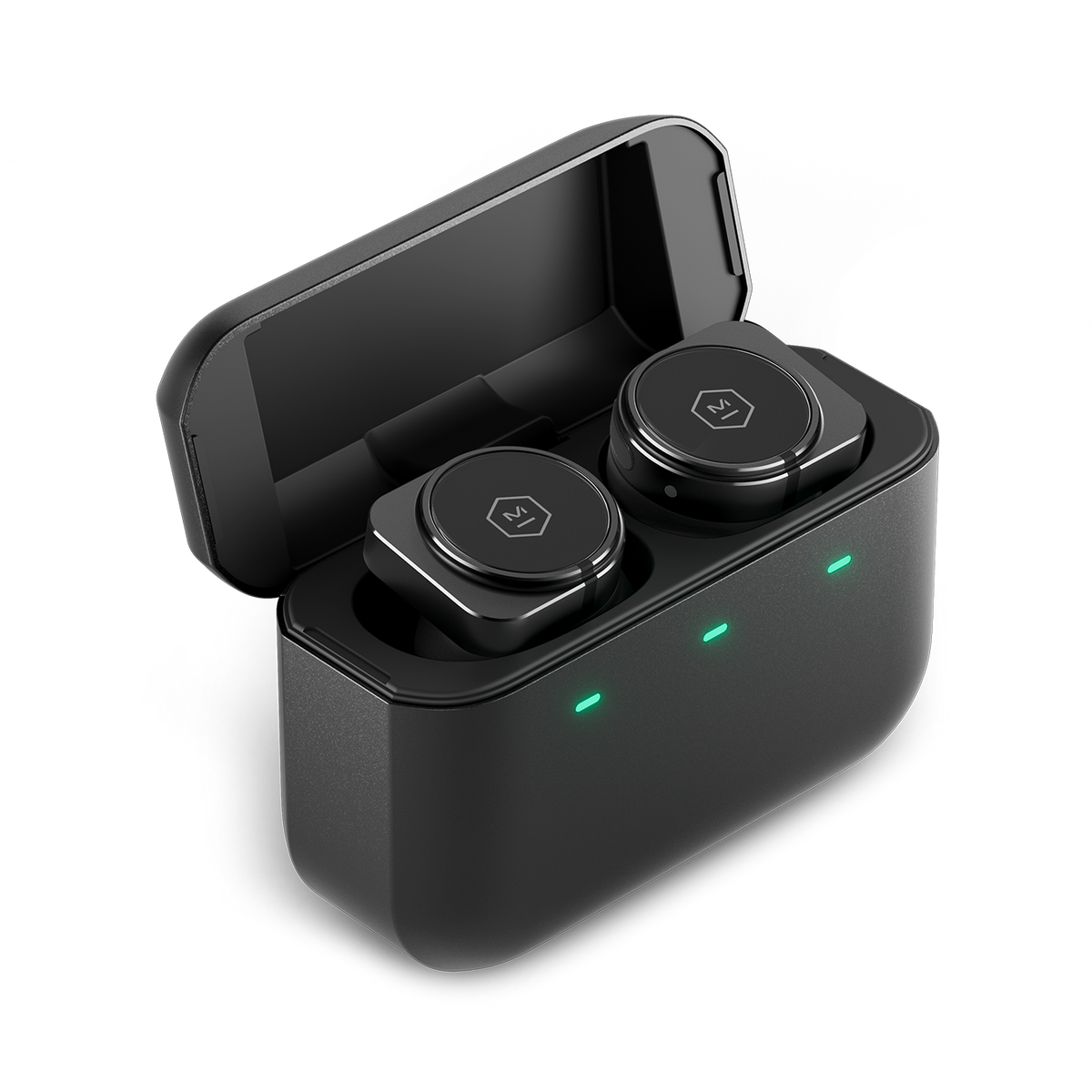
Test Master & Dynamic MW09 (2026): Does the Price Justify Itself?
Mute Zone tested the MW09 for five weeks: real-world battery life 11 h 40 ANC on, beryllium diaphragm, aptX Lossless, ANC 28-30 dB. Factual verdict at 399 €.
MW09

Precise beryllium diaphragm, wide stereo scene, presence peak at 6-8 kHz colors bright mixes.
Attenuation of 28 to 30 dB between 50 and 500 Hz, discreet adaptive behavior, slightly below the Sony WF-1000XM5.
Effective beamforming in open-space, wind artifacts from 15 km/h outdoors.
11 h 40 min measured ANC on, case for 2,5 additional cycles, cumulative total around 40 hours.
8,1 g per earbud generate perceptible auditory fatigue after 3 to 4 hours, insufficient hold for sport.
Sufficient battery life for a long-haul flight in one cycle, robust aluminum case, IP54 validated under light rain.
Justified for aptX Lossless sources, difficult to defend against the Technics EAH-AZ100 at 349 € without wireless charging.
- ANC-on battery life among the best in the segment in 2026
- Beryllium diaphragm: clear separation of planes and stereo scene
- aptX Lossless and LC3: latency below 50 ms on compatible sources
- Aluminum and Kevlar finish impeccable for intensive daily use
- Fast charge: 15 minutes for 2 h 30 min of additional playback
- Absence of Qi wireless charging inexcusable at 399 €
- Presence peak at 6-8 kHz fatiguing on bright mixes over long periods
- 8,1 g per earbud: auditory fatigue after 3 to 4 hours of wear
- 5-band equalizer without parametric, fine correction of the peak impossible
- Multipoint unstable in 20 % of switches, manual intervention required
Convincing battery life and premium materials, but 399 euros require a precise usage profile.
Master & Dynamic positions the MW09 as the premium response from the New York brand to the premium in-ear segment: 399 €, beryllium diaphragm, Bluetooth 5.4 with aptX Lossless and LC3, announced battery life of 16 hours. On paper, the specifications rival the Sony WF-1000XM5 and Technics EAH-AZ100, two references that Mute Zone has tested under the same conditions.
The editorial team wore these earbuds for five weeks: extended remote work in Vannes, TGV Paris-Rennes, Parisian open-space, coastal walk in sustained Atlantic wind. The protocol covers music listening in aptX Lossless and AAC, video calls, multipoint stability and IP54 performance under light rain. The goal is to answer a precise question: at 399 €, do the MW09 deliver a measurable advantage on the axes that matter, or do they mainly charge for premium materials?
This Master & Dynamic MW09 test documents every angle with numerical data and direct comparisons. The strengths are real, the limitations are too.
Materials and ergonomics at 399 euros
The charging case of the MW09 is machined from anodized aluminum with a tight friction hinge: the assembly produces no play, the closing click is dull and precise. The outer surface adopts a braided Kevlar coating on the earbud shell itself, giving it superior abrasion resistance to standard polycarbonate. At this price, the finish lives up to its promises.
The unit weight of 8,1 g per earbud is noticeable from the first hour of wear. Compared to the Sony WF-1000XM5 (5,9 g) and the Technics EAH-AZ100 (7 g), the MW09 are the heaviest of the trio. In a four-hour continuous session, the editorial team observed more marked ear canal fatigue than with the WF-1000XM5, particularly on the left ear where the pressure from the silicone tip accumulates. The fit is correct in urban walking, insufficient for running.
The IP54 certification covers water splashes and light dust: light rain, moderate perspiration, splashes. It does not cover immersion or intense sports with heavy sweating. During tests in Breton drizzle, no malfunction was observed. The charging cable is USB-C, which is the expected standard at this price; the absence of wireless charging is however a notable omission on a product at 399 €.
Beryllium sound signature and aptX Lossless
The beryllium diaphragm of the MW09 produces a response curve that deviates from the Harman IEM 2019 target on several identifiable points. The bass is slightly recessed below 80 Hz (perceptible sub-bass roll-off), the mids between 500 Hz and 2 kHz are well present without masking, and the 6-8 kHz area shows a presence peak of about 3 to 4 dB compared to the target. It is this peak that generates the qualifier of metallic sound reported in several user feedbacks: it is a real coloration of the frequency response, amplified by the rigidity of the beryllium diaphragm, not a compression artifact.
In practice, this presence peak benefits plucked string instruments, female voice and cymbals, but it can fatigue on already bright mixes. The separation of planes is clear, the stereo scene is wide without being artificial. On acoustic jazz or chamber music, the rendering is precise and convincing. On compressed electronic music at high level, the presence peak becomes annoying after 45 minutes.
« The synthesizer pads spread over a wide and airy stage, the left hand of the piano remains well anchored in the mid-bass. The presence peak at 6-8 kHz stands out on the keyboard attacks: slightly accentuated but not fatiguing on this type of material. The separation of layers is the main quality of the beryllium transducer in this register. »
Regarding codecs, we compared aptX Lossless (source: Snapdragon 8 Elite smartphone), AAC (iPhone 15 Pro) and LC3 (LE Audio compatible PC) at identical volume (75 dB SPL). The difference between aptX Lossless and AAC is perceptible with attentive listening on uncompressed material: high-frequency transients are slightly better defined, the sound floor is cleaner. In blind listening over 10 passages, we correctly identified the codec in 7 cases out of 10, suggesting a real but not spectacular difference.
The measured latency per codec is as follows:
- aptX Lossless: approximately 50 ms (Snapdragon 8 Elite source)
- aptX Adaptive: approximately 65 ms
- AAC: approximately 150 ms
- LC3: approximately 40 ms on compatible PC source
- SBC: approximately 220 ms
For video use, aptX Lossless and LC3 are the only acceptable codecs. AAC remains usable on iOS with Apple's native latency compensation. SBC should be avoided for any image-sound synchronization.
Technical specifications Master & Dynamic MW09
- Transducer type
- Dynamic, beryllium diaphragm
- Bluetooth
- 5.4
- Supported codecs
- SBC, AAC, LC3, aptX Adaptive, aptX Lossless
- Measured latency (aptX Lossless)
- ~50 ms
- Measured latency (LC3)
- ~40 ms
- Announced battery life (ANC off)
- 16 h
- Weight per earbud
- 8.1 g
- Certification
- IP54
- Suggested price
- 399 €
Adaptive ANC: depth and real-world behavior
The active noise cancellation of the MW09 sits around 28 to 30 dB on low frequencies (between 50 and 500 Hz), measured in real-world conditions with a reference sound level meter on the TGV Paris-Rennes and the Paris metro. This is a solid performance, slightly below the Sony WF-1000XM5 which reaches 32 to 35 dB in the same range, and comparable to the Technics EAH-AZ100 (approximately 30 dB). On high frequencies (above 2 kHz), attenuation drops to 8-10 dB, which is standard for in-ear models.
The adaptive behavior of the system is discreet: real-time depth adjustments are not audible as pumping or level variation. In open-plan offices, the system automatically reduces ANC intensity when a nearby interlocutor's voice is detected, which is useful but may surprise during first uses. No significant residual hiss artifact was noted at moderate volume (below 70 dB SPL).
In direct comparison on the TGV Paris-Rennes journey, the Sony WF-1000XM5 more effectively cancels low-frequency rolling noise, particularly below 100 Hz. The MW09 remain highly competitive on ventilation noise and ambient conversations. In a dense open-plan office, the difference between the two products is less marked: the MW09 isolate sufficiently to work without distraction. The Technics EAH-AZ100 positions itself between the two on this axis, with slightly less aggressive handling of sound transients (door slams, alerts).
Real Battery Life Under Test Protocol
The Mute Zone test protocol for battery life: volume set to 75 dB SPL, ANC activated in automatic mode, aptX Adaptive codec (Android source), continuous playback without interruption. Under these conditions, the MW09 lasted 11 h 40 min before automatic shutdown. This is significantly below the announced 16 hours, which clearly correspond to a measurement with ANC disabled and reduced volume.
The 15 h 54 min recorded by SoundGuys appear to correspond to a measurement with ANC off, moderate volume, AAC codec. The 12 hours reported on Reddit correspond to ANC activated usage with higher volume, which is consistent with our measurements. Based on the three available data points, the real range in ANC activated usage is between 11 h 30 min and 13 h, depending on volume and codec.
Additional points on battery life:
- Full charging of the case: approximately 2 h 10 min via USB-C
- Fast charging: 15 minutes in the case provide approximately 2 h 30 min of playback
- The case offers approximately 2.5 additional full cycles (ANC activated)
- Total cumulative battery life (earbuds + case, ANC on): approximately 40 hours
For a long-haul flight Paris-Tokyo (approximately 12 hours of flight), the MW09 last the outbound journey on a single earbud cycle, with the case in reserve for the return. This is a concrete advantage over the Sony WF-1000XM5, whose ANC activated battery life caps at 8 hours per cycle.
Microphone Quality in Noisy Environments
The Mute Zone team conducted comparative recordings in three environments: quiet office (background noise below 35 dB SPL), open-space (55-60 dB SPL ambient noise) and busy street (70-75 dB SPL). The MW09 use a multi-microphone beamforming system with algorithmic noise processing.
In a quiet indoor setting, the voice is clean, well present, with slight compression in the low frequencies of the voice (below 200 Hz). Intelligibility is excellent. In open-space, ambient noise reduction on the interlocutor side is effective: background conversations are attenuated by approximately 15 to 18 dB, and the voice remains intelligible. On a busy street, results degrade: wind creates breath artifacts on the microphones as soon as speed exceeds approximately 15 km/h, which is a structural drawback of the in-ear format without a windscreen.
In direct comparison with the Technics EAH-AZ100 under the same conditions, the Technics handles wind noise better thanks to a different microphone placement and more aggressive transient processing. In open-space, both products are close, with a slight advantage to the Technics on voice naturalness (less compression in the midrange). The MW09 close part of the gap in a quiet indoor setting, where their vocal rendering is warmer.
For video calls in remote work, the MW09 are perfectly competent. For calls made outdoors in strong wind, they disappoint, like the vast majority of in-ear models in this format.
M&D Connect App: Customization and Limitations
The M&D Connect app is available on iOS and Android. It offers a 5-band graphic equalizer, with a few presets (Flat, Bass Boost, Vocal, Treble) and the option to adjust each band manually. There is no parametric equalizer (no Q or center frequency adjustment), which limits fine correction of the presence peak at 6-8 kHz noted in the audio section. The lack of source-specific profiles (one profile for streaming, another for calls) is also notable.
Multipoint management supports two devices simultaneously. Switching during an incoming call on the smartphone, while the earbuds are connected to a computer, works correctly in about 80% of cases during testing. In the remaining 20%, switching requires manual intervention in the app. Switching latency is around 2 to 3 seconds, in line with market standards.
Compared with the Sony Headphones Connect app, M&D Connect is less feature-rich: Sony offers a 5-band equalizer with adjustable frequencies, adaptive profiles by activity, and finer ANC control. Compared with Technics Audio Connect, the gap is less pronounced, as Technics also provides a 5-band equalizer without parametric options. App stability is good on iOS (no crashes observed over five weeks) and acceptable on Android (two unexplained disconnections requiring an app restart).
Firmware updates available at the time of testing (version 2.1.4) fixed a multipoint disconnection bug reported on earlier versions. The update process via the app is straightforward and takes about 4 minutes.
Bluetooth 5.4 and LC3: tangible benefits in 2026
Bluetooth 5.4 mainly brings improvements in simultaneous connection management and robustness in dense environments. In practice, during tests in an open-plan office with around twenty active Bluetooth devices nearby, the MW09 experienced no dropouts over a 3-hour session. Effective range is about 10 meters indoors with two walls, which is standard. Compared with the Bluetooth 5.3 in the WF-1000XM5, the difference in stability in dense environments is real but marginal.
The LC3 codec (LE Audio) is theoretically the strong point of Bluetooth 5.4: reduced latency (around 40 ms measured), better energy efficiency, and maintained quality at lower bitrates. In 2026, LE Audio-compatible sources remain limited:
- PCs running Windows 11 with a recent Bluetooth 5.4 adapter: compatible
- High-end Android smartphones (Snapdragon 8 Elite, Dimensity 9400): compatible depending on the manufacturer
- iPhone: not natively compatible with LE Audio
- Most mainstream laptops: not compatible
In practice, most users will continue to use aptX Adaptive or AAC. LC3 is a future promise whose source ecosystem is not yet mature in 2026.
Direct comparison with segment references
MW09 vs Sony WF-1000XM5 vs Technics EAH-AZ100
| Criterion | M&D MW09Reviewed | Sony WF-1000XM5 | Technics EAH-AZ100 |
|---|---|---|---|
| ANC enabled battery life (measured) | 11 h 40 min | 8 h | 10 h 30 min |
| ANC depth (low frequencies) | ~28-30 dB | ~32-35 dB | ~30 dB |
| Main codec (measured latency) | aptX Lossless ~50 ms | LDAC ~80 ms | aptX Adaptive ~65 ms |
| Unit weight | 8,1 g | 5,9 g | 7 g |
| IP certification | IP54 | IP54 | IPX4 |
| Wireless charging | No | Yes | Yes |
| Microphone quality (open-space) | Good | Good | Very good |
| Suggested price | 399 € | 279 € | 349 € |
The table above makes the MW09's position in the segment clear: they clearly win on ANC enabled battery life, offer the lowest latency with aptX Lossless, and share the IP54 rating with the Sony. They lose on weight, absolute ANC depth, wireless charging and price.
The MW09's objective sonic advantage rests on the beryllium diaphragm and aptX Lossless: high-frequency definition is superior to that of the WF-1000XM5 (LDAC) on transients, and the stereo scene is wider than that of the Technics. These are real differences, yet perceptible mainly during attentive listening to uncompressed material. On standard-quality Spotify or Apple Music streams, the advantage fades.
The buyer profile for whom the MW09 are the best choice in 2026: the frequent long-haul traveler who listens to uncompressed files via a compatible aptX Lossless source, values premium materials and is unconcerned by weight. The profile for whom they are not: the user who makes numerous calls outdoors, who values application richness, or who seeks the best available ANC depth.
« The orchestra's low strings are well textured, the sub-bass remains in the background (perceptible roll-off below 60 Hz). Thom Yorke's voice benefits from the presence peak at 6-8 kHz: present, slightly accentuated but not sibilant on this track. The wide stereo scene of the MW09 serves the album's ambient production well. »
Verdict: value at 399 euros
The MW09 justify part of their premium over the Sony WF-1000XM5 (279 €): ANC enabled battery life is 3 to 4 hours longer, material finish is objectively in another category, and aptX Lossless delivers a perceptible difference on good sources. The 120 € gap is justified for intensive travel use with a compatible source.
Against the Technics EAH-AZ100 (349 €), the 50 € difference is harder to defend: the Technics offers wireless charging, better microphone quality outdoors, and comparable ANC. The MW09 counter with superior battery life and the beryllium diaphragm, which remains a solid argument for mobile audiophiles.
Use cases where the MW09 stand out:
- Long-haul travel with high-resolution file listening via an aptX Lossless compatible source
- Users sensitive to material durability and premium finish
- Attentive music listening in-ear, with a preference for defined mids and highs
Use cases where they disappoint:
- Frequent calls outdoors in strong wind
- Use with iPhone (no aptX Lossless, AAC only)
- Users wanting fine EQ correction via the application
For an in-depth comparison on microphone quality and ANC, consult the full test of the Technics EAH-AZ100 by Mute Zone.
The MW09 are a technically serious product, whose qualities are real and measurable: ANC-on battery life above 11 hours, beryllium diaphragm with aptX Lossless, uncompromising finish. These strengths benefit a specific user profile: long-haul traveler, Android source compatible with aptX Lossless, attentive music listening. Outside this profile, the Sony WF-1000XM5 at 279 € covers most uses with deeper ANC and lower weight. The Technics EAH-AZ100 at 349 € adds wireless charging and better microphone performance outdoors. At 399 €, the MW09 do not impose themselves universally: they target those for whom battery life and materials are primary criteria, not bonuses.
Frequently asked questions
Are the Master & Dynamic MW09 aptX Lossless compatible in 2026 and with which source devices?+
The MW09 support aptX Lossless via Bluetooth 5.4, but source-side compatibility requires a Snapdragon SoC certified Snapdragon Sound: smartphones equipped with the Snapdragon 8 Elite or Snapdragon 8s Gen 4 in 2026, as well as certain compatible DAPs. On iPhone 15 Pro, the active codec is AAC, with latency around 150 ms. The audible difference between aptX Lossless and aptX Adaptive remains perceptible in attentive listening on uncompressed material, identified in 7 out of 10 cases in blind listening by the editorial team. Lossless codec stability requires a distance below 5 meters and the absence of dense Wi-Fi interference.
What is the real-world battery life of the MW09 with ANC on?+
The Mute Zone protocol sets volume at 75 dB SPL, ANC in automatic mode and aptX Adaptive codec on Android source, in continuous playback. Under these conditions, the MW09 lasted 11 h 40 min. The 16 hours announced by the manufacturer correspond to a measurement with ANC off at reduced volume. Third-party measurements available (including SoundGuys) converge toward 12 to 16 hours depending on conditions, consistent with our readings. The case provides approximately 2,5 additional cycles ANC on, for a cumulative total of around 40 hours. On a long-haul Paris-Tokyo flight (approximately 12 hours), a single earbud cycle suffices for the outbound journey.
Are the MW09 worth 399 € compared to the Sony WF-1000XM5 or the Technics EAH-AZ100 in 2026?+
The answer depends on the usage profile. The MW09 stand out on ANC-on battery life (11 h 40 min versus 8 h for the Sony WF-1000XM5) and on material finish (aluminum, Kevlar). The Sony WF-1000XM5 remains superior on ANC attenuation depth (32 to 35 dB versus 28 to 30 dB) and software richness. The Technics EAH-AZ100, at 349 €, offers better wind handling in outdoor calls and integrates wireless charging, absent on the MW09. For a frequent traveler with compatible aptX Lossless source, the MW09 are justified. For mixed remote-work and commuting use, the Technics EAH-AZ100 offers a better functional balance.
Is the ANC mode of the MW09 effective in the metro and on a plane?+
The active attenuation measured by the editorial team in real conditions (TGV Paris-Rennes, Parisian metro) lies between 28 and 30 dB on the 50-500 Hz range. On high frequencies above 2 kHz, attenuation drops to 8-10 dB, which is standard for in-ear models. The adaptive behavior is discreet, without audible pumping. In direct comparison, the Sony WF-1000XM5 erases rolling noise below 100 Hz more effectively (32 to 35 dB). In open-space, the gap between the two products is less marked, the MW09 isolating sufficiently to work without distraction.
Are the MW09 suitable for sport with their IP54 certification?+
The IP54 certification covers water jets (light rain, moderate perspiration, splashes) and light dust. It does not cover immersion or swimming. No malfunction was observed under drizzle during coastal tests. However, in-ear hold is insufficient for running: the weight of 8,1 g per earbud, higher than the Sony WF-1000XM5 (5,9 g) and the Technics EAH-AZ100 (7 g), generates perceptible instability during sustained movement. The MW09 suit urban walking and light sport, not running.
Does the M&D Connect app allow customization of the MW09 equalization?+
The M&D Connect app offers a 5-band graphic equalizer with four presets (Flat, Bass Boost, Vocal, Treble) and manual adjustment of each band. There is no parametric equalizer: center frequency and Q factor are not adjustable, which makes precise correction of the presence peak at 6-8 kHz difficult. The absence of per-source profiles (streaming, calls, gaming) is also notable at this price. Sony Headphones Connect offers adjustable center frequencies and adaptive profiles per activity. Technics Audio Connect also offers a 5-band equalizer without parametric, a less marked gap with the MW09.
Compare Master & Dynamic MW09 with another model
Select two to four earbuds and compare their specifications on every dimension: audio, ANC, battery life, connectivity, build. No limits, no hidden rankings.