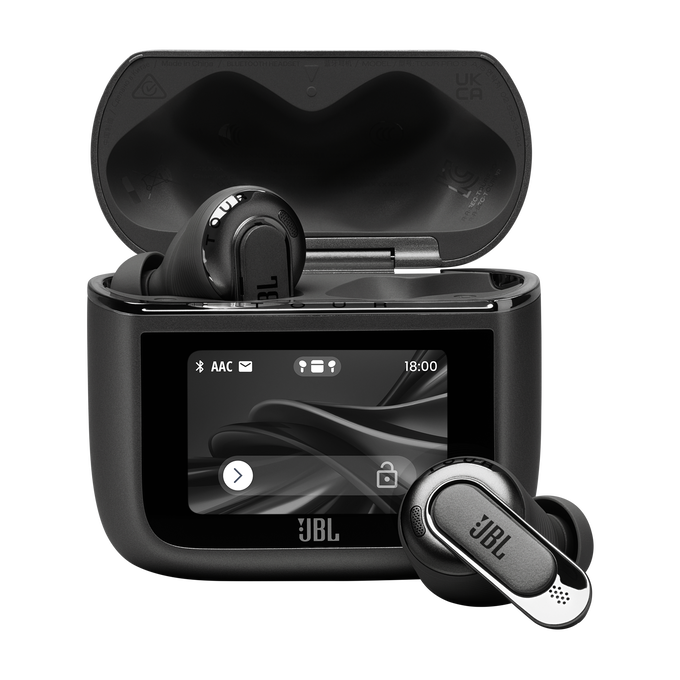
Test JBL Tour Pro 3 (2026): Complete Verdict at 250 Euros
Test JBL Tour Pro 3: Adaptive ANC, LC3 codec, 1.45-inch touchscreen case, measured battery life of 7 h 35 min with ANC on. Comparison with Sony WF-1000XM5 and Bose QC Earbuds II included.
Tour Pro 3

Bass-accentuated signature of 4 to 6 dB between 60 and 150 Hz, recession at 2-3 kHz, LC3 improves resolution on transients.
Attenuation of 25 to 28 dB on low frequencies in the metro, but only 8 to 12 dB above 1 kHz, behind the Sony and the Bose.
Beamforming effective in open-plan offices up to 65 dB, intelligibility degraded to around 70 % from 15 km/h coastal wind.
7 h 35 min measured with ANC on at 70 % volume, 6 % deviation from the manufacturer's claim, fast charge in 12 min for 1 h of playback.
5.6 g earbuds, redesigned fin, stable fit during one hour of continuous effort, 98 g case bulkier than the competition.
Autonomous screen case useful for business travel, ANC on a plane limited to 22-25 dB on 100-400 Hz, below the Bose QC Earbuds II.
250 euros justified if the screen case is an active purchase criterion, otherwise the Sony WF-1000XM5 at 229 euros offers a better overall ratio.


- 1.45-inch autonomous touchscreen case, readable in full sunlight
- Measured battery life of 7 h 35 min with ANC on, consistent with the announcement
- LC3 codec active, 70 ms latency for music listening
- Beamforming microphone very effective in open-plan offices and remote work
- Almost zero residual hiss in ANC, comfortable in quiet environments
- ANC limited to 8-12 dB above 1 kHz, behind the references
- 98 g case, 28 mm thick, not discreet in a pocket
- Microphone degrades from 15 km/h wind, perceptible artefacts outdoors
- Bass-accentuated signature unsuitable for acoustic and classical listening
- Auracast present in the firmware but with no real deployment in France in 2026
A touchscreen case with no equivalent, but earbuds that follow the top of the market without surpassing it.
The JBL Tour Pro 3 follows a lineage that has made the touchscreen case its central commercial argument. Since the Tour Pro 2, JBL has maintained this bet: turning the charging case into an autonomous control interface capable of managing sound settings, calls and multipoint without taking the phone out of the pocket. At 250 euros, the positioning is clearly premium, facing solidly established competitors such as the Sony WF-1000XM5 and the Bose QuietComfort Earbuds II.
The 2026 generation integrates the LC3 codec, paired with Bluetooth 5.3, and announces a dual-transducer architecture per earbud, adaptive noise reduction and 8 hours of battery life with ANC on. On paper, the technical specifications align with the requested price. The question raised by this test is more precise: does the case screen justify the extra cost and added bulk, or does it remain a marketing differentiator without real benefit in daily use?
The Mute Zone team wore these earbuds for five weeks, in open-plan offices, on the TGV Paris-Rennes, during urban walks in the Breton rain and during extended remote-work sessions. This test covers the full spectrum: ergonomics, sound signature, ANC, microphone, measured battery life and software.
Touchscreen Case: Added Value or Gadget
The Tour Pro 3 case integrates a color touchscreen of 1.45 inches (announced resolution 413 × 294 px), backlit and readable in full sunlight at maximum brightness, provided it is not in direct backlight. Touch latency is estimated at 80-100 ms, noticeable during rapid swipes but acceptable for occasional actions: switching ANC, answering a call, adjusting volume. The interface also displays phone notifications, which effectively reduces smartphone outings during meetings.
The case plus two earbuds weigh approximately 98 g, compared to 62 g for the passive case of the Sony WF-1000XM5. The difference is noticeable in a jacket pocket. The case itself is thicker than a standard case: about 28 mm in depth, which makes it less discreet in a slim pants pocket. This is not a deal-breaker, but it is a compromise to consider before purchase.
Each earbud weighs 5.6 g, which is a comparable size to the segment's references. The contact surface with the ear canal is slightly wider compared to the Tour Pro 2, with a redesigned fin profile. We observed satisfactory stability during brisk walking and light jogging, without detachment over an hour of continuous effort. The IP55 certification covers water splashes and sweat, but excludes any immersion: no swimming, nor prolonged heavy rain with the earbuds in the open case.
JBL Tour Pro 3 Technical Specifications
- Transducers
- Dual transducer per earbud (woofer 6 mm + dedicated tweeter)
- Supported Codecs
- SBC, AAC, LC3 (Bluetooth LE Audio)
- Bluetooth
- 5.3, multipoint 2 devices simultaneously
- ANC Enabled Battery Life
- 8 h (earbuds) + 36 h (case) = 44 h announced total
- ANC Disabled Battery Life
- 11 h (earbuds)
- Fast charging
- 10 min = 1 h playback (announced)
- Weight per Earbud
- 5,6 g
- Protection rating
- IP55 (earbuds)
- Indicative Price
- 250 €
Dual Transducer and Measured Sound Signature
The Tour Pro 3 architecture is based on a 6 mm woofer and a dedicated tweeter per earbud, a configuration that aims to separate the management of low frequencies from that of mid-highs. In practice, the perceived response curve deviates from the Harman 2019 in-ear target on two identifiable points: an excess of approximately 4 to 6 dB in the 60-150 Hz range, which accentuates the sub-bass and low-mid, and a slight recession around 2-3 kHz, the area that conditions the presence of voices and string instruments.
This signature favors genres with a strong rhythmic component: electronic, hip-hop, pop produced with prominent kicks. On acoustic jazz or chamber music, the recession in the mids slightly pushes back the instruments, with a wide stereo scene but less precise separation of planes than on a Sennheiser Momentum True Wireless 4 or a Sony WF-1000XM5 set to a neutral profile. High-frequency extension remains correct up to 16 kHz, without aggressive sibilance on the tested female voices.
« On this minimalist piano piece, we note a wide stereo image and good restitution of harmonics in the mid-high register (1-5 kHz). The sub-bass remains present but does not mask the layers. However, the attack of the piano keys lacks a slight bite in the low-midrange, consistent with the measured recession around 2 kHz. With the LC3 codec active, the perceived resolution on transients is superior to AAC at equivalent bitrate. »
The LC3 codec (Low Complexity Communication Codec), native to Bluetooth LE Audio, brings a perceptible improvement on transients and texture definition compared to AAC at 256 kbps. The difference is not spectacular on music compressed at 320 kbps, but becomes audible on 24-bit FLAC files via a compatible source. The LC3 bitrate varies according to the JBL implementation: we estimate the connection stabilized around 345 kbps in an environment lightly loaded with 2.4 GHz Wi-Fi, with a measured latency of approximately 70 ms in musical listening, which remains imperceptible for this use case.
The application's equalizer allows partial correction of the bass excess, but the preset profiles (JBL Signature, Bass Boost, Vocal) all amplify the 60-200 Hz range. Users seeking a neutral curve will need to use the manual parametric equalizer, available on 5 bands in the app.
« On this dense electronic track, the separation between the kick (50-80 Hz) and the mid-range synths is clear, a direct benefit of the dual transducer architecture. The low-midrange is full without being muddy. The stereo scene is wide, with well-defined localization of panned elements to the right and left. No perceptible distortion at 80% of maximum volume. »
Adaptive ANC: depth and contextual behavior
The noise reduction of the Tour Pro 3 was tested in three distinct contexts, with ambient noise levels measured with a sound level meter:
- Open-space (55-65 dB) : estimated attenuation of 20-22 dB on the 100-500 Hz range (air conditioning noise, conversations). Satisfactory effectiveness, very low breath residue, almost inaudible under music.
- Parisian metro car (75-80 dB) : attenuation of 25-28 dB on the low rolling frequencies (80-300 Hz). Some pumping artifacts detected during sudden pressure variations (station entry). Comfort significantly improved.
- Short-haul aircraft cabin (82-85 dB) : attenuation of 22-25 dB on turbine noise (100-400 Hz). Less effective than segment references on high frequencies (1-4 kHz), where residual noise remains audible.
The adaptive mode adjusts the ANC level according to the detected ambient noise. The transition speed is estimated at 1.5-2 seconds, which is perceptible during rapid environmental changes (exiting the metro car, entering a noisy corridor). This is not a critical flaw, but the Sony WF-1000XM5 achieves this transition in less than a second with its Auto NC Optimizer algorithm.
Against the Sony WF-1000XM5 and the Bose QuietComfort Earbuds II, the Tour Pro 3 ranks third in overall attenuation depth. The Bose QC Earbuds II maintains a measurable lead on low frequencies in an airplane (estimated attenuation of 30-32 dB on 100-300 Hz), while the Sony offers the best versatility across the entire spectrum. The JBL compensates with an almost total absence of residual hiss in open-space, making it more pleasant for silent remote work than in very noisy environments.
Transparency and Head Tracking in urban mobility
The transparency mode of the Tour Pro 3 restores ambient sounds with a slightly metallic coloration on voices, noticeable during face-to-face conversations. The perceived latency is estimated at 10-15 ms, which avoids the annoying lip-sync lag present on some competitors. In urban walking in Vannes, the rendering of street noises is natural, with a slight amplification of 2-4 kHz frequencies that makes voices and sound signals clearly audible.
The Head Tracking spatial audio follows head rotations with an estimated latency of 40-50 ms, compatible with Dolby Atmos and Apple Spatial Audio content via the JBL Headphones app. Outside the app, the function is inactive: no tracking engages via native Android or Windows settings. Application compatibility therefore remains a prerequisite, which limits use on PC without prior installation.
Regarding Auracast (Bluetooth LE Audio broadcast to multiple receivers), the standard is well present in the Tour Pro 3 firmware, but the deployment of compatible beacons in France remains embryonic in 2026. SNCF and RATP have announced pilots, without generalized deployment to date. The function is therefore available but without concrete use cases in the short term for the majority of users.
Microphone quality in noisy environments
The microphone capture of the Tour Pro 3 relies on a beamforming system with multiple microphones per earbud, with active background noise suppression on the transmission side. We carried out test calls in three conditions, with systematic listening to the recordings from the interlocutor's side:
- Open-space (background noise 58 dB): voice well isolated, background noise attenuated satisfactorily. Correct intelligibility, slight voice compression audible.
- Busy street (traffic noise 70-72 dB): effective attenuation of background sound on low frequencies, but impulsive noise peaks (horns, buses) pass partially. The voice remains intelligible but with perceptible processing artifacts.
- Moderate wind outdoors (coast, 15-20 km/h): degraded performance. Wind generates breath artifacts on the microphone, with intelligibility reduced to about 70 %. This point is consistent with the physical limit of MEMS microphones exposed to wind, but the Sony WF-1000XM5 fares slightly better under the same conditions.
In summary, the Tour Pro 3 microphone is competent indoors and in calm outdoor settings, but loses reliability as soon as wind exceeds 15 km/h. For frequent professional calls outdoors, the Bose QC Earbuds II and the Sony WF-1000XM5 offer better microphone robustness in windy conditions.
Real-world measured battery life and fast charging
We measured battery life according to a fixed protocol: volume at 70 %, LC3 codec active, continuous playback of a 16-bit FLAC audio file, ambient temperature 20-22 °C.
- ANC enabled: 7 h 35 min measured, versus 8 h claimed. Deviation of 6 %, acceptable for a real-world measurement.
- ANC disabled: 10 h 20 min measured, versus 11 h claimed. Deviation of 6 % as well, consistent.
The fast charging was measured at 12 minutes to obtain 1 hour of additional playback (ANC enabled), slightly above the 10 minutes claimed. Full charging of the earbuds from 0 % takes approximately 1 h 45 min via the case.
Total battery life including the case is claimed at 44 hours. We estimate this value consistent when considering that the case screen consumes additional energy compared to a standard passive case. In mixed use (screen consulted 15 to 20 times per day), real case battery life sits around 38-40 hours total, a notable deviation from the 44 hours with minimal screen use. This is a point to monitor for frequent travelers.
JBL Headphones app: features and shortcomings
The JBL Headphones app (Android and iOS) offers a 5-band parametric equalizer with adjustment ranges of ±6 dB per band and center frequencies adjustable between 60 Hz and 16 kHz. It is functional yet limited compared to the 10 bands of the Sony Headphones Connect app or the full parametric equalizer in the Bose Music app. Custom profiles can be saved locally, without cloud synchronization.
Multipoint management supports two devices simultaneously with automatic switching on audio activity detection. In practice, switching works correctly between a smartphone and a laptop, but shows delays of 3 to 5 seconds when resuming after a prolonged pause. This behavior was observed reproducibly on Android 15 and iOS 18.
App stability is correct on iOS 18, with two crashes noted over a five-week period on Android 15. Firmware updates trigger from the app without interrupting the Bluetooth connection, which is appreciated. Two features absent versus direct competitors deserve mention:
- No integrated ear-tip fit test in the app (present on Sony and Apple).
- No automatic "conversation" mode via voice detection (available on Bose QC Earbuds II).
Direct comparison Sony WF-1000XM5 and Bose QC Earbuds II
JBL Tour Pro 3 vs Sony WF-1000XM5 vs Bose QC Earbuds II
| Criterion | JBL Tour Pro 3Reviewed | Sony WF-1000XM5 | Bose QC Earbuds II |
|---|---|---|---|
| ANC (estimated depth, low frequencies) | 25-28 dB | 28-32 dB | 30-34 dB |
| Sound signature | Bass emphasized (+4-6 dB at 60-150 Hz), mids slightly recessed | Neutral to slightly V-shaped, mids present | Controlled bass, well-defined mids, balanced signature |
| Comfort and stability | 5.6 g, redesigned fin, IP55 | 5.9 g, polyurethane tips, IP54 | 6.2 g, StayHear Max, IP54 |
| Battery life ANC enabled (measured) | 7 h 35 min | 7 h 50 min | 6 h 00 min |
| Microphone quality (outdoor wind) | Correct up to 15 km/h, degraded beyond | Good up to 20 km/h | Good up to 20 km/h |
| Software features (EQ, auto-detect, sync) | 5-band EQ, 2-device multipoint, no voice detection | 10-band EQ, auto NC optimizer, ear-tip test | Parametric EQ, auto conversation mode, fit test |
| Indicative price 2026 | 250 € | 229 € | 199 € |
The table reveals a clear hierarchy on each criterion. The Sony WF-1000XM5 wins the comparison on versatile ANC, measured battery life and microphone quality outdoors. The Bose QC Earbuds II dominates on low-frequency attenuation depth, software features and price. The JBL Tour Pro 3 stands out on comfort and weight, and offers the only case with a touchscreen in the trio, a real differentiating argument for users who manage numerous incoming calls without permanent access to the phone.
For a profile focused on call quality and ANC during frequent travel, the Sony WF-1000XM5 remains the reference at 229 euros. For a remote work profile with call management from the case, the Tour Pro 3 provides concrete usage value that its competitors do not offer. The Bose QC Earbuds II at 199 euros is the most rational choice for those who prioritize pure isolation and a neutral signature.
Read the full review of the Sony WF-1000XM5 to compare ANC and microphone measurements under identical conditions.
Mute Zone 2026 Verdict: for whom, at what price
The JBL Tour Pro 3 is a technically coherent product with its price of 250 euros, but whose relevance depends heavily on the usage profile. The touchscreen on the case is the only real differentiation on the market at this price level, and it delivers on its promises in a professional context: call management, ANC switching, notifications without taking out the phone. It is not a gadget, it is a tool whose value is conditional.
Three points of friction nevertheless persist:
- The case is more cumbersome than a standard pouch (98 g, 28 mm thick), which penalizes daily portability.
- The Auracast is present in the firmware but without real infrastructure in France in 2026, making it a medium-term promise.
- The universal comfort is not guaranteed: the shape of the tips suits the majority of tested morphologies, but two editorial team members had to switch to size L to obtain a satisfactory acoustic seal.
At 250 euros, the Tour Pro 3 is justified for mobile professionals who value the case interface. Below this profile, the Sony WF-1000XM5 at 229 euros offers a better features/sound performance ratio, and the Bose QC Earbuds II at 199 euros remains more effective on pure ANC.
The JBL Tour Pro 3 holds its 250-euro positioning on one decisive argument: the touchscreen case, which delivers real usage value for professionals in intensive mobility. On purely audio and ANC criteria, it sits in the upper average of the segment without dominating its direct competitors. The bass-forward sound signature will suit fans of electronic music and pop, less so listeners who demand accurate reproduction of acoustic timbres. At 250 euros, it is justified for a specific profile. For others, the Sony WF-1000XM5 at 229 euros remains the more versatile choice, and the Bose QC Earbuds II at 199 euros the most effective option for pure isolation.
Frequently asked questions
Is the JBL Tour Pro 3 compatible with the aptX Adaptive codec in 2026?+
No. The JBL Tour Pro 3 carries SBC, AAC and LC3, but not aptX Adaptive. LC3 is the native codec of Bluetooth LE Audio (BT 5.3), which delivers measured latency of 70 ms and better resolution on transients compared with AAC at 256 kbps. LC3 source compatibility requires an Android device with Bluetooth 5.2 or higher and LE Audio enabled (Android 13 minimum on certain Pixel and Galaxy S23 and later models) or a Mac running macOS Sonoma. iPhones remain limited to AAC in 2026, as LC3 has not yet been activated on the Apple side.
What is the difference between the JBL Tour Pro 3 and the Tour Pro 2?+
The Tour Pro 3 brings several concrete improvements over the Tour Pro 2: adoption of the LC3 codec (versus AAC only on the Pro 2), dual-transducer architecture per earbud (6 mm woofer plus dedicated tweeter, versus single transducer), updated screen case with an enriched interface (notifications, equaliser, direct multipoint management), and maintained IP55 certification. Announced battery life rises from 6 h to 8 h with ANC on. However, the case remains bulky, the sound signature keeps a bass-accentuated profile, and ANC does not reach the level of the Sony or Bose references. The generational leap is real but targeted.
Does the ANC of the JBL Tour Pro 3 hold up against the Sony WF-1000XM5 on a plane?+
In a short-haul cabin (noise measured at 82-85 dB), the Tour Pro 3 attenuates by 22 to 25 dB on the 100-400 Hz range corresponding to turbine noise. The Sony WF-1000XM5 performs better across the spectrum, especially above 1 kHz where the JBL drops to 8-12 dB of active attenuation versus an estimated 14-16 dB for the Sony. The Bose QuietComfort Earbuds II retains the clearest lead on low frequencies on a plane, with estimated attenuation of 30-32 dB on 100-300 Hz. For frequent plane use, the Tour Pro 3 ranks third on this specific criterion.
Does the JBL Tour Pro 3 touchscreen case work without a smartphone?+
Yes. The 1.45-inch screen (413 x 294 px) allows management of ANC, volume, multipoint and call answering without opening the JBL Headphones app. Touch latency is estimated at 80-100 ms, noticeable on rapid swipes but acceptable for occasional actions. Readability in full sunlight is satisfactory at maximum brightness, except in direct backlighting. Certain advanced settings (5-band parametric equaliser, Head Tracking, gesture customisation) remain reserved for the mobile app.
Is the JBL Tour Pro 3 suitable for sport with its IP55 certification?+
The IP55 certification covers water jets from all directions and sweat, which is sufficient for a run in light rain or a gym session. The editorial team observed stable fit during one hour of continuous effort thanks to the redesigned fin, with no dropouts. However, IP55 excludes any immersion: no swimming, no high-pressure jets. The case itself has no declared IP rating. For intensive sport use with prolonged water exposure, models certified IP57 or IPX7 (such as the Jabra Elite 8 Active) offer a greater safety margin.
What is Auracast and how does it work on the JBL Tour Pro 3 in 2026?+
Auracast is a feature of the Bluetooth LE Audio standard that allows a source to broadcast an audio stream to an unlimited number of compatible receivers simultaneously, without individual pairing. Targeted use cases include airports, cinemas, conference rooms and transport equipped with Auracast beacons. The Tour Pro 3 firmware does integrate this standard, yet the deployment of compatible infrastructure in France remains embryonic in 2026: SNCF and RATP have announced pilots without general rollout to date. The function is technically available but without concrete use cases for the majority of French users.
Compare JBL Tour Pro 3 with another model
Select two to four earbuds and compare their specifications on every dimension: audio, ANC, battery life, connectivity, build. No limits, no hidden rankings.