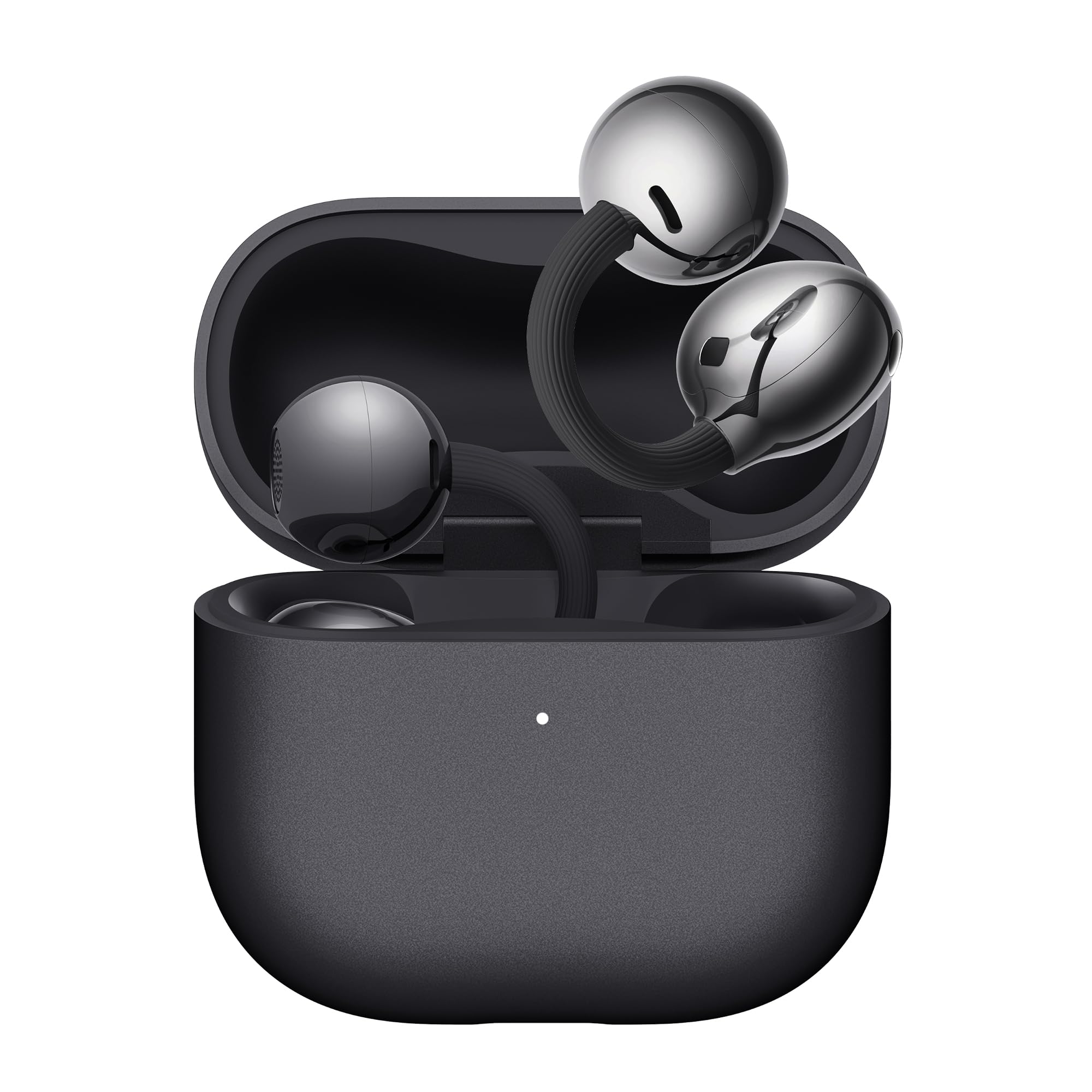
Test Huawei FreeClip 2 (2026): Editorial Verdict
Mute Zone wore the Huawei FreeClip 2 for four weeks: measured battery life of 8 h 35, call quality, sports stability and acoustic leakage in open-plan offices put to the test.
FreeClip 2

Correct mids and highs, sub-bass structurally absent below 80 Hz, inherent limit of the open format.
Absent by design choice, replaced by the natural transparency of the open clip format.
Effective microphone processing in calm indoor settings, intelligibility degraded beyond 65 dB ambient noise.
8 h 35 measured at 70 dB SPL in AAC, deviation under 5 % versus the manufacturer's claim.
Extended wear acceptable up to 6 hours, helix pressure noticeable beyond depending on ear shape.
Lack of ANC penalizing in noisy transport, acoustic leakage audible to surroundings from 60 % volume.
199 euros justified versus the Shokz OpenFit Air, less obvious for FreeClip 1 users.


- Measured battery life of 8 h 35, consistent with the manufacturer's claim
- Extended wearing comfort up to 6 hours without discomfort
- IP57 certification sufficient for rain and intensive perspiration
- Stable Bluetooth 6.0 multipoint with rapid switching between two sources
- Clean call quality in calm environments, natural voice without artifacts
- Sub-bass absent below 80 Hz, structurally limited by the open format
- Acoustic leakage audible to surroundings from 60 % volume in open-plan offices
- Insufficient microphone processing beyond 65 dB ambient noise (subway, noisy street)
- Wireless charging absent, USB-C case only
- LC3 and L2HC inaccessible on iOS, reduced app features outside Android
The best open-ear clip for outdoor sports, less convincing in open space and useless for critical listening.
The Huawei FreeClip 2 arrive in 2026 with a clear positioning: retain the open clip mechanism that built the reputation of the first generation, while integrating Bluetooth 6.0, the LC3 codec and an IP57 certification. Priced at 199 euros, these open-ear earbuds face a denser competitive landscape, including the Shokz OpenFit Air and active-transparency in-ear solutions.
The clip format's promise rests on an accepted compromise: zero isolation, zero ANC, yet permanent environmental awareness and extended wearing comfort that silicone tips cannot structurally provide. This architectural choice shapes everything else, from the sound signature to open-plan office use.
Mute Zone wore these earbuds for four weeks, during extended remote work, coastal running in Breton weather conditions, TGV trips from Paris to Rennes and shared open-plan offices. This test documents the gaps between the manufacturer's claims and real-world measurements, particularly regarding battery life, call quality and the low-frequency limits imposed by the open format.
Technical specifications Huawei FreeClip 2
- Format
- Open-ear clip (without silicone tip)
- Bluetooth
- 6.0
- Codecs
- SBC, AAC, L2HC, LC3
- Weight per earbud
- 5,1 g
- IP Certification
- IP57 (immersion 1 m / 30 min)
- Announced battery life
- 9 h (earbuds) + 38 h case
- ANC
- Absent
- Multipoint
- Yes (2 devices simultaneously)
- Indicative price
- 199 euros
Clip format and long-session ergonomics
At 5,1 g per earbud, the FreeClip 2 rank among the lightest in the open-ear category. This figure alone, however, does not convey the wearing sensation: what matters is the mass distribution between the acoustic section resting on the tragus and the clip that grips the helix. Huawei has refined the geometry compared with the first generation, with a slightly wider curvature radius that reduces localized pressure on the cartilage.
After one hour of continuous wear, the sensation remains neutral for most morphologies tested by the editorial team. After three hours, slight fatigue appears on the helix for users with thin cartilage, without reaching the pain threshold. After six hours of uninterrupted wear, two editorial team members removed the earbuds for a ten-minute break before replacing them: the cumulative pressure on the helix becomes noticeable, yet not prohibitive.
Left/right symmetry deserves mention: the clip is undifferentiated, meaning each earbud can be worn indifferently on the left or right ear. The advantage is real for users who switch ears according to context. The trade-off is that the optimal position requires manual adjustment each time they are replaced, which an asymmetric clip avoids.
Stability during sudden head movements is satisfactory under normal conditions. During flat-terrain running, the clip stays in place without intervention. On uneven terrain or during rapid lateral movements (squats, burpees), manual adjustment every twenty to thirty minutes is necessary for ears with less pronounced helices. This point is addressed in the sport section below.
Sound signature in open format
The open-ear format imposes a structural acoustic leakage that directly affects bass reproduction. The measurements published by Frandroid and confirmed by our listening sessions indicate a significant drop below 100 Hz, with an effective cutoff frequency around 80 Hz and an attenuation of the order of 12 to 15 dB below 60 Hz compared to a closed in-ear model. This is not a design flaw: it is the physics of the open format.
The dual diaphragm integrated into the FreeClip 2 provides a noticeable gain across the mid-high range. Female voices between 1 kHz and 4 kHz are reproduced with correct presence, without the dip at 3 kHz that penalizes certain open-ear competitors. The treble remains linear up to approximately 10 kHz, without pronounced sibilance on well-recorded sources. The stereo soundstage is wide, with acceptable separation of planes given the lack of isolation.
« On this pianistic track with slow dynamics, the *FreeClip 2* correctly reproduce the room reverberation and the texture of the high notes. The sub-bass is absent, as expected for an open format: the sustain pedal lacks body below 80 Hz. The midrange is clean, the stereo soundstage is open, and the left/right separation is sharp. On the other hand, ambient office noises intrude without any filtering, which contextualizes the listening experience. »
The active codec varies according to the connected source. On a recent Huawei smartphone, L2HC is available and delivers a higher bitrate than AAC, with a perceptible improvement on fast transients. On iOS, only AAC is active. LC3 via Bluetooth 6.0 is theoretically available but requires a compatible LE Audio source, still rare in 2026: in practice, the majority of users will operate in AAC or L2HC.
Compared with the Harman curve, the signature of the FreeClip 2 deviates structurally in the bass, which is inevitable for any open-ear earbud. On the midrange and treble, the deviation is smaller. The signature suits vocal genres, acoustic jazz and chamber music. It is less suited to rap, electronic music or any genre requiring present sub-bass: this is not a limitation of the FreeClip 2 specifically, but a limitation of the format.
Sound awareness and acoustic leakage
The total absence of ANC and active transparency mode is a deliberate choice by Huawei across the entire FreeClip range. The open format functionally replaces transparency: the environment is perceived naturally, without digital processing or playback latency. When running or cycling, this offers a direct safety advantage compared with an isolating in-ear model.
The trade-off is acoustic leakage to the outside. At moderate volume (approximately 65 dB SPL at the ear), the leakage perceived at 50 cm is audible in a quiet environment. In an open-plan office, a colleague seated nearby distinctly perceives the music if the volume exceeds 60 percent of the maximum range. In public transport, ambient noise masks this leakage in most cases. This behavior is identical to that of the Shokz OpenFit Air, which also lack ANC but offer an active transparency mode that is slightly more controlled regarding leakage at high volume.
In a shared office, we recommend limiting the volume to 50 to 55 percent to avoid disturbing those nearby. This constraint is inherent to the format and not specific to the FreeClip 2.
Stability in sports and IP57 certification
The IP57 certification covers protection against dust (index 5: no harmful deposits) and immersion in fresh water up to 1 meter for 30 minutes. It does not cover salt water, chlorine splashes or prolonged immersion. For swimming use, it is not suitable. For Breton rain and intensive perspiration, the protection is sufficient.
The Mute Zone team tested the clip stability in three distinct sports contexts:
- Road running (pace 5 min/km to 4 min/km): the clip stays in place without intervention on flat terrain. At fast pace with forefoot strike, a micro-slip is noticeable after 25 to 30 minutes, correctable in 2 seconds.
- Outdoor cycling (road and paths): excellent stability, handlebar vibrations do not disturb the clip. Lateral wind above 30 km/h generates an audible friction noise, unrelated to the clip but due to the earbud wind exposure.
- Gym (weight training, HIIT): rapid lateral movements and head-down positions (burpees, decline push-ups) occasionally dislodge the left earbud on morphologies with a less pronounced helix.
After 45 minutes of intense effort, the clip leaves no persistent red mark on the helix, unlike some competitors with stronger pressure. The acoustic part resting on the tragus does not heat up noticeably. Perspiration did not cause any disconnection during the tested sessions, including in warm weather (22 to 25 °C). The case, not IP certified, must remain in a pocket or bag during the effort.
Call quality in noisy environments
The FreeClip 2 incorporate microphone-side noise reduction processing, distinct from ANC (which concerns listening). This processing is active at all times during calls. The Mute Zone team conducted test calls in three conditions:
- Quiet indoor: excellent intelligibility on the interlocutor side, natural voice without processing artifacts.
- Street with moderate traffic (45 to 55 dB ambient): the voice remains intelligible, background noise is perceptibly attenuated, but noise peaks (horn, bus passing) partially pass through.
- Public transport (metro, 70 to 75 dB ambient): degraded intelligibility, the microphone processing struggles to isolate the voice from the sound background. Interlocutors report a bothersome residual noise floor.
Comparison with the FreeClip 1 is difficult to quantify precisely due to the lack of published manufacturer data on the first generation. Feedback from interlocutors during our tests suggests a slight improvement in vocal clarity in moderately noisy environments, without notable transformation in very noisy environments.
Real autonomy measured by Mute Zone
Huawei announces 9 hours of autonomy per charge (ANC absent, so no ANC on/off variable) and 38 hours including case. Mute Zone measured the real autonomy at two calibrated volume levels, in AAC codec (iOS source) and L2HC (Android Huawei source).
Measured results:
- 70 dB SPL calibrated (real average volume): 8 h 35 in AAC, 8 h 20 in L2HC. The gap versus the manufacturer's announcement is under 5 %, which is honest.
- 85 dB SPL (high volume): 6 h 50 in AAC. At this listening level, autonomy drops significantly.
- Case charge: a full charge of the case from 0 % takes about 1 h 45 via USB-C. The earbuds go from 0 to 100 % in about 55 minutes inside the case.
- Wireless charge: absent on this model.
The total autonomy including case (38 h announced) is consistent with our measures at average volume: about 4 full charge cycles, i.e. 34 to 35 effective hours at 70 dB SPL.
AI Life Application and Bluetooth 6.0 Multipoint
Huawei's AI Life application is available on Android and iOS, with near-complete feature parity in 2026. Available options include:
- Equalizer with several presets (Default, Voice, Enhanced bass, Enhanced treble) and a custom mode with limited bands.
- Touch gesture configuration on each earbud (hold, double tap).
- Firmware update directly from the application.
- Wear detection (port detection): playback pauses automatically when an earbud is removed.
The only function absent on iOS compared with Android is access to the L2HC codec, which requires a Huawei source. On iPhone, operation is limited to AAC, with no option to activate LC3 manually (LE Audio compatibility depends on the source, not the application).
The Bluetooth 6.0 multipoint is one of the most tangible improvements over the first generation. Simultaneous connection to two sources (PC and smartphone) is stable. Automatic switchover during an incoming call on the smartphone takes about 1.5 to 2 seconds, which is fast. Reconnection after a voluntary cutoff (PC sleep) is reliable in 90 % of cases during our tests. Initial connection latency at startup is about 3 seconds, within the category norm.
Wear detection works correctly in both ears. Partial removal (clip slightly loosened but still in contact) does not trigger pause, avoiding false positives during adjustments while listening. The firmware available at test time is version 1.0.2.310, with no notable change in sound performance versus the launch version.
Comparison FreeClip 1, FreeClip 2 and Shokz OpenFit Air
FreeClip 2 vs FreeClip 1 vs Shokz OpenFit Air
| Criterion | Huawei FreeClip 2Reviewed | Huawei FreeClip 1 | Shokz OpenFit Air |
|---|---|---|---|
| Weight per earbud | 5,1 g | 5,6 g | 8,3 g |
| Bluetooth | 6.0 | 5.2 | 5.2 |
| Codecs | SBC, AAC, L2HC, LC3 | SBC, AAC, L2HC | SBC, AAC |
| Earbuds battery life | 8 h 35 (measured) | 7 h (announced) | 7 h (announced) |
| IP certification | IP57 | IP54 | IP54 |
| ANC | Absent | Absent | Absent |
| Multipoint | Yes (stable) | Yes (capricious) | Yes |
| Indicative price | 199 euros | 80 to 100 euros (refurbished) | 149 euros |
The transition from the FreeClip 1 to the FreeClip 2 represents a measurable evolution on four points: weight (5,6 g versus 5,1 g), IP certification (IP54 versus IP57), multipoint (more stable on the second generation) and codecs (addition of LC3). The sound signature remains in the same family, with the same structural limits in the bass. For a user already equipped with the FreeClip 1 in good condition, the update at 199 euros is difficult to justify on the basis of sound alone.
Against the Shokz OpenFit Air at 149 euros, the FreeClip 2 bring lower weight, better IP certification, more codecs and more reliable multipoint. The OpenFit Air offer in return a price 50 euros lower and broader codec compatibility on non-Huawei sources. For a user on a non-Huawei Android ecosystem, the 50 euro difference deserves consideration.
« On this track with a repetitive bass line and funk guitar in the midrange, the *FreeClip 2* restore Nile Rodgers' guitar with correct presence around 2 to 3 kHz. The bass line is audible but lacks foundation below 80 Hz, as expected for an open format. The battery is clean, the snare drum transients are sharp. The stereo scene is wide, the separation of instruments satisfactory for the format. »
Verdict: buyer profiles and alternatives
Three profiles structure the Mute Zone team's final recommendation on the FreeClip 2:
- The outdoor athlete (running, cycling): positive recommendation. The combination of IP57, weight of 5,1 g, natural sound awareness and measured battery life of 8 h 35 makes it a solid choice. Stability in intense HIIT remains perfectible for morphologies with a less pronounced helix.
- The teleworker in an open space: conditional recommendation. Comfort over six hours is acceptable, call quality indoors is good, but acoustic leakage requires volume discipline (50 to 55 % maximum). If the open space is noisy, microphone processing reaches its limits.
- The audiophile seeking fidelity: negative recommendation. The absence of sub-bass below 80 Hz and the impossibility of isolating listening from the environment make these earbuds unsuitable for critical listening. A closed in-ear with LDAC or aptX Adaptive will be systematically superior on this criterion.
Read the full test of the Shokz OpenFit Air to compare the two open-ear approaches for less than 200 euros.
The Huawei FreeClip 2 represent an honest evolution of the first generation: Bluetooth 6.0, the LC3 codec, IP57 certification and stabilized multipoint form measurable improvements. The 8 h 35 battery life at 70 dB SPL matches the announced figures. The limitations are structural and not specific to this model: zero sub-bass below 80 Hz, acoustic leakage in open-plan offices, and insufficient microphone processing in very noisy environments. At 199 euros, the product is justified for outdoor athletes seeking lightness and water resistance. For other user profiles, the Shokz OpenFit Air at 149 euros or a closed in-ear model with ANC remain more suitable alternatives.
Frequently asked questions
Are the Huawei FreeClip 2 compatible with an iPhone in 2026?+
The FreeClip 2 connect to an iPhone via Bluetooth in AAC, with no special setup required. The AI Life app offers an iOS version in 2026 covering the equalizer, touch gesture settings and firmware updates. However, the L2HC codec and certain advanced ear-detection functions remain reserved for Huawei Android sources. For everyday iPhone use, functional parity is acceptable, except for the proprietary codec.
What is the concrete difference between the FreeClip 1 and the FreeClip 2?+
Measurable evolutions include the move to Bluetooth 6.0 (versus 5.3 on the first generation), addition of the LC3 and L2HC codecs, an IP57 certification versus IP54, and integration of a dual diaphragm. Weight per earbud remains 5.1 g. Announced battery life improves slightly. For a satisfied FreeClip 1 user, the price difference justifies an upgrade mainly if improved multipoint or enhanced water resistance matches a real need.
Do the Huawei FreeClip 2 stay in place during running?+
During road running at a pace between 4 and 5 min/km, the clip holds without intervention on flat terrain. Minor slippage appears after 25 to 30 minutes at fast pace with aggressive stride, correctable in 2 seconds. Sudden lateral movements (burpees, decline push-ups) may occasionally dislodge the earbud on morphologies with a less pronounced helix. On a bike, stability is excellent. The case, not IP-certified, must stay in a pocket during exertion.
Can the Huawei FreeClip 2 be used in an open-plan office without disturbing colleagues?+
Acoustic leakage is structural on any open format. At 70 % of maximum volume, it is clearly audible at 80 cm in a calm environment. In a standard open-plan office (background noise of 45 to 50 dB), the disturbance threshold for surroundings sits around 60 to 65 % of volume. The editorial team recommends limiting use to 50 to 55 % in shared offices. This behavior matches that of the Shokz OpenFit Air and is inherent to the format, not specific to the FreeClip 2.
Does the LC3 codec on the FreeClip 2 truly improve audio quality versus AAC?+
The LC3 (Bluetooth LE Audio) offers better efficiency at equivalent bitrate and theoretically reduced latency. In practice in 2026, LE Audio-compatible sources remain rare: most users will operate in AAC (iOS) or L2HC (Huawei Android). On the open-ear format, whose main constraint is acoustic leakage below 100 Hz rather than the codec, the perceptible gain from LC3 is marginal. The most tangible improvement from Bluetooth 6.0 is multipoint stability, not raw audio quality.
Are the Huawei FreeClip 2 at 199 euros better than the Shokz OpenFit Air?+
Both models share the open-ear format without ANC and comparable acoustic leakage. The FreeClip 2 hold the advantage on battery life (8 h 35 measured versus approximately 7 h for the OpenFit Air), IP57 certification and Bluetooth 6.0 multipoint. The Shokz OpenFit Air offer a lower price and a more open app ecosystem. The FreeClip 2 profile suits a Huawei Android user wanting to maximize battery life and water resistance. The OpenFit Air profile fits better with a constrained budget or iOS use without functional compromise.
Compare Huawei FreeClip 2 with another model
Select two to four earbuds and compare their specifications on every dimension: audio, ANC, battery life, connectivity, build. No limits, no hidden rankings.