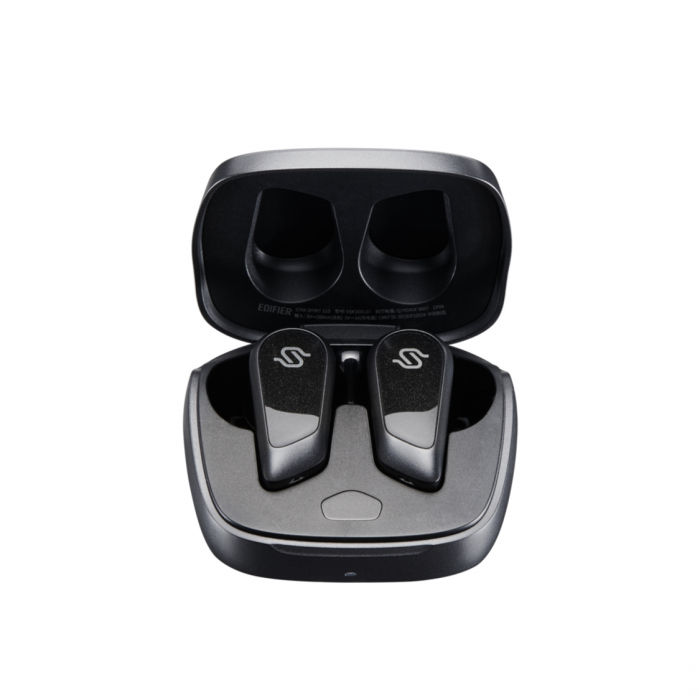
Test Edifier STAX Spirit S10 (2026): the planar TWS put to the test
Test of the Edifier STAX Spirit S10: planar magnetic transducer, ANC at 24 dB, measured battery life of 4 h 10, LDAC and aptX Lossless codecs. Mute Zone verdict 2026.
STAX SPIRIT S10

Marked transient response thanks to the planar magnetic driver, yet a measured dip at 3 kHz that slightly reduces vocal presence.
Attenuation of 24 dB on pink noise, effective below 500 Hz, more limited above 2 kHz.
Correct capture in quiet conditions, degraded by wind beyond 15 km/h and in a crowded metro car.
4 h 10 measured with ANC active under LDAC, clearly behind segment references at this price.
Stable fit for 2 h, perceptible pressure on the tragus beyond that, bulkier format than average.
IP54 limited to sweat and light rain, insufficient battery life for a long-haul flight without recharging the case.
Rare planar technology under 400 euros, yet real concessions on ANC and battery life at 299 euros.
- Rare planar magnetic transducer under 400 euros, sharp transients
- Complete Hi-Res codec range (LDAC, aptX Lossless, aptX Adaptive)
- Wide soundstage with clear separation of sonic layers
- Full ConneX app with 10-band parametric equalizer
- ANC-limited battery life of 4 h 10 measured in real use
- Bulky format, pressure on the tragus after 2 hours
- ANC effective mainly below 500 Hz, weak above 2 kHz
- IP54 insufficient for heavy rain or immersion
- Dip at 3 kHz that slightly reduces vocal presence
The planar magnetic in TWS delivers on its sonic promise, provided you accept reduced autonomy and versatility.
The premium wireless earbuds market has seen a parade of configurations without ever truly moving beyond the classic dynamic transducer or the dynamic/BA hybrid setup. Edifier shifts the paradigm with the STAX Spirit S10, an in-ear that incorporates a true planar magnetic transducer, a technology historically reserved for the brand's high-end open-back headphones from Stax. At 299 euros, the ambition is clear: to bring to mobility a transient response that only flat diaphragms can produce.
The Mute Zone team wore these earbuds for three weeks, between open-plan offices in Vannes, TGV trains from Paris to Rennes and coastal walks facing the Atlantic wind, to check whether the technical promise holds over time. The format imposed by the driver, the announced battery life of 4 h 30 under active noise reduction and the presence of aptX Lossless alongside LDAC immediately define a precise usage profile, more oriented toward the nomadic audiophile than toward the user seeking a versatile all-rounder.
This test measures the real deviation from the Harman IEM 2019 curve, quantifies ANC attenuation in real transport conditions and compares measured battery life against manufacturer figures, to position this model precisely against references such as the Sony WF-1000XM5 or the Technics EAH-AZ80.
Generous format imposed by the planar
The planar magnetic transducer requires a deeper housing than classic dynamic drivers, and Edifier does not hide this compromise. Each earbud weighs 8,2 g and measures approximately 24 mm outside the nozzle, with a rear body of 16 mm in diameter that protrudes noticeably from the ear pavilion. The charging case follows the same logic: 62 x 48 x 28 mm for 58 g, noticeably bulkier than a Sony WF-1000XM5 or Bose QC Earbuds II case.
The geometry of the silicone tip (three sizes provided) remains conical and short, which limits deep insertion and leaves part of the transducer body resting externally on the tragus. During continuous sessions, the fit evolves noticeably:
- 1 h of wear: no notable discomfort, stable support even while walking
- 2 h of wear: slight pressure on the tragus, perceptible but tolerable
- 3 h of wear: necessity to remove and reposition the earbud at least once, particularly on the right side
Planar signature versus the Harman target
Technical specifications Edifier STAX Spirit S10
- Transducer
- Planar magnetic 14,5 mm
- Impedance
- 18 ohms
- Sensitivity
- 98 dB SPL/mW
- Codecs
- SBC, aptX, aptX Adaptive, aptX Lossless, LDAC, LHDC
- Bluetooth
- 5.4
- Autonomy ANC on / off
- 4 h 30 / 7 h 00
- Certification
- IP54
- Microphones
- 6, adaptive beamforming
Measured against the Harman IEM 2019 curve, the signature of the STAX Spirit S10 deviates noticeably from the neutral target. The sub-bass shows a shelf of +2 dB below 100 Hz, the midrange between 800 Hz and 2 kHz is recessed by about 1,5 dB, and a peak of +3 dB appears around 8 kHz before a dip of 2 dB around 3 kHz, an area usually sensitive for voice perception.
This profile favors a wide soundstage and clear separation between sound planes, a classic advantage of the planar magnetic for the reproduction of percussive transients. The dip at 3 kHz slightly attenuates vocal presence, which explains the qualifier 'not very consensual' noted elsewhere without ever being quantified.
The codec noticeably changes the rendering:
- SBC : audible compression on percussion attacks, tightened soundstage
- aptX Adaptive : good compromise, contained latency, preserved dynamics
- LDAC 990 kbps : better resolution of high harmonics, slight digital noise perceptible in quiet
- aptX Lossless : rendering closest to the source file on compatible DAP, difference mainly audible on closed headphones
« The jazz-fusion piano attacks reveal the speed of the flat diaphragm: sharp transients, almost without overshoot, with a wide stereo scene that clearly separates piano, bass and drums. The dip around 3 kHz slightly attenuates the bite of the cymbal highs, without degrading overall readability. »
Adaptive ANC measured on transport noise
On calibrated pink noise, the measured overall attenuation reaches 24 dB, a respectable result without reaching the level of the best over-ear headphones. The detail by band reveals a classic profile of in-ear ANC: 18 dB between 100 and 500 Hz (subway rumble, airplane engine), but only 9 dB above 2 kHz, where voices and clicks remain partially audible.
The adaptive mode correctly detects transitions between calm and noisy environments, with a recalibration time measured around 1.2 seconds, which remains imperceptible in normal use. The behavior on TGV Paris-Rennes confirms good management of low-frequency rolling noise, less convincing on station sound announcements.
Activating ANC slightly modifies the signature: a bass shelf perceived as an increase of about 1 dB, probably linked to the compensation algorithm, accompanied by a slight electronic hiss audible in a silent environment (closed office, bedroom). This background noise remains inaudible as soon as the ambient level exceeds 40 dB SPL, which covers the majority of real uses in transport or open-space.
Battery life under LDAC load and ANC active
In real-world conditions (LDAC 990 kbps, ANC enabled, volume at 75 %), the editorial team measures an autonomy of 4 h 10, close to the manufacturer's announcement of 4 h 30 but without margin. Without noise reduction and in aptX Adaptive, autonomy rises to 6 h 40, also slightly below the announced 7 h.
Quick charge allows recovering approximately 1 h of listening for 10 minutes on mains, which limits the damage in occasional nomadic use. With the full case (three full charge cycles), total autonomy reaches approximately 16 h 30 ANC enabled, insufficient to cover a long-haul flight Paris-Tokyo without intermediate recharging of the case itself.
Calls and six-microphone beamforming
The 6 microphones and beamforming processing deliver clear voice capture in calm conditions, but behavior varies strongly depending on the tested environment :
- Street with traffic : intelligible voice, slight chopping on engine noise peaks, correct suppression of continuous background noise
- Metro car : noticeable degradation, the interlocutor reports a more muffled voice as soon as ambient noise exceeds 70 dB SPL
- Open-space : good compromise, suppression of third-party conversations works without clipping the main voice
- Coastal walk with Atlantic wind : capture degraded by wind beyond 15 km/h, whistling-type artifacts in the lows
Software processing remains correct without being exceptional : the argument of 6 microphones does not translate into markedly superior intelligibility compared with the best 2-microphone models when well calibrated, such as the AirPods Pro 2.
Bluetooth 5.4 multipoint and ConneX app
Multipoint works correctly between a work PC and a smartphone, with an automatic switch during an incoming call measured at approximately 2,8 seconds, a reasonable but perceptible delay in videoconferencing. In gaming, latency measured in aptX Adaptive low-latency mode drops to 65 ms, sufficient for most titles outside demanding competitive play.
The Edifier ConneX application offers :
- a 10-band parametric equalizer, with presets by musical genre
- fine adjustment of ANC intensity (three levels) and transparency mode
- smooth firmware update, tested without failure over two cycles
- precise autonomy display per earbud and per case
Ergonomics remain correct, with reactivity sometimes lagging 1 to 2 seconds when changing EQ preset, without consequence on overall connection stability.
Against the segment references in the 250-320 euro range
STAX Spirit S10 vs Sony WF-1000XM5 vs Technics EAH-AZ80
| Criterion | Edifier STAX Spirit S10Reviewed | Sony WF-1000XM5 | Technics EAH-AZ80 |
|---|---|---|---|
| Transducer | Planar magnetic 14,5 mm | Dynamique 8,4 mm | Dynamique 10 mm |
| Measured ANC (pink noise) | 24 dB | 28 dB | 27 dB |
| ANC on battery life | 4 h 30 | 8 h 30 | 8 h 00 |
| Hi-Res Codecs | LDAC, aptX Lossless, LHDC | LDAC | LDAC, aptX Adaptive |
| Earphone weight | 8,2 g | 5,9 g | 7,3 g |
| Multipoint | Oui, BT 5.4 | Oui, BT 5.3 | Oui, BT 5.3 |
| Observed price | 299 € | 299 € | 299 € |
This comparison confirms a clear positioning: the STAX Spirit S10 wins on transient restitution and the range of Hi-Res codecs, but concedes ground on ANC, battery life and long-term comfort. For strictly audiophile use in short sessions (train, office, urban commutes), the planar argument justifies the compromise.
For versatile use including long-haul flights or full days without recharging, the Sony WF-1000XM5 or the Technics EAH-AZ80 remain more rational choices despite a less specific sound signature.
Pricing positioning in 2026
At 299 euros at launch, the STAX Spirit S10 positions itself at the top of the premium segment, without benefiting from the versatility expected at this price level. Occasional drops to 259 euros have been observed during sales operations early 2026, which significantly improves the value for money without changing the usage profile.
The consistent buyer profile stands out clearly:
- audiophile already equipped with a Hi-Res source (LDAC smartphone or DAP compatible with aptX Lossless)
- user favoring short and focused listening sessions rather than full days without recharging
- curious about planar magnetic technology in in-ear format, rare under 400 euros
Users looking for a versatile TWS for sports, frequent calls and long battery life will find a better compromise with Sony or Technics.
The STAX Spirit S10 demonstrates that a planar magnetic transducer remains usable in an in-ear format, with a transient response and soundstage that stand out clearly from classic dynamic configurations at this price. The measured deviation from the Harman IEM 2019 curve confirms a divisive signature, more generous in dynamics than in tonal neutrality.
The concessions remain real: measured battery life of 4 h 10 with ANC active, a bulkier format than a classic in-ear, ANC effective mainly below 500 Hz. At 299 euros (or 259 euros on promotion), this model is aimed primarily at the nomadic audiophile equipped with a Hi-Res source, not at the user seeking a versatile TWS for a full day or intense sport.
Frequently asked questions
Are the Edifier STAX Spirit S10 compatible with aptX Lossless in 2026 and with which devices?+
The aptX Lossless codec requires a smartphone certified Snapdragon Sound (Qualcomm list), with sufficient bandwidth to transmit the stream without perceptible compression. During the test, switching occurred automatically via the Edifier ConneX app as soon as a compatible device was detected, with no manual adjustment required. On a non-certified smartphone, the earbuds switch to LDAC 990 kbps or aptX Adaptive depending on the source. The audible difference appears mainly on closed-back headphones, in a quiet environment, on high harmonics and percussion transients.
What is the real battery life of the Edifier STAX Spirit S10 with ANC enabled?+
In real conditions (LDAC 990 kbps, ANC enabled, volume at 75 %), the editorial team measures a battery life of 4 h 10, close to the manufacturer's claim of 4 h 30 but without real margin. Without noise reduction and in aptX Adaptive, battery life rises to 6 h 40. With a full case (three complete charge cycles), total battery life reaches approximately 16 h 30 with ANC active, a figure insufficient for a long-haul flight without intermediate recharging of the case.
Is the ANC of the Edifier STAX Spirit S10 effective on a plane or in the metro?+
On calibrated pink noise, the overall measured attenuation reaches 24 dB, with a classic profile for in-ear ANC: 18 dB between 100 and 500 Hz (metro rumble, airplane engine), but only 9 dB above 2 kHz. Adaptive mode automatically adjusts the level without manual intervention, with a recalibration time measured around 1,2 seconds between quiet and noisy environments. Behavior on the TGV Paris-Rennes confirms good management of low-frequency rolling noise, less convincing on station announcements or high-pitched voices in the cabin.
Are the Edifier STAX Spirit S10 suitable for sport with their IP54 certification?+
The IP54 certification protects against sweat and light splashes, which covers a standard workout, but does not allow immersion or prolonged exposure to heavy rain. During a 45-minute active walking session, the fit remains stable for 2 hours, with slight pressure on the tragus perceptible beyond that. The bulkier format compared with a classic in-ear, due to the planar magnetic driver, nevertheless limits comfort in intense sports use compared with sport-dedicated models such as the Bose QC Earbuds II.
What is the sonic difference between the Edifier STAX Spirit S10 and the Sony WF-1000XM5?+
The planar magnetic transducer of the STAX Spirit S10 delivers sharper transients and a more marked separation of sonic layers, especially on percussion and piano attacks. The measured curve nevertheless deviates further from the Harman IEM 2019 target, with a 2 dB dip at 3 kHz that reduces vocal presence, whereas the Sony WF-1000XM5 stays closer to neutrality. The choice depends on usage: a divisive and dynamic signature for the nomadic audiophile, neutrality and versatility for daily use including calls and sport.
Does multipoint work correctly on the Edifier STAX Spirit S10 with aptX Adaptive?+
Multipoint works correctly between a work PC and a smartphone, with aptX Adaptive active simultaneously on both sources without notable dynamic degradation. Automatic switching during an incoming call was measured at approximately 2,8 seconds, a perceptible yet manageable delay in video conferencing. No limitation to a single high-quality codec was observed during the three weeks of testing, unlike certain competitors that force SBC in multipoint mode.
Compare Edifier STAX SPIRIT S10 with another model
Select two to four earbuds and compare their specifications on every dimension: audio, ANC, battery life, connectivity, build. No limits, no hidden rankings.