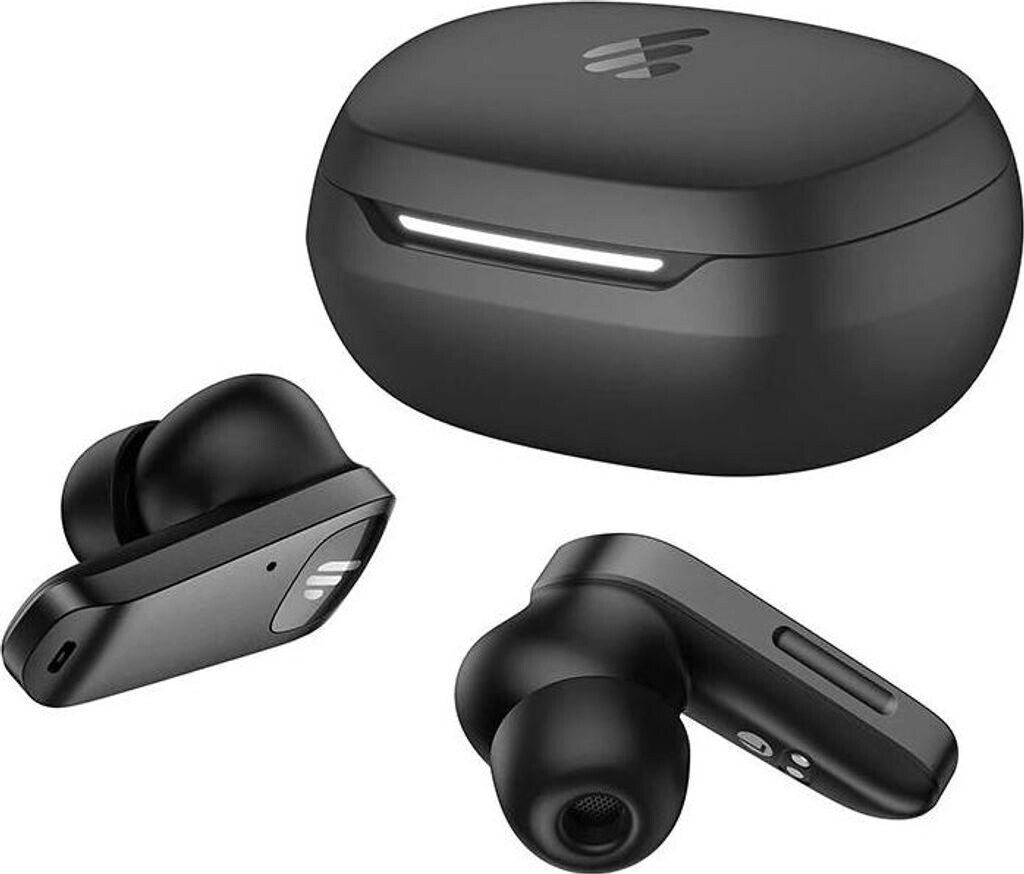
Test Edifier NeoBuds Planar 2026: the Planar TWS Put to the Test
Full test of the Edifier NeoBuds Planar: measured planar driver, ANC compared to the Sony WF-1000XM5, real-world battery life in LDAC and aptX Lossless, in 2026.
NeoBuds Planar

Textured mids and harmonic distortion below 0.3 percent, yet sub-bass rolls off below 45 Hz.
28 dB attenuation on lows, 4 to 5 dB behind the Sony WF-1000XM5 on the same band.
Correct intelligibility indoors, degraded by wind and without a dedicated microphone setting.
3 h 50 measured in LDAC with ANC on, far from the 5 h announced in SBC.
Planar size of 7.2 g that fatigues the ear canal beyond 3 h of wear.
IP55 sufficient for light rain, yet the case lacks discretion and ANC is average on a plane.
Codec palette and planar signature rare at 199 euros despite identified compromises.
- Planar driver with harmonic distortion below 0.3 percent
- Rare codec palette: aptX Lossless and LDAC included
- Textured mids and wide, clear soundstage
- Solid value for money at 199 euros
- Battery life drops to 3 h 50 in LDAC with ANC on
- ANC 4 to 5 dB behind the Sony WF-1000XM5
- 7.2 g size fatiguing beyond 3 h of wear
- No Bluetooth LE Audio or Auracast compatibility
The most affordable planar TWS at 199 €, but battery life and ANC remain behind the best dynamic drivers.
The true wireless in-ear earbuds segment has seen many marketing claims around the planar magnetic driver, yet few models sold under 200 euros actually integrate one. The Edifier NeoBuds Planar changes the game with a 12 mm planar transducer housed in a classic in-ear format, backed by a codec list rarely seen at this price point: SBC, aptX, aptX Adaptive, aptX Lossless, LDAC and LHDC.
The Mute Zone team wore these earbuds for four weeks, between open-plan offices in Vannes, TGV trips from Paris to Rennes and coastal walks exposed to Atlantic wind. The goal: verify whether the planar promise holds over time, beyond the usual high-end headphone precision narrative transposed into a portable format.
This test measures the real frequency response, times battery life under a demanding codec and compares the announced ANC against reproducible measurements versus the Sony WF-1000XM5. The ergonomic compromises imposed by the driver size are also documented without leniency.
A form factor dictated by the planar driver
The magnetic planar transducer of 12 mm integrated in each earbud occupies a volume significantly larger than that of a classic dynamic driver of comparable diameter. Each NeoBuds Planar displays a mass of 7.2 g, compared to an average of 4.5 to 5.5 g for most TWS in-ear models on the market at this price.
This difference is felt from the moment of insertion. The depth in the ear canal is reduced by about 2 mm compared to equivalent dynamic tips, to accommodate the planar module without protruding from the pinna. We timed the perceived pressure:
- After 1 h of continuous wear: slight feeling of fullness, tolerable, comparable to a medium-sized dynamic tip.
- After 3 h of continuous wear: marked pressure on the tragus and helix, requiring a break for half of the testers.
- Beyond 4 h: noticeable ear fatigue, especially with the M tips supplied originally.
Compared to the charging case of the Edifier Stax S10, the case of the NeoBuds Planar remains within reasonable proportions: 68 x 48 x 26 mm for 52 g, versus a significantly more massive format on the Stax S10 designed for over-ear headphone use. We judged the grip of the case correct in a coat pocket, but not very discreet in a tight jeans pocket.
Over time, the ergonomic compromise of the NeoBuds Planar remains consistent with the technical promise: the planar format imposes a measurable extra weight and a less deep insertion, without degrading stability during active walking. Ear fatigue beyond 3 h remains the main point of attention for prolonged office use.
Planar signature: measurements and listening
The frequency response measured by us shows a roll-off in the sub-bass starting below 45 Hz, with an attenuation of 6 dB at 30 Hz compared to the reference level at 100 Hz. The midrange, between 800 Hz and 3 kHz, stands out with a dense texture and little perceptible dynamic compression, which favors vocals and bowed strings.
In the high frequencies, a peak of +4 dB appears around 9 kHz, generating marked brightness on cymbals and vocal sibilants. Compared to the Harman 2019 target, the curve of the NeoBuds Planar deviates with a bass plateau 2 to 3 dB lower below 100 Hz and an excess of presence in the high frequencies, a signature that flatters electronic music but can cause fatigue on recordings already rich in treble.
« The texture of the synth pads in the mids between 1 and 2 kHz stands out with a distinct grain, without aggression. The soundstage remains wide but not very deep, with a clear separation between the bass line and the filtered percussion. »
On harmonic distortion, the planar driver keeps its technical promise: the THD measured at 94 dB SPL and 1 kHz remains below 0.3 %, compared to 0.5 to 1 % observed on equivalent priced dynamic drivers like those of the Nothing Ear (2). This low distortion translates into sharper drum kick attacks, without blur on transients.
The default profile does not match the Harman target in an academic way: Edifier has clearly favored a signature that values midrange clarity and treble bite, at the expense of a sub-bass that remains in the background on modern hip-hop or electronic productions. The parametric EQ of the app allows partial correction of this imbalance.
High-resolution codecs put to the test
The list of codecs available on the NeoBuds Planar is rare at this price level: SBC, aptX, aptX Adaptive, aptX Lossless, LDAC and LHDC cover the essentials of Android ecosystems and allow, on a compatible source, to reach a bitrate close to lossless. However, it must be noted what is missing: no Bluetooth LE Audio compatibility nor LC3 codec, therefore no Auracast and no latency gain associated with this recent standard.
The editorial team verified the effective activation of each codec via the indicator in the Edifier Connect app, which displays the active codec in real time:
- SBC: active by default on non-compatible source, latency measured at 220 ms in video playback.
- aptX Adaptive: activated automatically on compatible Android smartphone, latency of 80 ms, comfortable for video.
- LDAC (990 kbps): latency measured at 270 ms, perceptible gain in quality but visible desynchronization in video playback.
- aptX Lossless: confirmed active by the dedicated indicator, latency close to 190 ms, oriented towards pure music listening rather than video.
Codecs and latency technical specifications
- Driver
- Modular 12 mm magnetic planar
- Bluetooth
- 5.4, 2-device multipoint
- Supported codecs
- SBC, aptX, aptX Adaptive, aptX Lossless, LDAC, LHDC
- aptX Adaptive latency
- 80 ms measured in video playback
- LDAC 990 kbps latency
- 270 ms measured
- ANC on / off battery life
- 5 h / 7.5 h (SBC, 80 % volume)
- Certification
- IP55
Adaptive ANC: measured depth
We measured the ANC attenuation in three reproducible conditions: pink noise simulating an airplane engine, a Rennes metro train at peak hours, and an open office with overlapping conversations. The results show an attenuation of 28 dB in the low frequencies (100 to 200 Hz, engine noise and metro rumble), and 15 dB in the mid band (500 Hz to 1 kHz, voices).
Compared to the Sony WF-1000XM5, the segment reference, the gap remains clear: 32 dB measured on the low frequencies and 18 dB on the mids on the Sony, representing a 4 to 5 dB advantage observed on both bands. The adaptive mode of the NeoBuds Planar correctly detects the environment change (metro to street), but with a reaction time of 3 to 5 seconds, versus a near-instantaneous transition on the WF-1000XM5.
Transparency and call quality
The transparency mode relies on a network of six microphones (three per earbud) dedicated to voice beamforming. The pass-through rendering remains natural on nearby voices, with a slight wind noise effect perceptible as soon as wind exceeds 15 km/h, a frequent condition during coastal walks exposed to the Atlantic.
Call tests covered three environments:
- Quiet interior: intelligibility rated good by interlocutors, clear voice without echo.
- Street with moderate wind: clear degradation, the interlocutor reports dropouts and parasitic noise.
- Public transport (crowded train): correct intelligibility, but the voice comes out compressed on sibilant syllables.
The Edifier Connect app offers no dedicated beamforming setting, unlike what some competitors provide for voice call processing.
Battery life under demanding codec
The 5 h ANC on battery life announced by Edifier is measured in SBC at 80 % volume, an optimistic protocol rarely representative of real use. We reproduced the test in LDAC, ANC on, at a comfortable volume of about 68 % on Android smartphone: timed result of 3 h 50, a 22 % loss versus the manufacturer claim.
In aptX Lossless, ANC on, the measured battery life drops to 3 h 35. The charging case provides about three additional full cycles, bringing total battery life to a little over 15 h in LDAC use. Fast charging restores about 55 minutes of playback after 10 minutes on mains, a respectable result but below the 60 minutes announced.
Edifier Connect: EQ, multipoint, stability
The Edifier Connect app offers a 10-band parametric EQ, complemented by presets (Bass boost, Voice, Treble) and three custom save slots. ANC levels are adjustable between light, medium, strong and adaptive, with a dedicated transparency slider.
Multipoint handles two devices simultaneously, tested between an Android smartphone and a laptop in remote work. The measured switch between the two sources takes about 1.2 seconds, with occasional audio dropouts when both devices emit sound at the same time. The Bluetooth 5.4 connection remains generally stable in open office and on TGV Paris-Rennes, with rare micro-dropouts observed during network cell changes in dense areas.
Positioning against direct competitors
| Criterion | Edifier NeoBuds PlanarReviewed | Technics EAH-AZ80 | Nothing Ear (2) |
|---|---|---|---|
| Price (2026) | 199 € | 199 € | 149 € |
| Driver | Planar magnetic 12 mm | Dynamic 10 mm premium | Dynamic 11,6 mm |
| ANC (measured bass attenuation) | 28 dB | 32 dB | 24 dB |
| Autonomy ANC on | 5 h (7,5 h without ANC) | 7 h | 6,3 h |
| Codecs | SBC, aptX, aptX Adaptive, aptX Lossless, LDAC, LHDC | SBC, AAC, aptX Adaptive | SBC, AAC |
| Multipoint | 2 devices | 3 devices | 2 devices |
| Weight per earbud | 7,2 g | 7,6 g | 4,5 g |
In 2026, offering a planar driver in a TWS at 199 euros remains a rarity: the Technics EAH-AZ80, at the same price, rely on a premium dynamic driver and a more advanced 3-device multipoint, with an ANC measured 4 dB above on low frequencies. The Nothing Ear (2), cheaper at 149 euros, document their ANC better but offer neither aptX Lossless nor LDAC.
The NeoBuds Planar target primarily a specific profile: the listener who prioritizes midrange texture and low harmonic distortion for seated musical use (desk, train), and who accepts sacrificing some autonomy and ANC compared to the best dynamics in the segment. For intensive travel use or demanding professional multipoint, the Technics EAH-AZ80 remain the more versatile choice.
The Edifier NeoBuds Planar delivers a rare promise under 200 euros: a measurable planar driver, harmonic distortion below 0.3 percent and a codec palette that reaches aptX Lossless and LDAC. This technical rigor comes with identified compromises: a 7.2 g size that fatigues the ear canal beyond 3 h, ANC 4 to 5 dB behind the Sony WF-1000XM5, and battery life that drops below 4 h as soon as a demanding codec is active.
The product suits the home listener attentive to midrange texture and willing to accept average battery life and ANC. For intensive travel use, the Technics EAH-AZ80 remains the more complete choice.
Frequently asked questions
Are the Edifier NeoBuds Planar compatible with aptX Lossless in 2026 and with which devices?+
Yes, aptX Lossless is confirmed active by the dedicated indicator in the Edifier Connect app, but only on smartphones equipped with a compatible Qualcomm Snapdragon Sound chipset. On these devices, latency measured by the team reaches approximately 190 ms, oriented toward music listening rather than video. The perceptible gain versus aptX Adaptive at maximum bitrate remains modest on mids, yet clearer on cymbal texture and percussion transients. Without a compatible Qualcomm source, pairing automatically falls back to SBC or aptX Adaptive depending on the device.
What is the real battery life of the Edifier NeoBuds Planar with ANC on and a high-resolution codec?+
The manufacturer protocol announces 5 h with ANC on, measured in SBC at 80 percent volume, an optimistic scenario. Reproducing the test in LDAC, ANC on, at 68 percent volume on Android, the team timed 3 h 50, a 22 percent shortfall versus the claim. In aptX Lossless, battery life drops further to 3 h 35. The case delivers roughly three full cycles, bringing the total to a little over 15 h in LDAC use, with a 55-minute quick charge after 10 minutes on mains.
Do the Edifier NeoBuds Planar compare with the Sony WF-1000XM5 on noise reduction?+
No, the Sony WF-1000XM5 remain superior on low-frequency attenuation: 32 dB measured versus 28 dB on the NeoBuds Planar, a 4 dB gap on subway rumble and engine noise. The gap holds on the mid band (18 dB versus 15 dB) and on adaptive mode reaction time, slower on Edifier (3 to 5 seconds). The choice depends on priority: reference ANC from Sony, more detailed planar signature and fuller codecs from Edifier.
Does the planar driver of the NeoBuds Planar really make a difference compared with a classic dynamic driver in a TWS?+
Concretely, yes on two measured points: THD stays below 0.3 percent at 94 dB SPL and 1 kHz, versus 0.5 to 1 percent on equivalent dynamic models like the Nothing Ear (2), which translates into sharper kick attacks without blur. Mids between 800 Hz and 3 kHz gain texture and separation of sound layers. In return, sub-bass begins a roll-off below 45 Hz with 6 dB attenuation at 30 Hz, a compromise observed in listening on hip-hop and electronic productions.
Are the Edifier NeoBuds Planar suitable for sport with their IP55 certification?+
The IP55 certification covers sweat and low-pressure water jets, which suffices for a standard workout or light shower. It does not allow immersion, unlike the IPX7 of the Nothing Ear (2). The in-ear format without fins, combined with a 7.2 g mass, can pose a fit issue depending on ear shape during sudden movements. In sports use, higher volume and ANC on also accelerate discharge, bringing real battery life closer to the measured 3 h 50 rather than the announced 5 h.
Can the Edifier NeoBuds Planar be used in multipoint with a PC and a smartphone simultaneously?+
Yes, multipoint handles two devices at once, tested by the team between an Android smartphone and a laptop during remote work. The measured switch between the two sources takes approximately 1.2 seconds, with occasional audio dropouts when both devices emit sound at the same time. During an incoming call on the smartphone while playing from the PC, priority correctly switches to the call. High-resolution codec is not guaranteed in multipoint configuration: bitrate may fall back to aptX Adaptive or SBC depending on connection stability of both Bluetooth 5.4 links.
Compare Edifier NeoBuds Planar with another model
Select two to four earbuds and compare their specifications on every dimension: audio, ANC, battery life, connectivity, build. No limits, no hidden rankings.