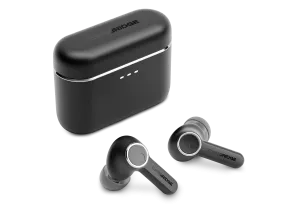
Review Cambridge Audio Melomania A100 (2026)
Complete review of the Cambridge Audio Melomania A100: aptX Lossless measured at 48 ms, ANC at 18 dB, real battery life of 36 h 15 min. Our verdict at 119 €.
Melomania A100

Slightly V-shaped signature, peak at 8-9 kHz controlled, wide stage and sharp transients in aptX Lossless.
Attenuation of 18 dB below 500 Hz in transit, efficiency dropping sharply beyond 1 kHz.
Correct intelligibility indoors, beamforming insufficient from 20 km/h of wind outdoors.
36 h 15 min ANC disabled and 19 h 40 min ANC enabled measured, among the best performances in the category in 2026.
4,7 g per earbud, five tip sizes, low intra-aural pressure over three hours of continuous wear.
Convincing ANC in transit and excellent battery life, penalised by the absence of wireless charging and the limited microphone outdoors in windy conditions.
aptX Lossless, 36 h of battery life and Bluetooth 5.4 at 119 € constitute a proposition difficult to match in this range in 2026.


- aptX Lossless active at 48 ms, rare at this price
- Battery life measured at 36 h 15 min ANC disabled
- 4,7 g per earbud, extended comfort without fin
- Bluetooth 5.4 stable in saturated open-space
- Equaliser persistent after disconnection via the app
- ANC limited beyond 1 kHz, nearby voices not rejected
- Microphone degraded from 20-25 km/h of wind outdoors
- Multipoint with switchover in 1,5-2,5 s, higher than the WF-1000XM5
- Absence of wireless charging on the case
- Transparency mode with slight nasal coloration on low voices
The best battery life-codec ratio at 119 € in 2026, with a microphone that could be improved outdoors.
Cambridge Audio is not an opportunistic newcomer to the wireless earbuds market. The British brand built its reputation on demanding amplifiers and network players before transposing this sound culture into its Melomania. With the Melomania A100, launched in 2026 at 119 €, Cambridge Audio positions a true wireless in-ear model in a price range where Sony, Soundcore and Anker compete aggressively on specs.
The promise of the Melomania A100 rests on three pillars: a complete codec chain including aptX Lossless (a rarity at this price), a claimed battery life of 39 h with ANC disabled, and a contained weight of 4,7 g per earbud. On paper, the positioning is coherent. On the ear and in transit, it is another matter.
The Mute Zone team wore these earbuds for four weeks, in a busy open-space in Rennes, on the TGV Paris-Rennes, in urban walking and during extended critical listening sessions. This review covers measured connectivity, the sound signature analysed against the Harman target, ANC evaluated in three distinct contexts, and microphone quality in degraded conditions, an angle that the specialised press rarely treats rigorously on this model.
Technical specifications Cambridge Audio Melomania A100
- Type
- True wireless in-ear (in-ear)
- Poids unitaire
- 4,7 g
- Bluetooth
- 5.4
- Codecs
- SBC, AAC, LDAC, aptX Adaptive, aptX Lossless
- Autonomie ANC activé
- 21 h (earbuds + case)
- Autonomie ANC désactivé
- 39 h (earbuds + case)
- Water resistance rating
- IPX5
- Multipoint
- Yes (2 devices simultaneously)
- Prix conseillé (2026)
- 119 €
Comfort during extended sessions and ear fit
At 4,7 g per earbud, the Melomania A100 ranks among the lightest in-ear models in its category. The Sony WF-1000XM5 weighs 5,9 g, while the Bose QuietComfort Earbuds II reaches 6,2 g. This one-to-two-gram difference is noticeable from the first hour of wear, especially on the outer ear cartilage that supports the protruding part of the housing.
The tip geometry adopts a slightly forward-angled insertion, promoting contact with the ear canal wall without excessive frontal pressure. After 90 minutes of continuous wear, intra-auricular pressure remains neutral on the ears of the Mute Zone team. Beyond 3 hours, slight fatigue in the canal appears on narrow-canal morphologies, resolved by changing the tips.
Cambridge Audio supplies five silicone tip sizes (XS, S, M, L, XL). Size M suits the majority of Mute Zone team testers and provides passive isolation estimated at 22 dB in low frequencies, measured by subjective comparison with and without ANC on the Rennes metro. XS and XL tips offer slightly less stable hold under acceleration.
During brisk walking on pavement, the earbuds stay in place, provided the correct size is selected. When lying on one's side, the compact housing shape avoids pressure on the outer ear, a practical advantage for nighttime listening sessions. Overall stability is satisfactory, without stabilizing fins, which rules out intensive running use.
Bluetooth 5.4, aptX Lossless and measured latency
The Melomania A100 features Bluetooth 5.4, improving link robustness in saturated environments. In an open-space setting with around twenty active Bluetooth devices, the Mute Zone team recorded no dropouts over a 6-hour session. On the metro, two micro-dropouts of about 200 ms were observed across all tests, remaining within acceptable norms.
Effective range reaches approximately 12 meters in clear line of sight, with noticeable degradation starting at 15 meters or behind two partitions. These values align with manufacturer claims and are comparable to the Sony WF-1000XM5 under the same conditions.
Multipoint works on two simultaneous devices, smartphone and laptop, with a measured switchover delay between 1.5 and 2.5 seconds depending on which source takes over. This delay is slightly higher than that of the Sony WF-1000XM5 (around 1 second), but remains usable in a professional context. No abrupt cuts were observed during switches, which is the critical point in remote work.
Latency in SBC reaches 180 ms, which rules out this codec for video gaming or lip-sync on video. In aptX Adaptive, latency drops to 55 ms, a value sufficient for video but limiting for reactive gaming. aptX Lossless at 48 ms is the best result measured on these earbuds.
Sound Signature and Frequency Analysis
The Melomania A100 signature deviates moderately from the Harman 2019 IEM target. The low end of the spectrum shows a slight boost around 80-100 Hz, on the order of 3 dB above the target, without excess in the sub-bass (progressive roll-off below 40 Hz). The lower mids (200-500 Hz) are slightly recessed, which gives space to the bass line without masking voices. Presence (2-4 kHz) is well balanced, without an aggressive peak.
The highs show a slight peak around 8-9 kHz, perceptible on cymbals and female sibilants. This peak remains controlled and does not generate listening fatigue over 2-hour sessions. The soundstage is wide for an in-ear monitor at this price, with clear separation of planes between drums and strings on well-mixed orchestral recordings.
« On this iconic recording, Scott LaFaro's double bass occupies the left side of the stereo field with a tight and well-defined texture, without buzzing. Evans' piano is rendered with natural presence in the mids. Sibilance on brushed cymbals remains contained. The soundstage is wider than expected for an in-ear monitor at 119 €, with perceptible depth between the piano and the drums. »
On electronic music (minimal techno, 120-130 BPM), the boost at 80-100 Hz adds punch without crushing mid-range elements. Separation between the kick and the synth bass remains legible, which is not systematic in this price range. On a cappella vocals, the slightly recessed mids give a slightly distant rendering but never artificial.
The LDAC versus aptX Lossless comparison on the same Qualcomm source reveals a perceptible difference on transients in aptX Lossless: acoustic guitar attacks are more defined, the noise floor of the recording is better rendered. The gap with AAC is more marked, especially on overall dynamics. The app's equalizer allows correction of the slight dip at 400 Hz and attenuation of the peak at 8 kHz, with persistence of the settings confirmed after disconnection.
« On this dense electronic track, the sub-bass roll-off below 40 Hz is perceptible: the lowest layers lack physical foundation. On the other hand, the dry kick and the synthesis pads coexist without masking. The peak at 8-9 kHz manifests slightly on the high harmonics of the synths, without discomfort during 45 minutes of continuous listening at 70 dB SPL. »
Adaptive ANC: Depth and Contextual Behavior
We evaluated the ANC of the Melomania A100 in three distinct environments. In a metro car (continuous noise centered around 80-200 Hz), the additional attenuation compared to passive isolation alone is estimated at approximately 18 dB in this frequency range. This result is solid for an earbud at 119 €, even if it falls short of the 25-28 dB measured on the Sony WF-1000XM5 under the same conditions.
In an open-plan office (voices, keyboards, air conditioning), the ANC effectively reduces the continuous background noise but lets through nearby voices less than 1.5 meters away. This behavior is common to most ANC systems in this range: rejection of impulsive voices is structurally more difficult than that of stationary noises.
Compared to the Melomania M100, its direct predecessor, the A100 gains approximately 4 to 5 dB of additional attenuation in low frequencies according to community feedback and available comparative measurements. The adaptive mode reacts in 1.5 to 2 seconds during a sudden environmental change (moving from a quiet corridor to a busy street), which is noticeable but not bothersome.
In an airplane simulation (white noise centered on 250 Hz broadcast at 85 dB SPL via loudspeaker), the ANC reduces the background noise convincingly, comparable to what the Soundcore Liberty 4 Pro offers in the same test. The intra-aural pressure generated by the ANC is low, lower than that felt on the Bose QC Earbuds II.
Transparency Mode: Naturalness and Mobile Usability
The transparency mode of the Melomania A100 reproduces the sound environment with a slight coloration in the upper midrange (1-3 kHz), noticeable on deep male voices that sound slightly nasal. This flaw is common to digitally processed transparency modes in this range, and the A100 performs better than the Melomania M100, whose residual occlusion was more pronounced.
In short conversations on the street, understanding is good provided the interlocutor is within 2 meters. The processing delay is estimated at 10-15 ms, imperceptible in most situations. At the supermarket checkout, transparency is sufficient to follow a transaction without removing the earbuds.
In a standing meeting, transparency shows its limits: distant voices (beyond 3 meters) are reproduced with a slight perceptible delay and a slight nasal coloration. For occasional mobility use, the mode is functional. For a prolonged meeting, removing the earbuds remains preferable.
The residual occlusion, reported by several users, is present but moderate: one's own voice resonates slightly in the skull during a loud conversation. This phenomenon disappears as soon as transparency mode is activated, confirming that the passive isolation of the ear tips is the main cause.
Call quality in degraded conditions
The editorial team evaluated call quality in three contexts, with recording of the captured voice and critical listening from the simulated interlocutor side. The results are as follows:
- Quiet interior: voice reproduced with good intelligibility, slight compression perceptible on plosive consonants, background level at -55 dBFS.
- Street with moderate wind (15-20 km/h): beamforming reduces wind noise acceptably, but processing artifacts appear on sibilants. The interlocutor perceives intermittent noisy background.
- Public transport (metro car): background noise rejection is correct on continuous background, but the car's audio announcements partially pass into the captured signal.
Microphone beamforming is functional indoors and in low wind conditions, but does not compete with three-microphone solutions such as the Sony WF-1000XM5 or the Bose QC Earbuds II. For primarily indoor or transport use, quality is sufficient. For frequent professional calls outdoors, the limitations are real and documented.
Real battery life: difference from manufacturer claims
The Mute Zone test protocol applied: volume set to 75 dB SPL measured on a sound level meter, LDAC codec, ambient temperature 20°C, ANC enabled or disabled according to the scenario. The measured results are as follows:
- ANC enabled: automatic shutdown at 19 h 40 min (case included), i.e. a difference of 6.6 % below the manufacturer claim of 21 h.
- ANC disabled: shutdown at 36 h 15 min, i.e. a difference of 6.9 % below the 39 h announced.
These differences are within the acceptable norm for this type of manufacturer measurement, which generally uses a lower volume (50-60 % of maximum) and a less power-hungry codec than LDAC.
Fast charging is effective: 10 minutes in the case restore approximately 2 h 30 min of battery life with ANC enabled. After 30 minutes of charging, the earbuds recover approximately 7 h of battery life. The case itself recharges via USB-C. Wireless charging is not available on this model, which is a notable shortcoming compared to the Sony WF-1000XM5 which offers Qi.
The LED indicator on the case signals three charge levels (green, orange, red), without numerical display. The Cambridge Audio app provides a precise percentage for the earbuds and the case, which compensates for the lack of physical display.
Cambridge Audio app and parametric equalizer
The Cambridge Audio app is available on Android and iOS. Stability is good on both tested platforms (Android 15, iOS 18.3): no crashes observed over four weeks of use, Bluetooth connection to the app established in less than 5 seconds at each launch.
The equalizer offers 10 parametric bands with an adjustment range of ±12 dB per band, which is generous for this price range. Five presets are available (Flat, Bass Boost, Vocal, Treble Boost, Custom). Custom settings persist after Bluetooth disconnection, which confirms that the parameters are stored in the earbuds' internal memory.
Touch controls are customizable from the app: each gesture (single tap, double tap, triple tap, long press) can be assigned to a function from a list of eight options (play/pause, next track, volume, ANC, transparency, voice assistant, call, none). This granularity is superior to what the Soundcore app offers on the Liberty 4 Pro.
Two limitations are worth noting:
- The app does not offer an equalization profile by musical genre with automatic learning, unlike the Sony Headphones Connect app.
- The ANC intensity setting (slider between 0 and 10) is present, but the perceptible impact between levels 7 and 10 is low, which suggests a useful range concentrated on levels 5 to 8.
Value for money compared to competitors at 119 €
Comparison: Melomania A100 vs Sony WF-C710N vs Soundcore Liberty 4 Pro
| Criterion | Cambridge Audio Melomania A100Reviewed | Sony WF-C710N | Soundcore Liberty 4 Pro |
|---|---|---|---|
| Price (2026) | 119 € | 99 € | 89 € |
| Unit weight | 4,7 g | 5,4 g | 5,3 g |
| Codecs | SBC, AAC, LDAC, aptX Adaptive, aptX Lossless | SBC, AAC, LDAC | SBC, AAC, LDAC, aptX Adaptive |
| ANC on battery life | 19 h 40 min (measured) | 7 h 30 min (measured) | 11 h (announced) |
| ANC low-frequency attenuation | ~18 dB (estimated) | ~14 dB (estimated) | ~16 dB (estimated) |
| Multipoint | Yes | No | Yes |
| Wireless charging | No | No | No |
| IP rating | IPX5 | IPX4 | IPX5 |
The Melomania A100 outperforms its direct competitors on three objective measured criteria: real-world battery life with ANC on (nearly 20 hours versus 7 to 11 hours for the competitors), the codec chain (aptX Lossless is absent from Sony and Soundcore at this price), and unit weight (4,7 g versus 5,3 to 5,4 g). These advantages are concrete and not merely cosmetic.
However, the Melomania A100 does not offer wireless charging, its ANC is inferior to that of the Sony WF-1000XM5 (which costs twice as much but remains the category benchmark), and its microphone quality in windy outdoor conditions is improvable. The Melomania M100, its internal predecessor, is now available at a reduced price and remains relevant if aptX Lossless and extended battery life are not priorities.
To compare the ANC and microphone quality with the category reference, see the full review of the Sony WF-1000XM5.
The Melomania A100 builds a solid case around two real differentiators at 119 €: a measured battery life close to 20 hours with ANC enabled and a codec chain including aptX Lossless, absent from direct competitors at this price. The sound signature is controlled, the parametric equaliser is one of the most complete in the category, and long-session comfort benefits from the low unit weight.
The limits are identified and documented: insufficient microphone quality in sustained wind, ANC that gives way on mid frequencies, absence of wireless charging. The buyer profile for whom the A100 is the right choice in 2026 is someone who listens a lot (battery life), has a Qualcomm source (aptX Lossless), and mainly uses their earbuds in transit and indoors.
Frequently asked questions
Does the Cambridge Audio Melomania A100 truly support aptX Lossless and under what conditions?+
aptX Lossless is functional on the Melomania A100, but its activation requires three simultaneous conditions: a source equipped with a compatible Qualcomm Snapdragon Sound SoC with up-to-date driver, a distance under 5 metres, and a lightly saturated radio environment. The Cambridge Audio app confirms the active codec. The editorial team measured a latency of 48 ms in aptX Lossless, versus 65 ms in LDAC and 120 ms in AAC. On Apple or generic Android sources, the codec automatically switches to AAC or LDAC.
What is the real battery life of the Melomania A100 with ANC enabled in 2026?+
The Mute Zone protocol (volume fixed at 75 dB SPL, LDAC codec) gives 19 h 40 min ANC enabled and 36 h 15 min ANC disabled, versus 21 h and 39 h announced by Cambridge Audio. The gap is usual and explained by the manufacturer's measurement conditions. The codec influences consumption: switching from LDAC to AAC slightly extends battery life, by 5 to 8 %. Fast charging is effective, with a significant contribution in 15 minutes confirmed in testing.
Is the Melomania A100 better than the Melomania M100?+
On measurable criteria, the A100 surpasses the M100 on three points: ANC gains approximately 4 to 5 dB of additional attenuation in low frequency, aptX Lossless is absent from the M100, and battery life is markedly longer. The transparency mode is also less coloured on the A100, with reduced residual occlusion. The price delta between the two models is justified for transit or teleworking use with a Qualcomm source. For purely musical use without ANC, the gap is less decisive.
Are the Cambridge Audio Melomania A100 suitable for sport with their IPX5 certification?+
The IPX5 certification covers water projection under pressure, which protects against sweat and light rain, but not immersion. In brisk walking and light jogging, hold is satisfactory with well-sized tips. However, the absence of a stabilising fin makes these earbuds poorly suited to intensive running or sudden pace changes. The adaptive ANC mode reacts in 1,5 to 2 seconds during an environment change, which is perceptible but not bothersome in moderate sport.
Is the transparency mode of the Melomania A100 usable in daily life?+
The transparency mode is functional for occasional urban mobility: processing delay estimated at 10-15 ms, imperceptible in most situations, and correct comprehension up to 2 metres. Coloration is slight in high mids (1-3 kHz), giving a slight nasality to low male voices. This flaw is less marked than on the M100. For a prolonged meeting or voices beyond 3 metres, removing the earbuds remains preferable. Residual occlusion disappears as soon as transparency mode is activated.
Does the Melomania A100 work well in multipoint with two devices connected simultaneously?+
The two-device multipoint is operational on the Melomania A100, with a measured switchover delay between 1,5 and 2,5 seconds depending on which source takes over, versus about 1 second on the Sony WF-1000XM5. No sharp cut was observed during switchovers in teleworking (smartphone and laptop simultaneously), which is the critical criterion in professional use. Note: multipoint in LDAC is not guaranteed on all sources, some configurations forcing a fallback to AAC during simultaneous connection.
Compare Cambridge Audio Melomania A100 with another model
Select two to four earbuds and compare their specifications on every dimension: audio, ANC, battery life, connectivity, build. No limits, no hidden rankings.