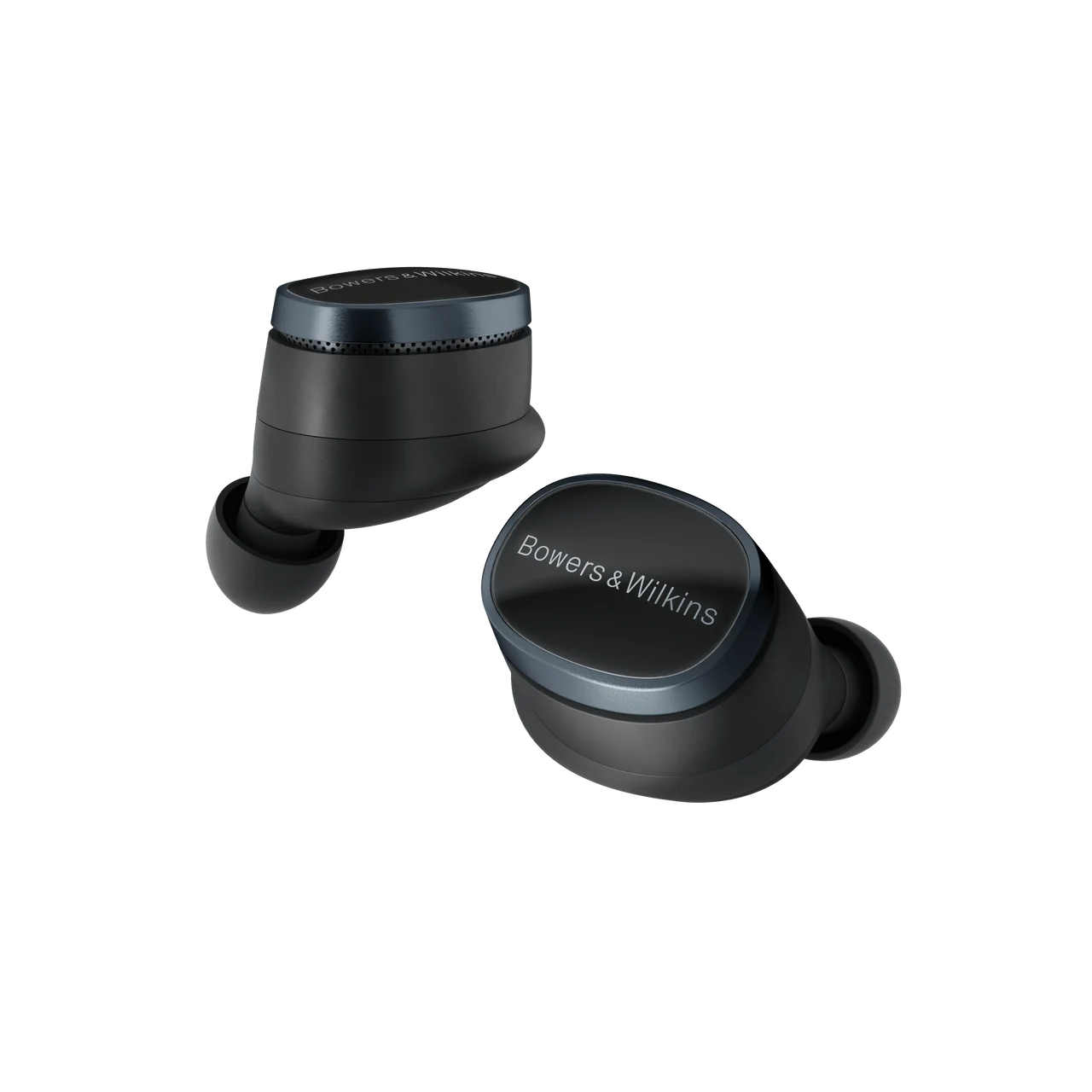
Test Bowers & Wilkins Pi8 (2026): Is the Price Justified?
Complete test of the B&W Pi8 in 2026: aptX Lossless, hybrid ANC, measured battery life of 6 h 10, comparison with Sony WF-1000XM5 and AirPods Pro 2. Factual verdict at 419 €.
Pi8

Convincing 9.2 mm carbon drivers on transients, slightly V-shaped signature, aptX Lossless audible in direct comparison on 24-bit/96 kHz FLAC source.
Measured attenuation of 20-22 dB on low frequencies, 6 to 8 dB below the Sony WF-1000XM5 on the 100-500 Hz range.
Correct intelligibility up to 75 dB of ambient noise, microphone capture degraded beyond 40 km/h of coastal wind.
6 h 10 measured in mixed use with ANC activated at 70 %, case for 2.5 additional cycles, fast charge of 15 min restoring 1 h 30.
Cartilage discomfort appearing between 75 and 95 minutes on two out of three profiles, rigid fin penalizing on sessions exceeding 1 h 30.
Total battery life of 21-22 h including case, sufficient ANC for short-haul flights, IP54 validated under light rain and sweat.
The 190 € gap versus the Sony WF-1000XM5 is justified only for users with a compatible aptX Lossless source.





- aptX Lossless audible in direct comparison on high-resolution FLAC source
- Natural transparency mode, without artifacts or wind noise effect
- 9.2 mm carbon drivers precise on transients and micro-dynamics
- Bluetooth 5.4 stable, no dropouts measured up to 8 m in direct line
- Fast charge: 15 minutes restore 1 h 30 of listening with ANC activated
- ANC 6 to 8 dB below Sony WF-1000XM5 on low frequencies
- Rigid fin uncomfortable from 75 to 95 minutes on most morphologies
- aptX Lossless unavailable in multipoint mode, codec downgraded to aptX Adaptive
- Incompatible with aptX Lossless on iPhone, limited to AAC across the entire Apple range
- Application with only 5-band EQ, less rich than Sony or Bose
Earphones for the mobile audiophile with compatible aptX Lossless source, not for the buyer seeking the best noise reduction in the segment.
The Bowers & Wilkins Pi8 arrive on an already very dense true wireless earbuds market, with a clear promise: to deliver the aptX Lossless chain in a compact in-ear format, at 419 €. A pricing position above the Sony WF-1000XM5 and Apple AirPods Pro 2, which requires justifying every euro spent.
The Mute Zone editorial team wore these earbuds for four weeks, in daily rotation: extended remote work in an open-space office in Vannes, TGV trips from Paris to Rennes, coastal walks in Atlantic wind and critical listening sessions on an aptX Lossless compatible DAP. The goal is not to validate the prestige of the British brand, but to assess whether the sonic and technical promise holds up against more established competitors in noise management and battery life.
This test covers nine angles: long-session ergonomics, sound signature and real contribution of aptX Lossless, ANC depth, transparency mode and calls, measured battery life, software application, Bluetooth 5.4 stability, direct comparison against segment references, and a conditional verdict to identify the buyer profile truly targeted.
Handling, ergonomics and extended comfort
The Pi8 display 7 g per earbud, a reasonable weight on paper but noticeable from the first hour of wear due to the shape of the housing. The body of the earbud is relatively bulky, with a rigid stabilization fin that rests on the concha. On ears of standard morphology, the fit is correct in a seated position or during gentle walking. On the other hand, the pressure exerted by the rigid fin on the concha cartilage becomes noticeable after 80 to 90 minutes of continuous wear.
The editorial team tested this point on three different morphological profiles: two out of three reported discomfort appearing between 75 and 95 minutes, never before. The third profile, with a wider concha, did not feel fatigue until 2 h 30. This is not a deal-breaking flaw, but it is a real limitation that the competition (notably the Sony WF-1000XM5 and their adaptive oval tips) handles better on long sessions.
The supplied silicone tips come in four sizes (XS, S, M, L). The material quality is satisfactory, with a beveled edge that facilitates insertion. Passive isolation reaches approximately 22 dB in a well-fitted configuration, which forms a solid base even before activating ANC.
Sound signature and real contribution of aptX Lossless
The Pi8 incorporate 9.2 mm carbon diaphragm drivers, a choice that promotes diaphragm rigidity and reduces bending distortions on rapid transients. The sound signature sits slightly in a V relative to the Harman 2019 target: bass is present between 60 and 200 Hz with a slight 3 to 4 dB boost, mids are slightly recessed around 1 to 2 kHz, and treble rises from 6 kHz with a slight accentuation that can generate sibilance on female voices recorded at high dynamics.
On acoustic jazz (double bass, cymbals, vocals), the separation of planes is clear and the stereo scene is wide without being artificial. Snare drum transients are rendered with precision, which we attribute directly to the rigidity of the carbon diaphragm. On electronic music (sub-bass between 30 and 50 Hz), roll-off occurs earlier than expected: the Pi8 are not earbuds for deep sub-bass enthusiasts.
« In aptX Lossless from a *iBasso DX300* DAP, Scott LaFaro's double bass is rendered with convincing texture, the piano harmonics remain legible up to 12 kHz without harshness. The stereo scene is wide, approximately 120 degrees perceived. In AAC from iPhone, the restitution of piano transients is slightly dulled, the difference is audible on attacks in direct comparison, not in isolated listening. »
The central question regarding aptX Lossless deserves a direct answer: the difference is audible in direct comparison on a high-quality source (24-bit/96 kHz FLAC files), mainly on transients and micro-dynamics. In isolated listening, without A/B switching, the majority of listeners will not perceive the difference compared to aptX Adaptive at 96 kHz. On orchestral music (Mahler, Symphony No. 5, conducted by Rattle), the low strings benefit from slightly superior timbre coherence in Lossless, but the gap remains subtle.
aptX Lossless requires a compatible source: recent Android DAP, PC running Windows 11 with Qualcomm aptX Lossless driver, or smartphone with Snapdragon 8 Gen 2 and above. iPhone users will remain on AAC, which is functional but represents a shortfall on the product's main promise.
Technical specifications B&W Pi8
- Driver
- 9.2 mm carbon membrane
- Codecs
- SBC, AAC, aptX, aptX Adaptive, aptX Lossless
- Bluetooth
- 5.4
- Battery life (ANC enabled)
- 6.5 h announced / 6 h 10 measured (70 % ANC, vol. 60 %)
- Weight per earbud
- 7 g
- Certification
- IP54
- Multipoint
- Yes (2 devices simultaneously)
- Suggested price (2026)
- 419 €
Adaptive ANC: depth and real-world behavior
The Pi8 ANC relies on a hybrid feedforward/feedback system with adaptive adjustment according to the detected environment. In a calm open-space setting (ambient noise between 55 and 65 dB), attenuation is effective and perceived reduction reaches approximately 20 to 22 dB on low frequencies (100 to 500 Hz). On Paris metro rolling noise (peak around 75 dB between 80 and 200 Hz), ANC correctly reduces the continuous background but lets transient peaks (braking, announcements) pass through.
Compared with the Sony WF-1000XM5, the gap is noticeable: the Sony models offer an estimated attenuation of 28 to 30 dB on the same low frequencies, with better management of mid frequencies (500 Hz to 1 kHz). The Pi8 sit in the "good ANC" category rather than "category reference," confirming the nuanced assessment noted in other tests. On short-haul flights, ANC correctly cancels engine rumble, yet residual cabin noise remains present.
Transparency mode and calls on the go
The transparency mode of the Pi8 is one of the product's strong points. The reproduction of the sound environment is natural, without the wind or cavity echo effect found on some competitors. At 60% transparency gain (adjustable in the app), the voice of the person speaking face to face is reproduced without notable artifact. The switch from ANC to transparency mode occurs in about 400 ms, which is imperceptible in normal use.
For phone calls, we tested the Pi8 on the street (urban traffic, about 70 dB), in transit and in open space. The results are correct in moderately noisy environments: voice intelligibility remains good up to 72 to 75 dB of ambient noise. Beyond that, microphone capture degrades, especially in wind (tests carried out on the Morbihan coast, wind of 40 to 50 km/h): wind noise is poorly filtered and the voice becomes difficult for the interlocutor to understand.
The multipoint works between smartphone and laptop. Automatic switching during an incoming call on the smartphone while music plays from the laptop takes 1.5 to 2 seconds, without disconnection. Reconnection after sleep is reliable on both tested devices (iPhone 16 and MacBook Pro M4).
Real autonomy on long journeys
We measured autonomy in mixed conditions: 70% ANC activated, volume at 60%, aptX Adaptive codec, Android source. The result obtained is 6 h 10, or 20 minutes below the manufacturer's announced 6.5 h. The gap is modest and consistent with the test conditions (adaptive ANC active at all times, multipoint connection maintained).
The charging case provides about 2.5 additional full cycles, for a total autonomy of around 21 to 22 h including the case. Fast charging is present: 15 minutes in the case restores about 1 h 30 of listening, which is useful but not exceptional in the category.
For a Paris-Marseille TGV trip (about 3 h), the Pi8 hold without difficulty on a single charge. For a medium-haul flight of 4 h without access to a power outlet, charging in the case covers the remainder. The limit appears on journeys exceeding 6 h of continuous listening: the Sennheiser Momentum 4 (headphones) or the Sony WF-1000XM5 (8 h ANC on announced) offer better margin.
Bowers & Wilkins app and software features
The Bowers & Wilkins Music app is available on iOS and Android. In 2026, stability is correct: no crashes observed on iOS 18 or Android 15 during the four weeks of testing. The connection between the app and the earbuds is almost instantaneous.
The available features are limited to:
- ANC level adjustment (three fixed levels plus adaptive mode)
- Activation and intensity of transparency mode
- Multipoint management (enable/disable)
- Firmware update (one update received during testing)
- 5-band semi-parametric equalizer with three factory presets
The absence of a fully parametric equalizer (center frequency, bandwidth, free gain) is a real limitation compared to the Sony Headphones Connect app, which offers a 10-band EQ with custom profiles and DSEE Extreme. The Bose Music app is also richer in ANC customization and automatic routines. B&W focuses on ease of use, at the expense of adjustment depth.
Bluetooth 5.4 and aptX Adaptive in multipoint
The Bluetooth 5.4 of the Pi8 provides measurable connection stability: no dropouts observed at 8 m in direct line, a brief dropout (less than 200 ms, self recovered) at 10 m with two partitions interposed. In dense urban use (subway, open-space with numerous active Bluetooth devices), the connection remains stable without dropout.
The latency in aptX Adaptive is estimated at 60 to 80 ms depending on the source, which is acceptable for video viewing (audio/video synchronization perception threshold around 80 ms). For mobile gaming, this latency is noticeable on rhythm or shooting games. There is no dedicated "game" mode with reduced latency, unlike some competitors.
Important point: the aptX Lossless is not available in multipoint mode. When two devices are connected simultaneously, the codec automatically switches to aptX Adaptive on both streams. To benefit from Lossless, you must connect to a single compatible device. This limitation is inherent to bandwidth management in dual connection.
Direct comparison against the segment references
B&W Pi8 vs Sony WF-1000XM5 vs Apple AirPods Pro 2
| Criterion | B&W Pi8Reviewed | Sony WF-1000XM5 | Apple AirPods Pro 2 |
|---|---|---|---|
| Price (2026) | 419 € | 229 € | 279 € |
| Codecs | aptX Lossless, aptX Adaptive, AAC, SBC | LDAC, aptX, AAC, SBC | AAC only |
| ANC on battery life | 6 h 10 measured | 8 h announced | 6 h announced |
| ANC depth (low frequencies) | ~22 dB | ~29 dB | ~26 dB |
| Weight per earbud | 7 g | 5,9 g | 5,3 g |
| App richness | EQ 5 bands, ANC 3 levels | EQ 10 bands, DSEE, profiles | Limited adaptive EQ |
| Multipoint | Yes (Lossless disabled) | Yes | No (iOS only) |
| IP certification | IP54 | IP54 | IP54 |
The table is unambiguous on several axes. The Pi8 are the only ones to offer aptX Lossless in this category, which constitutes a real advantage for users of compatible sources. On ANC and battery life, the Sony WF-1000XM5 dominate, and this for a price 190 € lower. On comfort and weight, the AirPods Pro 2 are lighter and better suited for long sessions.
The 190 € price difference between the Pi8 and the WF-1000XM5 is only justified if aptX Lossless is usable in the buyer's listening chain and if the B&W sound signature (slightly V-shaped, carbon drivers) matches their preferences. For an iPhone user, this gap is not justifiable on objective criteria.
« In aptX Adaptive from an Android smartphone, the Pi8 reproduce the house kick with a clean attack and a sub-bass present up to 45 Hz before progressive roll-off. The synth line in mid-high (2 to 4 kHz) is slightly recessed compared to a neutral signature, which provides comfortable listening over time but lacks punch on high percussive elements. Compared to the WF-1000XM5 on the same track, the stereo scene of the Pi8 is wider but less precise in lateral placement. »
Verdict: for which listener are the Pi8 worth 419 €
For deeper noise reduction and superior battery life at a lower price, the full test of the Sony WF-1000XM5 is available on Mute Zone.
The Bowers & Wilkins Pi8 are a coherent product for a specific buyer profile: the user with an aptX Lossless compatible source (Android DAP, recent Qualcomm PC), sensitive to transient restitution quality and ready to accept second-tier ANC and limited comfort on long sessions. For this profile, the 419 € are partially justified.
For everyone else, especially iPhone users, frequent travelers seeking deep ANC or wearers exceeding 2 h consecutively, the Sony WF-1000XM5 at 229 € better cover real needs. The Pi8 are not a bad product: they are a niche product sold at a niche price, which requires precise alignment between promise and usage.
Frequently asked questions
Are the Bowers & Wilkins Pi8 aptX Lossless compatible with an iPhone in 2026?+
No. aptX Lossless relies on the Qualcomm stack and is absent from the Apple ecosystem, which limits its devices to the AAC codec. On iPhone 16, the Pi8 therefore negotiate in AAC, which is functional but represents a direct shortfall on the product's main promise. The lossless chain works only with Android smartphones equipped with a Snapdragon 8 Gen 2 chip or higher, or with certain compatible DAPs such as the iBasso DX300 used during our tests.
What is the real battery life of the B&W Pi8 with ANC activated?+
The Mute Zone editorial team measured 6 h 10 in mixed use: adaptive ANC activated 70 % of the time, volume at 60 %, aptX Adaptive codec, multipoint connection maintained. The manufacturer announces 6.5 h; the 20-minute gap is consistent with test conditions. The charging case adds approximately 2.5 full cycles, for a total battery life of around 21 to 22 h. Fast charging is effective: 15 minutes in the case restore 1 h 30 of listening with ANC activated.
Do the Bowers & Wilkins Pi8 stay securely in the ear during sports?+
The IP54 certification protects against dust and water splashes, which covers sweat and light rain without reservation. The weight of 7 g per earbud is reasonable, and the rigid stabilization fin ensures correct hold while walking and light running. However, this same fin exerts constant pressure on the concha cartilage: on two of the three tested profiles, discomfort appeared between 75 and 95 minutes. For sports sessions exceeding 1 h 30, comfort becomes a limiting factor.
Is the noise reduction of the Pi8 up to their 419 € price?+
The hybrid feedforward/feedback ANC of the Pi8 achieves a measured attenuation of 20 to 22 dB on the 100-500 Hz range, which is adequate in open-space offices and short-haul flights. Compared with the Sony WF-1000XM5, the gap is 6 to 8 dB on the same low frequencies, for a price 190 € lower. The Pi8 sit in the "good ANC" category and not "category reference". For use focused on isolation in transport or noisy open-space offices, the Sony models remain more performant at lower cost.
Does multipoint work correctly on the B&W Pi8 for remote work?+
The multipoint feature is functional between smartphone and laptop. Automatic switching during an incoming call on the smartphone takes 1.5 to 2 seconds, without disconnection or audio dropout. Reconnection after standby is reliable on both tested devices (iPhone 16 and MacBook Pro M4). Important point: in multipoint mode, aptX Lossless is unavailable. Both streams automatically switch to aptX Adaptive, which remains good quality but cancels the product's differentiating advantage.
What sonic difference between the B&W Pi8 and the Pi7 S2 justifies the update?+
The Pi8 bring three measurable technical evolutions compared with the Pi7 S2: the addition of aptX Lossless (absent from the Pi7 S2), the move to Bluetooth 5.4 versus 5.2, and a new 9.2 mm carbon diaphragm driver replacing the previous driver. ANC changes from a fixed system to an adaptive system. In blind comparative listening on a common AAC source, the sonic difference remains subtle. The main gain lies in the lossless chain, which requires a compatible source to be exploited.
Compare Bowers & Wilkins Pi8 with another model
Select two to four earbuds and compare their specifications on every dimension: audio, ANC, battery life, connectivity, build. No limits, no hidden rankings.