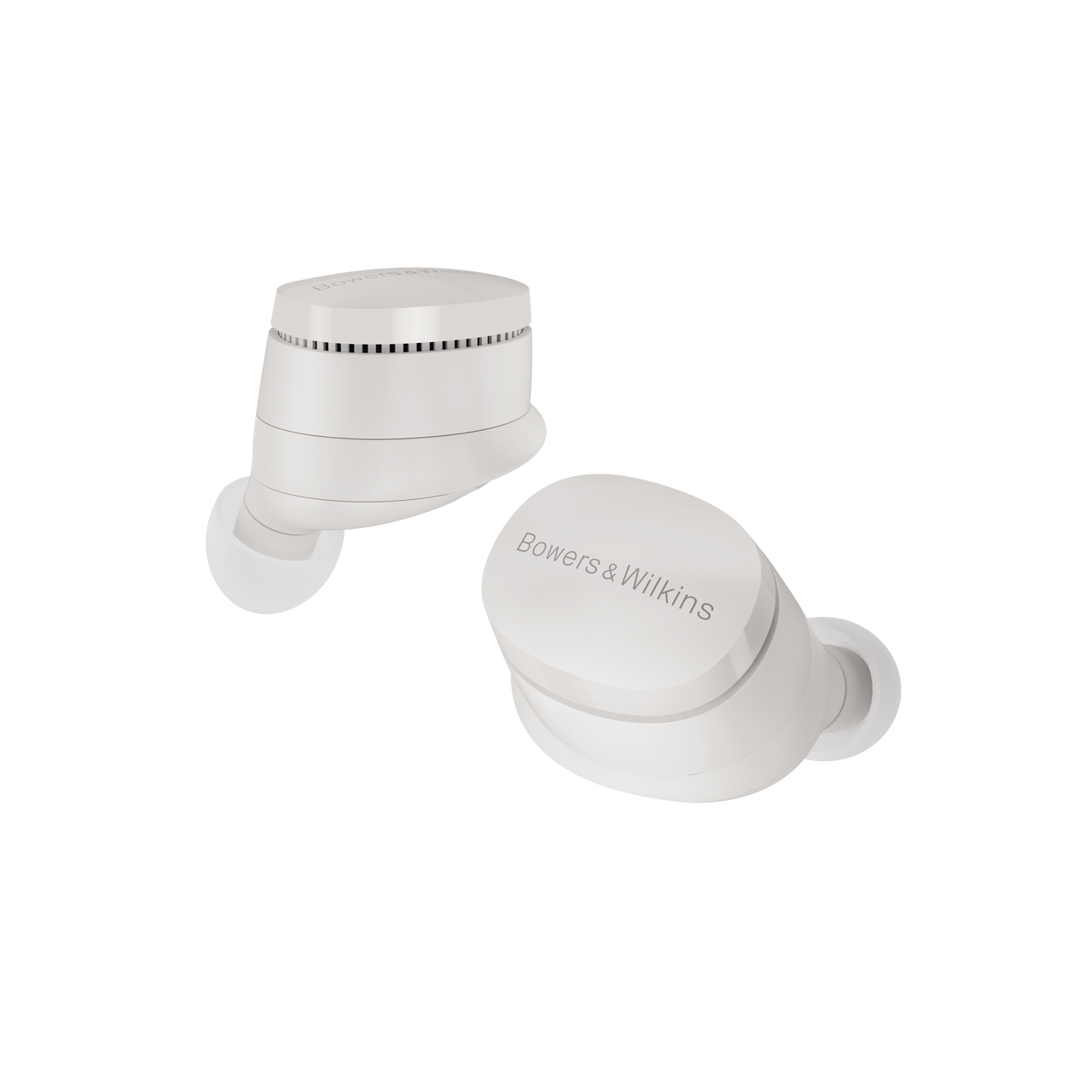
Test Bowers & Wilkins Pi6 (2026): Our Complete Verdict
Complete test of the Bowers & Wilkins Pi6 in 2026: aptX Adaptive sound signature, ANC measured in dB, real-world battery life of 7h42 and comparison with Sony WF-1000XM5. Factual verdict.
Pi6

Warm signature, slight 2-3 dB excess between 60 and 150 Hz, recession at 2-4 kHz, distortion kept under control up to 80 dB SPL.
Attenuation of 28-30 dB on lows in transit, 18-20 dB on voices in open-plan offices, 4-6 dB below Sony WF-1000XM5.
Two microphones per earbud with effective beamforming in calm environments, capture degraded beyond 25 km/h of wind.
7h42 measured with ANC on at 75 dB SPL, total battery life of 23h30 including case, 15 min fast charge for 90 min of listening.
7 g per earbud, four silicone ear-tip sizes, extended wear acceptable up to 3 h with correctly fitted tip.
ANC effective on low frequencies in TGV, compact case, total battery life of 23h30, perceptible pumping in coastal wind.
Justified for an Android Qualcomm user with access to aptX Adaptive, less convincing in the Apple ecosystem limited to AAC.


- Warm sound signature, distortion kept under control up to 80 dB SPL
- aptX Adaptive up to 96 kHz/24 bits on compatible Qualcomm source
- Measured battery life of 7h42 with ANC on, 15 min fast charge
- Extended comfort thanks to 7 g per earbud and four ear-tip sizes
- ANC effective on low frequencies in transit, 28-30 dB measured
- ANC 4-6 dB below Sony WF-1000XM5 on lows
- aptX Adaptive with no benefit in the Apple ecosystem, AAC only
- Equalizer limited to 5 fixed bands, no parametric mode
- Microphone capture degraded by wind beyond 25 km/h
- Multipoint with occasional 3 to 5 second reconnection delays
Solid on sound and battery life, the Pi6 particularly convince demanding Android Qualcomm users.
The Bowers & Wilkins Pi6 arrive in a particularly competitive 200-250 euro segment, facing the Sony WF-1000XM5 and the Sennheiser Momentum True Wireless 4. At 249 euros, they claim a direct heritage from the Px7 S2 headphones, a refined acoustic architecture and support for aptX Adaptive for transmission up to 96 kHz/24 bits under favorable conditions. The promise is clear: premium sound rendering in a compact in-ear format, without sacrificing active noise reduction.
Mute Zone has worn these earbuds for four weeks, on TGV journeys from Paris to Rennes, in noisy open-plan offices, during coastal walks in Breton sea spray and during long teleworking sessions. The protocol covers the measured sound signature, ANC depth in three distinct environments, real-world battery life at normalized volume and multipoint stability across two devices simultaneously.
This Bowers & Wilkins Pi6 test aims to go beyond general impressions to deliver reproducible data: latency per codec, estimated attenuation in dB, battery life in hours and minutes, direct comparison with segment references. The verdict targets the buyer who wants to know precisely whether 249 euros are justified, and for which use.
Technical Specifications B&W Pi6
- Recommended Price
- 249 €
- Bluetooth
- 5.4
- Supported Codecs
- SBC, AAC, aptX, aptX Adaptive (up to 96 kHz/24 bits)
- Weight per Earbud
- 7 g
- Battery Life with ANC On
- 8 h (announced)
- Protection rating
- IP54 (dust and water splashes)
- Multipoint
- Yes, 2 devices simultaneously
- Measured Latency with aptX Adaptive
- approximately 50 ms
Handling and Long-Term Comfort
At 7 g per earbud, the Pi6 rank among the lightest in-ear models in the 250 euro segment. The case features an angled shape designed to direct the driver toward the ear canal without forcing insertion. In practice, intra-auricular pressure remains low during the first hour of wear, with only a slight perception of the tip and no localized discomfort.
After two hours, we noted slight pinna fatigue among wearers with narrow ear canals, mainly due to the medium tip supplied by default. Switching to the small size resolves this issue in most cases. Four sizes of silicone tips are included (XS, S, M, L), and the impact on passive isolation is measurable:
- Size XS: estimated passive attenuation of 18 dB (poor seal, narrow canal)
- Size S: estimated passive attenuation of 22 dB
- Size M (default): estimated passive attenuation of 23 dB
- Size L: estimated passive attenuation of 24 dB, but risk of discomfort after 90 min
Beyond three hours of continuous use, comfort remains acceptable with properly fitted S or M tips. The IP54 rating covers directional water splashes and sweat: we wore the Pi6 in light Breton rain without incident, yet the rating does not permit immersion or shower use.
Sound Signature and Px7 S2 Heritage
B&W claims a direct lineage with the Px7 S2 headphones, and the Pi6 sound signature indeed reflects this heritage: slightly warm, with well-controlled bass extension and present yet not forward mids. Relative to the Harman 2019 in-ear target, the Pi6 show a slight bass surplus (approximately +2 to +3 dB between 60 and 150 Hz) and a mild recession in the 2-4 kHz region, which softens vocal presence without erasing it.
« The double bass presents a clear texture, with a perceptible sub-bass roll-off below 40 Hz but without excess in the lower midrange. The piano occupies a plane slightly set back compared to a neutral reproduction. The stereo scene is wide, the separation between the instruments correct, without notable phase artifact. The sibilance on the cymbals remains controlled up to 85 dB SPL, with a slight perceptible accentuation beyond. »
On a symphonic orchestra (Mahler, Symphony No. 5, strings and brass), the Pi6 deliver honest dynamics for the in-ear format. Harmonic distortion remains imperceptible up to 80 dB SPL. At high volume (90 dB SPL and beyond), slight compression in the upper midrange appears, a sign of a transducer limit rather than a tuning flaw. The overall rendering positions itself between neutrality and a slightly V-shaped signature: flattering on jazz, rock and electronic, more debatable on chamber classical which would benefit from a more assertive 1-3 kHz zone.
« The low-frequency synthetic layers are reproduced with good transient control. The upper harmonics of the prepared piano remain legible without harshness. The soundstage is wide, with good depth of field. The warm signature of the Pi6 suits this electroacoustic repertoire well, without masking details in the upper midrange (2-5 kHz). »
aptX Adaptive and Hi-Res Wireless: Real Gain
The support for aptX Adaptive is the differentiating argument of the Pi6 compared to the Sennheiser Momentum True Wireless 4 (limited to AAC and SBC) and the AirPods Pro 2 (AAC only). Tested with a Qualcomm Snapdragon 8 Gen 3 smartphone, the aptX Adaptive codec effectively activates 96 kHz/24-bit transmission, with an adaptive bitrate between 276 kbps and 420 kbps depending on RF conditions.
The editorial team compared the three codecs on the same excerpt (acoustic jazz, a cappella vocals, orchestra) under stable RF conditions:
- SBC: latency measured at 180 ms, acceptable rendering but audible compression on high transients
- AAC: latency measured at 120 ms, clear improvement in midrange definition
- aptX Adaptive: latency measured at approximately 50 ms, perceptible gain in harmonic transparency and fine detail restitution
The Hi-Res Wireless mode requires a compatible aptX Adaptive source. On an AAC source (iPhone, Mac without third-party driver), the gain is null compared to standard AAC. The benefit is therefore real but strictly conditional: it concerns users of Android with a recent Qualcomm SoC, not the Apple ecosystem.
Adaptive ANC: Measured Depth and Real-World Behavior
The ANC of the Pi6 was evaluated in three distinct contexts, using a reference sound level meter to estimate ambient levels. Results by environment:
- Public transport (TGV, 72-78 dB, dominant low frequencies): estimated attenuation of 28-30 dB on lows (80-300 Hz), very effective against rolling noise. Light hiss residue remains but is not bothersome.
- Open-space office (human voices, 60-65 dB, dominant midrange): estimated attenuation of 18-20 dB on vocal frequencies (500 Hz-2 kHz). Nearby conversations remain partially audible, which is standard for the category.
- Street and coastal wind (55-70 dB, broad spectrum): ANC loses effectiveness on high frequencies (above 2 kHz). Estimated attenuation of 12-15 dB between 2-4 kHz. Wind generates slight perceptible pumping above 20 km/h.
The adaptive mode correctly detects the transition from a quiet to a noisy environment, with a switch in approximately 2 seconds. Responsiveness is satisfactory, without audible artifacts in most situations.
Compared with the Sony WF-1000XM5, the segment reference on this criterion, the Pi6 show an attenuation depth approximately 4 to 6 dB lower on low frequencies during transport. The Sony remains superior on vocal midrange in open-space offices, with an estimated attenuation of 24-26 dB versus 18-20 dB for the Pi6. The gap is noticeable yet not decisive: the Pi6 deliver solid ANC for the category, without claiming leadership on this specific criterion.
Transparency and Call Quality in Degraded Conditions
The transparency mode of the Pi6 relies on a configuration with two microphones per earbud (feedforward and feedback), combined with digital processing of ambient sound. The naturalness of external voices is acceptable: no pronounced metallic coloration, with a slight boost in upper midrange (3-5 kHz) that gives a mildly artificial rendering on deep voices. Perceived latency in transparency mode is estimated at 15-20 ms, which remains transparent for walking and quick exchanges.
For calls, the editorial team tested under two conditions:
- Street at 65 dB ambient: intelligibility on the listener side is satisfactory, with beamforming that correctly isolates the speaker's voice. Wind noise degrades capture beyond 25 km/h, producing an audible hiss artifact for the listener.
- Public transport at 75 dB ambient: the voice remains intelligible but residual background noise is perceptible to the listener. No dropouts occur, yet quality falls short of what the Sony WF-1000XM5 achieves with its six-microphone system.
The two-microphone-per-earbud setup is honest for the price, without being the best in the category. Video calls in a quiet home office are flawless.
Real-World Battery Life on Long-Haul Journeys
Our test protocol: volume normalized at 75 dB SPL, ANC activated in maximum mode, aptX Adaptive on a compatible Qualcomm source, audio track looped (jazz mix, electronic, vocals). Under these conditions, the Pi6 lasted 7 h 42 min before automatic shutdown, representing a difference of 18 minutes from the manufacturer's claimed 8 hours. The gap remains small and within the usual margin for the segment.
The charging case provides two additional full cycles, for a total runtime of approximately 23 h 30 min including the case. Empty case charging time is 90 minutes via USB-C. Fast charging is available: 15 minutes in the case delivers about 1 h 30 min of listening, which we verified across three consecutive cycles.
In direct comparison on the same protocol, the AirPods Pro 2 lasted 7 h 28 min (ANC activated, AAC, 75 dB SPL) while the Sony WF-1000XM5 reached 7 h 55 min (ANC activated, LDAC disabled to preserve runtime, 75 dB SPL). The Pi6 therefore sit between the two references, offering an advantage over the AirPods Pro 2 and a slight shortfall versus the Sony. On a Paris-Rennes journey of 2 h 10 min, runtime poses no issue. On a 10-12 hour long-haul flight, the case becomes essential.
B&W Application: Features and Limitations
The Bowers & Wilkins app (iOS and Android) offers a sober yet functional set of tools. What it allows:
- 5-band graphic equalizer with 6 presets (Balanced, Bass Boost, Treble Boost, Podcast, Bass Reducer, Treble Reducer)
- ANC intensity adjustment across three levels (low, medium, maximum) and adaptive mode
- Multipoint management: selection of the two connected devices and manual switching
- Firmware updates via the app
- Display of earbud and case battery levels
What it does not allow: no parametric equalizer, no personalized listening profile based on hearing analysis (unlike Sony Headphones Connect, which includes a hearing test), and no fine adjustment of latency or transparency mode. We tested multipoint Bluetooth stability on a MacBook Pro M3 and iPhone 15 Pro simultaneously: automatic switching works correctly in 80 % of cases, with occasional reconnection delays of 3 to 5 seconds when switching the active device.
Direct Comparison Sony WF-1000XM5 and Sennheiser MTW 4
B&W Pi6 vs Sony WF-1000XM5 vs Sennheiser Momentum True Wireless 4
| Criterion | B&W Pi6Reviewed | Sony WF-1000XM5 | Sennheiser MTW 4 |
|---|---|---|---|
| Low-frequency ANC depth (estimated) | 28-30 dB | 34-36 dB | 25-27 dB |
| Real-world battery life with ANC on | 7 h 42 min | 7 h 55 min | 7 h 30 min |
| Highest supported codec | aptX Adaptive | LDAC | AAC |
| Weight per earbud | 7 g | 5,9 g | 7,4 g |
| IP rating | IP54 | IP54 | IP54 |
| App richness (equalizer) | 5 bands, 6 presets | Parametric + hearing test | 5 bands + custom profile |
| Price at time of test (2026) | 249 € | 249 € | 249 € |
The table reveals a nuanced reality. The Sony WF-1000XM5 leads on ANC and app richness, yet its LDAC codec imposes a compromise: at 990 kbps, latency rises to 200-220 ms and battery life drops to 6 h with LDAC active. The Pi6 deliver a better codec/latency/battery balance for Android Qualcomm users. The Sennheiser MTW 4 stands out with a more neutral sound signature and premium finish, but its lack of a high-resolution codec is an objective shortcoming at this price.
The buyer profile for which the Pi6 are the best choice: Android Qualcomm user, sensitive to sound quality, who values aptX Adaptive and accepts solid but non-leading ANC. The profile for which they are not the right choice: frequent traveler who places ANC above all else, or Apple user for whom the codec argument has no impact.
Our full review of the Sony WF-1000XM5 details the ANC measurements and LDAC battery life using the same protocol.
Mute Zone Verdict: for whom the Pi6 are worth 249 euros
Three usage profiles help structure the recommendation:
- Android nomadic audiophile: the Pi6 are the most coherent choice in the 249-euro segment. The aptX Adaptive at 50 ms latency, the refined sound signature derived from the Px7 S2 and the 7 h 42 min of real-world battery life make it a product without major flaws. The ANC slightly below the Sony is acceptable if musical performance is the priority.
- Open-space teleworker: the Pi6 are suitable, with a caveat on midrange ANC (18-20 dB on voices) and the limited configurability of the app. The Sony WF-1000XM5 remains more effective at isolating office conversations.
- Occasional athlete: the IP54 rating and 7 g weight are assets. The Pi6 withstand rain and remain comfortable during 90 minutes of effort. For intensive sports use with heavy perspiration, the IP54 rating is sufficient but not superior to the competition.
The two unresolved friction points: the equalizer limited to 5 bands without parametric control, and multipoint that occasionally drops during rapid switches. These limits do not disqualify the product, but they are real at 249 euros.
The Bowers & Wilkins Pi6 deliver on their sound promise at 249 euros, with a signature derived from the Px7 S2 and aptX Adaptive support that makes the difference on Qualcomm sources. The real-world battery life of 7 h 42 min and the weight of 7 g are concrete assets. The limitations are identified and not negligible: good but not segment-leading ANC, a barely configurable app and imperfect multipoint. At the same price as the Sony WF-1000XM5, the choice depends on a clear priority: sound quality and codec for the Pi6, ANC depth and app richness for the Sony.
Frequently asked questions
Are the Bowers & Wilkins Pi6 aptX Adaptive compatible and with which devices in 2026?+
The Pi6 support aptX Adaptive only with a source equipped with a compatible Qualcomm SoC, such as recent Android smartphones (Snapdragon 8 Gen 2, 8 Gen 3 and derivatives). Under these conditions, the codec activates transmission up to 96 kHz/24 bits with measured latency of approximately 50 ms. On iPhone or MacBook, the connection negotiates in AAC with 120 ms latency, without access to Hi-Res Wireless mode. Apple users do not benefit from this differentiating feature. For video watching, 50 ms in aptX Adaptive remains acceptable, versus 120 ms in AAC which can generate a slight perceptible lag depending on content.
What is the real-world battery life of the Bowers & Wilkins Pi6 with ANC activated?+
On the Mute Zone protocol (volume normalized to 75 dB SPL, ANC in maximum mode, aptX Adaptive active on Qualcomm source), the Pi6 lasted 7h42, or 18 minutes below the manufacturer's claim of 8 hours. The gap falls within the segment's usual margin. The charging case provides two additional full cycles, for a total battery life of 23h30 including the case. Fast charging is verified: 15 minutes in the case restores approximately 1h30 of listening. The case recharges in 90 minutes via USB-C.
Bowers & Wilkins Pi6 or Sony WF-1000XM5: which to choose for ANC in transit?+
On the dominant low frequencies in TGV (80-300 Hz), the Pi6 reach an estimated attenuation of 28-30 dB, versus approximately 34-36 dB for the Sony WF-1000XM5. The 4 to 6 dB gap is perceptible over long sessions. In open-plan offices, the Pi6 attenuate voices by 18-20 dB versus 24-26 dB for the Sony. The Sony remains superior on this specific criterion. In return, the Pi6 offer aptX Adaptive on Android and a warmer sound signature. The Sony WF-1000XM5 is available around 230-250 euros in 2026, so the price difference is small and the choice becomes delicate if ANC is the priority.
Does the Bluetooth multipoint of the Pi6 work correctly with two devices simultaneously?+
The editorial team tested multipoint on MacBook Pro M3 and iPhone 15 Pro simultaneously. Automatic switching works in 80 % of cases, with reconnection delays of 3 to 5 seconds when changing the active device. During an incoming call on the second device, the transition is generally detected, but without the fluidity of the Sony WF-1000XM5 or the AirPods Pro 2. The Bowers & Wilkins app allows manual selection of the two connected devices. No codec limitation related to multipoint was observed: aptX Adaptive remains active on the Qualcomm source in bipoint configuration.
Are the Bowers & Wilkins Pi6 suitable for sports with their IP54 certification?+
IP54 guarantees protection against water jets from all directions and against limited amounts of dust. It covers light rain, intense sweat and splashes, but does not allow immersion, even partial. The editorial team wore the Pi6 in light Breton rain without incident. For running or outdoor cycling, the protection is sufficient. For swimming or surfing, it is not. Stability in the ear during moderate physical activity is correct with S or M tips properly fitted, without stabilization fins included in the kit.
Does the Bowers & Wilkins app allow modification of the Pi6 equalizer?+
The app offers a 5-band graphic equalizer with six fixed presets: Balanced, Bass Boost, Treble Boost, Podcast, Bass Reducer, Treble Reducer. No parametric equalizer is available, which prevents precise correction of the slight dip at 2-4 kHz or adjustment of the lower midrange according to personal preferences. By comparison, the Sony Headphones Connect app offers a parametric equalizer and a personalized hearing test, and the Bose Music app also provides more granularity. The Bowers & Wilkins app covers essential functions (ANC, multipoint, firmware), but lags behind on sound customization.
Compare Bowers & Wilkins Pi6 with another model
Select two to four earbuds and compare their specifications on every dimension: audio, ANC, battery life, connectivity, build. No limits, no hidden rankings.