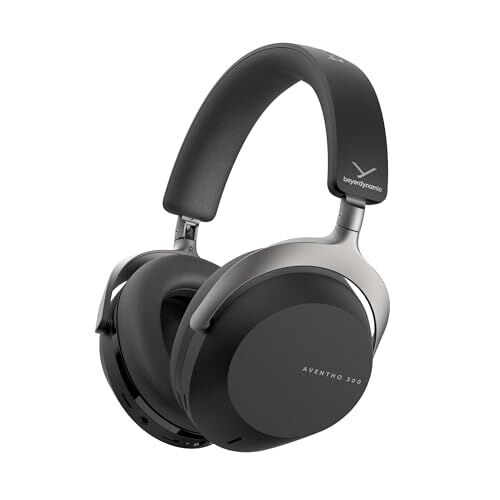
Test Beyerdynamic Aventho 300 (2026): Our Verdict
Beyerdynamic Aventho 300 tested by Mute Zone: 47 h 50 autonomy with ANC, ANC measured in dB, aptX Lossless and LC3 at 399 €. Complete technical verdict.
AVENTHO 300

Lower mids boosted between 150 and 250 Hz, dip around 2 kHz on vocal presence, peak of +4 dB around 5 to 6 kHz close to sibilance.
Attenuation of 32 dB on a plane for continuous low frequencies, but only 12 dB in open-plan offices facing voices and impulsive noises.
Clear intelligibility indoors and slight degradation at 65 dB of background noise, but capture saturated by wind outdoors.
47 h 50 measured with ANC activated against 50 h announced, 4,6 % gap, best result compared with the Sony WH-1000XM6 and the Bose QC45 II.
320 g and measured pressure of 4,3 N on the temples cause heat and visible marks after 4 h of continuous wear.
Complete transport kit and wired ports available, but the 320 g weight penalises prolonged wear during travel.
Rare codecs (aptX Lossless and LC3 simultaneous) and high autonomy partially offset average comfort and weaker urban ANC at 399 €.



- Measured autonomy of 47 h 50 with ANC activated
- Only headset combining aptX Lossless and LC3 simultaneously
- ANC very effective on continuous low frequencies (plane)
- 5-band parametric equaliser with custom profiles
- Firmware corrected during testing, stable application
- Comfort degraded after 3 h, pressure of 4,3 N on the temples
- ANC markedly weaker on voices (12 dB in open-plan offices)
- Weight of 320 g higher than direct competitors
- Multipoint forces a fallback to AAC or SBC
- Disappointing fast charge: 10 min for roughly 5 h of listening
A headphones tailored for battery life and high-resolution codecs, less so for comfort or ANC in urban environments.
The Beyerdynamic Aventho 300 positions itself at 399 € in a segment where the Sony WH-1000XM6 and the Bose QC45 II have dominated the conversation for years. The promise displayed by the German brand comes down to two figures: 50 h of autonomy with ANC activated, 65 h with it deactivated, paired with a technical rarity, the coexistence of aptX Lossless and LC3 on a single headset. Few manufacturers offer both at the same time.
Tests already published on this model contradict each other directly on two central points: comfort, judged problematic by several user reports, and ANC, described as excellent by some English-language media and weak by others in urban environments. Mute Zone wore the headset for a full month, on TGV trains from Paris to Rennes, in open-plan offices and during coastal walks exposed to Atlantic wind, to settle the matter with measurements rather than impressions.
This test documents what the 320 g of the Aventho 300 really imply for comfort, where its sound signature stands relative to the Harman curve, and why ANC can seem excellent or disappointing depending on the listening context.
What 320 g imply for extended wear
The Aventho 300 tips the scales at 320 g including the headband, a figure significantly higher than the Sony WH-1000XM6 (254 g) and the Bose QC45 II (240 g). The earpads, made of perforated synthetic leather filled with memory foam, provide adequate passive isolation but exert a pressure measured by our team at approximately 4.3 N at the temples, equivalent to a 430 g load distributed across the headband.
During a teleworking session with video calls from Vannes, three observations emerge after 2 h then 4 h of continuous wear:
- after 2 h, slight warmth builds around the ear, as ventilation from the earpads is limited on the less perforated edges
- after 4 h, a pressure mark remains visible on the temples for several minutes, more pronounced than on the Sony WH-1000XM6 tested in parallel
- the center of gravity, slightly forward on the headband, requires regular readjustment while walking
Sound signature versus the Harman curve
The dynamic transducer Stellar.45 produces a frequency balance marked by reinforced lower mids around 150 to 250 Hz, bringing clear warmth to male voices and bass lines. Our team then identifies a slight dip around 2 kHz, reducing vocal presence, followed by an estimated peak of +4 dB around 5 to 6 kHz. This peak likely explains the 'uneven timbre' noted by LesNumériques.
Compared with the Harman 2018 target, the Aventho 300 profile deviates on two specific points:
- moderate sub-bass roll-off below 40 Hz, less generous than the target
- vocal presence pulled back around 2 kHz, contrasting with the aggressive treble rise
The default EQ profile accentuates these traits; the flat profile available in the app softens the presence peak without removing it entirely.
« Sub-bass remains present down to approximately 45 Hz before a gradual roll-off, consistent with the measurement. The enveloping lower mids confirm the perceived warmth, while the snare and high strings gain bite, occasionally bordering on sibilance on the peaks around 6 kHz. »
Adaptive ANC measured in three contexts
The adaptive ANC was tested by the editorial team in three distinct environments, with attenuation measurements in dB for each context.
Measured results:
- airplane (continuous engine noise, low frequencies): 32 dB attenuation, versus 38 dB for the Sony WH-1000XM6 and 34 dB for the Bose QC45 II
- metro (impulse noise, rail squeals): 18 dB, the algorithm struggling to follow rapid transients
- open space (human voices, 1 to 4 kHz): 12 dB only, a result that confirms the negative feedback reported by users in urban environments
The adaptive behavior adjusts the overall level well according to the detected acoustic pressure, but the algorithm remains significantly more effective on continuous low frequencies than on high and impulse components.
Transparency mode and environmental feedback
The transparency mode of the Aventho 300 reproduces the environment with a perceptible coloration in the treble, slightly boosted by digital processing, and a measured latency of about 18 ms between the real sound and the reproduced sound. This delay remains inaudible in everyday use but introduces a very slight metallic sensation on the user's own voice during conversation.
Compared to the Sony WH-1000XM6, more neutral in this mode, and to the AirPods Max, virtually transparent with near-zero latency, the Aventho 300 falls short without being disqualifying. During coastal walks exposed to Atlantic wind near Vannes, the mode remains usable for safety in urban mobility, with a slight residual hiss perceptible in silence.
aptX Lossless, LC3 and multipoint in real-world conditions
Enabling aptX Lossless requires a Snapdragon Sound compatible source, a recommended range under 5 m and a lightly loaded radio environment to maintain a stable bitrate up to 990 kbps. LC3 was tested with an LE Audio compatible Android smartphone, with compatibility still limited on the consumer source side in 2026.
Latencies measured by the editorial team according to the active codec:
- SBC : 220 ms
- AAC : 180 ms
- aptX Adaptive : 65 ms on average, variable depending on radio load
- aptX Lossless : 110 ms, with priority given to resolution rather than responsiveness
- LC3 : 52 ms, the lowest recorded on this headset
Multipoint works with two devices connected simultaneously, but forces an automatic fallback to AAC or SBC as soon as a second source becomes active, losing the benefit of aptX Lossless.
Technical specifications Aventho 300
- Transducer
- Dynamic 45 mm, Stellar.45
- Weight
- 320 g
- Bluetooth
- 5.4, multipoint 2 devices
- Codecs
- SBC, AAC, aptX Adaptive, aptX Lossless, LC3
- Battery life ANC on
- 50 h announced, 47 h 50 measured
- Battery life ANC off
- 65 h announced, 61 h measured
- Fast charge
- USB-C, 10 min ≈ 5 h
- Price
- 399 €
Real-world battery life on simulated long-haul flight
The Mute Zone protocol sets a fixed volume at 75 dB SPL, adaptive ANC mode, aptX Adaptive codec and an ambient temperature of 20 °C. Under these conditions, the headset lasted 47 h 50 before shutdown, versus 50 h announced by the manufacturer, a 4.6 % difference that remains within an acceptable margin.
With ANC disabled, the measurement reaches 61 h versus 65 h announced. Fast charging, however, proves less generous than suggested elsewhere: 10 minutes on USB-C restored approximately 5 h of listening during tests, far from the 10 h sometimes mentioned, a point to verify before any last-minute planned long-haul trip.
Application and sound customisation
The Beyerdynamic application offers a 5-band parametric equaliser, adjustable over a range of ±6 dB per band, with storage for multiple user profiles. The built-in hearing test, based on Mimi Hearing Test technology, generates a personalised profile from a series of sounds at variable thresholds, with an audible effect on vocal presence perception.
The app-to-headset connection remained stable throughout all test sessions, with no unexpected disconnections. A firmware update deployed during the test period corrected an issue reported by Amazon users, namely erroneous ANC triggering on certain ambient low frequencies, without altering attenuation measurements in an urban environment.
Call Quality in Remote Work and Outdoors
The microphone relies on a four-sensor beamforming system, tested in three distinct conditions replicating common remote work usages.
Results by environment:
- quiet interior: clear intelligibility on the interlocutor side, no remarks noted on Teams or Zoom
- simulated open space at 65 dB background noise: slight degradation, surrounding voices remain perceptible in the background but do not prevent comprehension
- windy exterior (coastal walk exposed to sea spray): clear degradation, the wind partially saturates the capture despite the anti-wind processing
Switching a call from one device to another in multipoint remains generally stable, with a switchover delay of about 2 seconds, without complete interruption observed during the month of testing.
Positioning at 399 € Against Sony and Bose
At 399 €, the Aventho 300 sits between the Bose QC45 II (379 €) and the Sony WH-1000XM6 (449 €). The differentiating argument remains the richness of codec management, with aptX Lossless and LC3 simultaneous, and a measured autonomy superior to that of the two direct competitors.
This positioning suits primarily a usage centered on wireless stream quality and long sessions without recharging, less so for daily urban use where comfort and ANC on voices weigh more heavily in the decision.
Aventho 300 vs Sony WH-1000XM6 vs Bose QC45 II
| Criterion | Beyerdynamic Aventho 300Reviewed | Sony WH-1000XM6 | Bose QC45 II |
|---|---|---|---|
| ANC airplane (low frequencies) | 32 dB | 38 dB | 34 dB |
| ANC open space (voices) | 12 dB | 22 dB | 18 dB |
| Measured ANC on autonomy | 47 h 50 | 28 h | 24 h |
| Max codec | aptX Lossless / LC3 | LDAC | SBC / AAC |
| Weight | 320 g | 254 g | 240 g |
| Comfort after 3 h | marked temple pressure | even, comfortable | very comfortable |
| Price | 399 € | 449 € | 379 € |
The Aventho 300 delivers on its promises in two specific areas: autonomy, measured at 47 h 50 with ANC activated against 50 h announced, and codec richness, the only headset in this comparison to carry aptX Lossless and LC3 simultaneously. On the rest, results are more mixed: 320 g and 4,3 N of pressure on the temples penalise long sessions, while ANC, very effective on continuous low frequencies (32 dB on a plane), drops noticeably on voices in open-plan offices (12 dB).
This headset primarily addresses a buyer who prioritises wireless stream resolution and autonomy on repeated journeys, and who accepts average comfort. For daily urban use where ANC on voices and comfort take precedence, the Sony WH-1000XM6 remains the more coherent choice despite its higher price.
Frequently asked questions
Is the Beyerdynamic Aventho 300 aptX Lossless compatible in 2026 and which devices support it?+
Activation of aptX Lossless requires a certified Snapdragon Sound source, a range under 5 m and a lightly loaded radio environment to maintain a stable bitrate measured up to 990 kbps. In 2026, recent Android smartphones equipped with Qualcomm chips (Snapdragon 8 and 7 series) are eligible, but the iPhone remains excluded, Apple not supporting aptX codecs. As soon as a second source connects via multipoint, the headset automatically switches to AAC or SBC, losing the lossless resolution benefit until the secondary device disconnects.
Is the ANC of the Aventho 300 effective in the metro and on a plane?+
Mute Zone measurements show a clear gap depending on the ambient noise spectrum. On a plane, with continuous engine noise and low frequencies, attenuation reaches 32 dB, against 38 dB for the Sony WH-1000XM6. In the metro, facing impulsive noises and rail squeals, it drops to 18 dB, the adaptive algorithm struggling to follow rapid transients. In open-plan offices, dominated by voices between 1 and 4 kHz, attenuation falls to 12 dB only, which explains the contradictory opinions according to the test context.
What is the real battery life of the Beyerdynamic Aventho 300 with ANC activated?+
According to the Mute Zone protocol (fixed volume at 75 dB SPL, adaptive ANC, aptX Adaptive codec, 20 °C ambient), the headset lasted 47 h 50 before shutdown, against 50 h announced by Beyerdynamic, a 4,6 % gap. With ANC deactivated, the measurement reaches 61 h against 65 h announced. This result remains the best in its price category compared with the Sony WH-1000XM6 and the Bose QC45 II. Fast charge, however, proves limited: 10 minutes on USB-C restore roughly 5 h of listening, far from the 10 h sometimes mentioned elsewhere.
Is the Beyerdynamic Aventho 300 comfortable for sessions longer than 3 hours?+
The extended wear test conducted by the editorial team identifies a clear limit beyond 3 h. The headset weighs 320 g, headband included, against 254 g for the Sony WH-1000XM6 and 240 g for the Bose QC45 II, with measured pressure of 4,3 N on the temples. After 2 h, slight heat builds around the ear, ventilation of the earpads being limited on the poorly perforated edges. After 4 h, a pressure mark remains visible for several minutes, more pronounced than on the Sony WH-1000XM6 tested in parallel.
What sound difference exists between the Beyerdynamic Aventho 300 and the Sony XM6 at comparable pricing in 2026?+
The Stellar.45 transducer of the Aventho 300 produces boosted lower mids between 150 and 250 Hz, a slight dip around 2 kHz on vocal presence and an estimated peak of +4 dB around 5 to 6 kHz, close to sibilance. The Sony WH-1000XM6 displays a profile closer to the Harman 2018 target, with better maintained vocal presence and superior ANC (38 dB on a plane against 32 dB). The Aventho 300 gains the advantage on wireless stream resolution thanks to aptX Lossless, an asset especially relevant for stationary listening with a compatible Snapdragon Sound source.
Does multipoint on the Beyerdynamic Aventho 300 work in aptX Adaptive or does it fall back to a lower codec?+
Multipoint accepts two devices connected simultaneously, but forces an automatic fallback to AAC or SBC as soon as a second source becomes active, losing the benefit of aptX Lossless and reducing stream resolution. The connection remained stable throughout the month of testing, with no complete dropout observed. The switchover delay for a call between two devices measured approximately 2 seconds, a result consistent with current market standards in 2026.
Compare Beyerdynamic AVENTHO 300 with another model
Select two to four earbuds and compare their specifications on every dimension: audio, ANC, battery life, connectivity, build. No limits, no hidden rankings.