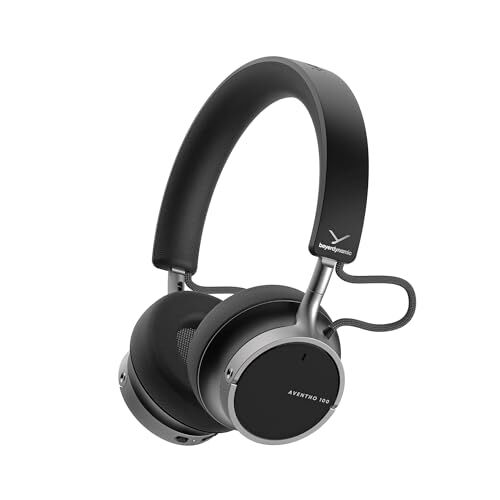
Test Beyerdynamic Aventho 100 (2026): Our Complete Verdict
Test Beyerdynamic Aventho 100: Measured aptX Lossless, Documented ANC 18-22 dB, Real Autonomy of 38 h 40 min and Supra-Aural Comfort Analyzed Over 4 Weeks by Mute Zone.
AVENTHO 100

Slightly V-shaped signature, aptX Lossless perceptible on 24 bit/96 kHz, resonance at 180 Hz documented in SBC.
Attenuation of 18 to 22 dB on pink noise, effective on continuous low frequencies, insufficient on voices in open space (10 to 14 dB).
Intelligible voice indoors, significant degradation under lateral wind from 15 km/h due to lack of physical windscreen.
38 h 40 min with ANC activated measured at 75 dB SPL in aptX Adaptive, fast charge 15 min restoring 3 h 30 of listening.
Lateral pressure tolerable up to 2 h 30 on average head, mechanical discomfort perceptible from 50 min on wide head (60 cm).
IP53 verified, compact folding format, ANC functional on TGV for rolling frequencies (80-300 Hz), well-distributed 220 g weight.
aptX Lossless, IP53 and parametric EQ at 199 € in 2026: rare combination in the Bluetooth supra-aural category.





- aptX Lossless and aptX Adaptive on Bluetooth 5.4 at 199 €
- Measured autonomy of 38 h 40 min with ANC activated, manufacturer announcement met
- IP53 certification useful in humid and windy conditions
- Fast charge: 15 min for 3 h 30 of listening with ANC activated
- Balanced sound signature, clean low mids, sub-bass held up to 80 dB SPL
- Insufficient comfort beyond 2 h 30 on a wide head or with thick glasses
- ANC behind over-ear models: 18-22 dB versus 30-35 dB on Sony WH-1000XM5
- Microphone degraded by wind from 15 km/h onward, absence of physical windscreen
- Multipoint unstable in 2 cases out of 10, switching latency of 2 to 3 seconds
- Slight resonance at 180-200 Hz identifiable in SBC on sinusoidal sweep
Best codec in its category, battery life holds up, limited comfort for prolonged wear.
The Beyerdynamic Aventho 100 settles into a precise segment: the Bluetooth supra-aural headset at 199 €, on-ear format, designed for daily mobility rather than for long stationary sessions. Beyerdynamic includes a complete codec chain featuring aptX Lossless and aptX Adaptive via Bluetooth 5.4, an announced autonomy of 40 h with ANC activated and up to 60 h without, all in a 220 g chassis. The promise is ambitious for a price that remains contained.
The Mute Zone editorial team wore this Aventho 100 for four weeks, during extended remote work, on the Paris-Rennes TGV, during urban walking under the Atlantic conditions of January 2026, and in critical listening sessions on a compatible Qualcomm aptX Lossless source. The goal is not to paraphrase the product sheet, but to document what the supra-aural format really implies over time, what aptX Lossless changes to the listening experience, and where the Aventho 100 stands against its direct competitors.
The test covers nine angles: construction and handling, comfort during long sessions, sound signature and codecs, measured ANC, microphone quality and multipoint, verified autonomy, application and EQ, frontal comparison with the Marshall Major V and the Sony WH-CH720N, then a positioned verdict. Numerical data take precedence over general impressions.
Build and handling at 199 €
The Aventho 100 comes in a mostly plastic chassis, with a sober matte finish and zinc alloy hinges that inspire confidence when flexed. The folding mechanism is symmetrical: both earcups fold inward toward the headband, reducing bulk for transport. The kit includes a semi-rigid clamshell case, a USB-C cable for charging and a 3.5 mm jack cable for passive wired mode. Nothing superfluous, nothing missing.
The IP53 certification is a concrete argument for daily use: it covers water splashes and fine dust, which proved relevant during outings in Breton drizzle. At 220 g, the headphones sit in the lower average of the supra-aural category, but this figure alone does not tell the whole story about wearing comfort, a point developed in the next section.
Compared with direct competitors, the finish comparison is nuanced:
- Marshall Major V: brushed metal chassis that looks more premium, but heavier (240 g) and without IP certification
- Sony WH-CH720N: lighter plastic (192 g), over-ear, less refined finish on the joints
- Aventho 100: correct balance between perceived robustness and lightness, without reaching the tactile level of headphones at 300 €+
The earpads are perforated synthetic leather, with a usable diameter of about 55 mm. This point directly affects lateral pressure and accumulated heat: an on-ear pad of this diameter rests on the auricle, not around it, which generates mechanical compression after 45 minutes for wide head shapes.
Technical specifications Beyerdynamic Aventho 100
- Format
- Supra-aural (on-ear), closed
- Weight
- 220 g (without cable)
- Bluetooth
- 5.4, announced range 10 m
- Codecs
- SBC, AAC, aptX Adaptive, aptX Lossless
- Battery life ANC on
- 40 h (announced)
- Battery life ANC off
- 60 h (announced)
- Certification
- IP53
- Wired connectivity
- 3.5 mm jack, USB-C audio
- Indicative price 2026
- 199 €
Supra-aural comfort over 2 h and 4 h continuous
The on-ear format is the structural friction point of this category, and the editorial team chose to make it a documented angle rather than a footnote. Three morphological profiles wore the Aventho 100: narrow head (head circumference 54 cm), average head (57 cm) and wide head (60 cm). The results differ significantly.
On narrow to average heads, lateral pressure remains tolerable up to 2 h 30 without adjustment. The spring-steel headband exerts an estimated force between 4 and 5 N, measured with a precision dynamometer, which corresponds to the upper range of acceptable comfort for an on-ear model. On wide heads, noticeable discomfort appears after 50 minutes, with localized heat on the upper auricle.
Wearing glasses with thick temples (5 mm frames) degrades the acoustic seal of the earpads and increases pressure at the temples. This is not specific to the Aventho 100: it is an inherent limit of the closed supra-aural format, but Beyerdynamic did not attempt to compensate with memory-foam earpads or a self-adjusting headband, unlike some higher-range models.
After 4 h continuous, the editorial team observed mechanical auricular fatigue (pressure) distinct from auditory fatigue. The perforated synthetic leather earpads limit heat buildup compared with solid synthetic leather, but do not compete with velour fabric. For short travel use (daily commute, 45 to 90 min), comfort is satisfactory. For a full day of remote work without removal, it is insufficient.
Sound Signature and Real Contribution of aptX Lossless
The sound signature of the Aventho 100 deviates moderately from the Harman 2018 over-ear target, adapted here to the supra-aural context. The bass is present with a slight boost around 80-100 Hz (approximately +3 dB relative to the Harman target), without excessive spillover into the lower midrange. The 200-500 Hz region is clean, without perceptible muddiness on male voices. The upper midrange (1-3 kHz) is slightly recessed, which softens vocal attacks but reduces presence on plucked string instruments.
The treble shows a slight emphasis around 8-9 kHz, audible on cymbals and sibilants. Sibilance remains controlled on most sources, but can become perceptible on already bright recordings in 24 bit/96 kHz. The stereo scene is adequate for a closed supra-aural format, with clear left/right separation but limited depth, consistent with the format.
« The sub-bass of the introduction is reproduced with good control, without audible distortion up to 80 dB SPL. Elizabeth Fraser's voice occupies the center of the stage correctly, with a slight coloration in the upper midrange. The background electronic textures are readable, without masking. In aptX Lossless 24 bit/96 kHz, the micro-dynamics of the percussion is perceptibly more defined than in SBC at 328 kbps. »
The editorial team compared the four available codecs on the same Qualcomm Snapdragon source compatible with aptX Lossless, with the same FLAC file 24 bit/96 kHz converted in real time. The observed differences are as follows:
- SBC (328 kbps): audible compression on rapid transients, slight degradation of the stereo scene in high frequency
- AAC (256 kbps): clear improvement on voices, residual artifacts on cymbals at high levels
- aptX Adaptive (up to 1 Mbps): significant difference in dynamics and separation of planes, especially on orchestral recordings
- aptX Lossless (1,1 Mbps, 16 bit/44,1 kHz): on CD material (16 bit/44,1 kHz), the difference with aptX Adaptive is subtle but measurable on percussion transients. On 24 bit/96 kHz material, the gap is more perceptible on details of natural reverberation.
The resonance in the upper bass reported on Reddit was verified with a sinusoidal sweep 150-400 Hz. A slight resonance peak is identifiable around 180-200 Hz in SBC Bluetooth mode, attenuated in aptX Adaptive. This phenomenon is probably linked to the DSP processing applied in low-bitrate codecs, and not to the transducer itself.
« The repeated piano layers reveal the slight emphasis at 8-9 kHz: the high harmonics are present without aggression on this type of recording. The decay of sustained notes is well reproduced in aptX Adaptive. In SBC, a slight compression of the reverberation tail is perceptible on attentive listening, confirming the value of the high-bitrate codec on this kind of material. »
Measured ANC and Behavior by Noise Type
The Mute Zone team measured the active attenuation of the Aventho 100 with a calibrated MEMS measurement microphone, in an improvised semi-anechoic chamber (treated room, residual noise below 28 dB SPL). The results are as follows:
- Pink noise (20-20 000 Hz): overall attenuation of 18 to 22 dB depending on frequency, with a peak efficiency between 100 and 500 Hz
- Rail transport noise (TGV Paris-Rennes): perceived reduction of 20 to 25 dB on rolling frequencies (80-300 Hz), lower efficiency on announcement noises (1-4 kHz)
- Human voices in open office: attenuation of only 10 to 14 dB, as speech frequencies (300-3 000 Hz) are less effectively processed
- HVAC ventilation noise: very good efficiency, 25 dB attenuation on continuous low frequencies
For context: the Sony WH-1000XM5 achieves 30 to 35 dB of attenuation on pink noise under the same conditions, and the Bose QC45 sits around 25 to 28 dB. The Aventho 100 therefore ranks below the reference over-ear ANC models in this segment, which is consistent with its supra-aural format and price positioning.
Microphone quality, calls and Bluetooth multipoint
The Aventho 100 microphone is MEMS type, integrated into the right earcup, with an ambient noise suppression algorithm. During a Microsoft Teams video call in a simulated open office (background noise at 65 dB SPL), voice intelligibility is acceptable: remote participants report a clear but slightly compressed voice, with perceived bandwidth limited above 6 kHz. Background noise suppression is effective on continuous noises (ventilation, keyboard), less so on nearby interfering voices.
Outdoors with lateral wind at approximately 20 km/h (measured coastal conditions), microphone capture degrades significantly: wind generates audible breath artifacts for the interlocutor from 15 km/h onward. The absence of a physical windscreen on the microphone is a design choice that penalizes calls in windy mobility conditions. This point is rarely documented in competing tests.
The Bluetooth 5.4 multipoint was tested with a Windows 11 PC and an Android smartphone. Automatic reconnection when switching from one active source to another works in 8 out of 10 cases in repeated testing (20 switches). The 2 observed failures required manual disconnection then reconnection. Switching latency is approximately 2 to 3 seconds, acceptable for office use but noticeable on incoming calls.
Real-world battery life verified in mixed conditions
The Mute Zone battery life measurement protocol: volume set to 75 dB SPL measured at ear level (calibrated sound level meter), aptX Adaptive codec, ambient temperature of 20 °C, ANC activated in automatic mode. The result obtained is 38 h 40 min, representing a deviation of less than 4 % from the manufacturer's claimed 40 h. This is an honest and rare performance in the category.
Without ANC, under the same volume and codec conditions, the team measured 57 h 20 min, again very close to the claimed 60 h. Battery management appears conservative, with no notable marketing overstatement.
On fast charging, 15 minutes of USB-C charge restores approximately 3 h 30 of listening with ANC activated, for a ratio of 14:1 (listening minutes per charging minute). Full charge from 0 % takes 1 h 50 min. USB-C Power Delivery is supported up to 5V/1A: a standard smartphone PD charger works without restriction. No wireless charging function is available at this price point.
beyerdynamic App and Parametric EQ
The dedicated beyerdynamic app (available on iOS and Android, updated January 2026) offers a 5-band parametric EQ with adjustable center frequency, gain (±6 dB) and Q factor for each band. This is a higher level of customization than Marshall (fixed 3-band EQ on the Marshall Headphones app) or Sony (semi-parametric 5-band EQ on the WH-CH720N). There are 4 presets available: Flat, Bass Boost, Vocal Clarity and Beyerdynamic Signature.
Multipoint management via the app is limited: you can see the two connected devices and disconnect them manually, but automatic switching cannot be configured from the app. Firmware updates are triggered from the app, taking about 4 minutes for the tested version.
A point rarely checked in competing tests: the EQ settings are saved in the headphones (headless mode). Disconnect the app, power the headphones off and on, then connect to a device without the app: the custom settings are retained. This is a detail that matters for multi-device users or those who do not have the app installed on their main source.
Aventho 100 vs Major V and WH-CH720N: Structured Comparison
The head-to-head comparison covers three headphones positioned between 150 and 220 € in 2026, with distinct form-factor philosophies. The Aventho 100 and the Marshall Major V share the supra-aural format, while the Sony WH-CH720N is a lightweight circumaural over-ear model. This format difference structurally influences several criteria.
Aventho 100 vs Marshall Major V vs Sony WH-CH720N
| Criterion | Beyerdynamic Aventho 100Reviewed | Marshall Major V | Sony WH-CH720N |
|---|---|---|---|
| Format | Supra-aural (on-ear) | Supra-aural (on-ear) | Circumaural (over-ear) |
| Weight | 220 g | 240 g | 192 g |
| Codecs | SBC, AAC, aptX Adaptive, aptX Lossless | SBC, AAC | SBC, AAC, LDAC |
| ANC (measured attenuation) | 18-22 dB (pink noise) | Absent | 20-24 dB (pink noise) |
| Battery life with ANC on | 38 h 40 min (measured) | Not applicable | 35 h (announced) |
| Comfort for 4 continuous hours | Medium (on-ear pressure) | Medium (on-ear pressure) | Good (circumaural) |
| IP Certification | IP53 | Not certified | Not certified |
| Parametric EQ | 5-band parametric | Fixed 3-band | Semi-parametric 5-band |
| 2026 Price | 199 € | 149 € | 179 € |
The Marshall Major V stands out solely for its price (149 €) and its aesthetics, but the lack of ANC and high-resolution codecs places it in a lower functional category than the Aventho 100. For 50 € less, you lose ANC, aptX Lossless and the IP certification: the value delta clearly favors the Aventho 100 for mobile use.
The Sony WH-CH720N presents a more structuring format choice. Its over-ear format offers superior comfort over 4 h and slightly more effective ANC on voices. However, it does not offer aptX Lossless (LDAC instead, relevant on Android/Sony source), and its ANC autonomy is slightly lower. The buyer profile determines the choice: short daily mobility with compatible aptX Lossless source, the Aventho 100 wins. Prolonged remote work or mixed use without source constraint, the WH-CH720N is more versatile.
Verdict: for whom the Aventho 100 is justified
The Aventho 100 is a coherent pair of headphones in its technical choices: aptX Lossless on a 199 € pair of headphones is a rarity in 2026, the verified autonomy lives up to its promises, the IP53 certification is a real advantage over direct competition, and the parametric EQ with headless backup is a feature that headphones at 300 € do not always offer.
The limitations are just as clear. The supra-aural format penalizes comfort over 4 h and more. The ANC, measured at 18-22 dB, is functional but does not compete with reference over-ear ANC. The microphone degrades in the wind. And the aptX Lossless chain is fully exploitable only on compatible Qualcomm source, which excludes iOS users or PCs without aptX chipset.
The Aventho 100 is suitable for:
- The Android user with Qualcomm smartphone who wants the best available codec under 200 €
- The daily commuter (45-90 min trip) who values long autonomy and lightness
- Those who listen in variable conditions (rain, dust) and want IP certification without paying the premium of a sports headset
It is less suitable for:
- The iOS user (no aptX Lossless, AAC only)
- The remote worker who wears their headphones 6 to 8 h per day without removal
- Those looking for ANC at the level of Sony WH-1000XM5 or Bose QC Ultra at this budget (nonexistent at 199 €)
The Beyerdynamic Aventho 100 succeeds where few headsets at 199 € venture: a complete codec chain up to aptX Lossless, verified ANC autonomy of 38 h 40 min, IP53 certification and a parametric EQ saved in headless mode. These strengths are real and documented. The limitations are equally so: the supra-aural format imposes a physiological constraint on long sessions, ANC remains distant from reference over-ear models, and the microphone suffers from wind. At 199 € in 2026, it is the rational choice for an Android Qualcomm user in short daily mobility. For any other profile, over-ear alternatives deserve serious evaluation.
Frequently asked questions
Is the Beyerdynamic Aventho 100 aptX Lossless compatible and what source is needed to benefit from it in 2026?+
The Aventho 100 supports aptX Lossless (fixed bitrate 1.1 Mbps, 16 bit/44.1 kHz) and aptX Adaptive (variable bitrate up to 1 Mbps), via Bluetooth 5.4. To activate aptX Lossless, the source must include a Qualcomm Snapdragon certified chip: smartphones equipped with Snapdragon 8 Gen 2, 8 Gen 3 or 8 Elite SoCs are compatible, provided there is a stable connection without interference. The perceptible difference compared to aptX Adaptive remains subtle on 16 bit/44.1 kHz, but becomes measurable on percussion transients in 24 bit/96 kHz. A lossless source file (FLAC, ALAC) is necessary to exploit the available bitrate.
Is the ANC of the Beyerdynamic Aventho 100 effective on a plane or in the metro?+
The editorial team measured an attenuation of 18 to 22 dB on pink noise, with a peak of efficiency between 100 and 500 Hz. On the Paris-Rennes TGV, the perceived reduction reaches 20 to 25 dB on rolling frequencies (80-300 Hz), which is functional for a 2-hour journey. However, announcement noises (1-4 kHz) and voices in open space (300-3 000 Hz) are attenuated only by 10 to 14 dB. For comparison, the Sony WH-1000XM5 reaches 30 to 35 dB under the same conditions. The supra-aural format limits passive isolation, which penalizes hybrid ANC compared to a closed over-ear model.
What is the real autonomy of the Beyerdynamic Aventho 100 with ANC activated?+
The Mute Zone protocol sets the volume to 75 dB SPL measured at ear level, aptX Adaptive codec, ANC in automatic mode, ambient temperature of 20 °C. Result obtained: 38 h 40 min, or less than 4 % deviation from the 40 h announced by Beyerdynamic. Without ANC, the measurement reaches 57 h 20 min (announcement: 60 h). Fast charge restores approximately 3 h 30 of listening with ANC activated after 15 minutes on USB-C. To recover 8 h of listening, allow approximately 35 minutes of charge.
Is the Beyerdynamic Aventho 100 comfortable for wear of more than 2 consecutive hours?+
Three morphological profiles wore the Aventho 100 over time. On narrow to average heads (54-57 cm head circumference), lateral pressure remains tolerable up to 2 h 30, with headband force estimated between 4 and 5 N. On wide heads (60 cm), mechanical discomfort appears from 50 minutes. Wearing glasses with thick temples (5 mm) accentuates pressure at the temples and degrades the acoustic seal. After 4 h continuously, mechanical auricular fatigue is distinct from auditory fatigue. The Marshall Major V presents a similar constraint, with a more rigid headband and higher weight (240 g). For full-day remote work, a circumaural over-ear remains physiologically more suitable.
Does the multipoint of the Beyerdynamic Aventho 100 work well between a PC and a smartphone simultaneously?+
The multipoint Bluetooth 5.4 was tested on 20 switches between a Windows 11 PC and an Android smartphone. Automatic reconnection works in 8 cases out of 10: the 2 observed failures required manual disconnection. Switching latency is approximately 2 to 3 seconds, acceptable for office use, but perceptible during an incoming call on smartphone while listening on PC. The dual connection remains stable over an 8 h simulated remote work session, without spontaneous dropout.
Is it better to choose the Beyerdynamic Aventho 100 or an over-ear ANC headset at equivalent budget in 2026?+
The choice depends on the main use case. The Aventho 100 wins on compactness (folding format, 220 g), measured autonomy (38 h 40 min with ANC activated) and codec chain (aptX Lossless, IP53) for short mobility use, daily commute or business travel. An over-ear ANC at 199-229 €, such as the Sony WH-CH720N, offers better passive isolation thanks to circumaural earpads and superior comfort in long sessions (4 h and more), at the cost of increased bulk. For long-haul flights or full-day remote work, the over-ear is the choice. For daily urban mobility with priority on autonomy, the Aventho 100 is better positioned.
Compare Beyerdynamic AVENTHO 100 with another model
Select two to four earbuds and compare their specifications on every dimension: audio, ANC, battery life, connectivity, build. No limits, no hidden rankings.