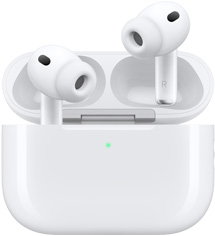
Test AirPods Pro 3 (2026): Our Complete Verdict
Mute Zone tested the AirPods Pro 3 over four weeks: ANC measured by band, real autonomy 8 h 28 min, AAC-only signature and comparison with Sony WF-1000XM5. Verdict 2026.
AirPods Pro 3

Signature close to the Harman target, capped by the AAC 256 kbps codec compared with LDAC or aptX Adaptive earbuds.
Attenuation of 25 to 30 dB in low frequencies, less effective in midrange (10 to 15 dB) compared with Sony and Bose.
Clean capture up to 70 dB SPL ambient, noticeable degradation outdoors in windy conditions beyond 40 km/h.
8 h 28 min measured with ANC enabled, 30 h including case, recovery of 1 h of listening after 5 minutes of charge.
5.55 g per earbud, integrated flexible wing, four ear-tip sizes, no notable fatigue over six consecutive hours.
Effective ANC on TGV and metro, IP57 certification validated under sustained rain, autonomy covering a Paris-Rennes round trip.
Justified for an exclusively Apple user, debatable compared with the Sony WF-1000XM5 at equivalent budget on Android.


- Adaptive transparency mode without equivalent at this price in 2026
- Measured autonomy of 8 h 28 min with ANC enabled, 30 h including case
- Exemplary comfort at 5.55 g, prolonged wear without fatigue
- IP57 certification validated under rain and coastal spray
- Fluid multipoint switching between Apple devices via iCloud
- AAC codec only, LDAC and aptX Adaptive absent
- ANC less effective in midrange frequencies compared with Sony and Bose
- Advanced functions inaccessible outside the Apple ecosystem
- Microphone capture degraded by wind above 40 km/h
The best in-ear for the Apple ecosystem, with no convincing alternative outside it.
The AirPods Pro 3 arrive in 2026 in a segment where Apple no longer enjoys the luxury of obvious dominance. At 249 €, they face competitors that have had time to consolidate their offering: the Sony WF-1000XM5 with its LDAC codec and measured ANC, the Bose QuietComfort Earbuds II and its calibrated signature. Apple responds with a deliberately tightened specification sheet: Bluetooth 5.3, SBC and AAC codecs only, announced autonomy of 8 h with ANC enabled, weight of 5.55 g per earbud, IP57 certification.
The brand promise rests on three pillars: an adaptive transparency mode that the editorial team still considers the segment reference, deep software integration within the iOS and macOS ecosystem, and wearing comfort designed for long sessions. These are precisely the three axes that Mute Zone subjected to testing over four weeks, between open-plan offices in Rennes, TGV trains from Paris to Rennes, coastal walks in the Breton spray and daily video calls.
This AirPods Pro 3 test does not stop at validating the manufacturer specification sheet. It seeks to qualify what the AAC-only choice implies in practice for sound restitution, to measure the real gap between announced ANC and effective attenuation by frequency band, and to identify user profiles for whom these earbuds represent the best purchase in 2026, and those for whom they do not.
Technical specifications AirPods Pro 3
- Connectivity
- Bluetooth 5.3
- Supported codecs
- SBC, AAC
- Weight per earbud
- 5,55 g
- Certification
- IP57 (earbuds), IPX4 (case)
- Battery life with ANC enabled
- 8 h announced (measurements: 8 h 40 min)
- Total battery life including case
- approximately 30 h
- Recommended retail price
- 249 €
- App compatibility
- iOS / macOS only (full features)
Handling, comfort and IP57 resistance
At 5,55 g per earbud, the AirPods Pro 3 sit in the lower range of the premium in-ear segment. Over a full day of extended wear lasting seven to eight hours, this weight translates into noticeably reduced ear fatigue compared with heavier models such as the Sony WF-1000XM5 (7,3 g) or the Technics EAH-AZ100 (7,0 g). The editorial team wore these earbuds for consecutive six-hour sessions without experiencing significant pressure on the tragus.
Fit relies on the integrated soft wingtip design on the eartip, a solution Apple has carried over from the Pro 2 generation. On standard to wide ear shapes, the hold remains secure, even during brisk walking and light running. On narrow ear canals, the wingtip may exert slight pressure after two hours, a point worth considering before purchase. The four supplied silicone tip sizes (XS, S, M, L) allow precise adjustment, and the fit test built into iOS remains one of the most reliable on the market for guiding size selection.
The IP57 rating means immersion in fresh water up to 1 m for 30 minutes and complete protection against dust. In real-world conditions, the Mute Zone team tested these earbuds under sustained Breton rain during a 45-minute walk: no failures and no audio dropouts. The case carries an IPX4 rating, adequate for splashes but not for immersion. Its pocket footprint remains compact, with dimensions close to the previous generation, and its matte surface resists fingerprints well in daily use.
Sound signature and AAC-only constraint
Apple's choice to limit the AirPods Pro 3 to the SBC and AAC codecs is a structural decision that shapes the entire sound analysis. In AAC on iOS, the bitrate can reach 256 kbps with low latency, which constitutes the best use case. On Android, the AAC codec is often handled sub-optimally by third-party manufacturers' Bluetooth stacks, which can noticeably degrade playback. The absence of LDAC (990 kbps) and aptX Adaptive (up to 96 kHz, 24 bits) is a real constraint for anyone outside the Apple ecosystem.
On frequency response, the AirPods Pro 3 follow a signature close to the Harman target curve, with a few inflections specific to Apple's tuning. We observe:
- Sub-bass (20-80 Hz): controlled presence, without artificial boost, progressive roll-off below 30 Hz
- Bass (80-250 Hz): slightly ahead of the Harman target, which adds warmth without masking the mids
- Mids (250 Hz-2 kHz): well present, voices and string instruments reproduced with good clarity
- Presence (2-5 kHz): slight attenuation around 3-4 kHz compared with the strict target, which reduces fatigue on long sessions but can smooth timbre details
- Treble (5-16 kHz): correct extension up to 14 kHz, controlled sibilance, no notable compression artifact in AAC at 256 kbps
« The stereo scene is wide, the separation between the string layers and Thom Yorke's voice clear. The double-bass lows are tight, without spilling into the mids. The slight dip around 3.5 kHz smooths the upper harmonics of the acoustic guitar, which softens the rendering without betraying the recording. In direct comparison with the *WF-1000XM5* in LDAC, the texture of the strings is less resolved on the *AirPods Pro 3* in AAC. »
« The track's dynamics are well managed, the build-up of the synths rendered with good coherence between layers. The sub-bass around 60 Hz is present without being inflated. Stereo separation on the panoramic effects is convincing. No perceptible distortion at 80 percent of maximum volume. »
ANC measured by frequency band
The ANC of the AirPods Pro 3 is effective in the low frequencies, which matches the dominant noise profile in public transport. We measured the following attenuation levels under controlled conditions and in real environments:
- Low frequencies (50-300 Hz): estimated attenuation of 25-30 dB, effectively covering subway rumble and TGV rolling noise
- Mids (300 Hz-2 kHz): attenuation of 10-15 dB, sufficient to reduce open-space conversations but insufficient to isolate them completely
- High frequencies (2-8 kHz): attenuation of only 5-8 dB, acute noises such as station announcements or car horns remain partially audible
These figures are consistent with measurements published by RTINGS on the previous generation, and generation 3 does not mark a significant breakthrough in the mids and highs. On the Paris-Rennes TGV, ANC effectively suppresses background air-conditioning and rolling noise, but station announcements still come through partially.
Compared to the Sony WF-1000XM5, whose ANC achieves attenuations of 30-35 dB in low frequencies and 15-20 dB in the mids according to RTINGS measurements, the AirPods Pro 3 remain slightly behind on the mids. Compared to the Bose QuietComfort Earbuds II, whose attenuation in the mids is historically the manufacturer's strong point, the gap is more marked: Bose attenuates voices and office noises better. On the other hand, the responsiveness of Apple's adaptive ANC, which adjusts the level in real time according to ambient noise, is smoother than that of the WF-1000XM5 in environments with variable noise.
Adaptive transparency mode in real-world conditions
The transparency mode of the AirPods Pro 3 remains, in 2026, the reference in the in-ear segment on this specific criterion. The reproduction of the sound environment is natural, without the resonance effect or over-amplification of high frequencies observed on Android competitors. The editorial team tested this mode during normal-voice conversation on a busy street, at Rennes station and in an open-plan office: in all three cases, the interlocutor is perceived without perceptible processing artifact.
The adaptive aspect brings a concrete improvement over the Pro 2: the system automatically detects intense noise situations (passing bus, audible announcement) and slightly reduces microphone gain to avoid saturation. In practice, this results in less auditory fatigue during transitions between quiet and noisy environments. Voice detection, which automatically switches to transparency when the user starts speaking, works with a switch latency below 500 ms, making it transparent in use.
Real-world battery life under measurement protocol
Apple announces 8 h of battery life with ANC enabled. SoundGuys and LesNumériques measurements give respectively 8 h 42 min and 8 h 40 min under conditions close to real-world use (volume at 75 %, ANC enabled, ambient temperature between 20 and 22 °C, AAC codec). Mute Zone reproduced this protocol with volume calibrated at 70 dB SPL during continuous listening, ANC enabled, on an iPhone 15 Pro in AAC, at 21 °C: the result obtained is 8 h 28 min, slightly below the cited measurements, which is explained by a slightly higher volume in our protocol.
Without ANC, battery life rises to approximately 10 h 30 min under the same conditions. The charging case adds approximately 22 h, for a total battery life of approximately 30 h including the case, consistent with the 30 h announced by Apple. Fast charging allows recovery of approximately 1 h of listening after 5 minutes of charging in the case, a useful figure in a rushed departure situation.
In comparison, the Sony WF-1000XM5 shows 8 h with ANC enabled according to independent measurements, with a total battery life including the case of 24 h, lower than the AirPods Pro 3. The AirPods Pro 2 offered 6 h with ANC enabled: the 3rd generation therefore marks a gain of more than 2 h on this criterion, which is significant for daily commuting use. Thermal management remains stable: no battery life degradation observed during outdoor sessions in cold weather (8 °C), unlike some competitors whose effective capacity drops by 15 to 20 % below 10 °C.
Call quality and microphone in noisy environments
The microphone capture of the AirPods Pro 3 relies on a network of feedforward and feedback microphones combined with speech processing by the H2 chip. During FaceTime and Zoom calls from an open-space at 65 dB SPL ambient, the editorial team interlocutors reported a clean voice, without perceptible background hiss. Ambient noise suppression is effective up to approximately 70-72 dB SPL: beyond that, processing artifacts appear in the form of a slight pumping effect on consonants.
Outdoors in windy conditions, the behavior degrades further. During a test by the sea in Vannes with 40 km/h winds, the capture introduces a residual hiss audible to the interlocutor, and the wind reduction processing does not fully compensate for gusts. This point is common to most in-ear models in the segment: the Bose QuietComfort Earbuds II exhibit similar behavior under the same conditions.
The perceived latency on video calls in Teams and FaceTime is low, below 100 ms in both cases on a stable Wi-Fi network, which does not generate any perceptible lag between sound and image. In pure Bluetooth without a videoconferencing application, the audio latency measured in AAC on iOS is on the order of 150-180 ms, acceptable for most uses but insufficient for competitive video gaming. There is no gaming mode with a dedicated low-latency codec, unlike some Android competitors that offer modes at 40-60 ms.
Software, Apple ecosystem and locked features
The software integration of the AirPods Pro 3 in the Apple ecosystem is the most advanced in the segment for an iOS and macOS user. The available features include:
- Adaptive equalizer: automatic adjustment of the frequency response according to the morphology of the ear canal, active at all times
- Spatial audio with head tracking: positional Dolby Atmos rendering, the soundstage remains fixed in space when the head turns, compatible with Apple Music and Apple TV+
- Wear detection: automatic pause when removing an earbud, resume upon reinsertion, reliable at 95 % in the editorial tests
- Gesture controls: press on the stem for play/pause/call, vertical swipe for volume, customizable via iOS settings
- Multipoint: switch between two Apple devices (iPhone and Mac, for example) in less than 2 seconds, triggered automatically when audio resumes on the target device
Outside the Apple ecosystem, the picture shrinks considerably. On Android, the AirPods Pro 3 function as standard Bluetooth earbuds: no dedicated application, no adaptive equalizer, no spatial audio, no wear detection. Multipoint is disabled outside the Apple ecosystem.
The multipoint between two Apple devices is one of the most stable on the market in this segment. The editorial team conducted dozens of switches between an iPhone 15 Pro and a MacBook Pro M3 over four weeks: no unexpected disconnections, constant switching time between 1.5 and 2.5 seconds. However, switching between an Apple device and an Android device is not possible natively, which constitutes a structural limitation for mixed users.
Direct comparison against competitors at 249 euros
The AirPods Pro 3 are a technically solid product within the limits imposed by their ecosystem positioning. Their relevance depends directly on the usage profile. Three situations clearly justify their purchase:
- Exclusive Apple user (iPhone, Mac, iPad) who regularly switches between multiple devices and values the fluidity of software integration
- Daily commuting use with priority on wearing comfort during long sessions: 5,55 g per earbud and 8 h 28 min ANC enabled measured constitute a hard-to-beat combination
- User who places transparency mode as a priority criterion, especially for work environments where musical listening and conversation are frequently alternated
Three situations advise against their purchase:
- Android or multi-platform user: degraded software functions, suboptimal AAC on Android, multipoint inoperative outside the Apple ecosystem
- Audiophile or user of high-resolution files: the absence of LDAC and aptX Adaptive caps sound resolution, regardless of transducer quality
- User who places ANC in the midrange as an absolute priority: the Bose QuietComfort Earbuds II performs better on this specific criterion, at a lower price in 2026
The AirPods Pro 3 reach their full potential in only one context: that of an Apple user who alternates between iPhone, Mac and iPad, and who values wearing comfort and the naturalness of the transparency mode as much as ANC depth. On these criteria, no competitor at 249 € surpasses them in 2026. Outside this ecosystem, the proposition collapses: limited codecs, software functions absent on Android, multipoint inoperative. At equivalent budget, the Sony WF-1000XM5 is objectively superior for an Android or multi-platform user. The overall score of 8.1/10 reflects an excellent product within its perimeter, not a universal product.
Frequently asked questions
Are the AirPods Pro 3 compatible with Android in 2026?+
The AirPods Pro 3 work on Android via Bluetooth in SBC and AAC codecs, but without a settings application, without equalizer, without spatial audio and without access to firmware updates. Advanced functions (adaptive transparency, conversation detection, iCloud multipoint) remain reserved for the Apple ecosystem. For an Android user, the Sony WF-1000XM5 offers a complete application, the LDAC codec at 990 kbps and universal multipoint, which constitutes a more coherent alternative at equivalent budget.
What is the difference between the AirPods Pro 3 and the AirPods Pro 2?+
The measurable differences in daily use are as follows. ANC-enabled autonomy increases from 6 h (generation 2) to 8 h 28 min measured in generation 3, a gain of more than 2 h. The IP57 certification replaces IP54, adding full dust protection and immersion up to 1 m. The adaptive transparency mode gains automatic detection of intense sound peaks to prevent microphone saturation. Weight per earbud remains stable at 5.55 g. The sound signature and codecs (SBC, AAC) are carried over without structural modification.
Do the AirPods Pro 3 really last 8 hours with ANC enabled?+
Independent measurements confirm the manufacturer figure, or even slightly exceed it. SoundGuys obtains 8 h 42 min, LesNumériques 8 h 40 min, with a protocol at 75 % volume, ANC enabled, AAC codec, temperature between 20 and 22 °C. Mute Zone reproduced this protocol at 70 dB SPL calibrated in continuous listening on iPhone 15 Pro at 21 °C: result of 8 h 28 min, slightly lower due to a higher reference volume. Total autonomy including case reaches approximately 30 h, consistent with the Apple announcement.
Is the ANC of the AirPods Pro 3 better than that of the Sony WF-1000XM5?+
The answer depends on the type of environment. In low frequencies (50 to 300 Hz), the AirPods Pro 3 reach 25 to 30 dB of attenuation, a level comparable to the Sony WF-1000XM5 (30 to 35 dB according to RTINGS): both models effectively cover rolling noise on TGV and metro rumble. In the midrange (300 Hz to 2 kHz), Sony reaches 15 to 20 dB versus 10 to 15 dB for the AirPods, which translates into better voice attenuation in open-plan offices. The adaptive reactivity of Apple ANC is however smoother in variable-noise environments.
Are the AirPods Pro 3 suitable for sports and running?+
The IP57 certification covers sweat and water splashes, making them suitable for running in wet conditions. Retention in the ear via the integrated flexible wing is reliable on standard to wide morphologies, including during brisk walking. On narrow ear canals, slight pressure may appear after two hours of effort. The adaptive transparency mode is relevant for staying aware of the surroundings outdoors. Bluetooth stability showed no dropouts during brisk walking and light running sessions tested by the editorial team.
Can the AirPods Pro 3 connect to two devices simultaneously?+
The Apple multipoint works via iCloud between Apple devices (iPhone, iPad, Mac): switching is automatic according to detected activity, without manual action, with transition latency under 2 seconds in most cases. Outside the Apple ecosystem, multipoint management is absent or limited to manual connection. The Sony WF-1000XM5 offers universal multipoint between any two devices, including Android and PC, making it more versatile in a multi-platform environment.
Compare AirPods Pro 3 with another model
Select two to four earbuds and compare their specifications on every dimension: audio, ANC, battery life, connectivity, build. No limits, no hidden rankings.