Headphones for Children: Age, Volume and Standards in 2026
The question of listening volume in children intersects two precise technical realities: the increased sensitivity of the immature cochlea to acoustic trauma, and the proliferation of consumer audio devices whose volume limiters often remain uncertified or bypassable. In 2026, the World Health Organization estimates that approximately 1.1 billion young people are exposed to a risk of hearing loss linked to personal listening practices.
The challenge for the reader of this guide is concrete: choosing the right headphone format, correctly setting the volume on platforms and operating systems, and understanding from what age reasoned use becomes possible without compromising a still-developing auditory system. The EN 50332 and IEC 60268-1 standards set thresholds, but their application in commercial products is uneven, which requires knowing how to read and compare them.
The Mute Zone team has analysed the certifications available on the market in 2026, reviewed the paediatric recommendations in force and tested several children's headsets under real usage conditions: commutes, parental teleworking sessions with a child nearby, and extended indoor listening. The scope covers in-ear, on-ear and over-ear formats, both wired and Bluetooth.
This guide is intended for parents who want precise answers rather than generic warnings, and for health or education professionals seeking verifiable technical references to support their recommendations.

Children's Hearing: Why It Is More Vulnerable Than That of Adults
Anatomy of the Ear Canal in Children Under 10 Years Old
The external auditory canal of a child under 10 years of age is significantly shorter and narrower than that of an adult: approximately 22 mm versus 35 mm on average. At the same volume setting on a device, this difference in residual air volume between the ear tip and the eardrum generates a higher acoustic pressure, estimated at an additional 7 to 9 dB SPL according to several audiological studies. In other words, a child listening at 60% of a smartphone's volume physiologically receives the equivalent of what an adult would perceive at a significantly higher level.
This phenomenon is amplified by the fact that children systematically underestimate the perceived sound intensity. Their discomfort threshold appears higher, which leads them to increase the volume without any subjective warning signal.
Hair Cells: Irreversible Damage Starting at What Threshold?
The outer hair cells of the cochlea constitute the most fragile link in the auditory system. These mechanosensory cells, responsible for amplifying weak sounds and frequency selectivity, do not regenerate in mammals. Exposure to 85 dB SPL for more than 8 hours is sufficient to initiate a process of cellular destruction, according to the criteria of the ISO 1999 standard. Beyond 100 dB, damage can occur in less than 15 minutes.
In children, the effective danger threshold is reached earlier, precisely because of the anatomical overpressure described above. The World Health Organization estimated as early as 2015 that 1.1 billion young people between 12 and 35 years old were exposed to a risk of hearing loss related to personal listening practices, a figure that remains the most cited epidemiological reference in audiological literature. The losses primarily affect high frequencies (4,000 to 6,000 Hz), often asymptomatic at first, which delays the diagnosis.
From What Age Can a Child Use Earphones
The recommendations vary according to health organizations, but several physiological thresholds are consensual. The American Academy of Pediatrics advises against any use before 3 years old, and the French recommendations from Santé publique France align with this position by emphasizing the maturity of the ear canal as the primary criterion, before any consideration of comfort or format.
Under 3 Years Old: Use Not Recommended
Before 3 years old, the ear canal is significantly shorter and narrower than in adults. At the same volume, the actual acoustic pressure in the ear can exceed by 7 to 9 dB the value perceived by an adult under the same conditions. The risk of irreversible cochlear damage is therefore structurally higher, regardless of the equipment used. No headphones, even certified, compensate for this anatomical factor.
From 3 to 6 Years Old: Strict Conditions and Maximum Duration
Between 3 and 6 years old, occasional use is tolerated under three cumulative conditions:
- Format supra-aural or circumaural exclusively: in-ear models are not recommended before at least 6 years old, as the ear canal does not allow stable and secure positioning of the tip.
- Volume capped at 75 dB SPL maximum, verified by a certified and non-bypassable limiter.
- Listening duration limited to 30 minutes per session, without excessive accumulation throughout the day.
INPES recalls that direct parental supervision remains essential at this age: a 4-year-old child is not able to identify emerging auditory fatigue.
From 6 to 12 Years Old: Volume and Duration Rules
| Age Group | Maximum Recommended Volume | Maximum Duration per Day | Recommended Format |
|---|---|---|---|
| 6 to 8 years | 75 dB SPL | 1 h | Supra or circumaural |
| 9 to 12 years | 80 dB SPL | 1 h 30 | Supra, circumaural or in-ear with adapted tip |
From 6 years old, in-ear models become feasible, provided that the size of the tips is rigorously adapted to the ear canal's dimensions. A tip that is too wide generates mechanical overpressure; a tip that is too small degrades passive isolation and prompts the child to increase the volume to compensate for ambient noise.
Adolescents from 13 Years Old: Specific Risks and Progressive Autonomy
Adolescence paradoxically concentrates the riskiest behaviors. Santé publique France estimates that 17 % of 15-17 year olds listen to music at levels above 85 dB SPL on a regular basis, a threshold beyond which a daily exposure of 2 hours is sufficient to initiate a process of chronic auditory fatigue.
The adolescent's growing autonomy makes direct supervision less applicable. The focus shifts to awareness of thresholds: 85 dB SPL for 2 hours equates, in terms of acoustic dose, to 88 dB for 1 hour or 94 dB for 15 minutes. These equivalences, derived from the ISO 1999 standard, constitute a concrete educational lever, more effective than an unargued prohibition.
Recommended Volume Thresholds by Age and Current Standards
Several reference frameworks coexist on the issue of listening volume in children, and their articulation is not always clear. Understanding what each one guarantees, and what it does not guarantee, is essential before choosing equipment or setting usage rules.
The 60/60 Rule: Definition and Practical Limits
The 60/60 rule recommends not exceeding 60 % of the maximum volume of the device, for listening sessions limited to 60 consecutive minutes. It is simple to remember, which explains its wide circulation in public health communications.
Its main limit is structural: 60 % of the volume of a headset limited to 85 dB SPL does not produce the same sound level as 60 % of the volume of an unlimited headset that can reach 110 dB. The rule does not rely on an absolute value in decibels, but on a fraction of a maximum that varies from one device to another. It therefore does not dispense with checking the technical specifications of the headset.
EN 50332 Standard: What It Actually Guarantees
The European standard EN 50332 governs the maximum output voltage of portable audio devices and their listening accessories. It comes in two complementary parts.
| Part | Scope | Maximum Output Threshold |
|---|---|---|
| EN 50332-1 | Complete system (device + earphones) | 100 mV RMS (corresponding to approximately 85 dB SPL) |
| EN 50332-2 | Accessory only (headset or earphones) | Voltage compatible with the system limit |
In practice, compliance with EN 50332-1 means that the system cannot exceed 85 dB SPL under standardized measurement conditions. Some manufacturers offer a child profile at 75 dB, activated via an application or a physical switch, which goes beyond the minimum requirements of the standard. Compliance with the basic standard therefore does not automatically guarantee a limitation suitable for children.
WHO Recommendation: 75 dB for Children, 80 dB for Adults
The World Health Organization sets distinct thresholds according to the exposure profile. For recreational listening via earphones or headset, it recommends not exceeding 75 dB(A) for children and 80 dB(A) for adults over a prolonged period.
These values are below the 85 dB threshold retained by EN 50332-1, which creates a tension zone between regulatory compliance and health recommendation. A headset certified EN 50332 can therefore comply with the European standard while exceeding the WHO threshold recommended for children.
Daily Sound Dose: Calculation in dB(A) and Exposure Duration
The notion of cumulative sound dose (noted LEX,8h in professional references) is more precise than the simple volume threshold. It integrates both the sound level and the exposure duration.
The basic principle is as follows: each increase of 3 dB halves the safe exposure duration. This ratio, derived from acoustic physics, applies directly to listening with a headset.
- At 80 dB(A): safe duration estimated at 40 hours per week (adult reference)
- At 83 dB(A): duration reduced to 20 hours per week
- At 86 dB(A): duration reduced to 10 hours per week
- At 92 dB(A): duration reduced to approximately 2 h 30 per week
For a child whose WHO reference threshold is set at 75 dB(A), the margin is even narrower. Daily listening at 78 dB(A) for one hour already represents a significant weekly dose. This calculation will be developed in the section devoted to maximum listening durations per session and per day.
Volume Limiters: How to Distinguish the Certified from the Ineffective
Not all headphones sold as "suitable for children" offer the same level of real protection. The fundamental distinction lies in the nature of the integrated limiter: software or hardware. This difference directly determines the reliability of the limitation, regardless of the mention on the packaging.
Software Limiters vs Hardware Limiters: Which Reliability
A software limiter acts at the firmware or audio driver level. It caps the volume in the source device's interface, but remains bypassable: a third-party application, an external equalizer or a portable amplifier can exceed this threshold without the headphones offering any physical resistance.
A hardware limiter relies on a resistor or a passive circuit integrated directly into the cable or the transducer. It mechanically reduces the power transmitted to the earpiece, independently of the source. This type of design cannot be bypassed by a software setting, making it the only truly robust guarantee.
| Type of Limiter | Mechanism | Bypassable | Reliability |
|---|---|---|---|
| Software | Firmware / source driver | Yes (EQ, external amp) | Low |
| Hardware | Passive resistor in the circuit | No | High |
CE Certification and EN 50332 Marking: How to Read the Label
The CE marking alone does not guarantee a limitation to 75 dB for children. It only attests to compliance with the general electrical and electromagnetic safety requirements of the European Union.
The relevant standard is EN 50332, divided into two parts:
- EN 50332-1: limits the maximum output power of the system (source device + combined headphones) to 100 mW.
- EN 50332-2: applies to the headphones alone and caps the sound pressure at 100 dB SPL peak, which remains insufficient for child use without additional limitation.
For real protection at 75 dB or 85 dB depending on age, look for an explicit mention of the guaranteed threshold on the packaging, accompanied by an independent test certificate. Brands like Puro Sound Labs, BuddyPhones or Belkin SoundForm publish this data in a verifiable manner, with hardware limiters tested in an anechoic chamber.
Cases of Limiters Bypassable by the Child
Some models offer a limiter unlockable via a parental application or a PIN code. The protection is real as long as the code remains confidential, but it relies on usage discipline rather than physical constraint.
Other designs are more fragile: a limiter wired on a 3.5 mm jack plug can simply be removed if the child connects another cable. We recommend checking that the limiter is integrated into the headphones themselves, and not into a removable accessory.
- Check that the limitation is documented in measured dB SPL, not only announced in marketing.
- Prefer models whose limiter is integrated into the transducer or the internal circuit.
- Discard products whose technical sheet does not mention any specific child auditory test standard.
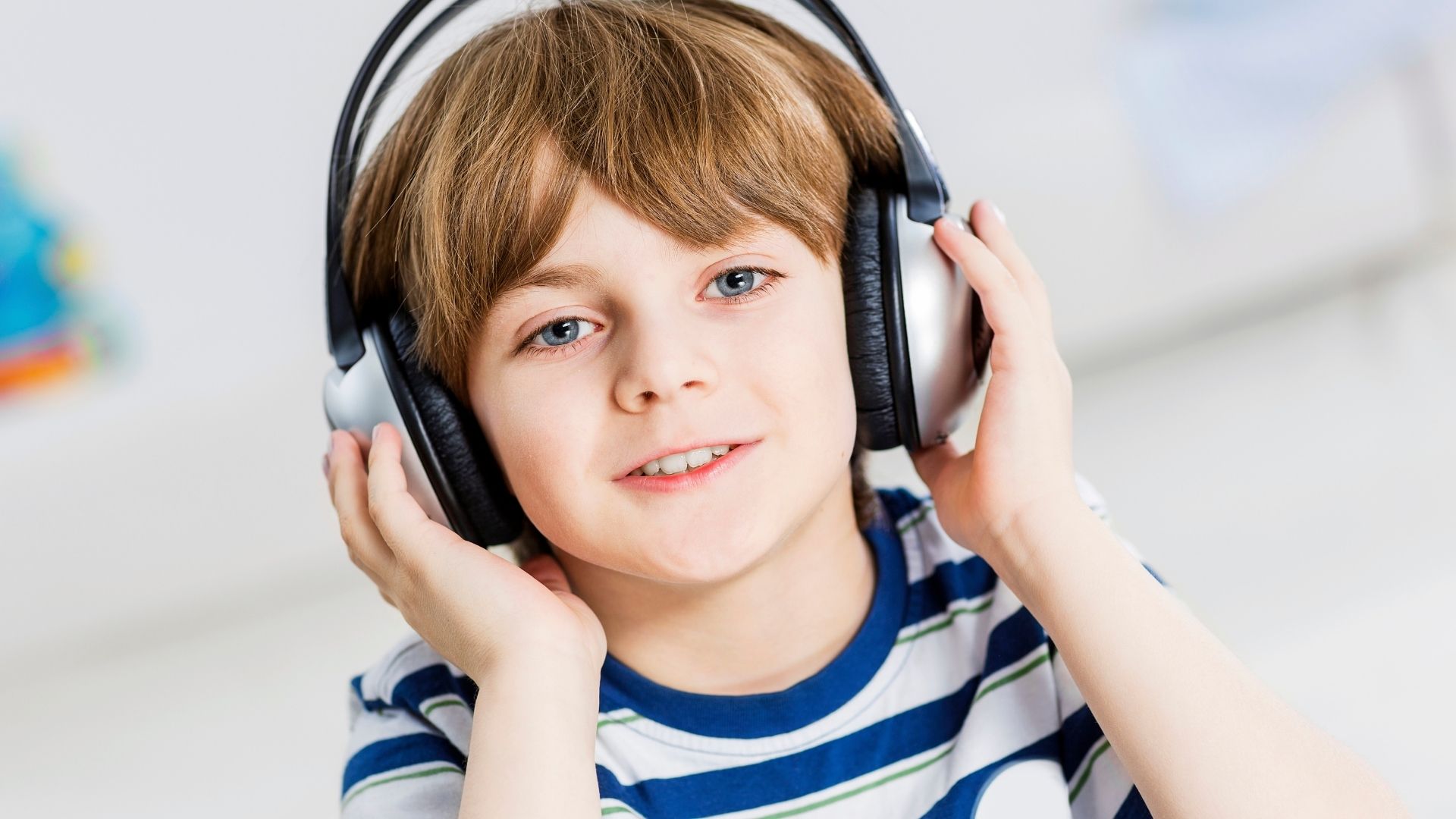
In-ear, On-ear or Over-ear: Which Format According to Age
The choice of physical format directly determines the level of acoustic pressure received by the ear, independently of the integrated volume limiter. Three families coexist, with very different risk profiles depending on the child's age.
In-ear: Specific Risks Before Age 10
In-ear models create an occlusion effect: the ear canal is sealed, which mechanically increases acoustic pressure in the residual air volume between the tip and the eardrum. In adults, this volume measures approximately 1.2 cm³. In a child aged 5 to 7 years, it drops below 0.7 cm³, which can represent a pressure gain of 3 to 6 dB at identical output level.
This excess pressure is not compensated by standard volume limiters, which measure the electrical signal at the output and not the effective pressure in the canal. Before age 10, the in-ear format is therefore not recommended, except for very occasional use under direct supervision.
On-ear and Over-ear: Comfort and Fit Criteria
On-ear headphones (earpads resting on the pinna) and over-ear headphones (earpads enclosing the ear) maintain a distance between the transducer diaphragm and the eardrum, which mechanically reduces acoustic pressure concentration. The over-ear format also provides passive attenuation of 15 to 22 dB depending on fit, compared with 8 to 12 dB for a typical on-ear model.
Insufficient fit is a frequently overlooked risk factor: when the headphones leak acoustically, the child instinctively compensates by raising the volume 4 to 8 dB to restore perceived comfort. The quality of the acoustic seal is therefore a safety criterion as much as a comfort criterion.
Three fit points warrant systematic verification:
- Adjustable headband: sufficient range for the child's morphology, without excessive tension on the skull
- Clamping force: ideally between 3 and 4 N for children under 10, compared with 4 to 6 N for adults
- Earpads: memory foam or soft cushioning, to compensate for pinna irregularities and limit leaks
Adjustable Headband and Weight: Target Values for Each Age Group
Headphone weight directly affects acceptable wear time and cervical fatigue, particularly pronounced before age 8. The values below represent the thresholds we consider relevant for prolonged daily use.
| Age group | Recommended weight | Target clamping force | Recommended format |
|---|---|---|---|
| 3 to 5 years | less than 130 g | 2.5 to 3 N | Light over-ear |
| 6 to 8 years | less than 150 g | 3 to 3.5 N | Over-ear or on-ear |
| 9 to 12 years | less than 180 g | 3.5 to 4 N | Over-ear or on-ear |
| 13 years and older | less than 220 g | 4 to 5 N | All formats, in-ear possible |
A headphone exceeding 150 g on a head under 8 years generates disproportionate cervical pressure after only 30 to 40 minutes of wear, prompting the child to reposition the headband, degrade the acoustic seal and, consequently, increase the volume. Weight and fit are therefore two variables directly linked to hearing safety, not merely to comfort.
Maximum Listening Duration per Session and per Day
The recommendations of the WHO and the EN 50332 standard converge on a simple principle: daily sound dose is assessed by combining sound pressure level and exposure duration. Exceeding either of these two parameters is enough to generate cochlear fatigue, even if the other remains within limits.
Summary Table: Age, Max Volume, Max Duration
| Age group | Recommended max volume | Max duration per session | Max duration per day |
|---|---|---|---|
| 3 to 5 years | 75 dB SPL | 30 min | 1 h |
| 6 to 9 years | 80 dB SPL | 45 min | 1 h 30 |
| 10 to 13 years | 80 dB SPL | 1 h | 2 h |
| 14 to 17 years | 85 dB SPL | 1 h | 2 h 30 |
| Adult (reference) | 85 dB SPL | 1 h 30 | 4 h |
These values are based on the WHO 85 dB/8 h rule, adjusted to the lower thresholds recommended for the immature ear. Each 3 dB increase halves the tolerable exposure duration: at 88 dB, the adult limit drops to 4 h, at 91 dB to 2 h.
Signs of Excessive Exposure to Monitor
An exposure outside thresholds does not always produce immediate pain. The warning signals are often subtle and transient, making them easy to minimize.
The clinical signs to identify:
- Temporary tinnitus: whistling or buzzing persisting several minutes after listening, a sign of fatigue in the outer hair cells.
- Reactive hyperacusis: everyday sounds perceived as abnormally loud or aggressive within the hour following the session.
- Auditory fatigue: reduced discrimination of high frequencies, a "cottony" sensation in the ears, sometimes accompanied by slight pressure.
- Difficulty following a conversation: the child asks for repetition, turns up the television volume or responds out of context without visible distraction.
These manifestations are reversible if they remain isolated. Their repetition over several consecutive days warrants an audiological consultation, as they may signal the onset of a temporary threshold shift (TTS, Temporary Threshold Shift), a documented precursor to permanent loss.
Wired or Wireless: Impact on Hearing Safety and Daily Use
Bluetooth and Waves: State of Knowledge in 2026
The debate on Bluetooth waves and children's health deserves a rigorous reading of the available data. The ANSES (Agence nationale de sécurité sanitaire) has not established a causal link between exposure to radiofrequency waves from Bluetooth headphones and a proven health risk in children. The transmission power of Bluetooth headphones remains much lower than that of a smartphone: the DAS (specific absorption rate) of a classic Bluetooth headphone is generally below 0.1 W/kg, compared to a regulatory limit set at 2 W/kg in Europe.
The precautionary principle recommended by French authorities nevertheless consists of limiting the duration of exposure and favoring wired for the youngest, especially before 6 years old. This position, shared by several pediatric audiologists, is not based on demonstrated evidence of harm, but on the lack of sufficient longitudinal data regarding chronic exposure from a very young age.
Latency and Educational Use: Why Wired Remains Relevant at School
Bluetooth latency constitutes a concrete technical argument in favor of wired in a school context. An SBC codec, used by default on the majority of entry-level devices, generates a latency between 150 and 200 ms: a perceptible lag between image and sound, sufficient to disrupt the understanding of an educational video or a phonology exercise. Wired, on the other hand, displays a latency of less than 5 ms under the same conditions.
The table below summarizes the latencies according to the codec, to situate the available options:
| Codec | Typical Latency | Availability on School Devices |
|---|---|---|
| SBC | 150 to 200 ms | Universal |
| AAC | 100 to 120 ms | iOS, macOS mainly |
| aptX | 40 to 70 ms | Android, PC (variable support) |
| Wired (3.5 mm jack) | Less than 5 ms | Universal |
For classroom use, especially with children under 8 years old whose attention window is narrow, the audio-video lag introduced by SBC can generate additional cognitive load. Wired remains the most reliable solution, independently of the waves issue. To go further on the differences between codecs, the technical guide on Bluetooth audio codecs from Mute Zone details the latency and compatibility parameters by use.
Volume Settings on iOS, Android and Streaming Platforms
The software settings described below constitute a useful layer of protection, but not sufficient. A certified hardware limiter (EN 50332-3 standard or equivalent) remains the main guarantee: the software can be bypassed, disabled or ignored when changing devices.
Volume Limitation on iPhone and iPad (Screen Time)
The procedure on iOS and iPadOS goes through the Screen Time menu, accessible in Settings. Here are the steps in order:
- Open Settings, then "Screen Time".
- Enable Screen Time if not already done, then set a 6-digit code distinct from the device's unlock code.
- Tap "Content & Privacy Restrictions", then "Audio & Visual".
- Select "Reduce Loud Volume" and choose the desired threshold (85 dB recommended for children according to European directive 2019/C 209/01).
- Lock access to this menu via the Screen Time code to prevent any modification by the child.
Apple states that this limitation applies to the headphone output and internal speakers, but it does not cover all third-party applications uniformly.
Limitation on Android (Digital Wellbeing)
Android does not offer a centralized volume limitation as direct as iOS. The procedure varies by manufacturer, but the most common path is as follows:
- Open Settings, then "Sound & vibration".
- Enable the high volume warning: most Android devices display an alert above 85 dB, but do not impose a ceiling.
- On Samsung devices (One UI 5 and higher), go to "Digital Wellbeing and parental controls", then "Volume".
- Enable the "Volume limiter" and set a maximum level, then protect the setting with the parental PIN code.
On devices without manufacturer overlay (stock Android), Google Family Link allows remote usage supervision, but does not offer native volume limitation in 2026. Third-party parental control remains necessary in this case.
Volume Settings on YouTube Kids, Spotify Kids, Disney+
Streaming platforms do not all offer the same level of parental control over volume. The table below summarizes the state of available features in 2026:
| Platform | Built-in volume limitation | Parental audio control | Notes |
|---|---|---|---|
| YouTube Kids | No | No | Volume depends entirely on the system |
| Spotify Kids | No | No | Child profile without dedicated audio setting |
| Disney+ | No | No | Parental control limited to content, not volume |
None of these three platforms offers volume capping in 2026. Control therefore relies entirely on the system settings described above, or on the hardware limiter of the earbuds or headphones themselves.
This lack of functionality on the streaming side reinforces the value of headphones equipped with a certified hardware limiter, whose nominal value (85 dB or 75 dB depending on age) applies independently of the source or application used.
Raising Children's Awareness of Hearing Protection: An Age-Group Approach
Hearing prevention is not limited to setting a volume limit and hoping it will be respected. It requires progressive transmission, calibrated to the child's actual cognitive abilities at each stage of development.
Ages 3 to 6: Simple Rules and Parental Controls
At this age, the child does not yet have the abstract tools to understand a deferred risk. Protection therefore rests entirely on the technical environment and adults. Two levers are available:
- Volume locking via iOS settings (Screen Time) or Android (Google Family Link parental controls), limited to a maximum of 75 dB.
- Selection of a headset certified to EN 71-1 with integrated, non-bypassable hardware limiter.
Verbal explanation remains short and concrete: "too loud, it hurts the ears for a long time." No notion of decibels or cumulative duration is accessible at this age.
Ages 6 to 12: Explaining Sound Dose with Concrete Analogies
Between ages 6 and 12, the child's brain begins to integrate delayed causalities. The concept of sound dose becomes transmissible, provided it is anchored in familiar sensory references.
Two analogies work well in practice:
- The auditory sunburn: just as skin burns gradually without being felt at the time, the ear is damaged at 85 dB without immediate alarm.
- The filling tank: each hour of listening at high volume "fills" an invisible counter, and once full, the hair cells do not regenerate.
The Journée nationale de l'audition (JNA), held each year in March, offers free educational materials adapted to this age group, usable at home or in class. Santé publique France also provides downloadable reference sheets, with thresholds expressed in listening duration rather than decibels, which facilitates understanding for primary-school children.
From ages 8-9 onward, it is relevant to introduce the duration/volume correspondence table, detailed in the previous section of this guide:
| Volume (% of maximum) | Recommended maximum daily duration |
|---|---|
| 60 % | Unlimited (approximately 80 dB) |
| 80 % | 90 minutes |
| 100 % | 15 minutes |
Displayed near the listening area, this table becomes a tool for gradual autonomous regulation.
Adolescents: Progressive Autonomy and Empowerment
Adolescents understand the risk but minimize it, a mechanism documented in developmental psychology under the term personal fable: "it only happens to others." A purely informative strategy is therefore insufficient. What works better: making the risk measurable and personal.
Two concrete approaches:
- Offer a sound exposure measurement application such as Decibel X or NIOSH SLM (free, iOS and Android) to visualize the received sound level in real time.
- Activate the weekly exposure alerts built into iOS 13 and later (Health > Hearing), which display the cumulative dose in dB(A) over a rolling 7-day period.
The goal is not to reassert parental control, but to build autonomous hearing awareness before risky listening habits become established. An adolescent who sees their own exposure curve exceed an average of 80 dB(A) weekly has a factual argument that parental injunction cannot replace.
Recognizing the First Signs of Hearing Fatigue in Children
Several behavioral signals often precede the clinical diagnosis by several months, sometimes several years. Spotting them early determines the reversibility of the damage, knowing that the cochlear hair cells do not regenerate once destroyed.
Symptoms to Monitor
Four manifestations deserve particular attention:
- Post-Listening Tinnitus: the child describes a whistling or buzzing after removing their earphones, even briefly. This signal, often downplayed, indicates temporary cochlear fatigue that can become permanent with repetition.
- Frequent Requests for Repetition: difficulty following a conversation in a calm environment, without any obvious distraction context.
- Spontaneous Increase in Television Volume: the child raises the sound beyond the household's usual level, for no apparent reason.
- Irritability or Headaches After Prolonged Listening: often misinterpreted as general fatigue, these symptoms may signal reactive auditory hypersensitivity.
When to Consult
An ENT consultation or with a hearing care professional is required as soon as two of these signals appear repeatedly over a period of two to three weeks. The tonal audiogram, feasible from age 4 with adapted methods (sound toys, conditioned response), can detect a notch at 4 kHz, the classic frequency signature of early noise trauma.
Do not wait for school screening to act: screenings in schools, generally conducted between ages 6 and 9, rely on portable audiometers under variable acoustic conditions. They detect established hearing losses, not early damage on high frequencies (6 to 8 kHz), precisely those first solicited by headphone listening.
Limits of School Screening
The French national protocol typically tests frequencies 500 Hz, 1 kHz, 2 kHz and 4 kHz at 30 dB HL. A child with emerging loss at 6 kHz or 8 kHz can pass this screening without detected abnormality, while their high-frequency range is already compromised. A complete audiological assessment in a clinic, including high frequencies up to at least 8 kHz, remains the only reliable diagnostic tool for intensive headphone use.
Selection of Certified Headphones for Children in 2026: Priority Technical Criteria
Selection Criteria: Hardware Limitation, Weight, Fit, Durability
Four criteria structure the choice of headphones for a child, beyond price or color.
- Type of limiter: hardware (resistor or passive filter integrated into the audio circuit, non-bypassable) or software (parameter modifiable via application or system setting, therefore bypassable). Only the hardware limiter offers a real guarantee.
- Limitation value: 75 dB SPL for children under 6 years, 85 dB SPL for 6-12 years, in accordance with standard EN 50332-2. Headphones labeled "85 dB max" suit a school-age child, not a toddler.
- Weight: under 150 g for circum-aural models intended for children under 8 years, to avoid cervical fatigue during extended sessions.
- Cable length (wired): 1.2 m maximum to limit snagging risks. 3.5 mm jack compatibility is essential for tablets and portable players without Bluetooth.
- Durability: reinforced hinges, flexible headband, BPA-free materials. An IP44 minimum rating is desirable for models intended for outdoor use.
Certification EN 50332-2 remains the only standardized indicator verifiable on the packaging. A mention of "limited volume" without reference to this standard guarantees nothing.
---
Certified Wired Models EN 50332
| Model | Limitation | Weight | Cable | Certification |
|---|---|---|---|---|
| BuddyPhones Explore+ | 75 / 85 / 94 dB (3 modes) | 110 g | 1.2 m | EN 50332-2 |
| Belkin SoundForm Mini | 85 dB hardware | 126 g | 1.2 m | EN 50332-2 |
| LilGadgets Connect+ | 85 dB hardware | 118 g | 1.5 m | EN 50332-2 |
The BuddyPhones Explore+ offers three physically selectable limitation levels via a button on the headband, which sets it apart from the competition: the 75 dB mode suits children from 3 years, the 85 dB mode suits 6-12 years. The Belkin SoundForm Mini opts for a single 85 dB limitation, simpler to verify but less adaptable according to the child's age.
---
Bluetooth Models with Verified Hardware Limitation
Wireless introduces an additional variable: the limitation must apply after Bluetooth decoding, in the analog circuit, and not upstream in the digital stream where it can be compensated by the gain of the onboard amplifier.
| Model | Limitation | Bluetooth | Battery Life | Weight |
|---|---|---|---|---|
| Puro BT2200 | 85 dB hardware | 5.0, SBC/AAC | 22 h | 145 g |
| BuddyPhones Cosmos+ | 75 / 85 dB (2 modes) | 5.0, SBC/AAC | 30 h | 155 g |
| Belkin SoundForm Mini BT | 85 dB hardware | 5.0, SBC | 30 h | 147 g |
The Puro BT2200 (released in 2022, still distributed in 2026) is one of the few references whose 85 dB hardware limitation has been verified by independent measurement, confirming the absence of bypass via the companion app equalizer. The BuddyPhones Cosmos+ reproduces on Bluetooth the logic of the two levels of its wired equivalent.
None of these models support aptX Adaptive or LDAC: for children's headphones, the codec is not the discriminating criterion. The priority remains the reliability of the limitation and mechanical robustness, two points that the wireless earbuds comparison from Mute Zone does not cover for this category, as adult models follow a different selection logic.
Frequently asked
Read next

At What Volume to Listen Without Risking Your Ears (2026 Guide)
Thresholds in dB, WHO-ITU H.870 Standard, EN 50332, Apple, Sony and Bose Limiters: Structured Guide to Preserve Hearing in 2026.

Tinnitus and Earbuds: Prevention, Thresholds and Best Practices 2026
Earbud-related tinnitus: danger thresholds in dB SPL, ANC, codecs and system settings to protect your hearing in 2026. Technical guide from the Mute Zone team.

Best meditation and yoga earbuds 2026: Mute Zone selection
Audio headbands, open-ear earbuds or bone conduction: Mute Zone analyzes headphone formats for meditation and yoga in 2026.